
I. INTRODUCTION
The Enterprise Resource Planning (ERP) system enables enterprises to manage their resources in more efficiently and effectively (Nah, et al., 2001). Additionally, ERP systems allow the presence of a comprehensive solution that integrates information, processes requests, and provides an integrated, consistent view of the information across the enterprise (Nah et al., 2001). ERP systems allow information to flow within and among the business entities (Hilletofth & Lattila, 2012). An ERP system in a firm allows a company to redesign its business processes, enhance its reporting cycle, and enlarge the possibilities of information access, which ultimately leads to an improvement in the firm's performance (Hong & Kim, 2002).
ERP system is designed to replace obsolete work with a more synchronized application suit for the company. Efficiency is enhanced through standardization and harmonization (Boo, 2007). Moreover, ERP allows the organization to achieve competitive advantage through innovative business strategy while bringing visibility and controlling of operations to work (Boo, 2007). Due to the highest growth rate of ERP in the IT industry, many scholars and industry experts refer the ERPs as one of critical innovations of the last decade (Al-Mashari, 2002).
ERP implementation is a collaborative effort of the ERP consulting team and the customer project team. The physical presence of the ERP consulting team at the customer site for business analysis, requirements gathering, solution mapping, prototypes, user training, data migration, user acceptance test, and go-live is usual during ERP implementation from the beginning to the end of the project. ERP software vendors had to transition from being physically present at the customer location to a remote ERP implementation procedure while preserving social distance and adapting to travel limitations with the Covid-19 pandemic.
In a usual ERP implementation setup, the interactions between the client company and the ERP consulting team are more frequent with the physical presence. To be more specific, the project implementation team, and the system users have frequent meetups, most commonly on the customer site, to identify the business processes of the clients, business requirements, customer expectations which includes training requirements, data setup plans, and data migration. Therefore, there is a mutual understanding regarding the requirements between the project implementation team and the customer project team. However, with the Covid-19 outbreak, physical meetings have been restricted due to the pandemic situation, which compelled in social distancing. Also, Covid-19 circumstances pressurized the companies to have more integrated business operations. Therefore, the companies identified the requirement of getting an ERP implemented, which would streamline integrated business operations. However, since the countries underwent lockdowns, to get this requirement fulfilled, the only feasible option was to do the ERP implementations remotely. Several companies undertook this initiative in implementing ERP remotely. However, unlike the usual ERP implementation process, no physical meet ups were conducted between the project team of the ERP vendor company with the customer, nor the project team could physically visit the customer site for user trainings as usual. All the processes of the implementation were done remotely in the virtual setup.
There is a plethora of past literature which discusses the importance and functionality of ERP systems (Ranjan & Jha, 2018; Saade & Nijher, 2016; Hwang, et al., 2015; Saini, et al., 2013).
Although several research has been conducted to identify the critical success factors for ERP implementation, most of the studies have been conducted from the perspective of management. However, the literature's focus on users who are actively working with the established ERP system, rather than just top management and senior ranking executives, appears to be dubious (Saade & Nijher, 2016). Because the ERP implementation will primarily affect the changing nature of employees' tasks, it's necessary to establish the critical success factors for ERP implementation from the user's perspective (Saini, et al., 2013). Several previous studies have emphasized the relevance of assessing actual users' perceptions (Nah, et al., 2007).
As a result of the Covid-19 pandemic, ERP implementation has grown more complex, and ERP software vendors have shifted to remote ERP implementations. While there are several studies on identifying CSFs in ERP implementation, there is a void in the literature on identifying CSFs in remote ERP implementation. According to the existing literature on critical success factors for ERP implementation, the factors vary depending on the circumstance. Based on the available literature, it is identified that from one geographical location to another geographical location, the factors that drive the successful ERP implementation are different. Moreover, from one situation to another situation these factors could be varied. Therefore, it is suggested that for more than 30 years, contingency theory has been the most prominent theory in the information systems literature (Donaldson, 2001). Although past literature has studied about the factors affecting successful ERP implementation in several geographical contexts, until the Covid-19 pandemic situation, almost all ERP implementations have been happening by having the ERP team physically present in the customer site. Therefore, based on the literature, it was found that, limited literature has been focused on remote ERP implementation. The current study tries to bridge these gaps by identifying the critical success factors of remote ERP implementation during Covid-19 by taking Sri Lanka as a case study.
II. OBJECTIVE
The main objective of the study is to identify critical success factors of remote ERP implementation from system users' perspective.
III. LITERATURE REVIEW
Various benefits have been demonstrated through the implementation of ERP, such as greater efficiency, improved communication and coordination, easier decision-making, better customer service and retention, increased financials, better asset management, and increased ease of use (Shang & Seddon, 2000). During ERP implementation phases, enterprises must focus on external factors (e.g., consultant and vendor commitment) and internal factors (e.g., project management). IT governance also plays a crucial role in enhancing the quality of ERP implementations (Scott & Vessey, 2000). According to the literature, roughly of ERP projects fail to deliver their estimated benefits and three-quarters of ERP projects fail to succeed. In average, these projects run over budget, take 2.5 times longer than originally estimated, and provide less than of the anticipated benefits (Al-Mashari, 2002). Suraj (2013) stated that the estimated failure rate is due to a poor-quality control system, which is abnormally high.
The right ERP system helps to boost the business and integrate the key business functions of a company (Jamie, 2013). Clare (2007), identifies a few controls that should be set up to keep consultants on task to work for the betterment of client organizations. Researchers looked at 18 factors in 10 different parts of the world, where commitment from the top management, and education & training emerged as the most important factors (Ngai et al. 2008).
There are many reasons for customization like resistance to change, low project acceptance, lack of importance given to the implementers' recommendations, and lack of resistance to customization requests (Rothenberger & Srite., 2009). During the implementation of ERP, there are several parallel roll-out activities, so organizations should ascertain the complexity of the project, align the work with the organizational priorities and ensure strong integration with all modules (Ribbers & Schoo, 2002). Also, the role of a consultant is vital. Consultants should have extensive knowledge of the software to execute projects effectively (Ranjan & Jha, 2018). Ideally, the clients and consultants should agree on a single project implementation strategy for success (Chen, et al., 2009). As well as, consultants should analyze the multiple consequences of failure factors on project outcomes and assess the implications if the failure factors are not mitigated (Zare Ravasan & Mansouri, 2016).
A successful ERP implementation involves two distinct phases - successful implementation and system support. There are a few factors that contribute to both domains, nonetheless (Jiwat, Cprkindale, and Wu 2013). According to Hasibuan and Dantes (2012), system success is measured by five indicators, which include system quality, service quality, information quality, strategic impact, and tactical impact. Success is usually viewed from different perspectives by different stakeholders.
Previous research has focused on the Critical Success Factors (CSFs) that a corporation must have to achieve the system's goals. Because the failure of such an ERP implementation would be a substantial financial, time, and effort loss for the firm, it would also jeopardize the organization's ability to gain a competitive advantage (Elmeziane & Elmeziane, 2012). Therefore, the current research focuses on characteristics that would enable a successful remote ERP implementation procedure based on contingency theory.
Any company undergoing a transformation must focus on several elements that could sabotage the transformation's success. As a result, ERP system implementation would necessitate a lot of criteria to be successful. The current study will use contingency theory to investigate the elements that influencing remote ERP implementation. Even though the theory has been tested in the research on CSFs of ERP implementation, there is a void in the literature on applying the contingency theory as a theoretical lens in detecting the CSFs of remote ERP implementation, which is now in vogue with the Covid-19 pandemic limits.
There are many CSFs that determine the success of an ERP implementation. A successful ERP implementation requires several factors that Shaul and Tauber (2013) list as CSFs, including project management, top management support, data management, sufficient training programs, and system users' support. The authors point out that the team of change managers, along with top management have the ability to manage user resistance (Shaul & Tauber, 2013).
According to the systematic literature review recently carried out by Saade and Nijher (2015), after reviewing 37 different cases with the unique eight-step coding system, it was revealed that there are 22 Critical Success Factors (CSFs) for a successful ERP implementation. Top management support and commitment, minimal customization, organization fit to the ERP, legacy system support, detailed cost, quality management, Business Process Re-engineering, data migration plan, measurable KPIs, small team, communication, base point analysis, morale maintenance, contingent plans, documentation of ERP success, results management, user feedback usage, and maximum potential were among the 22 CSFs identified in this study (Saade & Nijher, 2016).
The literature mentions that among all CSFs for ERP implementation, persistent top management involvement and the top management support at each stage of the ERP implementation is critical (Ranjan & Jha, 2018; Saade & Nijher, 2016).
A successful implementation is achievable only if high-degree executives have a sturdy dedication to the assignment (Gargeya & Brady, 2005). For numerous reasons, top management commitment to the project is critical throughout the implementation life cycle (Somers & Nelson, 2004). One benefit of top management prioritizing the project is a reduction in the time it takes to complete, it increased dedication from people in the organization, as well as management's capacity to provide the necessary resources and a sufficient amount of time to complete the task correctly. Senior management must be dedicated to their involvement in the implementation process and willing to devote precious resources to it. Employees should be informed about the organization's shared vision and the function of the new system and structures. It is necessary to establish and approve new organizational structures, roles, and duties. To develop new systems and techniques in the organization, top management should set policies. Managers should intervene between parties in times of disagreement. Finally, senior management support is not only motivating, but it also aligns the ERP project with the entire business strategy (Akkermans & Van Helden, 2002).
Change management refers to the ability to anticipate and manage changes (Mata, et al., 1995; Wade & Hulland, 2004). Change management has been identified as a CSF in ERP implementation (Elmeziane and Elmeziane, 2012; Al-Turki, 2011; Nour and Mouakket, 2011). Guha et al., 1997, emphasizes the importance of change management, and suggests that it is a prerequisite for achieving sustainable competitive performance.
The relevance of change management is highlighted during the project's initial phases and throughout the project's life cycle (Nah, et al., 2007). As a result, change management is unquestionably a CSF in ERP implementation success, as evidenced by a few previous CSFs in ERP implementation success literature. However, the shift must be carefully handled depending on the culture, institutions, and style of ERP deployment, as suggested in the literature (Saade & Nijher, 2016; Shaul & Tauber, 2013; Nah, et al., 2007).
According to the literature, change management is critical to ERP implementation success regarding empowered team management and adapting implementation strategies for identifying, managing, and training ERP project stakeholders (Dezdar & Ainin, 2011). There is a lack of comprehensive coverage of what change management entails from current literature on change management. A change management perspective encompasses not just altering current business processes and training users, but also changing the overall culture of the organization. The organization, for example, is receptive to new technologies and support systems (Hwang, et al., 2015).
Communication is also important in management when attempting to reduce opposition to change in any organizational situation (Dezdar & Ainin, 2011). Furthermore, efficient company-wide communication is dependent on cross-functional and interdepartmental cooperation, which assures ERP implementation success (Chen, et al., 2009). According to Motwani, et al. (2005), a company that encourages its employees to participate actively in the workplace is more likely to succeed. A corporation that implements open communication is more successful than one that does not. Furthermore, it was emphasized the necessity of open communication when sharing information about ERP system changes and continuing updates (Motwani, et al., 2005). When deploying an ERP system, cross-functional and interdepartmental cooperation is critical, as is having strong company-wide communication (Chen, et al., 2009). It was claimed that communication is a crucial technique for managers to use when attempting to overcome employee resistance to change (Dezdar & Sulaiman, 2009).
Furthermore, according to a slew of studies, a phased strategy is better for implementation because it allows the organization to make changes in the event of unforeseeable circumstances. As a result, it is also argued that the implementation strategy's flexibility has a significant impact on ERP implementation success (Saini, et al., 2013; Scott & Vessey, 2000). According to Mandal and Gunasekaran (2004), this is the most important CSF for a successful ERP implementation from the perspective of a top manager. Several questions must be answered to create a well-functioning implementation strategy: what are the particular information demands at the operational and management levels, how will the ERP system interact with the existing system, and what is the implementation schedule? By answering these questions, a company can develop a plan that will increase its chances of success by when compared to companies which do not have one (Mandal & Gunasekaran, 2003). Many academics support a phased implementation because it allows the organization to make changes to the timeframe if unexpected occurrences occur (Mandal & Gunasekaran, 2003; Scott & Vessey, 2000; Saini, Nigam, & Misra, 2013). Scott and Vessey (2000), use FoxMeyer and their disastrous SAP R/3 implementation as an example. They claim that FoxMeyer would have had a better chance of success if they had been able to change their implementation technique (Scott & Vessey, 2000).
Several authors stress the significance of thorough testing to avoid as many unexpected events as possible. Testing and creating a plan, according to
Gargeya and Brady (2005), is an essential part of the implementation process, and Collett (1999) agrees with Mandal and Gunasekaran (2004), that doing so dramatically increases the chances of success.
According to Somers and Nelson (2004), training and education are essential for establishing an ERP system. A lack of user training and a misunderstanding of the corporate applications appear to be the root of many ERP implementation failures. ERP implementations demand a massive amount of data for people to solve problems that may occur inside the system's architecture. If employees don't understand how the system works, they will develop their own processes by removing bits of the system that they can modify, according to Umble et al. (2003). User training should begin far before the implementation process begins to ensure success (Umble et al., 2003). One of the most important items to consider when planning for a new system is user education and training programs, which, along with other criteria, are necessary ingredients for successful implementation (Mabert et al., 2003).
Executives usually misjudge the level of knowledge and training required to establish an ERP system, as well as the associated costs; thus, top management engagement is crucial, as previously indicated (Zabjek et al., 2009; Sarker & Lee, 2003; Nah et al., 2003; Mabert et al., 2003; Umble et al., 2003). Executives must be able to estimate the amount of training and education required to reap the full benefits of the deployed technology (Motwani et al., 2002; Aladwani, 2001). According to Cobert and Finney (2007), training and education can be used to improve user acceptability of the project and develop a positive employee attitude. Nah et al. (2007) expands on this idea, arguing that education should be a priority from the outset of the project, with both money and time spent on various forms of teaching and training.
As a result, the organization aids system users in comprehending the benefits and necessity of the new ERP system, as well as how the system will alter business procedures (Motiwalla & Thompson, 2012; Somers & Nelson, 2004; Nah et al., 2007). Employees are typically expected to be able to efficiently administer and operate the new system based only on their educational background. However, for a substantial part of the learning process, Umble et al. (2003) emphasizes the need of hands-on experience in real-world circumstances.
Furthermore, it has been argued that user training and education is critical to a successful ERP adoption because training and development will allow for a smooth transition (Noudoostbeni, et al., 2010). Apart from training and development, a strong competent core team of qualified implementation team is essential for the ERP implementation to run smoothly.
This is especially important at the start of the project (Cliffe, 1999).
According to Nah et al. (2001), it is identified that the project management is crucial in ERP implementation projects. The project management approach indicates that project planning and control are related to project factors such as project size, technological experience, and project structure (Somers & Nelson, 2004; Holland & Light, 1999). The responsibility for project management success should be delegated to an individual or group of employees (Nah et al., 2001). After the project team has been properly formed, milestones must be established (Holland & Light, 1999). It comprises assessing the project's critical paths, calculating the timeliness of the project, and managing the force of timely decision-making (Nah et al., 2001). As a result, the project scope should be well-specified, well-defined, and limited. ERP projects are often massive and fundamentally challenging due to the comprehensive mix of hardware and software, as well as the various organizational, human, and political concerns (Somers & Nelson, 2004). When a project scope is too broad or ambitious, problems can occur (Somers & Nelson, 2001).
The impact of project management on ERP deployment has been empirically explored in the past literature, and it has been proven to be one of the CSFs in physical ERP implementation success (Ranjan & Jha, 2018). Apart from the aspects in the literature, the relevance of risk and quality management for any system deployment success is stressed in several IS publications (Saade & Nijher, 2016; Shaul & Tauber, 2013). The reason for this is that the system's overall performance is dependent on the team's ability to maintain data accuracy when converting it to the new system. Furthermore, Business Process Re-engineering (BPR) is mentioned in the literature as a CSF in physical ERP deployment during project management. Customization and BPR are essential at different stages of ERP systems, according to Francoise et al., (2009). Furthermore, BPR entails business alignment with the new ERP system, process adoption, adherence to new process standards, flexibility in business process skills, and job redesign (Dezdar & Sulaiman, 2009).
As a result of the literature analysis, it is clear that numerous elements have been identified as CSFs for physical ERP deployment success. Accordingly, a summarized literature review table is generated based on the literature study, which will serve as the foundation for the derived conceptual framework for identifying the elements that influence the success of remote ERP implementation.
| Proposed CSFs | Supportive Literature |
| Top Management Commitment | Persistent top management involvement (Ranjan & Jha, 2018) Top management support and commitment (Saade&Nijher, 2015) Support of top management (Shaul & Tauber, 2013) |
| Change Management | Cultural change readiness (Saade & Nijher, 2015) Organizational experience of major change (Shaul & Tauber, 2013) Change management programme (Nah, et al., 2007). |
| Communication | Open and transparent communication (Saade & Nijher, 2015) Enterprise-wide communication and cooperation (Dezdar & Ainin, 2011) Interdepartmental coordination for excellent communication (Chen, et al., 2009) |
| Implementation Strategy | Contingency plans (Saade & Nijher, 2015) Implementation strategy (Saini, et al., 2013) Implementation strategy and timeframe (Scott & Vessey, 2000) ERP team composition, competence and compensation (Dezdar& Suleiman, 2009) Balanced team (Finney & Corbett, 2007) |
| User Training & Education | Education and training (Shaul& Tauber, 2013) User training and education (Noudoostbeni, et al., 2010) |
| Project Management | Project Management (Ranjan & Jha, 2018) Project tracking (Shaul& Tauber, 2013) Project management and evaluation (Dezdar& Suleiman, 2009) Quality management (Saade&Nijher, 2015) System quality (Dezdar& Suleiman, 2009) |
| System testing (Finney & Corbett, 2007) Risk management (Saade&Nijher, 2015) Software analysis, testing and troubleshooting (Dezdar& Suleiman, 2009), software maintenance (Shaul& Tauber, 2013) |
a) Theoretical and Conceptual Frameworks
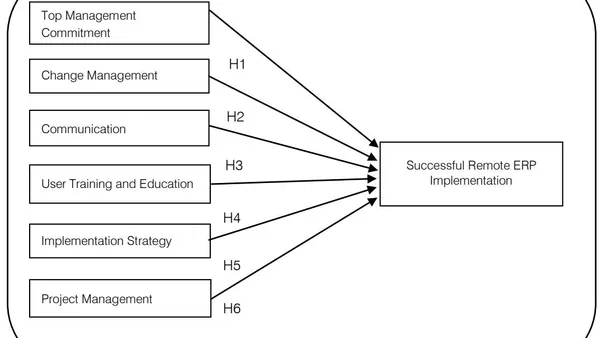
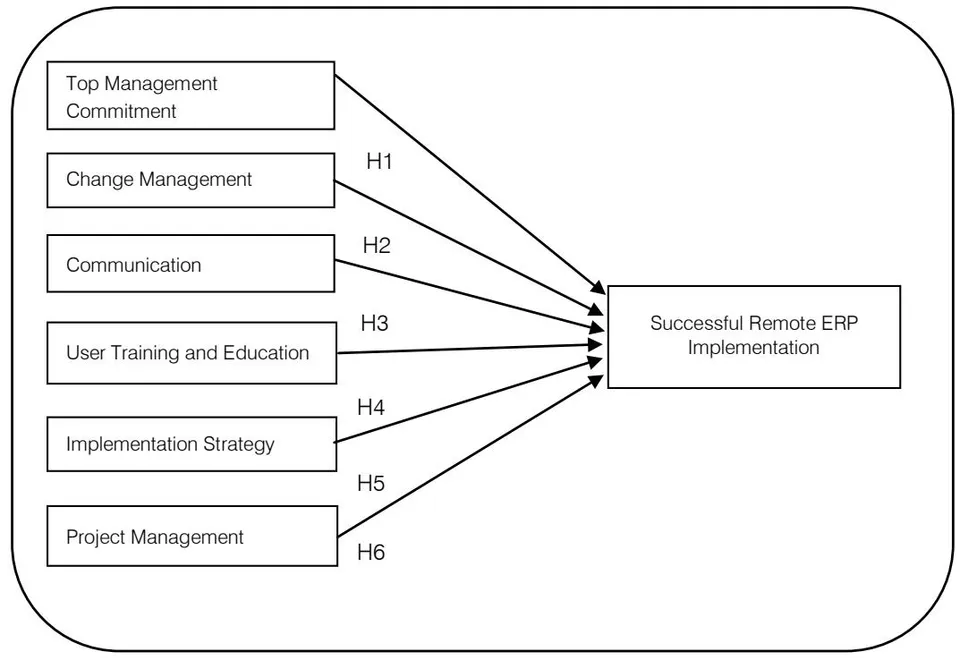
Based on the literature review, the following conceptual framework was derived.
b) Hypotheses
- H1: Top Management Commitment is a critical success factor of remote ERP implementation from system users' perspective.
- H2: Change Management is a critical success factor of remote ERP implementation from system users' perspective.
- H3: Communication is a critical success factor of remote ERP implementation from system users' perspective.
- H4: Implementation Strategy is a critical success factor of remote ERP implementation from system users' perspective.
- H5: User Training and Education is a critical success factor of remote ERP implementation from system users' perspective.
- H6: Project Management is a critical success factor of remote ERP implementation from system users' perspective.
IV. METHODOLOGY
The philosophy of research is a system of beliefs and assumptions about how knowledge develops. As discussed by Saunders et al. (2009), a coherent research philosophy is based on well-considered and consistent assumptions. Methodological choices, research questions, data collection techniques, and analysis procedures are based on this. The underlying philosophy of the study needs to be considered when researching since it implies a particular way of viewing the world (Saunders et al., 2009).
Since the purpose of the study was to reveal law like generalizations about phenomena, positivism was the philosophy adopted for this study. Additionally, since the study aimed to examine the Critical Success Factors (CSFs) when implementing an ERP system from a system user perspective, which is a different angle than prior studies, an observational phenomenon was considered as knowledge. During the study, the researchers were detached, neutral, and independent and took an objective stance to yield pure facts and data unaffected by human judgment or opinion.
According to Saunders et al. (2009), the deductive approach usually involves a survey strategy, which was presented in this research study. A deductive approach also emphasizes quantification in the collection and analysis of data (Bryman & Bell, 2011). To obtain a body of quantitative data connected to two or more variables, as well as their association, survey research entails a cross-sectional design (Bryman & Bell, 2011). With the aid of a survey, the authors were able to categorize and describe the population, and test relationships and assumptions (Jackson, 2015).
Since the primary goal of this study was to establish a correlation between a predictor variable and several response variables, and because it was descriptive and explanatory, data were collected using both a web-based and paper-based questionnaire, which was then used for statistical analysis.
This study adopted a quantitative approach, and in the current research, hypotheses are derived from extensive literature reviews to test the relationships between variables. Users were asked to rate the variables on a Likert scale using a web-based survey. Collected data converted into numerical data, was then further statistically tested using statistical software. As a result of the approach and purpose of this study, a quantitative approach was recommended to answer the research questions and test the hypothesis.
For primary data collection, the survey strategy used in this study included a questionnaire. The current study made use of a self-administered questionnaire for primary data collection. The research used both paper-based responses and online questionnaires to increase the number of responses of system users who are widely dispersed geographically.
As this study makes use of survey research strategies where one needs to draw inferences from a sample of a population to answer the research question, probability sampling was chosen (Saunders et al., 2009).
The current study targeted the system users of ERP systems implemented remotely in Sri Lanka. Since the targeted respondents were a niche group, the chosen respondents were credible since they were the best fit for the intended purpose. The study was aimed the companies in the manufacturing sector where ERP systems have been implemented remotely during the
Covid-19 pandemic in Sri Lanka. The population amounted to 900 ERP system users of remotely implemented ERP, based on the Krejcie & Morghan (1970), since the population size was 900, the sample size was taken as 269. According to the convenience sampling technique, the sample was selected, and responses were collected both using web-based and paper-based questionnaires. The research extensively made an effort to increase the response rate via e-mails by sending reminders to the respondents and following up the process by reminding them to finish the questionnaire.
To address the initial proposition of the study, the statistical analysis consists of examining, coding, tabulating, or otherwise combining the evidence (Yin, 1989). In this section, we analyze the data collected using questionnaires, using descriptive statistics, Pearson correlation, and multiple linear regression using the statistical package for social scientists (SPSS version 21), and presenting the results as tables and graphs. In terms of the original units of the data, regression analysis measures the average relationship between two or more variables. It shows cause-and-effect relationships between variables. Thus, the current study used multiple regression analysis to determine the type of relationship (positive or negative) that exists between the selected independent variables and the dependent variable - the remote ERP implementation success and whether those independent variables significantly impact on the remote ERP implementation success.
It is necessary to assess the validity and reliability of the measures for the instrument, according to Hair et al. (2003). This study used Cronbach's Alpha to assess the instrument's internal consistency and reliability. Effective research should have a Cronbach's Alpha result of at least 0.7. Thus, while the questionnaire is distributed to 33 first respondents, Cronbach's Alpha result has been checked and found to be above 0.7. This indicates the validity of the research.
| Cronbach's Alpha | Internal consistency |
| α ≥ 0.9 | Excellent |
| 0.9 > α ≥ 0.8 | Good |
| 0.8 > α ≥ 0.7 | Acceptable |
| 0.7 > α ≥ 0.6 | Questionable |
| 0.6 > α ≥ 0.5 | Poor |
| 0.5 > α | Unacceptable |
The scale of reliability of Cronbach's Alpha is shown in Table 2, and there have been various reports of accepted Alpha values above. The most acceptable score Alpha value is above 0.7. Also, a minimal number of questions and poor connections between items or heterogeneous notions could be reasons for a score below 0.7.
| Variable | Cronbach Alpha | No of Items |
| Top Management Commitment | .852 | 3 |
| Change Management | .961 | 3 |
| Communication | .923 | 3 |
| User Training and Education | .827 | 3 |
| Implementation Strategy | .863 | 3 |
| Project Management | .907 | 3 |
| ERP Implementation Success | .876 | 4 |
| Overall Value | .958 | 22 |
When all the questions in the Top Management Commitment variable were added together, Cronbach's Alpha value was.852, in the data set, it is generated as a good score. The Change Management variable has a good Cronbach Alpha rating of.961, it can be an excellent score for that data set. The Communication variable also got a.923 score for all their items. The Cronbach Alpha value for that data set is very high. The User Training and Education variable has a good Cronbach Alpha rating of.827, which means it can be taken as a good score for that data set. The Cronbach's Alpha value was.863 for the Implementation Strategy in the data set, it also generated a good score. The Project Management variable got a.907 score for all items, it means the Cronbach Alpha value for that data set is high. ERP implementation success is the dependent variable in the data set. It achieved a score of.952 among its four items. When identifying overall reliability, the data set achieved a score of.958, it was an excellent Cronbach Alpha value.
Bryman and Bell (2003) define validity as the degree to which any measuring instrument measures what it claims to measure. In this regard, different theories and empirical studies have been analyzed to ensure their validity in the literature survey. According to Stapleton (1997), an approach to discovering the number and nature of the variables which underpin a huge number of variables or metrics is factor analysis. It instructs the researcher on which tests or measurements should be used jointly. When a test user needs to have an implication from the test results to acts that may be categorized under a specific psychological construct, construct validity is investigated. According to Hair et al. (1998), the minimum communality value is 0.4 and the current study has a value of 0.570. The Cronbach's Alpha value of this study in diverse between 0.96 and 0.82. All the independent variables and dependents acquire a Cronbach's Alpha value which is higher than 0.7, as stated by Hair et al. (1998). The Kaiser-Meyer-Olkin measure confirmed the analysis's sampling adequacy (Field 2009). All individual items' KMO values were more significant than 0.7.
| Variable | Kaiser-Meyer-Olkin (KMO) |
| Top Management Commitment | .721 |
| Change Management | .874 |
| Communication | .832 |
| User Training and Education | .756 |
| Implementation Strategy | .811 |
| Project Management | .830 |
| ERP Implementation Success | .743 |
The validity of the study is established if the research tool evaluates what it claims to quantify (Field, 2009). According to Hair et al. (1998), if the cut-off level of KMO is 0.7, and all the variables exceeded that value, then instrument is valid.
V. RESULTS AND ANALYSIS
This section indicates the facts to which extent the identified factors are impacting onremote ERP implementation success and what are the critical factors that has the highest impact on remote ERP implementation success.
a) Demographic Characteristics
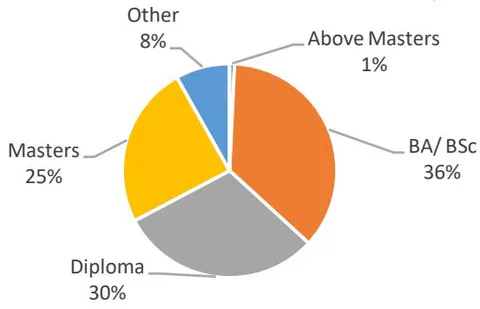
Only of the sample had the qualification above master's degree, which was the minimum representation of the sample.
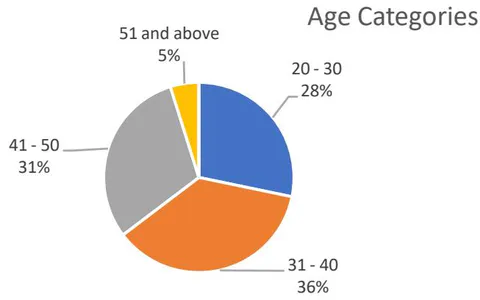
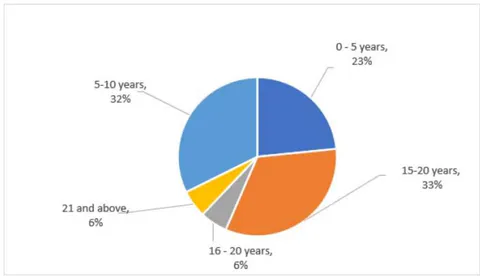
The sample included of the system users in the age range of 31-40 years, which represented the highest representation, while only of the system users were above 51 years. of the respondents had the experience of 5-10 years, and there have been of the respondents who had experience of only 5 years or below.
b) Relationship between each Factor and Remote ERP Implementation Success
The output generated precisely to discuss the relationship between the identified independent variables and remote ERP implementation success, and the impact of each factor on the remote ERP implementation success in the Sri Lankan context. Illustrating it through descriptive statistics, scatter plots were drawn for each control variable (Ursachi et al. 2015) with response variable being remote ERP implementation success (y) to explode on the nature of the relationship that may exist between identified factors and remote ERP implementation success. The scatter plot is one of the most effective tools for data analysis (sometimes also called x y diagrams) as well as the most common method for displaying multidimensional data to identify the direction of the relationship between two attributes and clusters of points (Keim et al., 2010).
Depicting the result obtained using scatter diagrams, the data in all six diagrams of Top Management Commitment, Change Management, Communication, User Training and Education, Implementation Strategy, and Project Management in relation to the remote ERP implementation success showed an upward trend from left to right, demonstrating a positive linear relationship between them and remote ERP implementation success.
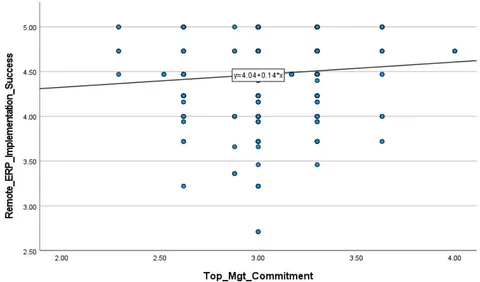
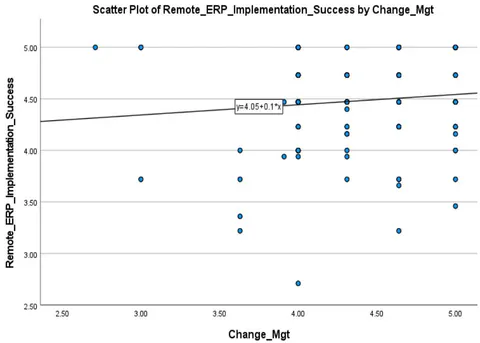
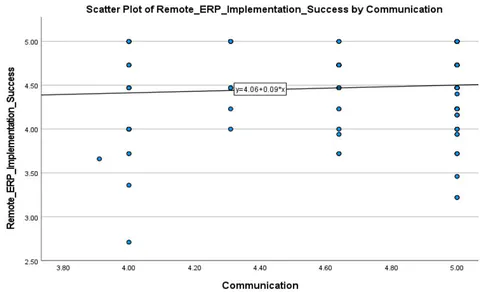
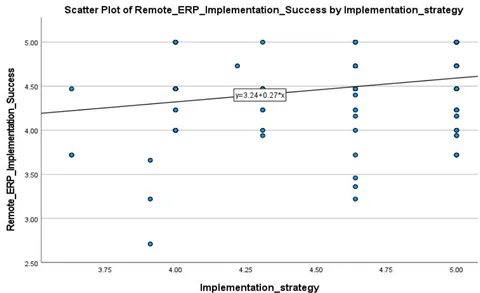
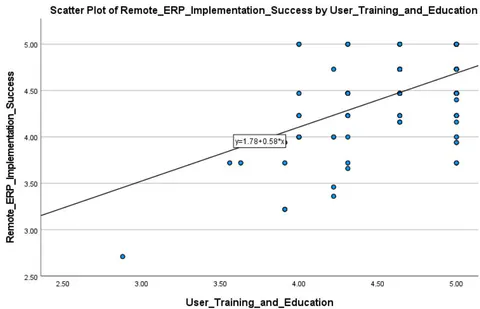
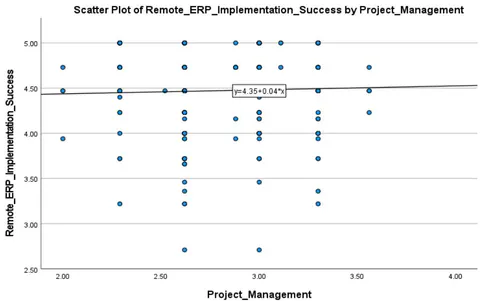
To further ascertain on positive relationship visible through scatter diagrams, the study accommodated an inferential statistic tool. Accordingly, the Pearson correlational test was performed using the sample size to affirm on positive relationship and further enrich the analysis by indicating the magnitude/strength of the identified relationship between identified factors and remote ERP implementation success.
Pearson correlation coefficients can be positive or negative (direction), and their magnitude might be high or low. Correlation coefficients range from -1 to +1, indicating perfect negative to positive correlation coefficients, and 0 indicating no correlation (zero relationships) (Sedgwick, 2012). Further, correlation coefficients less than 0.30 (negative or positive), between 0.30 - 0.6, and above 0.6 indicate a weak, moderate, and strong relationship between control and response variable (Akoglu, 2018).
| Remote ERP Implementation Success | ||
| Remote ERP Implementation Success | Correlation Coefficient | 1.000 |
| Sig. (2-tailed) | ||
| N | 269 | |
| Top Management Commitment | Correlation Coefficient | 0.087 |
| Sig. (2-tailed) | .157 | |
| N | 269 | |
| Change Management | Correlation Coefficient | 0.107 |
| Sig. (2-tailed) | .080 | |
| N | 269 | |
| Communication | Correlation Coefficient | 0.542** |
| Sig. (2-tailed) | .000 | |
| N | 269 | |
| Implementation Strategy | Correlation | 0.249** |
| Coefficient | .000 | |
| Sig. (2-tailed) | 269 | |
| N | 269 | |
| User Training and Education | Correlation Coefficient | 0.878** |
| Sig. (2-tailed) | .000 | |
| N | 269 | |
| Project Management | Correlation Coefficient | 0.031 |
| Sig. (2-tailed) | .607 | |
| N | 269 |
According to the results derived in Table 5 based on the Pearson correlational analysis, it was found that, the User Training and Education, Communication, and Implementation Strategy factors seem to have a statistically significant correlation with the remote ERP implementation success (Sig. (2-tailed) ). Among these three factors, User Training and Education has the strongest positive correlation with remote ERP implementation success, while a moderate correlation is witnessed between Communication and remote ERP implementation success, and a weak positive correlation is witnessed between Implementation Strategy and remote ERP implementation success. Although Top Management Commitment, Change Management, and Project Management seem to have positive correlations with remote ERP implementation success, they are not statistically significant, since the Sig. (2-tailed) has been greater than 0.05.
c) Multiple Linear Regression Analysis
According to the previous section, it was identified that a positive relationship exists between all the six independent variables and remote ERP implementation success. This section proceeds with a deeper investigation based on assessing the impact of the identified factors that ensure remote ERP implementation success. For this, the study accommodated the multiple linear regression model.
First, the data were analyzed to check on the convenience for regression analysis. Accordingly, the assumptions of normality, linearity, and absence of collinearity were tested as prerequisites for a multiple regression analysis. With reference to (Pallant, 2001), there are a few main identified assumptions to be tested for a multiple regression which include,
- The required sample size for a regression test
- No multicollinearity between independent variables
- Normality distribution of data set and test for outliers
- Linearity between independent and dependent variables
- Homoscedasticity of independent variables
Assumption 01: The Required Sample Size for a Regression Test As cited in (Pallant, 2001), it is recommended for social research to have at least 15 subjects per predictor for a valid regression test. The ideal sample size for a regression can also be calculated using the following formula: ( number of independent variables) (Pallant, 2001). Accordingly, the study consists of 6 main independent variables with primary data collected from 269 ERP system users. When outliers are comprised in a data set common, those data points should be removed (Osborne and Overbay, 2004). However, no outliers nor missing values were spotted in the data set, and therefore, 269 responses were used for a regression analysis.
Assumption 02: Multicollinearity Test of Predictor Variables
The collinearity diagnostics confirm whether there is a serious problem with multicollinearity. Condition Index Values greater than 15 indicate a possible problem with collinearity; greater than 30, a serious problem. A tolerance value suggests a concern with (multi) collinearity. VIF is simply the tolerance's reciprocal value. As a result, VIF values suggest concerns with collinearity. The results of these analyzes are presented in Table 6. It could therefore be seen that the tolerance levels are and VIF values are for all independent variables.
| (Constant) | Tolerance | VIF |
| Top Management Commitment | 0.978 | 1.023 |
| Change Management | 0.859 | 1.164 |
| Communication | 0.672 | 1.488 |
| User Training and Education | 0.700 | 1.429 |
| Implementation Strategy | 0.700 | 1.429 |
| Project Management | 0.978 | 1.023 |
The study also revealed a safer facet in its Condition Index (CI) values as shown in Table 7. All independent variables had a CI , which thereby indicates that the predictor variables are free from multicollinearity.
| Dimension | Eigen value | Condition Index | Variance Proportions | ||||||
| (Constant) | Top_Mgt_Commitment | Change_Mgt | Communication | Implementatio_n_on_strategy | User training and education | Project_Manageme ment | |||
| 1 | 6.956 | 1.000 | .00 | .00 | .00 | .00 | .00 | .00 | .00 |
| 2 | .015 | 21.406 | .00 | .04 | .13 | .01 | .03 | .01 | .49 |
| 3 | .009 | 27.210 | .00 | .18 | .59 | .02 | .01 | .03 | .22 |
| 4 | .008 | 28.751 | .00 | .47 | .17 | .08 | .01 | .11 | .11 |
| 5 | .005 | 38.219 | .00 | .02 | .06 | .00 | .78 | .38 | .03 |
| 6 | .004 | 43.304 | .01 | .00 | .00 | .77 | .15 | .45 | .02 |
| 7 | .002 | 56.772 | .98 | .29 | .05 | .12 | .02 | .01 | .14 |
Assumption 03: Normality Distribution of Data Set and Test for Outliers
Reponses for the survey instrument were collected from 269 respondents, which is a relatively large sample, and hence the Central Limit Theorem could be applied, posing no question on normality. Descriptive statistics relevant to normal distribution are shown in Table 8, with values of 4.47, 4.47, and 4.47 indicated as the mean, mode, and median of the dataset respectively.
| Remote ERP Implementation Success | |
| Mean | 4.474281 |
| Standard Error | 0.02771 |
| Median | 4.472136 |
| Mode | 4.472136 |
| Standard Deviation | 0.454478 |
| Sample Variance | 0.20655 |
| Kurtosis | 1.093872 |
| Skewness | -0.96841 |
| Range | 2.289194 |
| Minimum | 2.710806 |
| Maximum | 5 |
| Sum | 1203.582 |
| Count | 269 |
Assumption 04: Linearity between Independent and Dependent Variables
The link between dependent and independent variables can only be effectively estimated using standard multiple regression if the relationships are linear (Pallant, 2001). The findings of the regression analysis will underestimate the true relationship if the relationship between the independent factors and the dependent variable is not linear. As tested previously, both descriptively and inferentially using scatter diagrams and Pearson correlation coefficient, it was assured that a linear relationship exists between identified six factors and remote ERP implementation success, which thereby poses no concerns on linearity between variables.
Assumption 05: Homoscedasticity of Independent Variables
The variance of errors is the same across all levels of the independent variables, known as homoscedasticity. A visual study of a plot of the standardized residuals (errors) by the regression standardized projected value can verify this assumption (Jarque and Bera, 1980). In an ideal world, residuals are randomly spread around 0 (the horizontal line), resulting in a relatively uniform distribution that meets the homoscedasticity assumption.
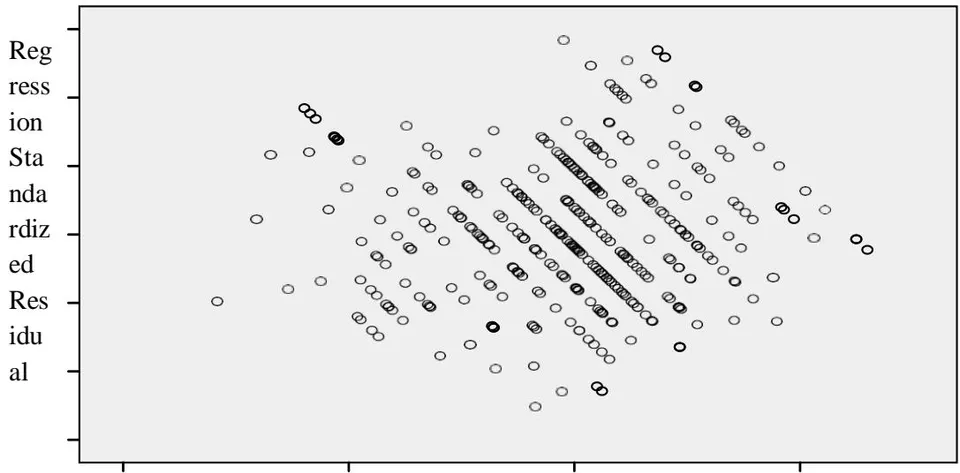
Accordingly, with data analyzed to test its viability for regression analysis, all assumptions were successfully cleared, and a multiple linear regression test was done as the next step to explore on the impact of six identified factors towards remote ERP implementation success.
Regression analysis is a mathematical measure that is used to determine the average relationship between two or more than two variables with the use of the data set. The cause-and-effect relationship between independent and dependent variables is indicated through regression analysis. The following Table 9 represents the results received after running multiple linear regression analysis based on the collected data set.
| Model Summary | ||||
| Model | R | R Square | Adjusted R Square | Std. Error of the Estimate |
| 1 | .599a | .359 | .345 | .36840 |
| ANOVA* | ||||||
| Model | Sum of Squares | df | Mean Square | F | Sig. | |
| 1 | Regression | 19.940 | 6 | 3.323 | 24.487 | |
| Residual | 35.558 | 262 | .136 | |||
| Total | 55.498 | 268 | ||||
In the process of model estimation, it is common to evaluate the appropriateness of a single descriptive model based on the coefficient determination (R2). R2 serves as a fast and easy way to measure the goodness of fit of an estimated model in empirical studies (Saunders, et al., 2009). Although R2 is a good indicator, it is not absolute. It is simply a measure of explained variance relative to the total variance in the dependent variable (Saunders, et al., 2009). The current study focuses on the system users' perspective on remote ERP implementation success.
The results of the regression analysis show that a variance of remote ERP implementation success is caused due to the independent variables Top Management Commitment, Change Management, User Training and Education, Project Management, Communication, and Implementation Strategy. However, looking at the ANOVA table based on the derived results, since; F (6, 262) = 24.487, p<0.001, R2=34.5%, it indicates that the derived regression model is significant to predict the ERP implementation success. However, in the derived regression model, since R2 = 34.5%, there could be some other factors that significantly impact on remote ERP implementation success apart from the considered six factors Top
Management Commitment, Change Management, User Training and Education, Project Management, Communication, and Implementation Strategy.
| Coefficients | ||||||
| Model | Unstandardized Coefficients | Standardized Coefficients | t | Sig. | ||
| B | Std. Error | Beta | ||||
| 1 | (Constant) | 1.995 | .442 | 4.513 | .001 | |
| Top Management Commitment | .077 | .081 | .047 | .945 | .346 | |
| Change Management | .018 | .050 | -.019 | -.358 | .721 | |
| Communication | .342 | .069 | -.298 | -4.946 | .001 | |
| Implementation Strategy | .139 | .064 | .128 | 2.163 | .001 | |
| User Training and Education | .691 | .064 | .643 | 10.871 | .001 | |
| Project Management | .031 | .070 | .022 | .444 | .658 | |
| a. Dependent Variable: Remote ERP system implementation success | ||||||
Table 10 illustrates the impact of each independent variable (Top Management Commitment, Change Management, User Training and Education, Project Management, Communication, and Implementation Strategy) on the dependent variable, which is remote ERP system implementation success. For all the independent variables, beta values derived were positive, which determined that with each of the considered independent variable there has been a positive correlation with the dependent variable remote ERP implementation success. However, looking at the significant values in addition to the constant, the other independent variables that have a significant impact on remote ERP system implementation success have been, User Training and Education (Sig. val = 0.001), Communication (Sig. val = 0.001), and Implementation Strategy (Sig. val = <0.001). Further, the results show that, 1% change in the User Training and Education, Communication, and Implementation Strategy; would increase the remote ERP implementation success by 69.1%, 34.2%, and 13.9% respectively. However, looking at the results, since the significance level of Top Management Commitment, Change Management, and Project Management has been greater than 0.05, although each of these factors have a positive correlation with the dependent variable - remote ERP implementation success, they were not found to be having a significant impact on remote ERP implementation success.
d) Hypotheses Testing
H1: Top Management Commitment is a critical success factor in remote ERP implementation from system users' perspective - Rejected since (B=.077, Sig. = 0.346).
Based on the regression results (refer to table 10), although Top Management Commitment is positively correlated with remote the ERP implementation, Top Management Commitment was found not to be significantly impact on the remote ERP implementation success. Thus, Hypothesis 1 is rejected.
This finding is different from what has been stated in the previous literature where it was mentioned that Top Management Commitment is a critical factor for ERP implementation success in a physical setting. However, since the setting was remote ERP implementation, the finding differed drastically from the previous literature.
Previous literature mentions that in a physical setting, successful ERP implementation is achievable only if high-level executives have a sturdy dedication to the assignment (Gargeya & Brady, 2005). For numerous reasons, top management commitment to the project is critical throughout the implementation life cycle (Somers & Nelson, 2004). According to the literature, among all the CSFs for ERP implementation, senior management engagement and support at each step of the ERP implementation are crucial (Ranjan & Jha, 2018; Saade & Nijher, 2016). Therefore, the rejection of H1 will undoubtedly lead to an argument and would be recommended for future research for further digging deeper to understand the root cause for the result through a qualitative approach.
H2: Change Management is a critical success factor in remote ERP implementation from system users' perspective - Rejected since (B=.018, Sig. = 0.721).
Based on the regression results (refer to table 10), although Change Management is positively correlated with the remote ERP implementation, Change Management was found not to be significantly impacting on the remote ERP implementation success. Thus, Hypothesis 2 is rejected.
The relevance of change management, on the other hand, is highlighted from the project's initial phase and during its whole life cycle (Nah, et al., 2007). Further, the literature mentions change management as a critical factor to ERP implementation success regarding empowered team management and adapting implementation strategies for identifying, managing, and training ERP project stakeholders (Dezdar & Ainin, 2011). Thus, the findings of the current study, questions whether Change Management is a critical success factor, especially for ERP implementation success in a remote setting since the H2 is rejected statistically.
H3: Communication is a critical success factor in remote ERP implementation from system users' perspective - Accepted since (B=.691, Sig. = 0.001).
Based on the regression results (refer to table 10), Communication is positively correlated with the remote ERP implementation, and Communication was found to be significantly impacting on the remote ERP implementation success. Thus, Hypothesis 3 is accepted.
According to Motwani et al. (2005), a company that encourages its employees to participate actively in the workplace is more likely to succeed. A corporation that implements open communication is more successful than one that does not. The current study findings are on par with the previous literature. The findings suggest that in a remote ERP implementation setting, communication is a critical success factor. Further, the findings exaggerate the statement where it was claimed that communication is a crucial technique for managers to use when attempting to overcome employee resistance to change (Dezdar & Sulaiman, 2009).
H4: Implementation Strategy is a critical success factor in remote ERP implementation from system users' perspective - Accepted since (B=.139, Sig. = 0.001).
Based on the regression results (refer to table 10), Implementation Strategy is positively correlated with the remote ERP implementation, and Implementation Strategy was found to be significantly impacting on the remote ERP implementation success. Thus, Hypothesis 4 is accepted.
According to Mandal and Gunasekaran (2004), implementation strategy is the most important CSF for a successful ERP implementation. Several questions must be answered to create a well-functioning implementation strategy: what is the unique information demands at the operational and management levels, how will the ERP system interact with the existing system, and what is the implementation schedule and methodology? By answering these questions, a business can develop a plan that will increase its chances of success by when compared to businesses who do not have one (Mandal & Gunasekaran, 2003). The current study finding also is on par with this literature and suggests that even in a remote ERP implementation setting, Implementation Strategy remains as a critical factor that would aid in ERP implementation success.
H5: User Training and Education is a critical success factor in remote ERP implementation from system users' perspective - Accepted since (B=.691, Sig. = 0.001).
Based on the regression results, User Training and Education is positively correlated with the remote ERP implementation, and User Training and Education was found to be significantly impacting on the remote ERP implementation success. Thus, Hypothesis 5 is accepted.
According to Somers and Nelson (2004), training and education is critical for deploying an ERP system. Further, in previous literature, it is also mentioned that to ensure that system user training is successful, it should begin well before the implementation process begins (Umble et al., 2003). Moreover, when planning for a new system, one of the most significant aspects to consider is education and training programs, which, along with other factors, are essential ingredients for successful implementation (Mabert et al., 2003). Thus, the findings of the current study are in par with this literature which suggest that may it be an ERP implementation that is done by the project team being physically present on the site or an ERP implementation that is done remotely, for both the situations User Training and Education is a critical success factor.
H6: Project Management is a critical success factor in remote ERP implementation from system users' perspective - Rejected since (B=.031, Sig. = 0.658).
Based on the regression results, although Project Management is positively correlated with the remote ERP implementation, Project Management was found not to be significantly impact the remote ERP implementation success. Thus, Hypothesis 6 is rejected.
However, past literature has empirically examined the impact of project management for ERP implementation in a physical setting and proved to be one CSFs in physical ERP implementation success (Ranjan & Jha, 2018), and according to Nah et al. (2001), good project management is stated to be critical in ERP adoption projects. Although the stated previous literature discusses project management to be a critical success factor, the current study findings do not indicate Project Management to be a CSF in remote ERP implementation. This could be because the current study is conducted focusing on the system users' perspective.
VI. DISCUSSION AND CONCLUSION
The main objective of the current study was to identify critical success factors of remote ERP implementation from system users' perspective. The study adopted a quantitative approach using self-administered questionnaires distributed to system users who have the experience of using remotely implemented ERP systems. The study considered 269 responses collected through web-based and paper-based surveys, and both descriptive and inferential statistics were used to analyze using SPSS version 21 software, and interpretations were done accordingly.
Based on the demographic characteristics, it was found that of responded system users are in the age range of 31-40 years. This was the highest representation of the sample, while the least representation was from the age category above 51 years which was . Further, the sample consisted of respondents who had a first degree (BA or BSc) which was representation of the sample, while only of the sample had the qualification above master's degree which was the minimum representation of the sample.
The study identified that out of Top Management Commitment, Change Management, Communication, User Training and Education, Implementation Strategy, and Project Management, only User Training and Education, Implementation Strategy, and Communication were found to be the critical success factors for the successful remote ERP implementation. Based on the multiple regression analysis, it was found that, although all the considered independent variables had positive correlations with the dependent variable, which is remote ERP implementation success, it was found that only User Training and Education, Implementation strategy, and Communication were statistically significant with remote ERP implementation success. Majority of the ERP system users believe that User Training and Education is the most important factor which ensure the success in remote ERP implementation setting, where the project is conducted without the physical presence of ERP consultants at the customer site.
| Hypothesis | Regression Coefficient | Significant Value | Result |
| H1: Top Management Commitment is a critical success factor in remote ERP implementation from system users' perspective | .077 | .346 | Rejected |
| H2: Change Management is a critical success factor in remote ERP implementation from system users' perspective | .018 | .721 | Rejected |
| H3: Communication is a critical success factor in remote ERP implementation from system users' perspective | .342 | .001 | Accepted |
| H4: Implementation Strategy is a critical success factor in remote ERP implementation from system users' perspective | .139 | .001 | Accepted |
| H5: User Training and Education is a critical success factor in remote ERP implementation from system users' perspective | .691 | .001 | Accepted |
| H6: Project Management is a critical success factor in remote ERP implementation from system users' perspective | .031 | .658 | Rejected |
Although the findings in the previous literature where it was mentioned that Top Management Commitment is a critical factor for ERP implementation success in a physical setting where ERP consultants and ERP system users work together with physical meetups, in the current study, it was found that Top Management Commitment cannot be considered to be a critical success factor in remote ERP implementation from system users' perspective where most of the implementation project activities are conducted in online. However, since the current study was aiming on remote ERP implementation success, the finding was drastically different from the previous literature, which had focused on the dependent variable of ERP implementation success where the project team was physically present in the customer site during the implementation project life cycle.
Previous literature mentions that in a physical setting, successful ERP implementation is achievable only when high-degree executives have a sturdy dedication to the assignment (Gargeya & Brady, 2005). For numerous reasons, top management commitment to the project is critical throughout the implementation life cycle (Somers & Nelson, 2004). The literature mentions that among all the CSFs for ERP implementation, persistent top management involvement and the top management support at each stage of the ERP implementation is critical (Ranjan & Jha, 2018; Saade & Nijher, 2016). Considering remote ERP implementation setup and traditional ERP implementation with the physical presence of the ERP project team, top management involvement is evident as representatives from the ERP software company will be mostly at the customer site for meetings and other activities, then top management of the customer company interact more with ERP consultants and having more formal and informal discussions with them. Also, top management had to play a vital role in resource allocation for project activities and coordinating projects as they are present throughout the exercise. The rejection of H1 will undoubtedly lead to an argument and would be recommended for future research for further digging deeper to understand the root cause for the result through a qualitative approach.
Although, Nah, et al. (2007) highlights the importance of change management during the initiation of the project phase and through its entire life cycle, the current study findings reject hypothesis 2, which states that Change Management is a critical success factor in remote ERP implementation from a system users' perspective. However, the literature mentions change management as a critical factor to ERP implementation success regarding empowered team management and adapting implementation strategies for identifying, managing, and training ERP project stakeholders (Dezdar & Ainin, 2011). With the Covid-19 new normal and after adapting to work from home and aligning with online work activities, Change Management has been more familiarized with employees. Therefore, Change Management has become a necessity for managing their operational activities. Thus, the findings of the current study, doubts whether Change Management is a critical success factor especially for ERP implementation success in a remote setting, since the H2 is rejected statistically.
According to Motwani et al. (2005), a company that encourages its employees to participate actively in the workplace is more likely to succeed. In par with the study findings, the current study accepts the H3 which indicates that Communication is a critical success factor in remote ERP implementation from system users' perspective. The finding further emphasizes, a corporation that implements open communication is more successful than one that does not. Further, the findings exaggerate the statement where it was claimed that communication is a crucial technique for managers to use when attempting to overcome employee resistance to change (Dezdar & Sulaiman, 2009).
Mandal and Gunasekaran (2004) stated that implementation strategy is the most critical CSF for successful ERP adoption. The current study findings are also on par with Mandal and Gunasekaran (2004), since hypothesis 4 is accepted, which states that the Implementation Strategy is a critical success factor in remote ERP implementation from the system users' perspective. It is identified that having a proper implementation strategy is important to an ERP implementation as it helps to complete the project successfully. Considering the Implementation Strategy, it can be decided how the implementation activities need to be planned, whether the project will be conducted as phase-wise or in a big bang approach, deciding exact project milestones in each phase provides more smooth resource allocation and smooth transitioning into the business process. Also, before moving into project implementation, providing prototypes enhances the reliability and effectiveness of the ERP system.
User training and education, according to Somers and Nelson (2004), are critical for deploying an ERP system. Further, in previous literature, it is also mentioned that to ensure that system user training is successful, it should begin well before the implementation process begins (Umble et al., 2003). Thus, the current study findings are also on par with the stated previous study findings since hypothesis 5 is accepted, which indicates that User Training and Education is a critical success factor in remote ERP implementation from system users' perspective. Moreover, when planning for a new system, one of the most significant aspects to consider is education and training programs, which, along with other factors, are essential ingredients for successful implementation (Mabert et al., 2003). User Training and Education is a critical factor that ensures ERP implementation success, whether ERP implementation is conducted while the project team being physically present at the customer site or ERP implementation that is completely done remotely. After having proper training and education, system users will be more familiarized with the ERP system and will have the capability to continue their business operations through the ERP system effectively with minimum supervision since ERP consultants will not be available at the customer site even after the project Go-Live.
Previous literature has empirically examined the impact of project management on ERP implementation in a physical setting and proved to be one CSF in physical ERP implementation success (Ranjan & Jha, 2018), and according to Nah et al. (2001), good project management is stated to be critical in ERP adoption projects. Although the stated previous literature discusses project management to be a critical success factor, the current study findings reject hypothesis 6, which indicates that Project Management is a CSF in remote ERP implementation. The deviation of the current study findings from the previous literature might be because, system user cannot see the presence of the project team, including the project manager and ERP consultants, in the customer site as usual in a typical ERP implementation setting, which might have been the main reason for the differences in perspectives.
The current study was focused on the Sri Lankan setting due to budgetary and time constraints. Further, the study considered only 269 system users in the sample representing the manufacturing sector. However, increasing the sample size and taking sample from different sectors would have increased the generalization ability of the findings of the current study to the Sri Lankan context. Also, since the current study adopted the positivism philosophy having followed the quantitative approach, the current study could not identify new avenues or drastically new factors which would have impacted the remote ERP implementation success from users' perspective that is not stated in the previous literature which was mainly focusing the ERP implementation success on the physical presence setting.
The current study findings would aid in deploying remote ERP system implementation successfully and would help the companies to reduce the cycle time taken for making the decisions which would increase performance efficiencies. Based on the present study, User Training and Education, Communication, and Implementation Strategy are the critical success factors which contribute significantly to remote ERP implementation success. Finally, although Top Management Commitment, Change Management, and Project Management are positively correlated with remote ERP implementation success, those factors are not considered to be significantly contributing to remote ERP implementation success based on the system users' perspective.