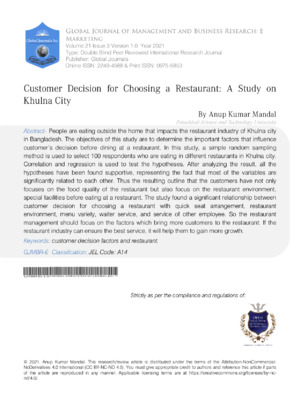
Customer Decision for Choosing a Restaurant: A Study on Khulna City

ยง Patuakhali Science and Technology University Patuakhali Science and Technology University

Send Message

To: Author

Customer Decision for Choosing a Restaurant: A Study on Khulna City

Article Fingerprint

ReserarchID

Y109S

Customer Decision for Choosing a Restaurant: A Study on Khulna City Banner

Key Research Insights

Synthesized scholarly intelligence & interactive research assistant
  • English
  • Afrikaans
  • Albanian
  • Amharic
  • Arabic
  • Armenian
  • Azerbaijani
  • Basque
  • Belarusian
  • Bengali
  • Bosnian
  • Bulgarian
  • Catalan
  • Cebuano
  • Chichewa
  • Chinese (Simplified)
  • Chinese (Traditional)
  • Corsican
  • Croatian
  • Czech
  • Danish
  • Dutch
  • Esperanto
  • Estonian
  • Filipino
  • Finnish
  • French
  • Frisian
  • Galician
  • Georgian
  • German
  • Greek
  • Gujarati
  • Haitian Creole
  • Hausa
  • Hawaiian
  • Hebrew
  • Hindi
  • Hmong
  • Hungarian
  • Icelandic
  • Igbo
  • Indonesian
  • Irish
  • Italian
  • Japanese
  • Javanese
  • Kannada
  • Kazakh
  • Khmer
  • Korean
  • Kurdish (Kurmanji)
  • Kyrgyz
  • Lao
  • Latin
  • Latvian
  • Lithuanian
  • Luxembourgish
  • Macedonian
  • Malagasy
  • Malay
  • Malayalam
  • Maltese
  • Maori
  • Marathi
  • Mongolian
  • Myanmar (Burmese)
  • Nepali
  • Norwegian
  • Pashto
  • Persian
  • Polish
  • Portuguese
  • Punjabi
  • Romanian
  • Russian
  • Samoan
  • Scots Gaelic
  • Serbian
  • Sesotho
  • Shona
  • Sindhi
  • Sinhala
  • Slovak
  • Slovenian
  • Somali
  • Spanish
  • Sundanese
  • Swahili
  • Swedish
  • Tajik
  • Tamil
  • Telugu
  • Thai
  • Turkish
  • Ukrainian
  • Urdu
  • Uzbek
  • Vietnamese
  • Welsh
  • Xhosa
  • Yiddish
  • Yoruba
  • Zulu
Reading Preferences
Font Size
Line Spacing
Background

Abstract

People are eating outside the home that impacts the restaurant industry of Khulna city in Bangladesh. The objectives of this study are to determine the important factors that influence customerโ€™s decision before dining at a restaurant. In this study, a simple random sampling method is used to select 100 respondents who are eating in different restaurants in Khulna city. Correlation and regression is used to test the hypotheses. After analyzing the result, all the hypotheses have been found supportive, representing the fact that most of the variables are significantly related to each other. Thus the resulting outline that the customers have not only focuses on the food quality of the restaurant but also focus on the restaurant environment, special facilities before eating at a restaurant. The study found a significant relationship between customer decision for choosing a restaurant with quick seat arrangement, restaurant environment, menu variety, waiter service, and service of other employee. So the restaurant management should focus on the factors which bring more customers to the restaurant. If the restaurant industry can ensure the best service, it will help them to gain more growth.

I. INTRODUCTION

Bangladesh has a remarkable track record for growth and development, aiming to be a middle income country by hers 50th anniversary (World Bank 2021). With the increasing level of development, people are more engaged in economic activities. By the expansion of business and employment opportunities people also have engaged in outside activities. Food is the basic need of social beings; people have to take food thrice a day. As people work outside of their homes, they have to eat at hotels and restaurants. Sometimes people go with their family, peer, and friends to take food at an outside restaurant. Businessman fixes their important meetings at the restaurant. Now a day's different social and cultural programs like birthday parties, marriage ceremonies, and inauguration ceremonies are held at hotels and restaurants. That's why the restaurants service industry has become very popular. The growth of restaurant industry is increasing higher year after year, according to BBS (2018), the restaurant industry earns Tk68.2 billion. But in 2019, this industry, earns Tk73.16 billion. Despite the growth of the restaurant industry it is facing numerous challenges due to external and internal factors in its business environment. The external factors include the highly competitive market, and internal factors include the restaurant environment, staff and employee behaviors, waiter service, restaurant special facilities and so on (Harun et al. 2013). Sometimes the customer visit with their family, friends and peer. At this time they desire best service from the restaurant (Younus et al. 2015). Restaurant environment is the most important factor to a customer. Customer demands a calm and noise-free environment where they can enjoy the food and Bonaparte. The environment should provide privacy to the customer (Haghighi and Dorosti, 2012). Arrangement of menu variety and food chart helps customer easily select their food. Procedure of wide range of menu items supports customer to choose their favorite food before eating at the restaurant, the food delivery time is also an important issue. Sometimes customers lost patience when they get late food delivery (Harun et al. 2013). Tamanna (2016) found that menu price, service quality and restaurant atmosphere are important factors for young customers to choosing the fast food at the restaurants. Restaurant entrepreneurs should consider the factors such as quality and price of food, to development of the restaurant (Latif et al. 2015). The selection of a restaurant is also dependent on quick service, physical atmosphere, food superiority and pricing (Tabassum and Rahman, 2012). Studies show that the consumers give most importance to the brand reputation of the food item charted by nearness to receive and availability, similarity of savor with earlier experience, cost and quality of the food, rebate and taste, sanitation and hygiene, salesmanship and decoration, fat and lipid level, and self-service factors (Islam and Ullah, 2010). According to Choi and Zhoa (2010), they revealed that the reasons for choosing a restaurant with concern health issues, yearly income level, the financial plan for dining out, and weight concerns. Cleanliness, food quality, and friendliness of the staff are most important factors for selecting the restaurant of travellers (Tripp et al. 1995). The study found that the physical design and exterior of the restaurant did not have a significant effect for choosing a restaurant (Andaleeb and Conway 2006). Restaurant location is also important factor for selecting the restaurant. (Edwards et al. 2003). Finally, according to Islam et al. (2018) they revealed that customer service, availability of variety and junk foods, maintenance of

ฮต = Random error privacy, the brand name of the restaurant, and availability of ready-made food is influencing factor for choosing a restaurant. There have several studies on the factor affecting customer decisions for choosing a restaurant. Most of the studies conducted with 3 or 4 variables in different cities. But no study has been done in Khulna city. So this need inspired me to conduct this study on Khulna city to explore how customers consider different factors before dining at the restaurant. In this study, we determine the factors as well as the correlation between two or more factor and their significance.

II. MATERIALS AND METHODS

This study has collected primary data from 100 customers who frequently eat in the restaurant at Khulna city. Data are randomly selected from a different restaurant at Khulna city. Data was collected through the questionnaire with face-to-face interviews.

a) Analytical technique

Factors affecting customer decision for choosing a restaurant at Khulna city

The extent to which various independent factors for choosing a restaurant were quantifies using a multiple regression function. The following multiple regression function specified in the present study:

Y = ฮฒ 0 + ฮฒ 1 X 1 + ฮฒ 2 X 2 + ฮฒ 3 X 3 + ฮฒ 4 X 4 + ฮฒ 5 X 5 + ฮฒ 6 X 6 + ฮฒ 7 X 7 + ฮฒ 8 X 8 + ฮฒ 9 X 9 + E

Where Y= Choosing Restaurant

ฮฒ 0 = Intercept

ฮฒ 1 โˆ’ 9 = Coefficient of variables
X 1 = ย Quick Seat Arrangementย 
X 2 = ย Restaurant Environmentย 

X 3 = Menu Variety

X 4 = Special Facilities

X 5 = Fast Order Delivery

X 6 = Known Restaurant

X 7 = Waiter Service

X 8 = Other Employee Service

X 9 = Supervisory Staff's Help

III. RESULTS AND DISCUSSION

Factors affecting customer decision for choosing a restaurant

The study considers the following factors where the customer decision for choosing a restaurant at Khulna city.

  1. Quick Seat Arrangement: After going to the restaurant the respondents want to sit promptly for their breakfast, lunch, or dinner.

  2. Restaurant Environment (Lighting, Noise Level and Parking): Restaurant's management decorates its dining place glowing and eye-catching lightings.

Noise level under control means there is no noise and a calm environment. Sometimes respondents go to restaurants with their best friends, and they want a peaceful place. Car parking facilities means the customers prefer the restaurant most where they park their car, bike, etc.

  1. Menu Variety: It means the restaurant's capability to arrange different types of food for different types of customers such as, some people like Chinese food, some like Bangladeshi food, and some like Indian food. To attract the more customers, a restaurant has to arrange every type of dish.

  2. Special Facilities (Vegetarians and non-vegetarians food, low price, Children's playground): It describes the restaurant can manage vegetarian and non-vegetarian customer segments and children's playground. In special cases, the customer often prefers the restaurants most where their children can play and fun.

  3. Waiter Service: Waiter service means when a waiter serves any type of service, how quickly they serve and their manner.

  4. Other Employee Service: The customer did receive any service from the restaurant's front desk executive, security guard, and receptionist.

  5. Supervisory Staff's Help: When the customer dines at the restaurants, did any supervisory staff member like the manager or any other person help the customer or not.

  6. Known Restaurant: This means the customer knows about the restaurant. They dined at this restaurant before or it is the new one.

  7. Fast Order Delivery: How many minute's a customer waited after giving an order for food. More than the customer's expected time or shorter than the expected time.

a) Analysis of correlation

H 1 = There is positive relation between fast seat arrangement and a restaurant environment of Khulna City.

Table I: Correction between seat arrangement and restaurant environment
Correlations
Fast Seat ArrangementRestaurant Environment
Fast Seat ArrangementPearson Correlation1.625**
Sig. (2-tailed).000
N4242
Restaurant EnvironmentPearson Correlation.625**1
Sig. (2-tailed).000
N4242
**. Correlation is significant at the 0.01 level (2-tailed).

Table I shows the value of the relationship between fast seat arrangement and restaurant environment is.625, and the significance value is.000. Thus the hypothesis is accepted. There is a positive and strong relationship exists between fast seat arrangement and the restaurant environment of Khulna city.

H 2 = There is a positive relationship between menu variety and special facilities of the restaurant of Khulna City.

Table II: Correction between menu variety and special facilities of the restaurant
Correlations
Menu VarietySpecial Facilities
Menu VarietyPearson Correlation1.527**
Sig. (2-tailed).000
N4242
Special FacilitiesPearson Correlation.527**1
Sig. (2-tailed).000
N4242
**. Correlation is significant at the 0.01 level (2-tailed).

From table II correlation coefficient between menu variety and special facilities is.527 and the significance value is.000 which shows there is a positive relationship between menu variety and special facilities of Khulna city.

H 3 = There is strong relationship between special facilities and waiter services of the restaurant of Khulna.

Table III: Correction between special facilities and waiter services of the restaurant
Correlations
Special FacilitiesWaiter Service
Special FacilitiesPearson Correlation1.290
Sig. (2-tailed).063
N4242
Waiter ServicePearson Correlation.2901
Sig. (2-tailed).063
N4242

Table III shows the correlation coefficient between special facilities and waiter service is.290, which shows a moderate relationship between special facilities, and waiter service and the value.063 shows the relationship is insignificant.

H 4 = There is a strong relationship between supervisory staff help and Repeat Purchase behavior of the customer of Khulna city.

Table IV: Correction supervisory staff help and repeat purchase behavior of the customer
Correlations
Supervisory Staff's HelpRepeat Purchase
Supervisory Staff's HelpPearson Correlation1.117
Sig. (2-tailed).461
N4242
Repeat PurchasePearson Correlation.1171
Sig. (2-tailed).461
N4242

The above table (Table IV) shows the correlation coefficient between supervisory staff help and repeat purchase behavior of the customer is.117 which, shows there is a moderate relationship between these two variables and the relationship is insignificant.

b) Regression analysis

The purpose of the regression analysis measures the relative influence of each independent variable on the dependent variable.

Hypothesis

H 0 = There is no relation between the independent variables (Quick Seat Arrangement, Fast Order Delivery,

Known Restaurant, Waiter Service, Other Employee Service, Menu Variety, Restaurant Environment, Special Facilities Supervisory Staff's Help) and dependent variable (Choosing restaurant).

H 1 = There is a relationship between independent variables (Quick Seat Arrangement, Fast Order Delivery, Known Restaurant, Waiter Service, Other Employee Service, Menu Variety, Restaurant Environment, Special Facilities Supervisory Staff's Help) and dependent variable (Choosing restaurant).

Table V: Model summary
Model Summaryb
ModelRR SquareAdjusted R SquareStd. Error of the EstimateDurbin-Watson
1.672a.451.297.296922.254
a. Predictors: (Constant), Supervisory Staff's Help, Quick Seat arrangement, Waiting Time, Known Restaurant, Waiter Service, Other Employee Service, Menu Variety, Restaurant Environment, Special Facilities
b. Dependent Variable: Choosing restaurant

The Pearson's correlation value, R = 0.672 > 0.50 which means there was highly correlation between the variables and the R square was 0.451 (Table V) which, denotes that about 45 % variation of the

Table VI: ANOVA test
A N O V b
ModelSum of SquaresdfMean SquareFSig.
1Regression2.3229.2582.926 .012 a
Residual2.82132.088
Total5.14341
a. Predictors: (Constant), Supervisory Staff's Help, Quick Seat Arrangement, Fast Order Delivery, Known Restaurant, Waiter Service, Other Employee Service, Menu Variety, Restaurant Environment, Special Facilities
b. Dependent Variable: Choosing restaurant

Table VI illustrates one-way variable test of the study. It is depicted from the table that the value (critical value) of F-statistic is 1.96 with ( 9 ร— 32 ) degrees of freedom which is less than the calculated value of 2.926 means the null hypothesis is rejected at 5% level of significance. The F-statistic is 2.25 with (9 x 32) degrees of freedom which is also less than the calculated value of 2.926, means the null hypothesis is rejected at 1% significance level. It also means that there is a significant correlation between the studied dependent variable and independent variables. It means that there is a relationship between the dependent and independent variables under study. So, we can say that the variables under study are very coherent.

Table VII: Multiple Regression Model
Coefficients
ModelUnstandardized CoefficientsStandardized CoefficientstSig.
BStd. ErrorBeta
1(Constant).551.2352.343.025
Quick Seat Arrangement.352.057.184.944.048
Restaurant Environment.706.052.073.380.026
Menu Variety.505.055.118.675.037
Special Facilities.072.063.2401.146.260
Fast Order Delivery.039.049.117.779.442
Known Restaurant-.137.112-.176-1.223.230
Waiter Service.164.080.3042.065.047
Other Employee Service.179.060.4752.978.005
Supervisory Staff's Help-.019.108-.027-.174.863
a. Dependent Variable: Choosing restaurant

The study considers the following factors where the customer decision for choosing a restaurant at Khulna city. It was hypothesized that there is no relation between the independent variable (quick seat arrangement, fast order delivery, known restaurant, waiter service, other employee service, menu variety, restaurant environment, special facilities supervisory staff's help) and dependent variable (choosing restaurant). To test the hypotheses, multiple regression analysis was used. Looking at the unique individual contributions of the predictor, the result (Table VII) shows that quick seat arrangement ( ฮฒ = .184 , t = .944 , p = .048 ), restaurant environment ( ฮฒ = .073 , t = .380 , p = .026 menu variety ( ฮฒ = .118 , t = .675 , p = .037 ), waiter service ( ฮฒ = .304 , t = 2.065 , p = .047 ) and Other Employee Service ( ฮฒ = .475 , t = 2.978 , p = .005 ) positively predict to choosing restaurant. The most influential factor that has a positive relationship with choosing the restaurant are seat arrangement, restaurant environment, menu variety, waiter service and Other Employee Service.

IV. CONCLUSION

From the above results and discussion, it has been concluded that the restaurant industry has become very competitive. To sustain in this competitive marketplace every restaurant company should put more effort into customer retention. In this competitive era, to become a market leader, not only food quality is important, but also restaurant's other features and services are very much important. The finding of the study also reveals that there is a strong relationship between customer visits and restaurant service. When a customer experiences good service from a restaurant, they will share with other people about good services. By providing the best service and considering the factor, it will help every restaurant company to capture more market share. Thus the findings of this study will help the restaurants to identify the ways to retain existing and loyal customers and attract new ones.

References

15 Cites in Article
  1. S Andaleeb,C Conway (2006). Customer satisfaction in the restaurant industry: an examination of the transaction-specific model.
  2. Dilip Bhadra (2018). Changing of Asian Outlooks and New Travel Demands are the Emerging Factors for Expanding Tourism Markets Globally.
  3. Jinkyung Choi,Jinlin Zhao (2010). Factors Influencing Restaurant Selection in South Florida: Is Health Issue One of the Factors Influencing Consumers' Behavior When Selecting a Restaurant?.
  4. J Edwards,H Meiselman,A Edwards,L Lesher (2003). The influence of eating location on the acceptability of identically prepared foods.
  5. Eiland,M Kinsey (2015). Factor Affecting Guest Satisfaction in the Restaurant Industry of South Mississippi.
  6. John Stefanelli (2021). Financial Management.
  7. M Haghighi,Dorosti (2012). A. Evaluation of Factor Affecting Customer Loyalty in the Restaurant Industry.
  8. M Harun,Ahmed Maniruzzaman (2013). Searching for Critical Success Factors: A Dimension-Specific Assessment of Service Quality and Its Relationship with Customer Satisfaction and Behavioral Intentions in Fast-Food Restaurants.
  9. Nazrul Islam,G Ullah (2010). Factors Affecting Consumers Preferences On Fast Food Items In Bangladesh.
  10. A Latif,S Yeasmin,Jony Islam (2015). Habit of Eating out by Professionals of Bangladesh-A Way to Save Time & Efforts for More Productive Works.
  11. A Tabassum,Rahman (2012). Differences in Consumer Attitude towards Selective Fast Food Restaurants in Bangladesh: An Implication of Multi-Attribute Attitude Model.
  12. M Tamanna (2016). Consumers' Interest in Fast Food Items-A Study on Sylhet City of Bangladesh.
  13. C Tripp,K Great House,C Shanklin,M Gregoire (1995). Factors influencing restaurant selection by travelers who stop at visitor information centers.
  14. (2021). Bangladesh - Systematic Country Diagnostic.
  15. Farah Qadriani,Nila Windasari (2015). Battle of Bootcamp: Analyzing Factor Affecting Customer Satisfaction and Continuance Intention in Coding Bootcamp Industry Indonesia.

Funding

No external funding was declared for this work.

Conflict of Interest

The authors declare no conflict of interest.

Ethical Approval

No ethics committee approval was required for this article type.

Data Availability

Not applicable for this article.

How to Cite This Article

Anup Kumar Mandal. 2021. "Customer Decision for Choosing a Restaurant: A Study on Khulna City". Global Journal of Management and Business Research - E: Marketing GJMBR-E Volume 21 (GJMBR Volume 21 Issue E3).

More Citation Formats

Download Citation

Customer decision restaurant Khulna.
Journal Specifications

Crossref Journal DOI 10.17406/GJMBR

Print ISSN 0975-5853

e-ISSN 2249-4588

Keywords
Classification
GJMBR-E Classification JEL Code: A14
Version of record

v1.2

Issue date
September 22, 2021

Language
English
Experiance in AR

Explore published articles in an immersive Augmented Reality environment. Our platform converts research papers into interactive 3D books, allowing readers to view and interact with content using AR and VR compatible devices.

Read in 3D

Your published article is automatically converted into a realistic 3D book. Flip through pages and read research papers in a more engaging and interactive format.

Article Matrices
Total Views: 755
Total Downloads: 65
All Trends

Request Access

Please fill out the form below to request access to this research paper. Your request will be reviewed by the editorial or author team.
X

This is the heading

Lorem ipsum dolor sit amet, consectetur adipiscing elit. Ut elit tellus, luctus nec ullamcorper mattis, pulvinar dapibus leo.

High-quality academic research articles on global topics and journals.

Customer Decision for Choosing a Restaurant: A Study on Khulna City

Anup Mandal
Anup Mandal Patuakhali Science and Technology University