
I. INTRODUCTION
Cystic fibrosis (CF) is a multisystem genetic disorder that commonly affects children and young adults and is the most common life-limiting disease among the Caucasian population. The disease, although can involve almost all systems of the body, most commonly involves the respiratory and digestive systems with phenotypic presentations of repeated respiratory tract infections, recurrent or persistent pneumonia, malabsorption, steatorrhea and failure to thrive (FTT).
The basic defect in CF is mutation in the Cystic Fibrosis Transmembrane Conductance Regulator (CFTR) gene located on the long arm of chromosome 7 at a position of which results in absence or improper chloride conductance by epithelial cells present on mucosal surfaces leading to dehydration of mucosal secretions that are too thick and viscid and difficult to clear.
Although mutation analysis for CFTR gene might be the confirmatory diagnostic tool, however, because of the large number of mutations, confirmation of CF diagnosis by genetic testing is limited and till today,the mainstay of CF diagnosis is the sweat chloride test. Pilocarpine iontophoresis sweat chloride testing for quantitative analysis of sweat to determine chloride concentration has been the gold standard for the diagnosis of CF for more than a half-century. Indeed, few tests in clinical medicine have the discriminating power of the sweat test.
The incidence of CF is variable in different kinds of literature reported from different corners of the world. The incidence is approximately 1 in 2500 children born in UK , less common in African Americans (1: 1500) and Asian Americans (1: 31000) . The accurate incidence of CF among the populations in the Indian subcontinent is exactly not known. CF was thought to be extremely rare or non-existent in this region with a widespread belief that
CF is a disease of white populations, so rarely suspected and diagnosed. But recent review of different published studies, reports and comments indicate that the presence of CF among the people in the Indian subcontinent is much more than previous thinking and the disease is under-diagnosed or missed in the majority of cases.[10] To our knowledge, till to date, there is no well accepted diagnostic procedure and structured management protocol for CF in Bangladesh.
The present study was designed to introduce the pilocarpine iontophoresis sweat chloride test using an indigenously developed and validated equipment for accurate and inexpensive diagnosis of CF for the first time in Bangladesh and to determine the phenotypic spectrum of CF for raising the physician's awareness about the disease in this country.
II. MATERIALS AND METHODS
a) Study design and setting
This prospective observational study was conducted over 3 years from January 2017 to December 2019 in the National Institute of Diseases of the Chest and Hospital (NIDCH), the largest respiratory care hospital and academic institute in government level in Bangladesh, in collaboration with Ibn Sine Hospital and Diagnostic Centre, a tertiary level referral Centre in Dhaka, the capital city of Bangladesh. The study was approved by the institutional review board.
b) Study population and sampling procedure
A total of 400 patients suspected of CF- having respiratory and/or GI symptoms, features of FTT, were included in the study regardless of age, sex and socioeconomic status with strictly following the inclusion and exclusion criteria. The majority of these patients were referred from different hospitals and medical centers of the country for proper diagnosis and better management.
A detailed history and thorough clinical examinations were done. Proper investigations for individual patients were advised. All patients or parents provided written consent prior to study commencement and the sweat chloride test was described individually. The clinical features, presence of one or more, considered as criteria to include the patient in the study to undergo sweat chloride test by pilocarpine iontophoresis were – recurrent respiratory tract infections, recurrent/persistent pneumonia, history of CF in siblings, ch malabsorption, steatorrhea, failure to thrive, nasal polyps, rectal prolapse, bronchiectasis in radiology. Patients having clinical and/or laboratory findings suggestive of tuberculosis, bronchial asthma, cong. heart disease, lactose intolerance were excluded from the study.
c) Sweat testing
Sweat chloride tests (SCT) were done by an independently developed and validated equipment using low-cost technology. It's a very useful and inexpensive method for sweat collection and chloride estimation in resource poor settings for CF diagnosis (video -1). Sweat collection was done by pilocarpine iontophoresis following Gibson and Cooke method and quantitative chloride estimation in collected sweat, minimum 100 mg collected within 30 minutes, was done by Schales and Schales method and labelled as follows:
| The concentration of Chloride (Cl-) | Indicator |
| < 29 mEq/L | normal |
| 30- 59 mEq/L | borderline |
| >60 mEq/L | positive 14 |
Validation of the SCT results were done periodically by performing chloride estimation on known strength of saline solution. The mean and standard deviation of the difference from the standard was calculated and confidence interval was estimated.
Sweat chloride tests were repeated at least one week apart in cases of positive or borderline results. Patients with normal sweat tests were properly evaluated to come to a diagnosis excluding possible differentials. Patients with borderline sweat test results were treated according to the clinical ground and subsequently prepared for mutation analysis.
d) Statistical analysis
Descriptive analyses were performed using frequency, percentage and mean with standard deviation (SD). Figures in the parenthesis indicate the corresponding percentage. Comparisons were made using the Chi-square test for categorical variables. A p-value of was considered as the level of significance. All the statistical analyses were conducted using Stata 16.
e) Ethical consideration
Ethical approval was obtained from the Institutional Review Board (IRB) of both centers (NIDCH/EC/09-2017). Informed written consent and with ascent was taken from each patient or their parents prior to study commencement. Confidentiality and anonymity of the patients were ensured. The sweat chloride test procedure as well as its potential benefit and risks were individually described to the patients and participation was voluntary where the participants had the right to withdraw at any time during the study. In case of refusal/non-response, no discrimination was done. Finally, no financial incentive or compensation was provided to the participants.
III. RESULTS
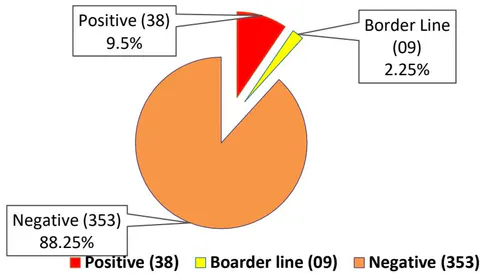
Out of 400 patients having clinical suspicion of CF and underwent pilocarpine iontophoresis, the test was positive in 38 patients (9.5%) and borderline in 9 patients (2.25%) on two occasions at least one week apart. The rest of the patients (88.25%) had normal sweat test results (Figure 1).
The relationship between the sweat chloride test results of the participants and their socio-demographic characteristics were described in table 1. The mean age of SCT positive patients was years, statistically significant ( ) number of them were male ( ) and reside in rural area ( ).
Table-1: Relationship between Sweat Chloride Test Results of the participants and their Socio-Demographic characteristics (N=400)
| Positive | Borderline | Negative | P-value | |
| Characteristics | SCT+Ve | SCT±Ve | SCT-Ve | |
| (n=38) | (n=9) | (n=353) | ||
| Age group | ||||
| <5 years | 8(21.1%) | 1(11.1%) | 85(24.1%) | 0.354 |
| 5-10 years | 20(52.6%) | 3(33.3%) | 120(34.0%) | |
| 11-15 years | 6(15.8%) | 3(33.3%) | 86(24.4%) | |
| >15 years | 4(10.5%) | 2(22.2%) | 62(17.6%) | |
| Mean ± SD, Yrs | 8.92 ± 6.72 | 10.11 ± 5.58 | 9.21 ± 7.91 | 0.748 |
| Sex | ||||
| Male | 24(63.2%) | 9(100.0%) | 190(53.8%) | 0.014 |
| Female | 14(36.8%) | 0(0.0%) | 163(46.2%) | |
| Consanguinity | ||||
| Present | 7 (18.42%) | 1(11.1%) | 47(13.3%) | 0.213 |
| Absent | 31 (81.57%) | 8(88.9%) | 306(86.7%) | |
| Residence | ||||
| Urban | 11(28.9%) | 5(55.6%) | 168(47.6%) | 0.015 |
| Sub urban | 7(18.4%) | 2(22.2%) | 102(28.9%) | |
| Rural | 18(47.4%) | 2(22.2%) | 83(23.5%) | |
Table 2 shows us the relationship between different clinical features of the participants and their SCT results. FTT, digital clubbing, recurrent pneumonia, nasal polyps and rectal prolapse were statistically significant
(p-value ) clinical presentations in SCT positive patients. On the other hand, persistent pneumonia and hemoptysis were present significantly in borderline SCT patients .
Table-2: Relationship between different clinical features of the participants and their SCT results (N=400)
| Clinical features | Positive SCT+Ve (n= 38) | Borderline SCT±Ve (n= 9) | Negative SCT-Ve (n= 353) | P-value |
| RRT Infection | 33 (86.8%) | 6 (66.7%) | 297 (84.1%) | 0.325 |
| Failure to thrive (FTT) | 32 (84.2%) | 3 (33.3%) | 128 (36.3%) | <0.001 |
| Ch cough with sputum | 25 (65.8%) | 4 (44.4%) | 214 (60.6%) | 0.494 |
| Wheezing | 23 (60.5%) | 5 (55.6%) | 205 (58.1%) | 0.982 |
| Digital clubbing | 17 (44.7%) | 1 (11.1%) | 53 (15.0%) | <0.001 |
| Recurrent pneumonia | 15 (39.5%) | 0 (0.0%) | 22 (6.2%) | <0.001 |
| Ch Diarrhea | 8 (21.1%) | 2 (22.2%) | 55 (15.6%) | 0.608 |
| Persistent pneumonia | 4 (10.5%) | 4 (44.4%) | 28 (7.9%) | 0.001 |
| Steatorrhea | 5 (13.2%) | 0 (0.0%) | 26 (7.4%) | 0.304 |
| Nasal Polyps | 4 (10.5%) | 0 (0.0%) | 8 (2.3%) | 0.016 |
| Hemoptysis | 3 (7.9%) | 4 (44.4%) | 32 (9.1%) | 0.002 |
| Rectal prolapse | 3 (7.9%) | 0 (0.0%) | 4 (1.1%) | 0.009 |
| Azoospermia | 1 (2.6%) | 0 (0.0%) | 6 (1.7%) | 0.845 |
Table 3 and 4 reflects the relationship between chest x-ray and HRCT findings of the participants and their SCT results. Bronchiectasis and consolidation were the statistically significant radiological findings in SCT positive patients .
Table-3: Relationship between chest x-ray findings of the participants and their SCT results (N=340)
| Chest X-ray findings | Positive SCT+Ve (n= 38) | Borderline SCT±Ve (n= 9) | Negative SCT-Ve (n= 293) | P-Value |
| Normal | 5 (13.2%) | 0 (0.0%) | 73 (24.9%) | 0.068 |
| Bronchiectasis | 14 (36.9%) | 3 (33.3%) | 52 (17.7%) | 0.013 |
| Consolidation | 12 (31.6%) | 1 (11.1%) | 47 (16.0%) | 0.008 |
| Prominent broncho Vascular markings | 10 (26.3%) | 2 (22.2%) | 198 (67.6%) | <0.001 |
| Hyperinflation | 8 (21.1%) | 2 (22.2%) | 190 (64.8%) | <0.001 |
| Lobar collapse | 8 (21.1%) | 1 (11.1%) | 30 (10.2%) | 0.144 |
| Destroyed lung | 4 (10.5%) | 1 (11.1%) | 22 (7.5%) | 0.761 |
Table-4: Relationship between HRCT result of the participants and their SCT results (N=201)
| HRCT Result | Positive SCT+Ve (n= 38) | Borderline SCT±Ve (n= 9) | Negative SCT-Ve (n= 154) | P-Value |
| Normal | 2 (5.3%) | 0 (0.0%) | 12 (7.8%) | 0.605 |
| Bronchiectasis | 26 (68.4%) | 5 (55.6%) | 52 (33.8%) | <0.001 |
| Consolidation | 18 (47.4%) | 1 (11.1%) | 40 (26.0%) | 0.016 |
| Consolidation/collapse | 0 (0.0%) | 1 (11.1%) | 30 (19.5%) | 0.011 |
| Air trapping/Mucus plugging | 8 (21.1%) | 2 (22.2%) | 18 (11.7%) | 0.250 |
| Cavity | 8 (21.1%) | 2 (22.2%) | 46 (29.9%) | 0.515 |
The microbiological profile shown in table 5 reveals that Pseudomonas and Klebsiella were found to have highly statistically significant prevalence in the specimens of SCT positive result holders than other groups .
| Microbiological Profile | Positive SCT+Ve (n= 38) | Borderline SCT±Ve (n= 9) | Negative SCT-Ve (n= 273) | P-Value |
| No growth | 0 (0.0%) | 2 (22.22%) | 55 (20.14%) | 0.009 |
| Pseudomonas | 22 (57.89%) | 2 (22.22%) | 60 (21.97%) | <0.001 |
| Streptococcus | 7 (18.42%) | 2 (22.22%) | 112 (41.02%) | 0.017 |
| Staphylococcus | 9 (23.68%) | 4 (44.44%) | 118 (43.22%) | 0.070 |
| H. Influenza | 4 (10.52%) | 3 (33.33%) | 98 (35.89%) | 0.008 |
| Klebsiella | 17 (44.73%) | 0 (0.0%) | 55 (21.14%) | 0.001 |
| Moraxella | 0 (0.0%) | 0 (0.0%) | 25 (9.15%) | 0.096 |
| Acinetobacter | 1 (2.63%) | 1 (11.11%) | 19 (6.95%) | 0.513 |
| Aspergillus | 1 (2.63%) | 0 (0.0%) | 08 (2.93%) | 0.869 |
IV. DISCUSSION
Cystic Fibrosis (CF), considered to be the most common genetic disorder among the Caucasian population had remained largely unrecognized in developing countries like Bangladesh. Clinical features of this disease individually resemble those of other common diseases in this country like asthma, pneumonia, tuberculosis, chronic diarrhea etc. and the diagnosis may be missed invariably and patients treated wrongly with frequent changing physicians (video-2). Due to low index of suspicion, physicians usually not consider CF in a differential diagnosis. On the other hand, due to unavailability of pilocarpine iontophoresis SCT in
Bangladesh, physicians have to rely on patient's clinical presentations for making a diagnosis and treating the patient. In a few centers, sweat collection is done for analysis by an indigenously wrapped sweating technique[15] where to whole body of the patient is wrapped with a long piece of polythene and heat generated by room heater for sweating which is not well established and validated rather hazardous often for pediatric patients and also inconsistency in sweat chloride results. Moreover, alternate procedures are no longer acceptable for the diagnosis of CF [16]. The present study has introduced an indigenously developed inexpensive technology for the diagnosis of CF by quantitative pilocarpine iontophoresis sweat chloride test and also brought to light the phenotypic spectrum of CF in this country.
In the present study, sweat chloride test was conducted in 400 patients with high clinical suspicion and diagnosis of CF was based on the CF Foundation guidelines in consensus report in 2008 for diagnosis of CF i.e., presence of characteristic clinical features of CF or history CF in a sibling or a positive newborn screening test result plus a positive sweat chloride test or presence of two CF causing mutations or abnormal nasal potential differences.[17]
Among 400 patients included in the study, the sweat chloride test was positive in 38 patients (9.5%). In India, Kabra et al. conducted a study in the All-India Institute of Medical Sciences (AllMS) pediatric chest clinic and found sweat test was positive in of patients which is lower than our study. Another study conducted in India by Manzoor A. Raina et al. found sweat chloride test positive in of patients which is much higher than the present study. These differences might be due to differences in the number of study population, age at presentation of disease symptoms and variation in geographical and ethnic populations. No such study has been conducted previously in this country and further studies are needed to get the actual scenario of CF in Bangladesh.
The mean age at diagnosis of CF in our study was yrs with a range of 2 - 32 yrs which is close to the studies reported by Homash et.al and Kawoosa et al. where the age at diagnosis was 9.6 yrs and 10.5 yrs respectively. The age at diagnosis of CF is much higher in the Indian sub-continent in contrast to the patients of USA where of CF cases are diagnosed by year of life. Reality might be due to low index of suspicion among the treating physicians and lack of proper diagnostic facilities.
Regarding gender discrimination, there was a male preponderance of the disease in SCT positive patients in our study (63% male vs 37% female) which is statistically significant . This could be related to greater attention received by the male child and greater provision of medical care to them.
Consanguinity was present in of SCT positive patients in present study, not significant statistically but this finding is supported by a study in India where of CF patients were presented with consanguinity. However, a higher rate of consanguinity was reported in CF patients in studies reported from Middle East countries.
Statistically significant number of CF patients (18, 47.4%) in present study were from rural area and 29% and 18% patients from urban and sub urban areas respectively . This might reflect the aforementioned thoughts about CF being a rare disease and also financial constraints and long travels to get sweat test done.
The most frequent mode of clinical presentation among the study participants was repeated respiratory tract infection. FTT, digital clubbing, recurrent pneumonia, nasal polyps and rectal prolapse were the significant clinical manifestations among SCT positive patients . On the other hand, persistent pneumonia and hemoptysis were present significantly in borderline SCT group. These clinical manifestations are almost similar to the studies reported by Raina et al. from India 19, El Falaki et al. 25 from Egypt and Farahmand et al. 26 from Iran with few differences in percentages in some points of clinical involvement which might be due to differences at the age of CF diagnosis and also big differences in study samples.
Failure to thrive (FTT) was present in of the SCT positive patients in present study, highly significant statistically . Shaha et al. [27] reported FTT in and Kabra et al. [18] reported in of CF patients in their studies, which supports the present study.
Clinical presentations of pancreatic insufficiency such as ch. Diarrhea, steatorrhea was present in and of patients respectively in SCT positive group, not significant statistically in present study. Raina et al. from India reported diarrhea in and steatorrhea in of patients in their study. El - Falaki et al. from Egypt reported steatorrhea in of CF patients which is much higher than the present study. Pancreatic insufficiency might be less in Bangladeshi population than others due to different genetic variants could be a speculation for this reason and could be a matter of thinking for future researchers in their next studies.
Regarding radiological profile, bronchiectasis and consolidation were the significant radiological findings in both X -ray and HRCT of the chest in SCT positive patients . Almost similar radiological findings were shown by Aziz DA et al. from Pakistan and Kawoosa et al. from India.[28,20] The presence of bronchiectasis, an end-stage pulmonary disease in the majority of CF patients at the time of diagnosis indicates the delay in diagnosis and advancement of the disease deterioration.
The microbiological profile obtained from sputum and throat swab culture revealed the preponderance of P. aeruginosa (57.89%) and Klebsiella (44.73%) in SCT positive patients and highly significant statistically . This finding was supported by Indika et al. from Srilanka (60%) and Shah et al. from Pakistan (87%). Bowler et al. in their study found the growth of this pathogen at a significantly earlier age in Asian patients and may adversely affect the outcome. It was not possible for us to sub type the P. aeruginosa into mucoid or non-mucoid strains. A more accurate pattern of lung infection would emerge from bronchoalveolar lavage (BAL) fluid study after bronchoscopy.
The strength of this study is that, this is the first study in Bangladesh introducing the SCT by quantitative pilocarpine iontophoresis, the gold standard for the diagnosis of CF, using an indigenously developed and validated low-cost equipment instead of performing sweat chloride test by wrapping the whole body and heating for collection of sweat which is obsolete and too risky for young patients. However, the study has some limitations. Only 38 cases could be diagnosed over 3 years and lack of adequate follow-up services and therapeutic modalities.
V. CONCLUSION
Cystic fibrosis does occur in the Bangladeshi population far more than anticipation and in the majority of cases, the diagnosis is delayed and at that time the disease is far advanced.
A stronger and more structured system is required for proper diagnosis and effective management of this disease. Creating awareness among the physicians about the disease along with adequate training regarding proper sweat collection and chloride estimation in any suspected CF patient is necessary. Also need to develop a management protocol for CF patients based on locally available recourses.
Authors contributions:
- MSK= Conceptualized the study design, collected data and wrote the initial manuscript.
- FA- Helped in data collection, Microbiology laboratory tasks and revision of manuscript.
- JK- Helped in data collection and Biochemistry laboratory work.
- SI- Analyzed and interpreted the data. Critically analyzed the manuscript.
- MGDH- Statistical analysis and revision of the manuscript.
All authors read and approved the final manuscript.
Ethics approval and consent to participate: The study was approved by the IRB (NIDCH/EC/09-2017) and written consent was taken from each patient and/or parent.