Annotation- The purpose of the article is to substantiate the expediency of searching for ways of personal spirituality. The work methodology is based on the use of methods of analysis, synthesis, and specification. An analysis of the search for the ways of the individual's spirituality was carried out, outlining which ones, there are prospects for solving cross-cutting issues of cultural, aesthetic, intellectual and physical content. Synthesis, as a scientific method, made it possible to systematize the patterns of relationships between dance culture and the essential basis of the spirituality of the individual. The concretization method directed research in the direction of reconstruction of the multifacetedness of dance culture in the personality-process-culture system. We parallelize the understanding of dance first of all with plastic expressiveness and scientific pulsation, because dance demonstrates meaning and meaning mostly in movements, rather than in words with a content full of culturally significant information. The specified thesis can be substantiated by various aspects, namely by the spirituality of the individual against the background of which the trajectory of semiotics, linguistics, symbolism, phenomenology, and textology should be considered.
The text of the article can be used in the preparation of lecture material on professional disciplines (history of art, culture, methodology): choreography, music education. The work claims to use a creative approach in practical teaching activities, which will qualitatively affect the final result on the path of the individual's spirituality.
I. THE RELEVANCE OF THE TOPIC OF THE STUDY
The question of the spirituality of the individual is one of the priorities at the current stage of improvement of Ukrainian higher education. Among various approaches to solving problematic issues, we single out the cultural, aesthetic, intellectual and physical interests of student youth. As one of the ways of individual spirituality, we present dance in a variety of interpretations, focusing on modern and sports in the plane of artistic and creative interests. This is possible under the conditions of student interest in dance art, activation of the emotional sphere, psychophysical freedom and creative activity.
Dance as a living component of culture has the ability to actively respond to the trends of the globalized world. Cultural information inherent in dance can be considered as a micro-gadget that contains a relationship from the past to the present. Yes, the phenomenon of cheerleading can be considered as a rethinking of innovative trends in culture, art, and sports that affect the spiritual potential of young people.
II. FORMULATION OF THE PROBLEM
Spirituality is a philosophical concept that characterizes the set of valuable assets of humanity in the process of socio-historical development and the accumulation of personal human experience in the process of ascent in spiritual forms; integral phenomenon of human life and culture (Nakonechna, 2002: 201). Modern cultural studies, comprehending aspects of the phenomenon of spirituality, comprehends the special role of spirituality in harmonizing the personal dimension of human life, organizes the mechanism of self-development and the value universe ("the world as a whole").
The problem of the spirituality of the individual and ways to solve it have a general cultural priority. Personality, as a product of social life, is a powerful source of the phenomenon of culture, strength, will, and talent with a focus on the result of future creativity. The culture of dance (sports, modern) orients the individual first of all to the emotional impact and cultural saturation of the characteristics of the iconic specifics of knowledge, skills and abilities. Such a worldview inversion (phenomenon) is due to changes in the cultural genesis and understanding of human existence, and hence the spirituality of the individual.
Currently, the moral and ideological crisis of the entire cultural and educational system of a globalized society must be solved by actualizing basic values, reconstructing European integration processes, taking into account the national memory of the Ukrainian people and spiritual values, understanding the direction of the vector on cultural and historical traditions.
The spirituality of the personality of any people differs against the background of the directions of integration and interaction of general approaches to life. However, in Ukraine, we see a key resource of individual spirituality in the kinship between traditional values and priorities of the Euro-Atlantic community. This understanding allows us to understand, first of all, the cultural paradigm (in the context of our research). As the core of this theory, we take the plane of spiritual-cultural interaction, where we pay special attention to culture and education.
III. ANALYSIS OF RECENT RESEARCH AND PUBLICATIONS
Obviously, the powerful impulse to search for ways of personal spirituality is marked by numerous types of dance directions and original styles. It is they who claim a certain expression and demonstration of implemented strategies of art education. Dance, the basis of which is dominated by planning for future prospects, dance as an instructional guide for health, a conductor of aesthetic direction, a means of education and upbringing, a stimulator of harmony in space and time (Savchyn, 2023).
The household justification of dance stylistics, "modern" or mostly "sporty", in view of the spirituality of the individual, came to Europe from the USA, it was primarily based on the interaction of dance culture and sports body sculpting. That is, the emphasis in the article is sports dance. The understanding of this phenomenon in modern culture came thanks to extensive scientific research on "cheerleading" in the works of modern culturologists, teachers, psychologists, philosophers, and athletes. Cheerleading was studied by V. Boloban (sports acrobatics); A. Bolyak, N. Bolyak (cheerleading in the formation of leadership qualities of students); M. Golyan (modern trends in cheerleading), I. Zinchenko (building the training process of athletes in cheerleading); L. Lutsenko (training of cheerleaders), Yu. Ivanchenko (organization of the training process), L. Savchyn, V. Godovsky (methodology of working with the choreographic team);
V. Sutula (theoretical-methodological principles of the education of the physical culture of the individual); Yu. Shushpanova (cheerleading as an effective form of active education of students); O. Shiyan (historical aspects of cheerleading in the world and Ukraine); O. Shinkaruk, N. Blazhko (significance of movements in the cheerleading training system) and others.
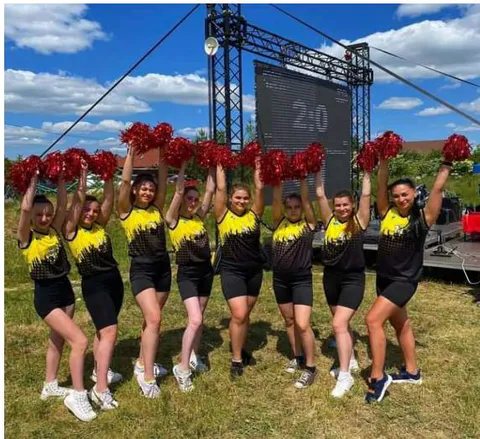
The authors are united by the reasoning that creativity is a leading cluster on the path of priorities in the lives of young people. Focusing on cheerleading as a connection between dance and sport, we note that beauty and femininity are combined with strength, physical endurance and sensuality, movement culture and artistry, a sense of music and rhythm. During the long evolutionary path, cheerleading was enriched with life and artistic materials, thus changing and forming new means of expression in the system of dance culture. Even today, cheerleading is not only entertainment, but also a serious sport with a powerful aesthetic load.
Considering cheerleading as one of the historical ways of searching for the spirituality of an individual, in the scientific study of O. Shiyan, the emergence of sports dance is described in detail and this phenomenon is initially connected with football. Mostly in the universities of the USA at the end of the 19th century, student youth united with the aim of organized support for their sports team.
IV. THE PURPOSE OF THE ARTICLE
To reveal the cultural potential of dance in substantiating the expediency of searching for ways of personal spirituality.
The beginning of the 20th century formed the concept of sports dance directly demonstrating dexterity, flexibility, speed, endurance before football matches. To interest the spectators in the stands and the players on the field, the cheerleaders used special exclamations-recitatives. Later, similar youth groups appeared in many American universities. So guys with a sports physique (with a full set of physical corrections) demonstrated all new techniques and elements. In 1923, on the wave of feminism, girls were involved in teamwork. By the middle of the 20th century, boys were completely replaced. In the middle of the 20th century, aerial jumps and head-down splits with rhythmic musical accompaniment proved the complete interaction of dance culture and sports. Currently, the total number of sports dance participants exceeds several million people, mostly girls accompany sports competitions in basketball, football and other sports (Shiyan, 2013).
V. PRESENTING MAIN MATERIAL
Obviously, the laws of understanding the world (dance culture) regulate the balance between ethics and aesthetics, the rhythmoplastic basis and technical means, popularizing cheerleading as a type of dance culture, as a way to find the spirituality of an individual. The All-Ukrainian Cheerleading Federation has been active since 2004. In the regions of Ukraine, sports competitions are held in stadiums and sports halls with the support of a team of girl cheerleaders who, not only rhythmically, but also with chants and recitatives encourage athletes to victory. Since 2005, cheerleading championships (competitions) have been held annually in two categories: cheer and dance. The trends of cheerleading shorok have similarities and differences - the technique of performing some elements, evaluation criteria, species diversity of performance programs. Potentially, cheerleaders are a driving force in the canvas of sports competitions or mass sports and cultural events.
The decisive emphasis at the stadium or on the sports ground is not only the ability of girls to demonstrate cheerleading in colorful costumes, but also to use props - pompoms, megaphones, posters, logos of trade marks, etc. Cheerleading creates a favorable psychological climate in the stadium, softens the aggressive mood of the fans, and sometimes manages the emotions of the spectators.
This ideology of the support group creates a favorable "weather", raises the fighting spirit of the team, ensuring the spectacle of the show programs.
Cheerleading is primarily a collective effort, the effectiveness of which depends on the contribution of each athlete. Performing acrobatic pyramids and stunts, young people demonstrate a high level of organization, personal confidence, discipline, flexibility, empathy, and creativity. The team performance of complex elements requires demandingness, perseverance, determination - without which it is impossible to win over yourself and the sports team supported by the cheerleaders. Cheerleading, as a type of dance, is an effective means of physical culture and education, contributes to a high quality of influence on the human body and the formation of personal harmony.
Yuliya Shushpanova substantiates in a scientific study that in recent years, against the background of the intensification of the educational process in higher educational institutions, there is a tendency to decrease the amount of motor activity of young people, which negatively affects the indicators of their physical condition. However, the lack of motor activity of student youth is mostly a social and not a biological phenomenon, and therefore should be compensated by regular physical exercises and health training. This puts on the agenda the issue of improving the current system of physical education at the level of interaction with dance culture, increasing the motivation of students to engage in physical culture and sports, transforming the content and structure of traditional academic classes in physical education, introducing such forms of student activity that ensure the development of endurance and other physical indicators. In addition, they contribute to the improvement of motor skills, coordination, sensitive sphere, positive self-perception, creative activity, sense of rhythm, memory, attention, etc. The scientist emphasizes the specifics of the significance of the development of these qualities for young people (girl students) both for the implementation of professional duties and during the period of preparation for performing the reproductive function and education (Shushpanova, 2017: 73).
Since dance has both educational and educational significance in the mechanism of creating the valuable potential of youth, cheerleading can be justified as a path to spirituality. At the same time, dance instills love for art and encourages physical perfection: a slender posture, lightness of movements, and grace are formed. It should be noted that music also strengthens the ability of young people to reflect the subtletest shades of spirituality in the problems of individual life space. Thus, the surrounding world is a source for culture and knowledge of its reality. This is caused by changes in the philosophical and aesthetic paradigm of spiritual development, shaping the cultural thinking of an individual.
To this day, modern trends in choreographic art are being normalized, which encourage new searches. And the use of modern technologies in the model of cultural reproduction contributes to the formation of the spiritual potential of young people. At the same time, now the introduction of cheerleading dance into the educational process of the university actualizes the professional opportunities of artists to apply various movement exercises in practical classes. Considering the above, the dance is projected as a synthesis of the creation of plastic movement against the background of the priorities and ideals of the person who "creates" the dance.
Demonstration of the ideals and values of culture by means of dance at all times contributed to its deep understanding and built the worldview and aesthetic connections of a person with a certain social environment. This is stated in the writings of leading culturologists, art critics, teachers and athletes who actualize spirituality as an important necessity for the characteristics of young people in the conditions of modern civilizational pressures and threats.
In particular, in accordance with the principle of value determination of culture, spiritual priorities are an incentive for the actualization of traditions, under the influence of which the life world of an individual is enriched. Values are derived from the human attitude to the world, which once again proves: without a person, value cannot exist, and vice versa. This confirms the thesis that spirituality has a humanistic origin and the meaning of being. At the center of the spiritual paradigm are the ideas of humanism, which affirm the concept of a whole person. This is how spirituality is a superstructure in the content and method of affirming the universal values of culture and art. Undoubtedly, nowadays cheerleading is important and necessary in the context of the "reevaluation of values" (according to F. Nietzsche), not only in the sports or dance space, but also as a phenomenon that demonstrates an epoch-making cipher of the understanding of dance culture.
After all, culture as a phenomenon of cultural memory about spiritual ideals, as a phenomenon, powerfully fulfills the role of preserving and transmitting information from generation to generation through various symbolic systems.
The understanding of dance balances between a scientific concept and is paralleled primarily with plastic expressiveness, because in some places dance demonstrates meaning and content mostly in movements, rather than in words with a content full of culturally significant information. The specified thesis can be substantiated by various aspects, namely, to outline the path of the individual's spirituality by the trajectory of scientific pulsations of semiotics, linguistics, symbolism, phenomenology, textology.
Thus, semiotic substantiation involves the accumulation and preservation of the flow of information, hence its transformation into a system of spiritual basis. That is, the cheerleading dance contains signs and texts that interpret cultural phenomena with the help of physical practices, logical ideas about physical culture, the cultural orientation of thinking provoked by the body, hence the ability to convey the accumulated experience with the amplitude of certain movements in a symbolic form. It is in the semantic field that the information embedded in the deep structures of spiritual culture and its transformation into a system of symbolic elements is accumulated, normalized in the text.
In view of this, dance culture is the embodiment of the multifaceted essence-content basis of the spiritual personality. In dance, personality finds its own expression in the ability to communicate, therefore the natural phenomenon of semiotic justification accompanies the rhythm and plasticity of the human body. This is how communicative abilities are realized, which make it possible to express not articulated language, but to model the inexhaustible essence of choreographic art.
Linguistics of the text, as an aspect on the path to spirituality, forms the rules for building a coherent text and its semantic categories. She deals with finding out the deep meanings contained in a certain text. In the paradigm of the humanitarian sphere, the text (image of dance) is considered as an important means of embodying and consolidating the achievements of the human spirit. Thus, from high-quality communication between the text and its deciphering, dance is able to form the mental structures of the individual (the inner world of a person).
Symbolism in cultural studies is the key to the culture of all mankind. We are impressed by the concept of the nature of the symbol of E. Casirer, who considered symbolization as the main function of human consciousness. Therefore, we consider the symbol as a cluster of expression of a part of the universe, where the symbol directly progresses, demonstrating the physical activity of a person (in our study, dance). At the same time, I. Kant closely connected the symbol with beauty (beautiful image, high morality). A symbol in art carries within itself the relationship of communication with aesthetic pleasure. The ascending symbolism of the dance requires understanding and perception by the soul.
Phenomenology. The problem of dance corporeality separates the "natural body" and the "cultural body" and their communication at the level of a method of meaningful communication - a cultural phenomenon. Since phenomenological phenomena acquire an essentially substantive basis, functioning thanks to the combination of choreography, music, singing, sports, etc. Such language of dance inevitably organizes the interpretation of the text of the dance drawing. In this case, the text decodes ancient, traditional information embedded in cultural structures.
Textology (interrelation of plastic and literary) in dance culture is mostly focused on the interpretation of the text, in which the stylistic features of the artistic text actualize the vocabulary of a certain dance, form the ability to express the expressive possibilities of the artistic and plastic text, convey the idea of the work based on emotional and aesthetic ideas. Textology in dance culture enables a universe in which dance opens up opportunities for the artistic reasoning of the author-ballet master, shapes his worldview, models the spirituality of the individual (the dance performer) on the laws of worldview, individuality - this is how history, culture, philosophy is studied and causes the need for a cultural study of dance culture. No text can be used in a dance performance until it is given a logical explanation of certain circumstances, history, and culture.
In Latin, textum means connection. An author's work or a document reproduced in writing or in print (according to P. Herchanivska), in semiotics and linguistics, is a sequence of signs that form a single whole (Herchanivska, 2015: 179).
VI. CONCLUSIONS
So, cheerleading in modern time-space fulfills various roles of an educational, physical, and aesthetic nature. Mastering the dance culture of cheerleading promotes interest in the artistic and aesthetic priorities of young people and their spiritual motivation for the harmony of life creativity. That is why it is important to understand the dance culture as a truly important trend that contributes to the individual's approach to self-improvement and understanding of one's own significance in society. This requires active involvement of her, the individual, in the field of cultural, sports and educational activities, which will become an effective way of improving the personal social climate, moral and ethical priorities based on age-old traditions.
Dance culture is an important component of spiritual culture, contributes to the full formation of a worldview, as a kind of universal way of integrating cultural meanings in the search for ways into the spiritual world of an individual.