
1. Introduction
1.1 Analyses of Dào dé Jing
We may identify Dao De Jing (DDJ---note 1), e.g., first line 道可道 非常道 as (near-spiritual or religious) thought experiments, (S/R)TE, paradigmatic like Descartes' Cogito, for originated in time of crisis, starting off a new era and still famous today as initial text of Daoism, to whose interpretation, as an ancient philosophical or religious text, application of procedure of hermeneutic circle as well as its logical criticisms may be fruitful (see Part I of research into DDJ, Hertogh 2026b). We may shortly show how the enthymematic first line 道可道 非常道 may be completed to valid modus ponens by explicitating (e.g.) the core of Ch. 35 as its major.
The analyses we propose don’t pretend to be the only possible logical resolutions, more analyses are possible, possibly starting from different versions and translations of DDJ, or from different interpretations of the same chapters and aphorisms (it is congruent with pluralistic philosophical assumptions as Goodman’s and Quine’s---see Hertogh 2020).
We propose three types of logical formalizations, the first (Section 1), applying to simple oppositions, showing there is no attempt to breach any logical laws in DDJ, the second (Section 2) which may apply to complex oppositions, applying predicate logic, deriving major (part of argument) from elsewhere in chapter or DDJ text, or more Chinese classics as Analects, I Ching (Yi Jing in Pinyin) and Zhuangzi, and the third (Section 3), a modal logical interpretation, applying modal logical box and diamond operators, and Kripke-style model of triple set of possible worlds, accessibility relation and satisfiability function.
Next (Section 4), we discuss logical interpretations of concept of wuwei as (double) negation which could simplify traditional translations to a high extent.
Lastly (Sections 5, 6, 7), we add results of literature studies on ecological turn (Jinghui Wang, Ellen Zhang---Section 5), ecocriticism and ecofeminism (e.g. Qingqi Wei referring to Pauli Murray, Stacy Alaimo, Greta Gaard et al.---Section 6), provisionally concluding, e.g., that (sexist, racist etc.) mistakes of western logic, science, technology etc. can’t be denied anymore and need to be reversed and revised from a global cross-culturalism and environmental pragmaticism perspective, but that we could hold on to binary logic, possibly basically derived from and corresponding to yīn and yáng, possibly including noncoercive, holistic, mutualist, reciprocal, intersectionalist etc. interrelations.
Feminist ecocriticist literature may lay bare maternalist and ecological nature of DDJ, whereby logical analyses as applied by TE Matrix methodology may contribute to transparency of these main aspects of the text, e.g., use of opposites may reveal preference for “abiding by the soft” (e.g. Din Lau 1958); wúwéi may be understood as “living in harmony with nature” (Jinghui Wang 2018); and broader yīn yáng rationality, exemplified in ecofeminist concepts, such as water (e.g. Joseph Needham 1956, Shannon Lee 2020), ziran-wúwéi (e.g. Tim Jenkins 2002, Ellen Zhang 2023), androgyny (e.g. Roger Ames 1981, Pauli Murray 2007), vegetarian ecofeminism (Greta Gaard 2002), which has been visualized in well-known yīn yáng diagram, e.g. symbolizing “subcontrariety quantification” (e.g. Jean-Yves Béziau 2012).
2. Logical Analyses
Simple oppositions don't violate logical laws.
There are some examples of linguistic opposition in Ch. 2, which may be considered as concerning mainly (reducible to) predicates
beauty vs. ugliness
kindness vs. unkindness
difficult vs. easy
long vs. short
high vs. low
front vs. back
(from Ch. 36 Donia Zhang 2022)
As Lau 1958 observes yīn and shēng (e.g. sound and speech, or Legge’s musical notes and tones) is not like a simple opposition---is “hardly of the same type as … good and not-good, beautiful and ugly” (Lau 1958, 347n2), who goes on to discuss different types of oppositions as gradual vs. abrupt (see note 2).
Oda and Zheng 2023, 2024 propose a generic predicate logical formula involving conjunction to express contradiction where (inclusive or exclusive) disjunction may do, like this
which describes relations “within an ultimate and universal set of Dao (x)” as on a pluralist view of Dao (e.g. “myriad things” see also e.g. Fox 2023), but not particularly contradiction, rather, e.g., exclusive or inclusive disjunction, possibly depending on type of (semantic) opposition. (cf. Oda and Zheng 2023: 1 note 2)
There are many more oppositions, or pairs of opposites, semantically speaking antonyms, in DDJ--- in different grammatical forms, e.g. verbs
to shrink vs. to expand
to weaken vs. to strengthen
to abolish vs. to promote
to take vs. to give
(from Ch. 36 Zhang 2022)
which are part of what is called “the subtle sign, the weak overcomes the strong” (Zhang 2022), “Hiding the light (of his procedure)/The soft overcomes the hard; and the weak the strong” (Legge 1891), “subtle discernment: The submissive and weak will overcome the hard and strong” (Lau 1963).
And predicates again
Therefore, the ancients wrote:
The bright Dao looks dark;
The Dao forward looks backward;
The smooth Dao looks rugged;
(Ch. 41 Zhang 2022; “even” and “rough” e.g. Lau 1963 are synonyms of “smooth” and “rugged”)
From different realms of reality, including (social) values, virtues vs. vices, e.g., balancing ups and downs of life
Misfortune is where good fortune rests;
Good fortune is where misfortune hides
Who knows whether it will be misfortune or good fortune?
There are not established standards.
Good suddenly turns into evil, kind suddenly turns into cruel,
(Ch. 58 Zhang 2022)
Ethical values that collapse into their opposites when describing the way of the sage or good ruler
So it is that the sage (ruler), wishing to be above men, puts himself by his words below them, and, wishing to be before them, places his person behind them.
(Ch. 66 Legge 1891; “lead” and “follow (behind)” e.g. Lau 1963 are synonyms of “be before” and “be behind”)
This interpretation is consistent with logico-linguistic interpretation as offered in Zhuangzi paper (Hertogh 2024) where we discussed, e.g., interdependency of opposites as after Zhuangzi’s wuhua (物化) in Butterfly Dream. From perspective of studies of Zhuangzi the pairs of opposites may be interpreted as exemplifications of the principle of interdependency of opposites (e.g. wuhua) as between many more opposites, e.g., few/many, small/great (Ch. 34), thick/thin, highest/lowest virtue (Ch. 38), bright/dull, forward/backward, even/rough (Ch. 41) etc.; the interdependency is phrased and explained in different ways, e.g., as “subtle discernment” regarding shrink/stretch, weaken/strengthen, lay aside/set up, give/take in Ch. 36 (“This is called subtle discernment”), or “the blending of the generative forces” regarding yin/yang (Ch. 42) (trans. Lau 1963).
DC Lau discusses DDJ oppositions at length in ‘The Treatment of Opposites in Lao Tzu’ (1958) and tries to explain them as slightly different from hexagrams and principle of constant circular change in I Ching, as (e.g.) “valuing the soft,” “abiding by the soft.”
3. Explicitating of Aspect
Complex oppositions may be analyzed by TE methodology of TE Matrix, which in this case comes down to explicitation of an aspect, or point of view, relevant context of comparison, (thematic) dimension etc. (note 3) It may remind of Jacques Derrida “il n'ya pas de hors-texte” (Derrida 1967, e.g. “there is nothing without context”), or Wittgenstein's 1953 contextualism (e.g. Vaidya 2023). The Chinese signs of the first two lines of DDJ are the same in traditional and modern Chinese, we quote Chinese text and English translation from Zhang 2022, who uses modern Chinese transcript (different from traditional in e.g. wuwei); Hanyu Pinyin (including tone marks) is derived from, e.g., Wikibooks. The title of the first chapter is omitted (like titles of all DDJ chapters in this paper) since translations vary widely, e.g., ‘Embodying the Dao’ (Legge 1891), ‘Reason’s Realization’ (Suzuki and Carus 1913), ‘What is the Dao?’ (Goddard 1919)
道 可 道 , 非 常 道 ;
名 可 名 , 非 常 名 。
(Chinese characters e.g. Zhang 2022)
dào kě dào fēi cháng dào
míng kě míng fēi cháng míng
(Hanyu Pinyin e.g. DDJ 2020 Wikibooks)
The dao that can be said is not the true Dao;
The name that can be called is not the real Name.
(trans. e.g. Zhang 2022)
In the literature we find a great variety of translations, e.g. of chang, and views on which translations are most appropriate, e.g., Fox 2023 refers to Boodberg 2007
常 cháng,
constant,'regular,'common,'ordinary,'persistent,'conventional,'enduring,' never meanteternal' or `absolute' in our sense, as wrongly used by so many translators of the first couplet of the Lao Tzu.
(Boodberg 2007: 603)
Apart from these translations we have found “unvarying” (e.g. Waley 1958), “uncharted” and “nature” (e.g. Blakney 1961), “nature” and full expression or representation (e.g. Bahm 1958), “immortal” (e.g. Red Pine 1996), “everlasting” (e.g. Yang 1962), “common” and things instead of names (e.g. Xu 2006), “unchanging” (e.g. Richter 1998), “permanent” (e.g. Duyvendak 1954), “true” and “real” (e.g. Zhang 2022), “perennial” (e.g. Ryden 2008). We will take no side in the debate and propose logical analyses for both, let's say, secular philosophical and (possibly westernized or Christianized) metaphysical religious positions by use of respectively classical logic and modal logic. (note 4)
Our provisional formalization derived from proposition logic is rather complex, saying Dao under aspect a, is not equal, identical (with respect to, say, ) to Dao under aspect b
A second formalization applies TE methodology and tries to find relevant aspect, explanation in more lines of the chapter or parts of the treatise, and was eventually successful in discerning, let's say, major of incomplete argument of first line in Ch. 35
When the Dao is spoken out,
it becomes plain and tasteless,
One can not see it, nor can hear it,
but its effects are endless.
(Ch. 35 – Zhang 2022 – note 5)
After exemplifying missing part of the argument, the analysis may be completed with help of predicate logic, where it appears the missing part is the major of the argument, generalizing the individualized statement of the first line
(2)
Suppose
Table 1: Symbols and Explanations
| Symbol | Explanation |
|---|---|
| x is (true) Dao, lit. x Daos | |
| x is not (true) Dao | |
| x can be said, spoken, or have any other perceptual property |
Deriving major from context or theory, in fact one (more) passage(s) from same treatise DDJ, e.g. Ch. 35 (note 6) as on an individualized reading of the first line dao ke dao … ( - Chinese grammar does not distinguish between singular and plural, concrete or abstract here)
We may generalize from constant a to variable x, i.e., from to , as after John Norton 1991 definition of TE, where there is an inductive step from particularity of (TE) premise(s) to generality of conclusion
Thought experiments are arguments which:
(i) posit hypothetical or counterfactual states of affairs, and
(ii) invoke particulars irrelevant to the generality of the conclusion.
(Norton 1991: 129)
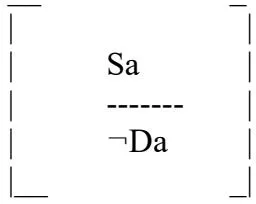
The core argument may be simplified to modus ponens instantiation as after Carnap 1966 (see Hertogh 2016, where there are similar TE analyses of Descartes' Cogito)
(3)
on which interpretation dao ke dao fei chang dao appears as minor and conclusion to major as derived from Ch. 35 and the original TE may be displayed like a bracketed TE argument (cf. Descartes' Cogito).
It is not just about imperceptibility, as some translations may suggest, in the sense of inaccessibility by the five senses, for which there is support in Ch. 35 but also Ch. 14 (note 7), since the strongest formula is “is spoken,” whereby also possible nonsensuous perception and religious interpretations are included as, e.g., Dao as a Godhead may be an abstract entity that is not directly accessible to the five common senses (like metaphysical entities as substance but also virtue, humility, simplicity etc.) but that can be spoken about. Many religions may contend their Divine entity is accessible by indirect and/or nonsensuous perception, that goes beyond the Humean direct sensuous perception, as in visions, prophecies, miracles, signs etc., possibly mediated by supernatural agencies or the Divinity itself (in secular terminology these phenomena are partly covered by ESP, extra sensory perception, such as telepathy). Next, it may be a mode of perception that goes beyond words, discursive reasoning, logic as in meditation, Kōans and Huàtóus, where the words only point at a next level that is not expressible in words, nor accessible by logic, discursive reasoning and so on (in western religions e.g. emotivism). The latter interpretations may also go beyond the limits of religious TE, RTE, that are derived from phrasings and passages in religious texts.
Nevertheless, as we have argued in analyses and interpretations of STE as Vipassanā Meditation (Hertogh 2018), Kōans and Huàtóus (Hertogh 2021), logic may take us further than often suggested and above logical analyses are to be understood in this vein. Besides, above logical symbolization may capture a manifold of nonmetaphysical and nonreligious interpretations of DDJ.
4. Modal Logic
When considering the second part about essential Dao and Name, “essential” may be logically translated as “necessary,” with help of modal logical box operator or by quantification over all (possible) worlds (e.g. Kripke-style models).
As with help of modal box operator e.g.
is Dao is not equal to is necessarily Dao.
Additionally suppose:
is/has a Name
is a name is not equal to is necessarily a name.
Or with help of Kripke semantics, supposing model , where is a nonempty set of (possible) worlds, is a satisfiability relation that assigns subsets of to propositions, and is a binary accessibility relation () saying which worlds are accessible to which worlds, e.g.
is Dao in the actual world () is not equal to is Dao in all (possible) worlds.
Binary accessibility relation is to be understood in a descriptive semantics view mode --- not as a forcing prescribing relation as related to a prescriptive formal valuation function --- that can't be given in advance unless one has already decided on type and content of interpretation, which is however quite cumbersome and is rather to be expected afterwards than beforehand. may be described after, as on a set of possible worlds (PW) as a search engine on a DDJ database (or Google, Google Scholar, Baidu etc.), when PW may be defined as (elementary) parts of theories, theoretical constructs, scientific scholarly propositions that may be used as premises or conclusions in logical analyses and arguments. As the PW of parts of (TE) arguments (premises and conclusions) pick out accessible PW (as from axioms to principles) unto an argument is both formally and informally logically validated (i.e. logical inference is valid, premises and conclusions are true --- so, argument is sound), we don't need to prescribe any forcing formal valuation function nor accessibility relation.
Equations (4) and (6) may go against an axiom of modal logic (e.g. Kripke 1959: 1, Axiom 1)
since equals .
So, we should change (4) into
which could be a likely candidate for a modal logical interpretation of first line in translation like dao (e.g. that may be said) is not necessary (possibly real, essential etc.) Dao as e.g. distinguishing an actual instantiation of dao from necessity, reality, essence of Dao.
And we should change (6) into
5. Wúwéi (Double) Negation
Do things in accordance with nature,
Then the world will be well governed.
(Ch. 3 – trans. Donia Zhang 2022)
Wuwei (or wu-wei, trad. Chin. 無 為, mod. Chin. 无为 , Pinyin wúwéi) may be literally translated as “not” (無) “to do,” “to act” (為), e.g. as “non-action” (e.g. Liu 1991, Moon 2015), modified into variants as “effortless action” (e.g. Slingerland 2000, 2003), “actionless action” etc., which latter term is itself contradictory. The concept is considered to have originated in DDJ, but it is also used in Confucianism and (Zen) Buddhism, where it may signify, e.g., non-attachment. Many authors consider wuwei a core concept of DDJ and Daoism. E.g. Loy 1985 considers wuwei “the central paradox” of Daoism.
Wei-wu-wei, ‘the action of non-action,’ is the central paradox of Taoism and as a concept is second in importance to the Tao itself, which incorporates it ...
(Loy 1985: 74)
And Hansen 2007 in SEP considers wei and wuwei (無 為 deeming action and non-deeming action) one of the important Daoist concepts (among more, like Dao 道 Way, Guide, Road, De 德 Virtuosity, Virtue, Power, ming 名 name, chang 常 constant, eternal, pu 樸 pre-linguistic purity).
Checking a variety of translations and comments, wuwei and its paradoxical statements in DDJ (e.g. in Ch. 3, 37, 38, 43, 48, 57, 63, 64 in Legge 1891 Chinese Text Project) may appear a problem of negation and double negation.
Law (or principle) of double negation is one of the basic logical laws (or principles), next to law of identity (LID ), law of excluded middle (LEM ), law of noncontradiction (LNC ) as acknowledged by, e.g., Russell and Whitehead in Principia Mathematica
This is the principle of double negation, i.e. a proposition is equivalent of the falsehood of its negation.
(Russell, Whitehead 1910-1913: *4.13 – negation sign updated)
However, we could expect, analogous to our view on oppositions, that it is not about strict contradiction (formalized with help of conjunction) but about contextualized (exclusive or inclusive) disjunctions, that is is not a logical but rather a rhetorical device, e.g., not a meaningless semantic formal contradiction, but rather an emphatic pragmatic colloquial linguistic confirmation, like there ain’t nothing, meaning 'there is nothing,' instead of 'there is not nothing,' possibly meaning 'there is something,' or on a modal view 'there is possibly something/anything/everything.'
On this interpretation the so-called paradoxes may loose their mystery and change into (emphatic) tautologies rather than contradictions, e.g. Donia Zhang 2022, who translates wuwei as non-action contrary to nature (e.g. Ch. 43 twice, 45, 47, 48 twice, 57 no action ..., 63, 64), i.e. action not contrary to nature, action in accordance with nature, natural law, or
non-action contrary to nature
no action contrary to nature
all action(s) in accordance with nature/natural law
which view occurs in DDJ again and again, with and without contextual mention of wuwei, which may be understood as an ecological mantra nowadays.
Interpretation of reference to natural law, nature is confirmed by e.g. Moon 2015
…. Away from its literal meaning of inactivity or taking no action, wuwei refers to not taking action that is against Natural Law. That is, letting Natural Law take its own course is important....
(Moon 2015)
We may agree on Zhang's univocal near-tautological translations of, e.g., Ch. 3 and Ch. 64, which some comments may consider paradoxes and some translations (as Legge 1891 and Lau 1963) render incomprehensibly abstract and mysterious
Do things in accordance with nature,
Then the world will be well governed.
(Ch. 3 – Donia Zhang 2022)
instead of Legge's underdetermined and abstract
When there is this abstinence from action,
good order is universal.
(Ch. 3 – Legge 1891)
and Lau's mystifying adagial advice
Do that which consists in taking no action,
and order will prevail.
(Ch. 3 – Lau 1963)
Zhang 2022 translation of Ch. 64 reads like a tautology
And they [the sages] follow the natural laws with non-action contrary to nature.
(Ch. 64 – Donia Zhang 2022)
rather than incomprehensible translations like Legge's
This is because the saint has no reason and is undefeated.
(Ch. 64 – Legge 1891)
and Lau's still using unexplained and possibly inexplicable metaphysical terms from the first chapters like “myriad creatures”
In order to help the myriad creatures to be natural and to refrain from daring to act.
(Ch. 64 – Lau 1963)
The 19th-century “very capable” but “a bit pedantic” translations by James Legge et al. are criticized by John Bruno Hare, founder of Internet Sacred Text Archive (ISTA) in 2004, recommending Dwight Goddard's translation instead, that, however, still is quite impenetrable
…. The concepts of Taoism are very lucid, and wrapping them in too much verbiage, as Legge et al did, add an unneeded layer of obscurity....
The Chinese have developed (formal) logic in Mohism (see e.g. Mozi 2006--2026, Mei 1929, Liu and Zhang 2010, Liu and Sun 2020, Hansen 1983). If, and in as far as, rhetoric and informal use of logic in DDJ may have affected Mohist logic (and possibly vice versa in later editions of DDJ as in Neo-Daoism) goes beyond the scope of the present research, but may possibly change some of the outcomes of TE analyses and interpretations.
We mention only one related example here, Gongsun Long (孙 龙 公 ca. 320-240 BCE) paradox
白馬非馬
pai ma fei ma
white horse is-not horse
(Gongsun Longzi/White Horse Discourse (320–250 BCE), e.g., #1, #4, #14--quoted in Hansen 1983: 140; trans. Donald Sturgeon (“) a white horse is not a horse (”))
which shares negation fei (非) with first two lines of DDJ. It is discussed in, e.g., White Horse Discourse (白馬論 see at Gongsun Longzi in references), which could be considered sophistry showing the limits of logic and reason, of which Wittgenstein could have said “{Now you are only playing with words}” (Wittgenstein 1953, #67 -- see also, e.g., Fraser 2024, Harbsmeier 1998, Indraccolo 2016, with regard to the White Horse Discourse). Slingerland 2000 shows wuwei is unlikely to be understood in a relativistic, sophistic way as it has a long history in Chinese philosophy, from the (noble warrior in) Book of Poetry (詩經 Shījīng 11th–7th cent. BCE) to (the virtuous sage-ruler in) Confucianism of Xunzi (荀子 ca. 310–238 BCE), and in the sense of “try not to try,” it is, apart from political contexts, about how to acquire spiritual ideal of self-cultivation, either spontaneously in Daoism (“not to try”) or by training in Confucianism (“try”).
6. Ecological Turn
In Hertogh 2024 about Zhuangzi’s Butterfly Dream and Happiness of Fish (Zhuangzi 2006–2026, Ch 2 #14, resp., Ch 17 #13) we have inferred to presupposition of animal consciousness, and found confirmation of this assumption, e.g., in cosmocentrism and vegetarian tendencies of Daoism, and we could conclude as with Komjathy 2021 that Daoism shows that humans may learn emotions from animals, such as flying from birds and butterflies and happiness from fish. Jinghui Wang in a 2018 contribution to a special issue of Comparative Literature Studies on ‘Ecocriticism in East Asia: Toward a Literary (Re)Construction of Nature and Environment’ finds a “typical example that shows how Dao De Jing advocates learning from nature” (Wang 2018: 817) in Ch. 8
Water is good at nourishing everything and not competing with anything.
It stays where no one likes to go, so it is closest to the Dao.
(Ch. 8 trans. Donia Zhang 2022 --- note 8, 9)
Wang translates wuwei as “being water and nonstriving,” where nonstriving “actually goes together with the essence of ‘being water’” (Wang 2018: 818 - note 8) and emphasizes DDJ view of “living in harmony with nature,” to “form a harmonious orchestra with nature,” going “beyond consumption orientation, industrialization, urbanization, or even science and technology” (Wang 2018: 822)
… Ecologically speaking, the water metaphor in Dao De Jing does reflect the working of Dao, and symbolically speaking, this metaphor represents a very naturalistic and sustainable philosophy which has affected numerous writers, including poets … Their poems are evidences proving that the Daoist ecological motif has contributed tremendously in ancient Chinese people’s forming of the simple Daoist ideal of governance without interference (wu wei er zhi) … and at present, this metaphor still has the potential of functioning as an ideal ecological example to show the invincible power of the noncoercive and reciprocal application of Dao.
(Wang 2018: 822)
Needham 1956 in chapter on Daoism discusses the water symbol together with the feminine symbol in one section under the heading of Daoist approach to nature and psychology of scientific observation
The observation of Nature, as opposed to the management of Society, requires a receptive passivity in contrast to a commanding activity, and a freedom from all preconceived theories in contrast to an attachment to a set of social convictions. This is the sense (though doubtless not the only sense) in which we may interpret the symbols of ‘water’ and ‘the feminine’ so dear to the early Taoist schools and so perplexing to later commentators. …
(Needham 1956: 57)
Ellen Zhang on “greening” of Daoism adds an interpretative reconstruction of ziran-wuwei “that is relevant to environmental or ecological concerns.” Ziran (自然 --- zi, 自, meaning nose or self, and ran, 然, meaning suchness), appearing five times in DDJ as in Ch. 5, 17, 23, 51, 64; translated (by Waley 1958) as, e.g., self-so, natural(ly), spontaneous(ly); (by Donia Zhang 2022) as natural (laws); (by Pinghua Liu 2024) as self-arising nature of things, and Principle of Naturalness (vs. Dao’s The Way Beyond Words and Wuwei’s The Art of Non-Action).
Next to possible political meanings of wuwei (“governing without governing,” possibly motivated by “Laozi’s disapproval of any aggressive policies such as war, cruel punishment and heavy taxation” Ellen Zhang 2023: 76), wuwei is rendered as “acting naturally,” reminding Donia Zhang’s acting in accordance with nature, and, e.g., Jenkins allowing to take ziran and wuwei as “guidelines for an environmental ethic” (Jenkins 2002: 42-43), Ellen Zhang eventually opts for a ziran-wuwei ethics herself confirming possible green tendencies in Daoism, concluding
… Daoism can be reconstructed as a wake-up call and an ethical framework to accommodate our reflection upon the human relation with the natural world in the face of an environmental crisis caused by an over-emphasis on human achievement and domination over nature.
(Zhang 2023: 90-91)
7. Ecofeminism and Androgyny
Dao De Jing is well-known for its feminine and maternal nature (see e.g. Chen 1969 “mother principle,” Needham 1956 “very exaltation of the ‘Valley Spirit’,” Lai 2000 “contemporary feminist thinking,” Li 2000 “women’s movement and … status in China”) e.g.
Nameless was the beginning of heaven and earth;
Naming is the mother of all things.
(Ch. 1 – trans. Donia Zhang 2022)
The Dao that gives birth to all things
Is empty and eternal like the God of Valley,
It is called mysterious maternity.
The birth gate of the mystic mother’s fertility
Is called the root of heaven and earth.
It seems to exist continuously,
And its effects are endless.
(Ch. 6 – trans. Donia Zhang 2022)
Studies of ziran, wuwei and DDJ as a whole may now add ecological features as harmony between humans and nature of Planet Earth. We’ll discuss some ecofeminist research, ecofeminism as coined by French writer Françoise d’Eaubonne in 1974 (d’Eaubonne 1974/2022)
... an attempt at synthesis is possible between two struggles previously thought to be separated, feminism and ecology .... we need urgently to remake the planet around a totally new model. This is not an ambition, this is a necessity; the planet is in danger of dying, and we will die along with it.
In Wei 2018 Qingqi Wei explains ecofeminism with indigenous Chinese characteristics, basing it in “ancient Chinese ecological wisdom particularly found in Daoism,” blending it with ecological holism---Laozi establishes Daoism from concept of ziran (spontaneous being or nature), “ardently commends yin’s feminine power,” explains “wu wei or noninterference has exerted great influence on the way of life and way of thinking of Chinese people from all walks of life,” different from western way of life its love of nature is “pantheist and harmonious,” “not conceived of as forever struggling against Nature but forming part of it,” and ecofeminism as nonbinary and intersectional “trans-corporeality” (Stacy Alaimo), Nancy Tuana’s “viscous porosity” and Terry Williams’ “porous” quality, “both laying emphasis, much like the Dao’s qi, on the way the boundaries between subject and object is being abrogated…” (Wei 2018: 775). Ecofeminism emphasizes connection between femininity and nature, equality of morality (Greta Gaard’s vegetarian ecofeminism, “surely feminism’s third generation”)
... [Daoist] intuitive methodology has long been blamed by many for hindering the development of science and technology, including Lin [Yutang], who attributed China’s lagging behind in the development of natural science to ancient Chinese philosophies and their focus on elusive terms such as the Dao and benevolent governance. But after the eruption of ecological disasters that are at least partly due to the overuse of science and technology for the growth of economy and consumerism, environmentalists and ecofeminists have been reflecting upon the limitations of the scientific methodology and revaluing the holistic and intuitive way of thinking.
(Wei 2018: 779)
We can’t agree on this for we hold that DDJ like Confucianism, (Zen) Buddhism, Christianity, Judaism, Islam etc. is not illogical, irrational etc. and may be comprehended as consistent with classical logic, if not modal logic, like we are about to show in this research. We were assuming that DDJs conundrums would breach basic logical laws, such as LNC, LID, LEM, but our research is not confirming these assumptions and shows that the enigmatic statements may initially be looking like incomprehensible paradoxical enthymematic thought experiments, that however may be completed to valid and sound arguments using our TE Matrix methodology (see above examples, first line is modus ponus instantiation exemplifying core of Ch. 35, wuwei statements are not apparent paradoxes but seeming paradoxes, e.g., not contradictions but, in fact, tautologies). Different from what Wei and more commentaries may suggest—China was and is in high economic and scientific esteem with, e.g., the Four Great Inventions, that preceded western inventions. West and East now acknowledge China was the first to invent printing press, gunpowder, fireworks, paper, compass, smallpox inoculation, mechanical clocks, suspension bridges, silk, etc. In mathematics the Chinese Gougu Theorem (勾股定理) or Shang Gao Theorem (商高定理 - 11th cent. BCE) may have predated the Greek Pythagorean Theorem (see e.g. Han version Zhoubi Suanjing 周髀算經). Postmodern scholarship has criticized, reversed and revised Eurocentric patriarchal views, and updated global cross-culturalist, environmentalist and egalitarian histories of science and logic.
But we do agree that DDJ and ecofeminism may come to the rescue from an ecological apocalypse, e.g., may help to replace patriarchy by (ecofeminist) androgyny (see also e.g. Ames 1981 “androgynous ideal”), as Wei quotes from Pauli Murray
It is therefore not serendipitous for Pauli Murray, one of the leading American feminists to imagine and realize that ‘an androgynous society is vastly superior to a patriarchal society,’ … and that it may ‘well hold the key to many of the complex social issues for which we do not now have answers.’
(Wei 2018: 782)
West and East, North and South need a more harmonious relation with both human nature and nonhuman environment, which we understand as principle of environmental pragmaticism—we may have to adjust and revise some parts of science and technology until they are environmentally friendly and their societal applications won’t hurt Mother Nature, won’t damage humanity, human health and Planet Earth anymore. (note 10)
8. Some Provisional Conclusions
DDJ may open a way to a broader rationality involving concepts like holism, mutualism, reciprocity, intersectionality, androgyny, that may fit in with present-day ecocriticism and ecofeminism (see e.g. Wei 2018), and it is well possible to read the ancient treatise as predating our present-day ecological paradigm, like Zhuangzi’s Butterfly Dream could contribute to new paradigms featuring concepts of dream and animal consciousness.
Possibly different from some ecofeminisms, we may hold that alternate proposals don’t necessarily need to breach—but could instead suspend, extend, supplement—(classical) logic and any more binarisms, such as in gender studies, just like the digital revolution is promising, just like DDJ itself may hold on to binary logic
…. for the Chinese yin and yang are more than one of the ingenuous pairs in early time. Instead, they constitute an ecofeminist [yin commending] androgyny that pinpoints the reconciliation of male and female, culture and nature, and any other form of antitheses.
(Wei 2018: 781)
We may agree with ecocriticisms etc. that the many atrocious and deplorable environmental disasters as caused by mistakes of western logic, science, technology etc., e.g., occurring during the first industrial revolutions on to today's and tomorrow's climate crisis, can’t be denied and that e.g. western chemophysical technological societal applications need to be reversed and revised from a global cross-culturalist and environmental pragmaticist perspective. (note 11)
Acknowledgements
The research has been developed from presentations and discussions on Zhuangzi and Laozi. The text has been initiated as part of research into Zhuangzi’s Butterfly Dream and Happiness of Fish, on which topic there has been delivered a lecture at Chongqing University (CQ/CN) in May 2013, as intermezzo to Prof. Li Weixue’s (李为 学) course on Dao De Jing—thanks to Prof. Fan Hongjuan, Ass.-Prof Li Lixian (李丽 仙), Feng Xiaoling (冯 小 玲), Li Xiao (肖 礼), Li Kai (李 凯) (see Hertogh 2024). Next, there have been presentations on logical analyses, predication and opposition of Dao De Jing for VII Congreso Internacional de Doctorandos en Filosofía (Pontificia Universidad Católica de Chile CL, September 28–29, 2023) and 6th Asian Philosophical Texts Conference: Philosophies and Literatures (University of Edinburgh SCOT/UK, July 29–30, 2024).
Finally, the research has benefited from discussions during 4th World Congress on Logic and Religion (WoCoLoR 4), September 3–8, 2023, in Sinaia (RO/EU)—thanks to, e.g., Takaharu Oda, Susana Gómez Gutiérrez, Caroline Pires Ting (丁 小 雨), Anand Jayprakash Vaidya.
The part on ecocriticism and ecofeminism has been developed as contribution to Bloomsbury collection of conference essays to More Than Human—Non-Western Philosophies and the Environment (University of Antwerp BE/EU, May 14–15, 2024).
Notes
1. Abbreviations and logical symbols Unicode
| Symbol / Abbr. | Meaning / Description | Unicode |
|---|---|---|
| DDJ | Dào Dé Jīng | |
| TE | thought experiment(s) | |
| STE | spiritual thought experiment(s) | |
| RTE | religious thought experiment(s) | |
| box operator necessary/ily | (U+25FB) | |
| diamond operator possible/y | (U+25C7) | |
| implication if … then … | (U+2192) | |
| nonimplication if not … then … | (U+219B) | |
| negation no(t) … | (U+00AC) | |
| conjunction … and … | (U+2227) | |
| (inclusive) disjunction … or … | (U+2228) | |
| existential quantifier for some, at least one, it holds that … | (U+2203) | |
| universal quantifier for all it holds that … | (U+2200) | |
| equality … is/are equal to … | (U+003D) | |
| nonequality … is/are not equal to … | (U+2260) | |
| equivalence … is/are equivalent to … | (U+2194) | |
| identity … is/are identical to … | (U+2261) | |
| nonequivalence … is/are not equivalent to … | (U+21AE) | |
| Kripke-style model | ||
| W | set of (possible) Worlds | |
| R | accessibility Relation | |
| satisfiability function |
There are many different conventions of logical symbolisms, their significations and keyconcepts of logic. Above list is based on a variety of (internet) sources, textbooks, philosophical treatises etc., particularly, as in accordance with guidelines of Bloomsbury, Unicode, https://home.unicode.org/ (accessed July 24, 2026).
Lack of global cross-cultural standardization and explanation may bring about quite a lot of miscommunication and misunderstanding in logic, that can't be merely reduced to mis- or disinformation.
2- Oda and Zheng 2023 propose and explain on p. 2 n2
The interlocking Ying-Yang opposites, such as non-being/being and occult/manifest, are one and the same ultimate reality that embraces all. In the Daodejing, these opposites can be understood in ‘correlative’ logic and thinking (both/and), which are neither monist nor dualist (either/or) .... More specifically, we formulate correlative opposites into sentences about contradictions.
And it may depend on type of (semantic) opposition. Although lexical semantics may consider the word pairs of opposites or antonyms binary, the relation between the antonyms may vary as from gradual to abrupt (Lau 1958)—or updated by modern semantics
The term antonym (and the related antonymy) is commonly taken to be synonymous with opposite, but antonym also has other more restricted meanings. Graded (or gradable) antonyms are word pairs whose meanings are opposite and which lie on a continuous spectrum (hot, cold). Complementary antonyms are word pairs whose meanings are opposite but whose meanings do not lie on a continuous spectrum (push, pull). Relational antonyms are word pairs where opposite makes sense only in the context of the relationship between the two meanings (teacher, pupil)....
(https://en.wikipedia.org/wiki/Opposite acces. July 24, 2026 bold antonym, antonymy replaced by italics, underline added)
Part of thought experimental logical analyses of the aphorisms containing oppositions in DDJ consists in finding appropriate contexts, dimensions, aspects, points of view or comparison of the opposition in same chapter of elsewhere in DDJ text or possibly in related texts as I Ching, Analects, Zhuangzi, as well as appropriate logical operator or connective, which is, generally speaking, rather (inclusive or exclusive) disjunctive than conjunctive.
Béziau describes the famous yin-yang diagram as “Tao as the symbol of subcontrariety quantification” (see picture 26 in Béziau 2012, visualization of yin-yang in black-white circular diagram as in https://en.wikipedia.org/wiki/Yin_and_yang accessed July 24, 2026), additionally explaining
This means that there is some black in the white and some white in the black. This situation describing the subcontrariety phenomenon ...
. . . can be illustrated by the Tao symbol ...
3- In analyses of metaphors (e.g. Bartsch 1987, Leezenberg 2001, Hertogh 1997) we may distinguish between standard semantic metaphors and context-dependent or pragmatic metaphors. The latter may be identified, analyzed and formalized with help of thematic dimensions, a semantic term for context; in case of metaphors it is most often about the actual context, that is the sentence in which the metaphor theme appears (e.g. M (Alex is a fox) = Alex is a clever, crafty person (context)).
One may criticize this treatment as contextualism, but we don't think it boils down to relativism, possibly to relativity, saying that different parts of reality (domain, discourse etc.) may be analyzed and interpreted differently as in accordance with possibly different structure, texture, substrate etc. of different parts of reality. E.g. Galileo's gravity theory may hold (by approximation) for Planet Earth, Einstein's relativity theory for micro- and macrocosm. E.g. Voodoo and Hollywood Zombies should be analyzed differently from p- or philosophical Zombies (see Chalmers 2017). E.g. poetical metaphors may be analyzed differently from philosophical metaphors, which latter ones are often a tip of a submerged (theoretical) model.
It would be a kind of word magic to suggest that a word may mean the same in each context. Historical and etymological research may show how word meanings develop by, e.g., metaphorical and metonymical extensions, whereby extensive use of a word in a new context may result in a new (dictionary) sense.
4- Fox 2023 claims there is no eternity in western or Christian sense in DDJ, so like Boodberg Fox rejects “eternal” as translation of chang 常 etc., e.g.,
Many readers of the Dao De Jing have identified an ontology associated with the text. In such an ontological reading, the term dao is taken to refer to some type of monolithic (hence the use of the definite article “The Dao”), eternal (a troubling yet consistent translation of chang 常 in the first chapter), abstract (hence the use of the upper case for “Dao”), and uniquely ineffable fundamental reality (fundamental reality posits a reality on which all other realities depend, as opposed to the concept of reality as interdependent and intercausal).
Fox 2023 defends a cyclical (instead of linearly eternal), concrete, interdependent and intercausal concept of daos (plural) against appearance to the contrary in the first chapters.
However, we can also conceive of a sound argument in favor of the metaphysical-religious interpretation following translation of Donia Zhang 2022, who translates the last concluding line of Ch. 52, involving chang, by “This is called ‘the eternal Dao,’” and chang in the first two lines of Ch. 1 as resp. “true” (Dao) and “real” (Name). Since Ch. 52 starts off with a linear cosmogony (“Everything in the world has a beginning, this beginning is the root of everything”) it may confirm a similar interpretation of Ch. 1, assuming that possibly ambiguous parts of the first chapters are to be explained later in the text. At the moment we hold both interpretations are possible (e.g. cyclical vs. linear) until (overwhelmingly) proven otherwise (on first impression the latter coincides with a biased, in sense of westernized, Christianized, monotheistic etc., view).
5- Translation of Ch. 35 by James Legge in Chinese Text Project
But though the Dao as it comes from the mouth, seems insipid and has no flavour, though it seems not worth being looked at or listened to, the use of it is inexhaustible.
(Legge 1891)
Translation of Ch. 35 by DC Lau
The way in its passage through the mouth is without flavor.
It cannot be seen,
It cannot be heard,
Yet it cannot be exhausted by use.
(Lau 1963)
6- Similar methodology may be practiced by more scholars of DDJ, e.g., Oda and Zheng 2024 after Sōseki Natsume 2004
Argument 1 ...
無名天地之始: Nameless is the beginning of heaven and earth. [Daodejing, ch. 1]
道常無名: Dao (i.e. the ‘way’) is always nameless. [ch. 32]
故道天地之始: Therefore, Dao is the beginning of heaven and earth.
(Oda and Zheng 2023: 2)
In the article published after WoCoLoR 4 presentation Oda and Zheng 2024 add another example, as it appears derived from Japanese novelist Natsume Sōseki (夏目漱石, 1867–1916)
Argument 2 ...
萬物的實體是道: ... The substance of everything is Dao. [chs. 4, 25]
道不可知於五官: Dao cannot be known by the five senses. [chs. 14, 21, 35]
故萬物的實體不可知於五官: Therefore, the substance of everything cannot be known by the five senses.
(Oda and Zheng 2024, from ‘Introduction’)
remarking at first premise of argument 1 that Oda and Zheng use Ryden's 2008 translation of DDJ, and at first premise of argument 2 that Sōseki does not provide the original Chinese quotations for the second argument and that Oda and Zheng have translated Sōseki's Japanese into (traditional) Chinese and English. Oda and Zheng explain both arguments are derived from Sōseki, who “learnt analytical methods of philosophy whilst studying Western logic and philosophy” at Tokyo Imperial University; both arguments have an Aristotelian syllogistic structure, consisting of two premises and a conclusion, having S(ubject) and P(redicate) in conclusion and a M(iddle term) in each of the premises, (generalizing) resp. Barbara (all M-P, all S-M, all S-P) and Celarent (no M-P, all S-M, no S-P). (See Aristotle Prior Analytics e.g. Aristotle 2014, Copi et al. 2014, e.g. 211-254).
7- There are some more indications of imperceptibility of Dao in Ch. 14
Looking at it, it cannot be seen, this is called ‘colorless’;
Listening to it, it cannot be heard, this is called ‘soundless’;
Touching it, it cannot be felt, this is called ‘formless’.
(Ch. 35 – Donia Zhang 2022)
We may derive relevant major from notably Ch. 35 (and 14), generalizing Dao has no perceptual properties, Dao is imperceptible, possibly implying criticisms of Humean secular perception recently updated by e.g. Bocheński's The Logic of Religion (1965).
8- Wang uses translation of Waley 1958
The highest good is like that of water.
The goodness of water is that it benefits the ten thousand creatures;
Yet itself does not scramble,
But is content with the places that all men disdain.
It is this that makes water so near to the Way.
As quite usual Donia Zhang's translation is more transparent and it has been quoted in the body of the text.
9- According to Wang 2018 the concept “to be like water” left “a tremendous influence” on martial artist and film actor Bruce Lee (Wang 2018: 818). In Be Water, My Friend: The Teachings of Bruce Lee Lee's daughter Shannon tries to explain “what my father's ‘Be Water’ philosophy is” and how she understands it. The book has the full “be water” quote that may remind of DDJ in more than just one respect:
Empty your mind. Be formless, shapeless like water. Now you put water into a cup, it becomes the cup. You put water into a bottle, it becomes the bottle. You put water in a teapot, it becomes the teapot. Now water can flow or it can crash. Be water my friend.
The cover of Bruce Lee's 1975 posthumous The Tao of Jeet Kung Do has a yin-yang diagram on both front and back cover.
10- It is about, e.g., transition to zero-carbon footprints (COP Cooperation of the Parties has set a limit of 1.5°C global warming by 2030 as by reduction of emission of greenhouse gases etc.), transition to renewable and sustainable energy, such as solar, wind, hydro, tidal, geothermal energy, transition from oil-driven combustion engines to biofuel cars (e.g. sugarcane cars in Brazil) and electrical vehicles (many EVs are produced in China), introduction of green cities (like Shenzhen), reversion of ecological disasters (like use of pesticides etc.) to ecological, environmental healthy projects etc.
Discussion on ins and outs of a variety of possibly new energy resources is going on, e.g., biofuels vs. EVs, advantages vs. disadvantages of nuclear power, pros vs. cons of hydrogen technology. It may depend on natural resources and technical know-how of a particular region which alternate resolution may work best (e.g. geothermal energy in Iceland, ethanol in Brazil).
Stacy Alaimo 2010 discusses some examples of ecological industrial disasters, e.g., poisoning by pesticides, silica dust (e.g. Hawk’s Nest tunnel catastrophe of Gauley Bridge, West Virginia, in 1930s), that have caused many victims among farmers, workers, and the general population.
Global perspective could not be missing out e.g. how the developing (say, second world, Eastern Europe, China etc.) and less-developed countries (say, third world, Global South) are victims of pollution of the developed countries, who have much higher pollution indices now than North America and Europe—see e.g. discussions on environmental justice (e.g. Robert D. Bullard 2005, Jingjing Liu 2012), climate justice, climate debt, climate reparations etc., e.g. quoting from Moe-Lobeda 2016
…. Many voices of the Global South recognize this as climate debt or climate colonialism and situate it as a continuation of the colonialism that enabled the Global North to enrich itself for five centuries at the expense of Africa, Latin America, Indigenous North America, and parts of Asia ….
(Moe-Lobeda 2016: 28)
11- Environmental pragmaticism (EP) and global cross-culturalism (GCC) are tendencies of 21st-century (post)modern science and society. EP has been defined at the end of Section 7. GCC may be defined as condition that data and results of research, range of societal applications etc. should involve at least two different global cross-cultural, ethnic, linguistic, religious, political etc. heterogeneous groups; it may also entail political correctness, inclusiveness, antisexism, antiracism etc.; e.g. many aphorisms of DDJ are global cross-cultural, i.e., they appear in more ancient philosophical and religious texts of different cultures and civilizations, e.g., about having one or more divinities, circular or linear sense of time, certain common virtues, sayings like “Those who know do not talk, Those who talk do not know” (Ch. 56), which we discuss in Part III, Interpretations (Hertogh 2025d).