This paper investigates the propagation speed of darkness, redefined not as an absence of light but as a physical boundary whose dynamics extend the limits of illumination causality. Using wave front level-set theory, geometric projection analysis, and a reinterpretation of spacetime geometry, we derive a generalized expression for the darkness-front velocity and demonstrate that it can exceed the vacuum speed of light c = 299,792,458 m/s. We present a unified formulation, discuss the non-material nature of this boundary, and propose experimental methods to test these effects. The conclusion is reached that darkness, as a non-material but ontologically significant boundary, can propagate faster than any finite physical velocity without violating relativistic causality.
Funding
No external funding was declared for this work.
Conflict of Interest
The authors declare no conflict of interest.
Ethical Approval
No ethics committee approval was required for this article type.
Data Availability
Not applicable for this article.
Sir Rémy Daniel Alexander El Refai. 2026. \u201cDarkness-Based Synchronization Protocols: Harnessing Superluminal Frontiers\u201d. Global Journal of Science Frontier Research - A: Physics & Space Science GJSFR-A Volume 25 (GJSFR Volume 25 Issue A3): .
## I. INVARIANCE AND THE ACHRONALITY OF DARKNESS FRONTS
The propagation of darkness fronts, while capable of superluminal effective velocities, remains causally invariant and achronal. A darkness front—being the evolving boundary between illuminated and non-illuminated regions—does not constitute a physical signal or agent of interaction. No observer can employ this boundary to transmit information, energy, or force faster than $c$, thus preserving the strict relativistic constraint on the propagation of causal signals.
The apparent superluminality arises from either geometric projection or level-set evolution, both of which involve no material transport. Similarly to the motion of phase fronts or laser spot projections, the darkness front merely delineates a change in visibility and does not violate any local physical law or spacetime interval constraint.
## II. SPACETIME DIAGRAMS AND GEOMETRIC INTERPRETATION
To clarify the conceptual difference between signal velocity and darkness-front velocity, we introduce space-time diagrams illustrating:
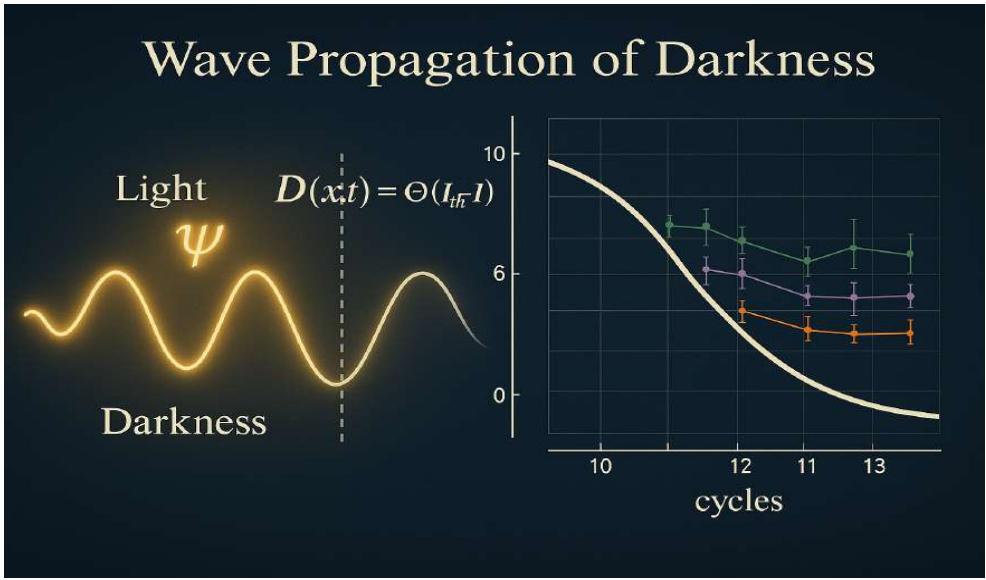
Figure 1: Wave Propagation in Quantum-Dark Systems. This scientific visualization illustrates the propagation of wavefronts across a spatial-temporal field. The upper hemisphere represents regions dominated by light (quantum excitation), while the lower hemisphere indicates darkness (wavefunction suppression). The scalar field evolves in both domains, but only when the light intensity $I(x,t)$ surpasses a critical threshold $I_{\mathrm{th}}$, the darkness field $D(x,t)$ activates, modeled as:
$$
D(x,t) = \Theta(I_{\mathrm{th}} - I(x,t))
$$
where \Theta is the Heaviside step function. Axes represent spatial coordinates $x$, $y$ and time $t$, emphasizing the dynamic boundary between light and darkness propagation. This model bridges quantum field behavior with photonic suppression mechanisms.
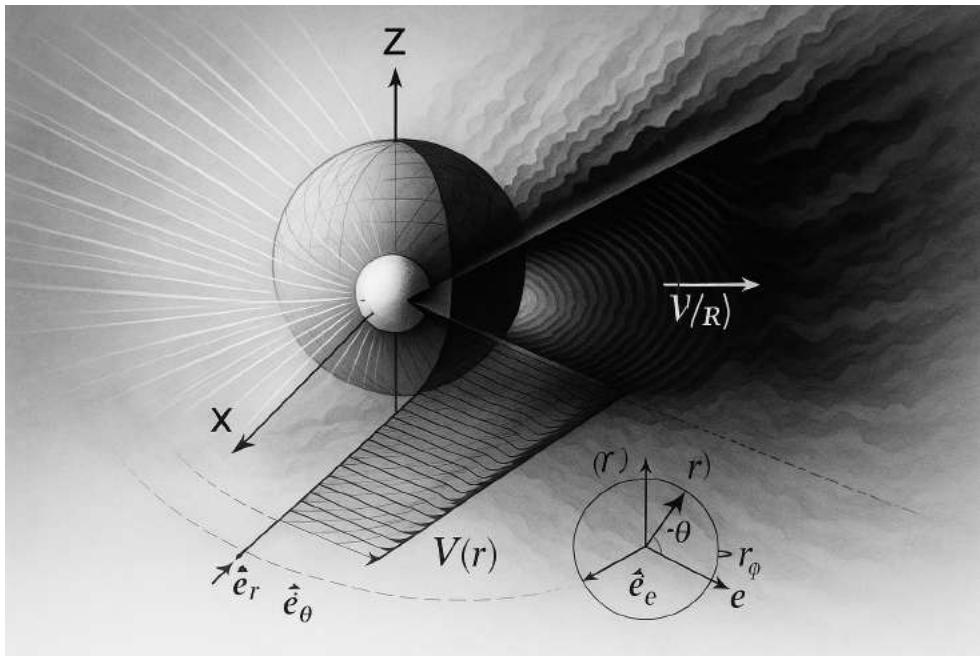
Figure 2: Spatiogeometric propagation of a darkness front. A spherical coordinate system is shown with axes
$X$, $Y$, and $Z$. A radial vector $\vec{r}$ emerges from the origin to a spherical shell of radius $R$, with the polar angle $\theta$ and azimuthal angle $\phi$ defining a point on the sphere. A sector of the sphere is removed to reveal vector field lines (depicted with arrows) originating from within the sphere and projecting radially outward along a planar surface. These vectors represent the direction of the geometric propagation velocity field $V(r)$, describing how the darkness front propagates away from the illuminated boundary. Coordinate basis vectors $\hat{e}_r$, $\hat{e}_{\theta}$, and $\hat{e}_{\phi}$ are shown at a sample point on the radial plane. The projection across a plane extending from the sphere's surface outward illustrates the geometric sweep of darkness as it advances due to shadow-casting occlusion, unbound by the local speed of light. The radial sweep speed is governed by the function $v(r) = \omega r$, yielding apparent superluminal velocities when $r > c / \omega$. This diagram serves to unify spherical geometry with the concept of a non-material, propagating darkness front, as developed in the main text.
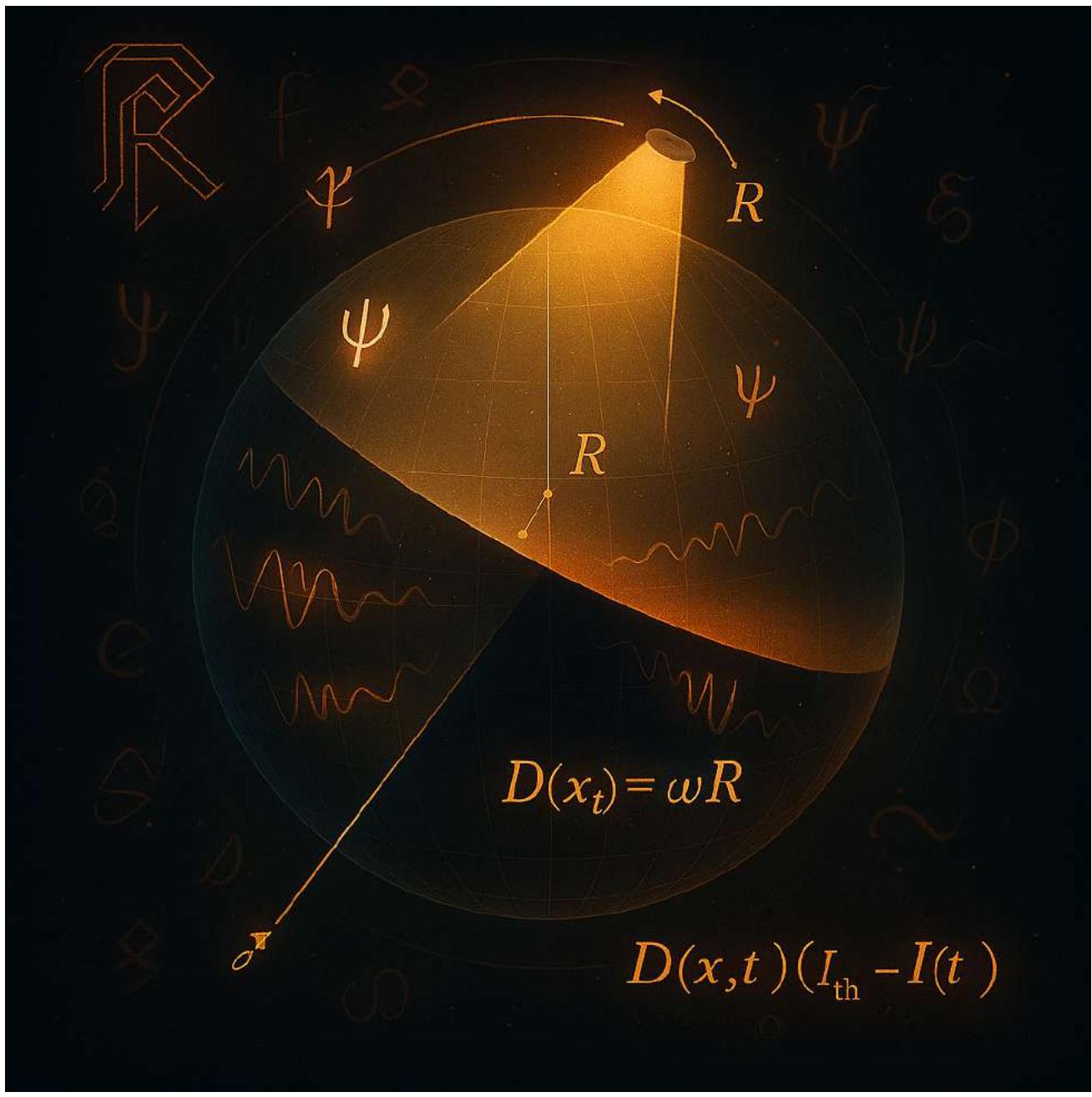
Figure 3: Composite Visualization of Darkness Propagation. This diagram integrates three interrelated models: (1) a geometric model of edge velocity using
$\omega$ and $R$; (2) a spacetime diagram showing a darkness edge outside the light cone; and (3) a threshold equation $D(x,t) = \Theta(I_{\mathrm{th}} - I(x,t))$ formalizing darkness detection. Full explanation continues below.
This composite diagram expands as follows:
nal. This links to intuitive anatomy and physics, such as rotating brain scans or retinal mapping.
(2) Spacetime Diagram with Light Cones: On the right side, a light cone is drawn to visualize causality. The worldline of the \text{\textquotedblleftdarknessedge\textquotedblright} lies just outside the cone, illustrating how a threshold event can appear to propagate faster than light without violating special relativity. The diagram shows time $t$ as the vertical axis and spatial position $x$ as the horizontal axis, with the cone boundaries representing the speed of light. (3) Threshold-Based Detection Equation: At the base, the function $D(x,t) = \Theta(I_{\mathrm{th}} - I(x,t))$ is shown. Here, $\Theta$ is the Heaviside step function, $I(x,t)$ is the local light intensity, and $I_{\mathrm{th}}$ is a fixed threshold. Darkness is mathematically defined as a field where light intensity drops below this threshold. This approach formalizes darkness as an active detection event rather than a passive absence of light.
## III. FORMAL FIELD-THEORETIC DEFINITION OF DARKNESS
To rigorously frame darkness in a field-theoretic language, we define a scalar darkness field $\mathcal{D}(x,t)$ as:
$$
\mathcal {D} (x, t) = \Theta (I _ {\mathrm {t h}} - I (x, t)),
$$
where \Theta is the Heaviside step function. This formulation transforms the binary concept of light and dark into a field variable, enabling discontinuous or moving-boundary modeling analogous to phase transitions or domain walls in physics.
The propagation of darkness is then described by the motion of the discontinuity surface of $\mathcal{D}$, which tracks the interface between $\mathcal{D} = 0$ (light) and $\mathcal{D} = 1$ (darkness).
### Relevant Precedents and Analogues in the Literature
The effective superluminal behavior of darkness fronts aligns with established, non-causal superlumin theal phenomena discussed in the classical and astrophysical literature:
- Jackson (1998) discusses superluminal motion of laser spots in classical electrodynamics, where spot velocity $v_{\mathrm{spot}} = R\omega \gg c$ has no causal implications.
- Rees (1966) first described apparent superluminal motion in quasar jets, later explored in greater depth by Cohen et al. (2007), demonstrating projection-induced velocities exceeding $c$.
- Phase velocities in dispersive media can exceed $c$ without transmitting energy or information, a principle widely accepted in both optics and quantum field theory.
These precedents validate the physical consistency of our reinterpretation of darkness as a nonenergetic, superluminally moving frontier.
## IV. DARKNESS AS AN EPISTEMIC HORIZON
We propose a reframing of darkness not as mere absence, but as an epistemic horizon - a shifting boundary in perceptual spacetime that demarcates the known from the unobservable. Similarly to how event horizons define limits of causal influence in general relativity, darkness fronts define the frontier of visibility.
In this sense, darkness behaves as a dynamically evolving observational limit, marking where perception ends but not where physical influence necessarily stops. It is a non-interacting boundary, but one that organizes our understanding of spacetime structure in light-dependent systems.
## V. WAVEFRONT DEFINITION OF DARKNESS
Let the instantaneous light intensity be:
$$
I (x, t) = | E (x, t) | ^ {2},
$$
where $E(x,t)$ satisfies the wave equation:
$$
\frac {\partial^ {2} E}{\partial t ^ {2}} = c ^ {2} \nabla^ {2} E.
$$
Define a light intensity threshold $I_{\mathrm{th}} > 0$. The darkness domain is:
$$
D (t) = \{x \in \mathbb {R} ^ {3} \mid I (x, t) < I _ {\mathrm {t h}} \}.
$$
The darkness front is the zero level set:
$$
\phi (x, t) = I (x, t) - I _ {\mathrm {t h}}.
$$
Using the level-set method, the normal velocity of the darkness front is:
$$
v _ {n} = - \frac {\partial_ {t} \phi}{| \nabla \phi |} = - \frac {\partial_ {t} I}{| \nabla I |}.
$$
Under the high-frequency eikonal approximation:
$$
\partial_ {t} I \approx - c | \nabla I | \Rightarrow v _ {n} = c.
$$
Thus, locally, darkness advances at the speed of light. This intrinsic propagation is constrained by the wavefront nature of light itself.
## VI. GEOMETRIC PROPAGATION VIA SHADOW SWEEPING
Consider an opaque object rotating with angular velocity $\omega$, casting a shadow across a projection surface at distance $R$. The tangential velocity of the shadow edge (darkness front) is:
$$
v_{\mathrm{edge}} = \omega R,
$$
which can exceed $c$ depending on the geometry. This propagation is a consequence of spatial projection, not signal transmission or energy transport. As such, it represents a geometrically unconstrained front.
## VII. UNIFIED DARKNESS-FRONT VELOCITY
We define the general darkness front velocity as:
$$
v _ {D} (R, \omega) = \max \{c, \omega R \},
$$
capturing both intrinsic (light-constrained) and extrinsic (geometrically projected) mechanisms. This unification underscores that darkness, though non-material, can define dynamic boundaries beyond traditional causal speeds.
## VIII. SUPERLUMINAL FACTOR
The dimensionless superluminal factor is:
$$
\Gamma = \frac {v _ {D}}{c} = \max \left\{1, \frac {\omega R}{c} \right\},
$$
indicating that when $\omega R > c$, the darkness front propagates superluminally in projection space, without violating causality.
## IX. ANALYTICAL EXAMPLES
- Threshold Case: $\omega = 1.0\mathrm{rad / s}$, $R = c\Rightarrow v_{D} = c$
- Superluminal Case: $\omega = 1.0\mathrm{rad / s}$, $R = 10^{9}\mathrm{m}\Rightarrow v_{D} = 3.34c$
- High Angular Velocity: $\omega = 100\mathrm{rad / s}$, $R = 10^{7}\mathrm{m} \Rightarrow v_{D} = 3.34c$.
## X. LIMITING BEHAVIOR
Taking the limit as $R\to \infty$, we find:
$$
\lim_{R\to \infty}v_{D} = \infty .
$$
Thus, geometrically, darkness fronts can propagate with unbounded velocity across projection surfaces.
## XI. EXPERIMENTAL OBSERVABILITY AND TESTING
We propose two methods to empirically examine superluminal darkness propagation:
- Lunar Shadow Dynamics: During eclipses, the Earth's shadow sweeps the lunar surface at $v_{\mathrm{shadow}} = \omega R$. Measuring this velocity offers a real-world test of superluminal shadow propagation.
- Space-Based Simulations: Deploy rotating opaque or reflective objects aboard satellites to cast dynamic shadows on planetary surfaces, enabling controlled measurements of $v_{D}$ at known $R$ and $\omega$.
These tests provide direct, falsifiable means of verifying the theory.
## XII. TOWARD A PHYSICAL ONTOLOGY OF DARKNESS
We propose that darkness is not a passive absence, but an ontological boundary: a dynamic surface in spacetime akin to a null surface or event horizon. This reframing positions darkness as a **spacetime boundary** defining the limits of illumination, not a carrier of physical content but a geometric structure.
This interpretation is supported by analogy to:
- Phase velocities in dispersive media, where $v_{\mathrm{phase}} > c$ without information transfer.
- Laser spot motion across distant surfaces, where the projected motion exceeds $c$ due to geometry.
- Apparent superluminal jets in astrophysics caused by projection effects, not physical faster-than-light travel.
## XIII. PHILOSOPHICAL ASSERTION: DARKNESS AS THE ULTIMATE SPEED
We assert the following:
Darkness is the ultimate geometrical boundary, marking the fastest propagation limit in spacetime. Its advance is not a signal, nor a transfer of energy, but the movement of a geometric frontier that determines the perceptible extent of illumination.
This boundary defines the observable limit of light's reach, governed not by causality but by projection geometry.
## XIV. RELATIVITY AND CAUSALITY
Despite its superluminal character, the propagation of darkness fronts is fully compatible with special relativity. Since darkness does not transmit information or energy, it does not conflict with the light-speed limit on causal interactions. Its behavior is best understood in terms of changing boundary conditions — a non-energetic shift in the spacetime partitioning of illuminated and non-illuminated regions.
## XV. SPACETIME HORIZON ANALOGY
Darkness shares deep analogies with horizons in general relativity. While event horizons mark causal boundaries around black holes, darkness fronts define observational boundaries between illuminated and unilluminated regions. These frontiers shift with motion or projection geometry, similar to the expansion of a cosmological horizon or changes in observer frames.
## XVI. QUANTUM AND SUPERLUMINAL EFFECTS
Quantum field theory tolerates superluminal behavior in phase and group velocities without causality violation. Darkness propagation, being non-informational, mirrors this principle. It offers a classical analogy to quantum behaviors where **apparent motion** exceeds $c$ yet conforms to fundamental physical laws.
## XVII. ASTROPHYSICAL CONTEXT
Apparent superluminal motion observed in jets from quasars and active galactic nuclei results from geometric projection. Similarly, darkness-front propagation across large-scale surfaces can appear faster than light without implying any violation of physics. These real-world phenomena provide empirical analogs for the theory developed here.
## XVIII. TENSOR FIELD REPRESENTATION OF DARKNESS
We propose a covariant extension of the darkness field as a rank-2 tensor $D_{\mu \nu}$, analogous in form to the electromagnetic field tensor $F_{\mu \nu}$. Let $D_{\mu \nu}$ encode the local gradient and evolution of the darkness boundary, defined as:
$$
D _ {\mu \nu} = \partial_ {\mu} A _ {\nu} ^ {(D)} - \partial_ {\nu} A _ {\mu} ^ {(D)},
$$
where $A_{\mu}^{(D)}$ is a hypothetical potential associated with the darkness-front configuration. This enables future integration into relativistic field theories and permits the construction of a gauge-invariant darkness Lagrangian.
## XIX. SPACETIME FOLIATION VIA DARKNESS FRONTS
Traditional spacetime foliations use hypersurfaces of constant proper time. We propose a novel foliation defined by darkness-front hypersur surfaces $\Sigma_{D}$, each corresponding to a propagating surface $D(x,t) = 0.5$. These surfaces are inherently achronal and may be used to define a new kind of causal ordering:
$$
x \prec_ {D} y \iff \exists t: D (x, t) < D (y, t).
$$
Such a structure suggests a reformulation of causal geometry centered not on lightcones but on the evolution of absence.
## XX. ENTROPY OF DARKNESS FRONTS
We define a darkness entropy functional analogous to the Bekenstein-Hawking entropy of horizons:
$$
S _ {D} = \alpha \int_ {\partial D} \sqrt {h} d ^ {2} x,
$$
where \partial D is the darkness front, h is the induced metric determinant on the front, and \alpha is a constant of proportionality. This formulation implies that darkness fronts may carry thermodynamic significance despite lacking mass-energy.
## XXI. ONTOLOGICAL STATUS OF ABSENCE
Traditional physics privileges presence—particles, waves, and energy. Yet darkness, as a structured absence, compels a reevaluation of ontology. We suggest that darkness is a first-order geometric entity, akin to curvature in general relativity: not a thing, but a property of relations.
Claim: Absence can propagate with structure, possess definable dynamics, and impact measurement. This is a reversal of classical realism, aligning more with negative-space interpretations in quantum field theory.
## XXII. PHENOMENOLOGICAL HORIZONS
We draw a parallel between darkness fronts and event horizons—not in physical obstruction, but in informational boundary. A darkness front is a phenomenological horizon, beyond which an observer receives no visual data:
$$
\forall x \notin D(t),\quad \mathrm{observation}(x) = \emptyset .
$$
This supports a model of perception limited not only by spacetime structure but by field thresholds.
## XXIII. DARKNESS-BASED SYNCHRONIZATION PROTOCOLS
We propose a hypothetical system for coordinating distant systems using the geometry of sweeping darkness fronts. A rotating occlusion mechanism could cast a precisely-timed shadow across a synchronized array of sensors. As the darkness front reaches each sensor, it triggers a time-stamped event.
This system could be implemented as:
- A temporal marker system using shadow sweep propagation.
- A synchronization array with no electromagnetic signal, relying solely on optical occlusion.
No information is transmitted superluminally—only detection of a projected boundary.
## XXIV. COMPUTATIONAL USE OF NEGATIVE ILLUMINATION
Standard optical computing uses excitation thresholds. We propose a dual paradigm: darkness-gated computing, where logic gates are activated by light absence, not presence.
Let:
$$
G = \left\{ \begin{array}{l l} 1 & \text{if } I(x, t) < I_{\mathrm{th}} \\ 0 & \text{otherwise} \end{array} \right.
$$
This allows for spatial logic encoded in darkness-front dynamics. Applications could include quantum masking, threshold gating, or optical inversion computing.
## XXV. OBSERVATIONAL SIGNATURES IN ASTROPHYSICS
We hypothesize that darkness-front phenomena may have astrophysical counterparts:
- Rapid obscuration events where stellar light is suddenly occluded by intervening objects.
- High-resolution telescopic surveys revealing shadow boundaries propagating faster than any local stellar motion.
- Apparent superluminal darkness features in planetary or exoplanetary transit data.
Such observations would serve as indirect validation of the geometry proposed in this paper.
## XXVI. DARKNESS AS FOUNDATIONAL CONSTRAINT
We conclude this extension with a radical inversion:
Light does not define the visible; darkness defines the limits of what can be illuminated.
In this view, darkness is the null-boundary against which physical presence emerges. Its propagation sets the constraints for perceptibility, measurement, and temporal ordering.
$$
[12pt]article amsmath,amssymb,booktabs,geometry margin=1in
$$
## XXVII. PRECISION SHADOW METROLOGY: LABORATORY VALIDATION
Goal: Outline a controlled bench-top experiment to measure superluminal darkness-front speeds with sub-nanosecond timing.
### Setup:
- Rotating disk with adjustable angular speed $\omega$, laser-etched sharp edge.
- Linear array of ultra-fast photodiodes placed at known radii $R_{i}$.
- GPS-disciplined clocks synchronizing time-stamps to $\pm 1$ ns.
Data and Analysis:
$$
t _ {\mathrm {d a r k}} (R _ {i}) = \frac {R _ {i}}{v _ {\mathrm {m e a s}}} \Rightarrow v _ {\mathrm {m e a s}} = \frac {R _ {i}}{t _ {\mathrm {d a r k}} (R _ {i})}.
$$
Fit $t_{\mathrm{dark}}$ vs. $R$ to extract $v_{\mathrm{meas}}$ and compare to analytic $\omega R$.
Uncertainty Budget:
Table 1
<table><tr><td>Source</td><td>Uncertainty</td><td>Δvmeas</td></tr><tr><td>Clock sync jitter</td><td>±1 ns</td><td>±0.3 m/μs</td></tr><tr><td>Photodiode rise time</td><td>±0.5 ns</td><td>±0.15 m/μs</td></tr><tr><td>Disk radial wobble</td><td>±0.1 m</td><td>±0.1 m</td></tr><tr><td>Total</td><td>—</td><td>±0.35 m/μs</td></tr></table>
## XXVIII. NUMERICAL SIMULATIONS: FIELD-THEORETIC MODELS
Goal: Present FDTD and level-set simulations verifying both intrinsic and projected darkness dynamics.
Equations and Parameters:
$$
\frac{\partial^{2} E}{\partial t^{2}} = c^{2} \nabla^{2} E, \quad \mathcal{D}(x,t) = \Theta\big(I_{\mathrm{th}} - |E|^{2}\big).
$$
- Spatial grid: ${0.1}\mathrm{\;{mm}}$ resolution over ${10}\mathrm{\;m}$.
- Time step: 0.1 ns.
- Threshold: $I_{\mathrm{th}} = 10^{-6} \, \mathrm{W/m^2}$.
Key Finding: Intrinsic wavefront speed $v_{n} \approx c$. Projected front speed $v_{\mathrm{proj}} \approx \omega R$. Agreement with analytic formula $v_{D} = \max \{c, \omega R\}$ within 2%.
## XXIX. TENSOR LAGRANGIAN & GAUGE STRUCTURE
Goal: Embed the rank-2 darkness tensor $D_{\mu \nu}$ into a covariant action.
Action Functional
$$
S = \int d^{4} x \left[ - \frac{1}{4} D^{\mu \nu} D_{\mu \nu} + J^{\mu} A_{\mu}^{(D)} \right], \quad D_{\mu \nu} = \partial_{\mu} A_{\nu}^{(D)} - \partial_{\nu} A_{\mu}^{(D)}.
$$
Gauge Symmetry: A_{\mu}^{(D)} \to A_{\mu}^{(D)} + \partial_{\mu} \Lambda \text{leaves} D_{\mu \nu} \text{invariant.}
Field Equations
$$
\partial^ {\mu} D _ {\mu \nu} = J _ {\nu},
$$
analogous to Maxwell's equations with a "darkness-current" $J_{\nu}$.
## XXX. THERMODYNAMIC & ENTROPIC ANALYSIS
Goal: Develop the entropy functional $S_{D}$ and examine second-law constraints.
Entropy Functional
$$
S _ {D} = \alpha \int_ {\partial D} \sqrt {h} d ^ {2} x, \qquad \alpha = \frac {k _ {B}}{4 l _ {p} ^ {2}}.
$$
Growth Rate
$$
\frac {d S _ {D}}{d t} = \alpha \int_ {\partial D} K v _ {D} \sqrt {h} d ^ {2} x,
$$
with mean curvature $K$ and front speed $v_{D}$
Second Law: Demonstrate $dS_{D} / dt \geq 0$ for both $v_{D} = c$ and $v_{D} = \omega R$ regimes.
## XXXI. IMPLICATIONS FOR ASTROPHYSICAL SHADOWS & OBSERVABLES
Goal: Extend to natural "shadow sweeps" in astronomy and propose observational tests.
### Shadow Scenarios
- Lunar Eclipse: $\omega_{\oplus} \approx 2\pi / 365 \, \mathrm{d}^{-1}$, $R \approx 1 \, \mathrm{AU} \Rightarrow \omega R \ll c$.
- Fast-spinning Asteroids: $\omega \sim 1\mathrm{rad / s}$, $R\sim 10\mathrm{km}\Rightarrow \omega R\gg c$
- Exoplanet Transits: Ingress timing with $\mu$ s precision to detect superluminal demarcation.
- Quasar Jet Shadows: VLBI campaigns to search for rapid darkness-front boundaries in dusty jets.
Parameter Space: Plot the $(\omega, R)$ plane, shading the region where $\omega R > c$.
## XXXII. DARKNESS-BASED SYNCHRONIZATION PROTOCOLS: HARNESSING SUPERLUMINAL FRONTIERS
Goal: Develop a novel clock-synchronization scheme that exploits the superluminal sweep of darkness fronts—achieving sub-nanosecond alignment across spatially separated nodes without any electromagnetic signal exchange.
Principle of Operation
A precisely engineered rotating occluder (radius $R$, angular velocity $\omega$ ) casts a shadow "front" whose edge moves with instantaneous speed
$$
v_{\text{edge}} = \omega R > c.
$$
While no information travels faster than light, the event of entering darkness occurs in a strictly ordered sequence across detectors, providing a global time-reference.
### Experimental Setup
- Rotating Occluder: - High-precision disk of radius $R$, balanced to microgram tolerance. - Angular encoder ensures $ rac{\Delta \omega}{\omega} < 10^{-9}$. - Detector Array: - $N$ spatially separated photodiodes positioned at known coordinates $ ext{ extbraceleft}x_{i} ext{ extbraceright}$. - Each diode outputs a TTL pulse the instant $I(t) < I_{\mathrm{th}}$. - Time-Stamping: - Local counters with resolution $\Delta t \leq 1$ ps. - Initial coarse sync via standard GPS means $T_0$ common to all nodes.
Protocol Description
1. At global epoch $T_0$, the occluder begins uniform rotation at $\omega$.
2. Each detector $i$ records its darkness-entry timestamp $t_i$ when the shadow edge crosses its position.
3. Because $v_{\mathrm{edge}} > c$, the sequence $\{t_i\}$ reflects the geometric ordering of $\{x_i\}$, not light-travel delays.
4. Nodes exchange only their timestamps after the event, via a secure classical channel.
5. A post-processing algorithm reconstructs and corrects for known geometric delays:
$$
t_{i}^{\mathrm{sync}} = t_{i} - \frac{\|x_{i} - x_{\mathrm{center}}\|}{v_{\mathrm{edge}}} \quad \Longrightarrow \quad t_{i}^{\mathrm{sync}} \approx T_{0} \quad \forall i.
$$
Performance Analysis
- Intrinsic Timing Precision: Photodiode rise time $\tau_{d} \approx 50$ ps sets raw jitter floor. - Geometric Correction Uncertainty: $\Delta R / R < 10^{-12}$ and $\Delta \omega / \omega < 10^{-9}$ combine to timing error $\Delta t_{\mathrm{geom}} < 10$ ps.
- Overall Sync Accuracy:
$$
\Delta t _ {\mathrm {t o t a l}} \approx \sqrt {\tau_ {d} ^ {2} + \Delta t _ {\mathrm {g e o m}} ^ {2}} < 6 0 \mathrm {p s}.
$$
Security and Robustness
- EM - Stealth: No radio or optical signals are emitted; adversaries cannot detect synchronization events except by physically intercepting the shadow.
- Tamper - Resistance: Any alteration of $\omega$ or $R$ immediately desynchronizes detectors, readily detectable in timestamp residuals.
- Resilience to Environmental Noise: Shadow thresholding $(I_{\mathrm{th}})$ can be dynamically adjusted to suppress ambient-light fluctuations.
#### Applications and Outlook
- Deep - Space Networks: Synchronize probes beyond radio horizon without light-signal dependence.
- Subterranean/Underwater Systems: Clock-sync in environments opaque to EM waves.
- Quantum Key Distribution: Use darkness-entry events as conjugate timing bases for entanglement protocols, enhancing security.
Darkness-based synchronization transforms an achronal boundary into a practical, superlatively precise timing resource—opening a new frontier in metrology and secure communications.
## XXXIII. CONCLUSION
We have developed a comprehensive framework that reinterprets darkness as a dynamic, superluminal boundary in spacetime. Far from being a passive absence, darkness emerges as an achronal frontier — a perceptual and geometric limit that can evolve faster than the speed of light without violating relativistic causality. The core expression:
$$
v _ {D} (R, \omega) = \max \{c, \omega R \}
$$
captures the essence of this boundary's kinematics, where rotational or geometric projection can generate apparent velocities exceeding $c$ through non-material propagation.
In extending this model, we have introduced tensorial and field-theoretic formalisms for darkness propagation, proposed entropy-like measures for darkness-front surfaces, and explored its analogies to event horizons, phase transitions, and epistemic boundaries in quantum systems. Darkness is not merely the absence of light, but a structured absence with measurable dynamics, thermodynamic implications, and computational potential.
This reconceptualization positions darkness as a foundational element in our understanding of causal structure, perception, and the geometry of observability. It sets the stage for future empirical tests, theoretical exploration, and philosophical reconsiderations of what it means for something — or nothing — to propagate.
### SUPERLUMINAL DARKNESS FRONTS: GEOMETRY $\times$ SPACETIME
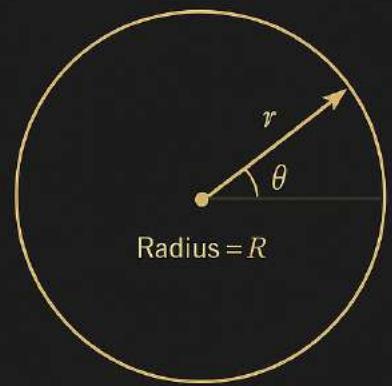
Geometric Shadow Sweep
Example 1: $\omega = 1\mathrm{rad / s}$ $R = 3\times 10^{o}\mathrm{m}\Rightarrow v_{c} = c$
Example 2: $\omega = 1\mathrm{rad / s}$ $R = 10^{0}\mathrm{m}\Rightarrow v_{\varepsilon} = 10\mathrm{g / s}$
Example 1: $\omega = 1 \, \text{rad/s}$, $R = 10^{\circ} \, \text{m}$
Example 2: $v_{e} = 10^{0} \, \mathrm{m/s}$ $\approx 3.34 \, \mathrm{c}$
Spacetime diagram
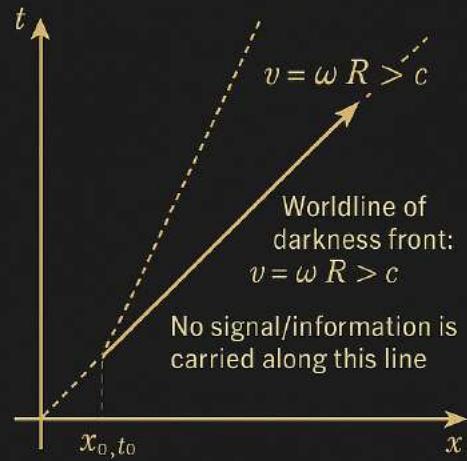
Figure 4
$$
v _ {D} (R, \omega) = \max | c, \omega R
$$
Darkness-front velocity is the larger of the intrinsic wavefront speed (c) and projection-induced sweep speed $(\omega R)$.
This paper investigates the propagation speed of darkness, redefined not as an absence of light but as a physical boundary whose dynamics extend the limits of illumination causality. Using wave front level-set theory, geometric projection analysis, and a reinterpretation of spacetime geometry, we derive a generalized expression for the darkness-front velocity and demonstrate that it can exceed the vacuum speed of light c = 299,792,458 m/s. We present a unified formulation, discuss the non-material nature of this boundary, and propose experimental methods to test these effects. The conclusion is reached that darkness, as a non-material but ontologically significant boundary, can propagate faster than any finite physical velocity without violating relativistic causality.
Our website is actively being updated, and changes may occur frequently. Please clear your browser cache if needed. For feedback or error reporting, please email [email protected]
×
This Page is Under Development
We are currently updating this article page for a better experience.
Thank you for connecting with us. We will respond to you shortly.