
Data Adaptive Multi-Band Approach for Robust Audio Watermarking Using Adaptive Threshold

A.K.M. Nazmus Sakib
A.K.M. Nazmus Sakib B.Sc.
K. M. Ibrahim Khalilullah
A K M Wasif Abedin
A K M Wasif Abedin
Mahfuza Khatun
Mahfuza Khatun
Mohammad Tareq
Mohammad Tareq
Md. A. R. Pramanik
Md. A. R. Pramanik
Chittagong University of Engineering & Technology

Send Message

To: Author

Data Adaptive Multi-Band Approach for Robust Audio Watermarking Using Adaptive Threshold

Article Fingerprint

ReserarchID

CSTGV6754O

Data Adaptive Multi-Band Approach for Robust Audio Watermarking Using Adaptive Threshold Banner

AI TAKEAWAY

Connecting with the Eternal Ground
  • English
  • Afrikaans
  • Albanian
  • Amharic
  • Arabic
  • Armenian
  • Azerbaijani
  • Basque
  • Belarusian
  • Bengali
  • Bosnian
  • Bulgarian
  • Catalan
  • Cebuano
  • Chichewa
  • Chinese (Simplified)
  • Chinese (Traditional)
  • Corsican
  • Croatian
  • Czech
  • Danish
  • Dutch
  • Esperanto
  • Estonian
  • Filipino
  • Finnish
  • French
  • Frisian
  • Galician
  • Georgian
  • German
  • Greek
  • Gujarati
  • Haitian Creole
  • Hausa
  • Hawaiian
  • Hebrew
  • Hindi
  • Hmong
  • Hungarian
  • Icelandic
  • Igbo
  • Indonesian
  • Irish
  • Italian
  • Japanese
  • Javanese
  • Kannada
  • Kazakh
  • Khmer
  • Korean
  • Kurdish (Kurmanji)
  • Kyrgyz
  • Lao
  • Latin
  • Latvian
  • Lithuanian
  • Luxembourgish
  • Macedonian
  • Malagasy
  • Malay
  • Malayalam
  • Maltese
  • Maori
  • Marathi
  • Mongolian
  • Myanmar (Burmese)
  • Nepali
  • Norwegian
  • Pashto
  • Persian
  • Polish
  • Portuguese
  • Punjabi
  • Romanian
  • Russian
  • Samoan
  • Scots Gaelic
  • Serbian
  • Sesotho
  • Shona
  • Sindhi
  • Sinhala
  • Slovak
  • Slovenian
  • Somali
  • Spanish
  • Sundanese
  • Swahili
  • Swedish
  • Tajik
  • Tamil
  • Telugu
  • Thai
  • Turkish
  • Ukrainian
  • Urdu
  • Uzbek
  • Vietnamese
  • Welsh
  • Xhosa
  • Yiddish
  • Yoruba
  • Zulu
Font Type
Font Size
Font Size
Bedground

Abstract

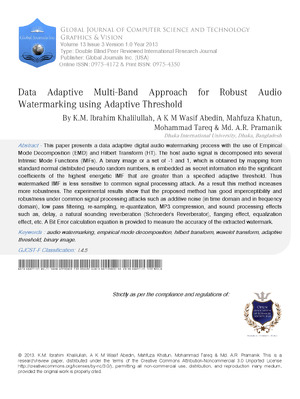
This paper presents a data adaptive digital audio watermarking process with the use of Empirical Mode Decomposition (EMD) and Hilbert Transform (HT). The host audio signal is decomposed into several Intrinsic Mode Functions (IMFs). A binary image or a set of -1 and 1, which is obtained by mapping from standard normal distributed pseudo random numbers, is embedded as secret information into the significant coefficients of the highest energetic IMF that are greater than a specified adaptive threshold. Thus watermarked IMF is less sensitive to common signal processing attack. As a result this method increases more robustness. The experimental results show that the proposed method has good imperceptibility and robustness under common signal processing attacks such as additive noise (in time domain and in frequency domain), low pass filtering, re-sampling, re-quantization, MP3 compression, and sound processing effects such as, delay, a natural sounding reverberation (Schroeder’s Reverberator), flanging effect, equalization effect, etc. A Bit Error calculation equation is provided to measure the accuracy of the extracted watermark.

References

7 Cites in Article
  1. Ahmet Eskicioglu,Edward Delp (2001). An overview of multimedia content protection in consumer electronics devices.
  2. A Eskicioglu,E Delp (2003). Security of Digital Entertainment Content From Creation to Consumption.
  3. I Cox,M Miller,J Bloom (2002). Digital Watermarking.
  4. Norden Huang,Zheng Shen,Steven Long,Manli Wu,Hsing Shih,Quanan Zheng,Nai-Chyuan Yen,Chi Tung,Henry Liu (1998). The empirical mode decomposition and the Hilbert spectrum for nonlinear and non-stationary time series analysis.
  5. Lingfei Liang,Ziliang Ping (2008). Information Hiding Based on Empirical Mode Decomposition.
  6. A Zaman,K Khalilullah,M Islam,M Molla (2010). A robust digital audio watermarking algorithm using empirical mode decomposition.
  7. S Foo,T Yeo,D Huang (2001). An adaptive audio watermarking system.

Funding

No external funding was declared for this work.

Conflict of Interest

The authors declare no conflict of interest.

Ethical Approval

No ethics committee approval was required for this article type.

Data Availability

Not applicable for this article.

How to Cite This Article

A.K.M. Nazmus Sakib. 1970. \u201cData Adaptive Multi-Band Approach for Robust Audio Watermarking Using Adaptive Threshold\u201d. Global Journal of Computer Science and Technology - F: Graphics & Vision GJCST-F Volume 13 (GJCST Volume 13 Issue F3).

Download Citation

Journal Specifications

Crossref Journal DOI 10.17406/gjcst

Print ISSN 0975-4350

e-ISSN 0975-4172

Version of record

v1.2

Language
en
Experiance in AR

Explore published articles in an immersive Augmented Reality environment. Our platform converts research papers into interactive 3D books, allowing readers to view and interact with content using AR and VR compatible devices.

Read in 3D

Your published article is automatically converted into a realistic 3D book. Flip through pages and read research papers in a more engaging and interactive format.

Article Matrices
Total Views: 24882
Total Downloads: 10863
2026 Trends
Related Research
Our website is actively being updated, and changes may occur frequently. Please clear your browser cache if needed. For feedback or error reporting, please email [email protected]

Request Access

Please fill out the form below to request access to this research paper. Your request will be reviewed by the editorial or author team.
X

Quote and Order Details

Contact Person

Invoice Address

Notes or Comments

This is the heading

Lorem ipsum dolor sit amet, consectetur adipiscing elit. Ut elit tellus, luctus nec ullamcorper mattis, pulvinar dapibus leo.


High-quality academic research articles on global topics and journals.

Data Adaptive Multi-Band Approach for Robust Audio Watermarking Using Adaptive Threshold

K. M. Ibrahim Khalilullah
A K M Wasif Abedin
A K M Wasif Abedin
Mahfuza Khatun
Mahfuza Khatun
Mohammad Tareq
Mohammad Tareq
Md. A. R. Pramanik
Md. A. R. Pramanik

Research Journals