Data Science and Management : A Study of Theoretical Approaches to computer System with Organisation using Advanced Analytics

α
Khemraj Dangi
Khemraj Dangi

Send Message

To: Author

Data Science and Management : A Study of Theoretical Approaches to computer System with Organisation using Advanced Analytics

Article Fingerprint

ReserarchID

CSTSDE8O26L

Data Science and Management : A Study of Theoretical Approaches to computer System with Organisation using Advanced Analytics Banner

AI TAKEAWAY

Connecting with the Eternal Ground
  • English
  • Afrikaans
  • Albanian
  • Amharic
  • Arabic
  • Armenian
  • Azerbaijani
  • Basque
  • Belarusian
  • Bengali
  • Bosnian
  • Bulgarian
  • Catalan
  • Cebuano
  • Chichewa
  • Chinese (Simplified)
  • Chinese (Traditional)
  • Corsican
  • Croatian
  • Czech
  • Danish
  • Dutch
  • Esperanto
  • Estonian
  • Filipino
  • Finnish
  • French
  • Frisian
  • Galician
  • Georgian
  • German
  • Greek
  • Gujarati
  • Haitian Creole
  • Hausa
  • Hawaiian
  • Hebrew
  • Hindi
  • Hmong
  • Hungarian
  • Icelandic
  • Igbo
  • Indonesian
  • Irish
  • Italian
  • Japanese
  • Javanese
  • Kannada
  • Kazakh
  • Khmer
  • Korean
  • Kurdish (Kurmanji)
  • Kyrgyz
  • Lao
  • Latin
  • Latvian
  • Lithuanian
  • Luxembourgish
  • Macedonian
  • Malagasy
  • Malay
  • Malayalam
  • Maltese
  • Maori
  • Marathi
  • Mongolian
  • Myanmar (Burmese)
  • Nepali
  • Norwegian
  • Pashto
  • Persian
  • Polish
  • Portuguese
  • Punjabi
  • Romanian
  • Russian
  • Samoan
  • Scots Gaelic
  • Serbian
  • Sesotho
  • Shona
  • Sindhi
  • Sinhala
  • Slovak
  • Slovenian
  • Somali
  • Spanish
  • Sundanese
  • Swahili
  • Swedish
  • Tajik
  • Tamil
  • Telugu
  • Thai
  • Turkish
  • Ukrainian
  • Urdu
  • Uzbek
  • Vietnamese
  • Welsh
  • Xhosa
  • Yiddish
  • Yoruba
  • Zulu

Abstract

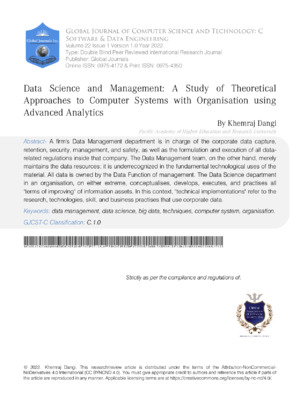
A firm’s Data Management department is in charge of the corporate data capture, retention, security, management, and safety, as well as the formulation and execution of all datarelated regulations inside that company. The Data Management team, on the other hand, merely maintains the data resources; it is underrecognized in the fundamental technological uses of the material. All data is owned by the Data Function of management. The Data Science department in an organisation, on either extreme, conceptualises, develops, executes, and practises all “terms of improving” of information assets. In this context, “technical implementations” refer to the research, technologies, skill, and business practises that use corporate data.

References

15 Cites in Article
  1. Loan Dinh,Gour Karmakar,Joarder Kamruzzaman (2020). A survey on context awareness in big data analytics for business applications.
  2. Phaphama Kangelani,Tiko Iyamu (2020). A Model for Evaluating Big Data Analytics Tools for Organisation Purposes.
  3. Meena Jha,Sanjay Jha,Liam O'brien (2016). Combining big data analytics with business process using reengineering.
  4. M Anshari,W Sumardi (2020). Employing big data in business organisation and business ethics.
  5. Rameshwar Dubey,Angappa Gunasekaran,Stephen Childe,David Bryde,Mihalis Giannakis,Cyril Foropon,David Roubaud,Benjamin Hazen (2020). Big data analytics and artificial intelligence pathway to operational performance under the effects of entrepreneurial orientation and environmental dynamism: A study of manufacturing organisations.
  6. Uthayasankar Sivarajah,Zahir Irani,Suraksha Gupta,Kamran Mahroof (2020). Role of big data and social media analytics for business to business sustainability: A participatory web context.
  7. Richard Walker,Irwin Brown (2019). Big data analytics adoption: A case study in a large South African telecommunications organisation.
  8. Iman Malaka,Irwin Brown (2015). Challenges to the Organisational Adoption of Big Data Analytics.
  9. Rakesh Raut,Sachin Mangla,Vaibhav Narwane,Bhaskar Gardas,Pragati Priyadarshinee,Balkrishna Narkhede (2019). Linking big data analytics and operational sustainability practices for sustainable business management.
  10. John Hopkins,Paul Hawking (2018). Big Data Analytics and IoT in logistics: a case study.
  11. M Ijab,S Wahab,M Salleh,A Bakar (2019). Investigating big data analytics readiness in higher education using the technology-organisation-environment (TOE) framework.
  12. M Van Rijmenam,T Erekhinskaya,J Schweitzer,M Williams (2019). Avoid being the Turkey: how big data analytics changes the game of strategy in times of ambiguity and uncertainty.
  13. Ozgur Araz,Tsan‐ming Choi,David Olson,F Salman (2020). Data Analytics for Operational Risk Management.
  14. Lina Dagilienė,Lina Klovienė (2019). Motivation to use big data and big data analytics in external auditing.
  15. Karthik Kambatla,Giorgos Kollias,Vipin Kumar,Ananth Grama (2014). Trends in big data analytics.

Funding

No external funding was declared for this work.

Conflict of Interest

The authors declare no conflict of interest.

Ethical Approval

No ethics committee approval was required for this article type.

Data Availability

Not applicable for this article.

How to Cite This Article

Khemraj Dangi. 2026. \u201cData Science and Management : A Study of Theoretical Approaches to computer System with Organisation using Advanced Analytics\u201d. Global Journal of Computer Science and Technology - C: Software & Data Engineering GJCST-C Volume 22 (GJCST Volume 22 Issue C1): .

Download Citation

Data Science and Management: Theoretical Approaches to Computer Systems.
Issue Cover
GJCST Volume 22 Issue C1
Pg. 33- 38
Journal Specifications

Crossref Journal DOI 10.17406/gjcst

Print ISSN 0975-4350

e-ISSN 0975-4172

Keywords
Classification
GJCST-C Classification: C.1.0
Version of record

v1.2

Issue date

July 16, 2022

Language
en
Experiance in AR

Explore published articles in an immersive Augmented Reality environment. Our platform converts research papers into interactive 3D books, allowing readers to view and interact with content using AR and VR compatible devices.

Read in 3D

Your published article is automatically converted into a realistic 3D book. Flip through pages and read research papers in a more engaging and interactive format.

Article Matrices
Total Views: 2601
Total Downloads: 33
2026 Trends
Related Research

Published Article

A firm’s Data Management department is in charge of the corporate data capture, retention, security, management, and safety, as well as the formulation and execution of all datarelated regulations inside that company. The Data Management team, on the other hand, merely maintains the data resources; it is underrecognized in the fundamental technological uses of the material. All data is owned by the Data Function of management. The Data Science department in an organisation, on either extreme, conceptualises, develops, executes, and practises all “terms of improving” of information assets. In this context, “technical implementations” refer to the research, technologies, skill, and business practises that use corporate data.

Our website is actively being updated, and changes may occur frequently. Please clear your browser cache if needed. For feedback or error reporting, please email [email protected]

Request Access

Please fill out the form below to request access to this research paper. Your request will be reviewed by the editorial or author team.
X

Quote and Order Details

Contact Person

Invoice Address

Notes or Comments

This is the heading

Lorem ipsum dolor sit amet, consectetur adipiscing elit. Ut elit tellus, luctus nec ullamcorper mattis, pulvinar dapibus leo.

High-quality academic research articles on global topics and journals.

Data Science and Management : A Study of Theoretical Approaches to computer System with Organisation using Advanced Analytics

Khemraj Dangi
Khemraj Dangi

Research Journals