

I. INTRODUCTION
The tumour suppressor protein p53 is a transcription factor[1-4]. In response to DNA damage, p53 levels show pulsed or sustained dynamics[5, 6]. Different dynamics of p53 can activate different target genes expression, and trigger different cell fate [7-10]. How does p53 dynamics regulate target genes expression? The steady-state fold change in target protein expression driven by p53 pulsing can be described by the Hill-type equation [11]
where is the duration, T is the period, A is the amplitude, is the maximal fold change in mRNA transcription, is the dissociation constant.
And, the average steady-state fold changes in mRNA transcription and target protein expression are the same[11, 12], i. e.
where represents the average steady-state fold change in mRNA transcription [12]. This equation reveals universal principles of central dogma of molecular biology.
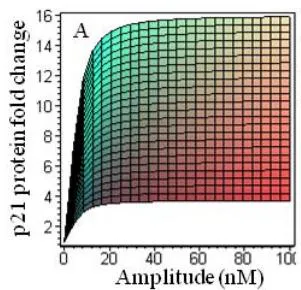
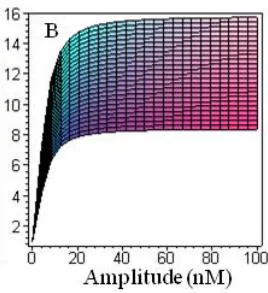
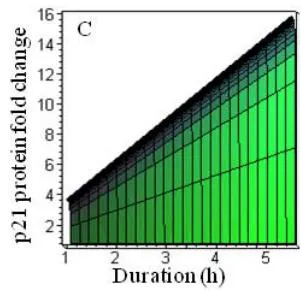
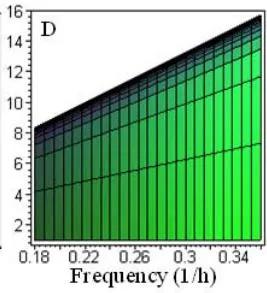
According to the Hill-type equation, as shown in Fig. 1, the pulsed signalling nature is that fold change in p21 protein expression with high affinity is insensitive to amplitude modulation and easy to saturate (Fig. 1 A,B), duration and frequency rather than amplitude can fine-tune p21 protein expression with higher affinity beyond saturation (Fig. 1C,D). In addition, for n > 1, the cooperative binding can increase the sensitivity of amplitude modulation for lower-affinity expression[12]. By Equation 2, we can predict fold change in target protein expression from mRNA transcription.
The mean time to reach the average steady-state fold change in target protein expression is mainly determined by the rate constants of mRNA decay and protein degradation. The short-lived p53 targets reached maximum transcript levels earlier than the long-lived p53 targets[9, 12, 13] The fold change in protein expression must spend a longer time to attain the average steady state for longer mRNA and protein halflives. The mean number of p53 pulses required to reach average steady state is [11]:
where represents the mean time to attain average steady-state fold change in target protein expression under p53 pulsing, and are the rate constants of mRNA decay and target protein degradation, respectively. Using Equation 3, for the p21 protein related to cell cycle arrest, the mean number of p53 pulses required to reach the steady state is:
However, for the BAX protein related to apoptosis, the mean number of pulses is:
Therefore, here, the p53 pulsing is a timer. Cells count the number of pulses to express the target gene. This counting mechanism not only provides sufficient time for DNA repair, but also leads to the accumulation of fold change in protein expression required for triggering apoptosis. Furthermore, the third term of Equation 3 shows that p53 pulses increase the sensitivity of gene expression.
For p53 target genes, the mRNA decay rate constants of PUMA, MDM2, p21, and the BAX are 73 h , 0.27 h , 0.265 h , and 0.018 h , [8, 14] respectively, and the protein degradation rate constants are 0.056 h , 0.792 h , 0.255 h , and 0.0262 h , [15] respectively. For p21 and BAX, why are the lifetimes of mRNA and protein so close? Here, I will investigate the biological significance of a phenomenon.
II. MATHEMATICAL MODEL AND ITS SOLUTION
To calculate the response time and mean time to attain the steady-state fold change, for sustained p53 signalling, we have the model of target gene expression dynamics [11]
Here and represent the fold changes in mRNA and target protein in response to sustained p53 dynamics, respectively, is the maximal mRNA fold change, A is the sustained p53 concentration, is the dissociation constant, , are the rate constants of mRNA decay and protein degradation, respectively.
If , we have
If , we have
Here, .
III. RESULTS
a) The response time for the different rate constants
The response time is defined as the time needed to reach halfway between basal and activated steady state in target protein[16]. The steady state for Equation 6 is
thus, the response time satisfies the equation
When , , we have
b) The response time for the same rate constants
The steady state for Equation 7 is
thus, the response time satisfies the equation:
When , we have the solution
c) The condition for
For , from Equations 9 and 11, we have
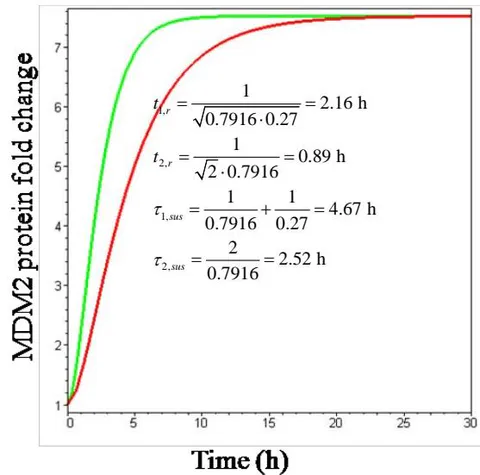
Therefore, for , the fold changes in target protein expression with the different rate constants of mRNA decay and protein degradation can provide high sensitivity by regulating the mRNA decay rate constant to be the same as the rate constant of protein degradation. As shown in Fig 2, let , the MDM2 protein expression dynamics (green) exhibits more sensitivity than that (red) with and .
d) The mean time to reach steady-state fold change in the target protein expression
In Equation 3, represents the mean time to attain the average steady-state fold change driven by p53 pulsing. Let , from Equation 3, we have
which describes the mean time to reach steady-state fold change in protein driven by sustained p53 dynamics. In order to deepen the understanding of such mean time, similar to Salazar, C., et al [17], I try to derive the Equation 13 again by a different way. can be defined as
Thus, if ,
Similarly, if , we have
e) The optimising principle for target protein expression dynamics upon sustained p53 input From equation 15, we have
Therefore, reaches a minimum if and only if .
For p53 target genes p21 and BAX, the rate constants of mRNA decay and protein degradation are very close, which satisfies this simple optimizing principle, so that cells can reach rapidly the state of cell cycle arrest or apoptosis. However, for MDM2, the different lifetimes may produce sufficient time needed for feedback inhibition.
IV. Discussion
Let us investigate a fundamental property that is independent of the lifetimes of mRNA and p53 target protein. From Equations 4-5, we can easily obtain the steady-state fold changes in mRNA transcription and target protein expression under sustained p53 dynamics:
Thus, we obtained again a fundamental property of gene expression pathway that the steady-state fold changes in mRNA and target protein expression are the same. This is the classical Hill equation that reveals the regulatory principle of target protein expression. For a higher binding affinity, , we have
Thus, the steady-state fold change in target protein expression with higher affinity reaches the maximal mRNA fold change. The target protein expression with lower affinity is sensitive to the change in amplitude. Compared with Equations 1 and 18, the fold change in target protein expression under sustained p53 dynamics is greater than that under pulsed p53 dynamics. Therefore, sustained p53 dynamics can easily trigger cell apoptosis.
V. CONCLUSION
p53 target protein expression dynamics is determined by the rate constants of mRNA decay and protein degradation. The mathematical time needed to attain the steady-state fold change in protein goes to infinite, thus, the response time and mean time are defined as two flexible indicators that characterize the sensitivity of target protein expression.
If the rate constant of protein degradation is greater than half of the rate constant of mRNA decay, increasing the mRNA decay rate constant to be the same as the protein degradation rate constant can provide higher sensitivity. Similarly, if the mRNA decay rate constant is greater than half of the protein degradation rate constant, increasing the protein degradation rate constant to be the same as the mRNA decay rate constant can also provide higher sensitivity.
The mean time needed to attain the steady-state fold change in target protein expression reaches a minimum if and only if the lifetimes of mRNA and target protein are the same.
Funding Statement: The author received no funding for this work.
Author Contributions: Xiaomin Shi conceived and performed the study, wrote, reviewed, and edited the article.
Acknowledgments: I appreciate the editors and reviewers helping me to improve the manuscript.
Conflict of Interest Statement: The author declares no conflicts of interest.
Ethical Approval: Not applicable.
Informed Consent: Not applicable.
Data Availability Statement: The data used in this article are included in this text and from the references.