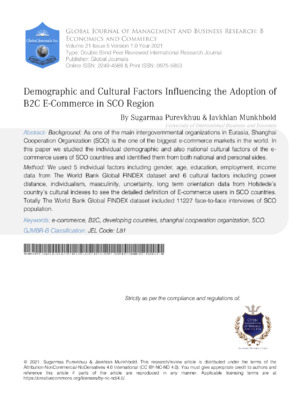
Demographic and Cultural Factors Influencing the Adoption of B2C E-Commerce in SCO Region

Sugarmaa Purevkhuu
Sugarmaa Purevkhuu
Javkhlan Munkhbold
Javkhlan Munkhbold

Send Message

To: Author

Demographic and Cultural Factors Influencing the Adoption of B2C E-Commerce in SCO Region

Article Fingerprint

ReserarchID

H825B

Demographic and Cultural Factors Influencing the Adoption of B2C E-Commerce in SCO Region Banner

AI TAKEAWAY

Connecting with the Eternal Ground
  • English
  • Afrikaans
  • Albanian
  • Amharic
  • Arabic
  • Armenian
  • Azerbaijani
  • Basque
  • Belarusian
  • Bengali
  • Bosnian
  • Bulgarian
  • Catalan
  • Cebuano
  • Chichewa
  • Chinese (Simplified)
  • Chinese (Traditional)
  • Corsican
  • Croatian
  • Czech
  • Danish
  • Dutch
  • Esperanto
  • Estonian
  • Filipino
  • Finnish
  • French
  • Frisian
  • Galician
  • Georgian
  • German
  • Greek
  • Gujarati
  • Haitian Creole
  • Hausa
  • Hawaiian
  • Hebrew
  • Hindi
  • Hmong
  • Hungarian
  • Icelandic
  • Igbo
  • Indonesian
  • Irish
  • Italian
  • Japanese
  • Javanese
  • Kannada
  • Kazakh
  • Khmer
  • Korean
  • Kurdish (Kurmanji)
  • Kyrgyz
  • Lao
  • Latin
  • Latvian
  • Lithuanian
  • Luxembourgish
  • Macedonian
  • Malagasy
  • Malay
  • Malayalam
  • Maltese
  • Maori
  • Marathi
  • Mongolian
  • Myanmar (Burmese)
  • Nepali
  • Norwegian
  • Pashto
  • Persian
  • Polish
  • Portuguese
  • Punjabi
  • Romanian
  • Russian
  • Samoan
  • Scots Gaelic
  • Serbian
  • Sesotho
  • Shona
  • Sindhi
  • Sinhala
  • Slovak
  • Slovenian
  • Somali
  • Spanish
  • Sundanese
  • Swahili
  • Swedish
  • Tajik
  • Tamil
  • Telugu
  • Thai
  • Turkish
  • Ukrainian
  • Urdu
  • Uzbek
  • Vietnamese
  • Welsh
  • Xhosa
  • Yiddish
  • Yoruba
  • Zulu
Font Type
Font Size
Font Size
Bedground

References

133 Cites in Article
  1. H Abu,Ayob (2021). E-commerce adoption in ASEAN: who and where?.
  2. Afizah Hashim,K Erlane,Jamaliah Ghani,Said (2009). Does consumers' demographic profile influence online shopping? : An examination using Fishbein's theory.
  3. Alexander Yap,Jayoti Das,John Burbridge,Kathryn Cort (2006). A Composite-Model for E-Commerce Diffusion.
  4. Ali Yayla,Qing Hu (2007). User acceptance of ecommerce technology: a meta-analytic comparison of competing models.
  5. Alice Shemi (2007). Behavioral influences on ecommerce adoption in a developing country context.
  6. Chad Allred,Scott Smith,William Swinyard (2006). E‐shopping lovers and fearful conservatives: a market segmentation analysis.
  7. Andrej Szymkowiak,Urszula Garczarek-Bak (2018). Gender differences in e-commerce.
  8. Asli Demirgüç-Kunt,Leora Klapper,Dorothe Singer,Saniya Ansar,Jake Hess (2020). The Global Findex Database 2017: Measuring Financial Inclusion and Opportunities to Expand Access to and Use of Financial Services*.
  9. Mark Doms,Ron Jarmin,Shawn Klimek (2000). IT Investment and Firm Performance in U.S. Retail Trade.
  10. Markus Barnikel (2005). The tide is turning in favour of e-cigarettes.
  11. Justin Beneke,Marie-Kristin Scheffer,Wei Du (2010). Beyond Price – An Exploration into the Factors That Drive Young Adults to Purchase Online.
  12. Amit Bhatnagar (2007). Do determinants of online shopping differ for personal shoppers and professional shoppers?.
  13. A Bhatnagar,S Ghose (2004). Online information search termination patterns across product categories and consumer demographics.
  14. Prasad Bingi,Ali Mir,Joseph Khamalah (2000). The Challenges Facing Global E-Commerce.
  15. Damien Chaney,Mourad Touzani,Karim Ben Slimane (2017). Marketing to the (new) generations: summary and perspectives.
  16. M Chang,W Cheung,V Lai (2005). Literature derived reference models for the adoption of online shopping.
  17. Chien-Wen Chen,Chiang-Yu Cheng (2013). How online and offline behavior processes affect each other: customer behavior in a cyber-enhanced bookstore.
  18. C Chiu,Etg Wang,Y Fang,H Huang (2014). Understanding customers' repeat purchase intentions in B2C e-commerce: The roles of utilitarian value, hedonic value, and perceived risk.
  19. Jinsook Cho (2004). Likelihood to abort an online transaction: influences from cognitive evaluations, attitudes, and behavioral variables.
  20. Shih-Wei Chou,Chia-Shiang Hsu (2015). Understanding online repurchase intention: social exchange theory and shopping habit.
  21. Ta‐tao Chuang,Kazuo Nakatani,Duanning Zhou (2009). An exploratory study of the extent of information technology adoption in SMEs: an application of upper echelon theory.
  22. Michael Clemes,Christopher Gan,Junli Zhang (2014). An empirical analysis of online shopping adoption in Beijing, China.
  23. Constance Porter,Naveen Donthu (2006). Using the technology acceptance model to explain how attitudes determine Internet usage: The role of perceived access barriers and demographics.
  24. A Crespo,I Bosque (2010). The influence of the commercial features of the Internet on the adoption of e-commerce by consumers.
  25. Timur Dadabaev (2004). Post-Soviet realities of society in Uzbekistan.
  26. Danish Dada (2006). E‐Readiness for Developing Countries: Moving the focus from the environment to the users.
  27. Datareportal (2021). Overview for 2021.
  28. Robert Davis,Bodo Lang,Josefino San Diego (2014). How gender affects the relationship between hedonic shopping motivation and purchase intentions?.
  29. Delia Sorana,Varvara Mityko (2012). Consumers' education level impact on the perception of the search experience credence products-empirical evidence.
  30. Dharmendra Singh,Nikola Stakic (2020). Financial inclusion and economic growth nexus: Evidence from SAARC countries.
  31. Helga Dittmar,Karen Long,Rosie Meek (2004). Buying on the Internet: Gender Differences in On-line and Conventional Buying Motivations.
  32. Patricia Doney,Joseph Cannon,Michael Mullen (1998). Understanding the Influence of National Culture on the Development of Trust.
  33. Donna Mccloskey,Karen Leppel (2010). The Impact of Age on Electronic Commerce Participation.
  34. Jacqueline Eastman,Rajesh Iyer (2004). The elderly's uses and attitudes towards the Internet.
  35. Eungkyu Kim,Roman Urunov,Hyungjoon Kim (2016). The Effects of National Culture Values on Consumer Acceptance of E-commerce: Online Shoppers in Russia.
  36. Farid Huseynov,Sevgi Ozkan (2016). Behavioral issues in B2C e-commerce.
  37. Tommaso Federici (2009). Factors influencing ERP outcomes in SMEs: a post‐introduction assessment.
  38. Candace Flippin (2017). Generation Z in the workplace: Helping the newest generation in the workforce build a successful working relationship and career paths.
  39. Francesca Pratesi,Lala Hu,Riccardo Rialti,Lamberto Zollo,Monica Faraoni (2021). Cultural dimensions in online purchase behavior: Evidence from a cross-cultural study.
  40. Frederick Pobee,Daniel Opoku (2018). The Moderating Effects of Gender on E-Commerce Systems Adoption Factors.
  41. Ellen Garbarino,Michal Strahilevitz (2004). Gender differences in the perceived risk of buying online and the effects of receiving a site recommendation.
  42. Jennifer Gibbs,Kenneth Kraemer,Jason Dedrick (2003). Environment and Policy Factors Shaping Global E-Commerce Diffusion: A Cross-Country Comparison.
  43. Gichang Cho,Stephanie Koh Jialin (2009). Influence of gender on internet commerce: an explorative study in Singapore.
  44. Avi Goldfarb,Jeff Prince (2008). Internet adoption and usage patterns are different: Implications for the digital divide.
  45. W Gong (2009). National culture and global diffusion of business to consumer e-commerce.
  46. Laura Grazzini,Diletta Acuti,Valentina Mazzoli,Luca Petruzzellis,Daniel Korschun (2020). Standing for politics: What consequences for brands?.
  47. Haque Ahasanul,Javad Sadeghzadeh,Ali Khatibi (2011). Identifying potentiality online sales in Malaysia: a study on customer relationships online shopping.
  48. Simon Harris,Mark Dibben (1999). Trust and Co-operation in Business Relationship Development: Exploring the Influence of National Values.
  49. Hassan Alaaraj,Fatimah Ibrahim (2014). Unknown Title.
  50. Heli Hallikainen,Tommi Laukkanen (2018). National culture and consumer trust in e-commerce.
  51. Blanca Hernández,Julio Jiménez,M José Martín (2011). Age, gender and income: do they really moderate online shopping behaviour?.
  52. G Hofstede (1980). Review Article : Geert Hofstede: Culture's Consequences: International Differences in Work Related Values.
  53. G Hofstede (2001). Culture's consequences: Comparing values, behaviors, institutions, and organizations across nations.
  54. G Hofstede,M Minkov (2010). Cultures and Organizations: Software of the Mind.
  55. Ilyoo Hong,Hoon Cha (2013). The mediating role of consumer trust in an online merchant in predicting purchase intention.
  56. Yujong Hwang,Kun Lee (2012). Investigating the moderating role of uncertainty avoidance cultural values on multidimensional online trust.
  57. W Hwang,H-S Jung,G Salvendy (2006). Internationalisation of e-commerce: a comparison of online shopping preferences among Korean, Turkish and US populations.
  58. Ibrahim Akman,Mohammad Rehan (2010). Online purchase behaviour among professionals: a socio-demographic perspective for Turkey.
  59. Ibrahim Akman,Mohammad Rehan (2014). Online purchase behaviour among professionals: a socio-demographic perspective for Turkey.
  60. James Gentry,Robert Mittelstaedt (2017). The Rapidly Aging World: Implications For Marketing.
  61. Japhet Lawrence,Usman Tar (2010). Factors and Barriers to Adoption of E-Commerce: The Case of Developing Countries.
  62. C Jayawardhena,L Wright,Dennis (2007). Consumers online: Intentions, orientations, and segmentation.
  63. E Jokisuu,M Kankaanranta,P Neittaanmaki (2007). Computer usage among senior citizens in central Finland.
  64. Jong Kang,Tengfei Wang,Dorothea Ramizo (2021). The Role of Technology in Business-to-Consumer E-Commerce: Evidence from Asia.
  65. Jorge Vieira,Rui Frade,Raquel Ascenso,Inês Prates,Filipa Martinho (2020). Generation Z and Key-Factors on E-Commerce: A Study on the Portuguese Tourism Sector.
  66. Jp Morgan (2020). E-commerce payment trends report: India.
  67. Jung Wan,Lee (2010). the Roles of Demographics on the Perceptions of Electronic Commerce Adoption.
  68. Sejfudin Zahirović,Jasmina Okičić,Amra Gadžo (2016). GENERALIZATION OF LINEAR MODELS FOR MULTIPRODUCT BREAK-EVEN ANALYSIS WITH CONSTANT RATIOS.
  69. Paul Kamel Rouibah,Lowry (2015). Dimensions of Business-To-Consumer (B2C) systems success in Kuwait: Testing a modified DeLone and McLean is a success model in an ecommerce context.
  70. Kapcova Anastaisya,Sergeevna (2018). Unknown Title.
  71. Kanchana Kariyawasam (2008). The growth and development of e-commerce: an analysis of the electronic signature law of Sri Lanka.
  72. Kathryn Kimery,Samad Amirkhalkhali (2011). Cultural Influences On The Adoption Of Electronic Commerce: Initial Results From Japan And The United States.
  73. J Kim,Yang Kim,B (2013). Online retailer reputation and consumer response: Examining cross-cultural differences.
  74. Jooyoung Kwak,Yue Zhang,Jiang Yu (2019). Legitimacy building and e-commerce platform development in China: The experience of Alibaba.
  75. Leo Sin,Alan Tse (2001). Profiling Internet Shoppers in Hong Kong.
  76. Li Keqiang (2020). Qingdao Declaration of the Shanghai cooperation organization Council of heads of state.
  77. Austin Rong-Da Liang,Chia-Ling Lee,Wei Tung (2014). The role of sunk costs in online consumer decision-making.
  78. A De Groot,V Groenhuis,S Stramigioli,F Siepel (2005). Breast surface reconstruction utilising autonomous robotic assisted ultrasound image acquisition.
  79. Sabina Lissitsa,Ofrit Kol (2016). Generation X vs. Generation Y – A decade of online shopping.
  80. Margarita Išoraitė,Neringa Miniotienė (2018). ELECTRONIC COMMERCE: THEORY AND PRACTICE.
  81. Charla Mathwick,Naresh Malhotra,Edward Rigdon (2001). Experiential value: conceptualization, measurement and application in the catalog and Internet shopping environment☆11☆This article is based upon the first author’s doctoral dissertation completed while at Georgia Institute of Technology..
  82. Mee Ly,C Huei (2015). A profile of the Internet shoppers: Evidence from nine countries.
  83. Mei Cao,Qingyu Zhang,John Seydel (2005). B2C e‐commerce web site quality: an empirical examination.
  84. Whitacre Mills F Bradford,E Brian (2003). Understanding the non-metropolitan-metropolitan digital divide.
  85. V Mitchell,G Walsh (2004). Gender differences in German consumer decision-making styles.
  86. Y Nanehkaran,A (2013). An Introduction to Electronic Commerce.
  87. (2019). Education at a Glance.
  88. Fred Palumbo,Paul Herbig (1998). International marketing tool: the Internet.
  89. A Parment (2011). Generation Y in consumer and labor markets.
  90. Anders Parment (2013). Generation Y vs. Baby Boomers: Shopping behavior, buyer involvement and implications for retailing.
  91. Perez Hernandez,J,Sanchez Mangas,R (2011). To have or not to have the internet at home: implications for online shopping.
  92. Afa Pontevia,N' Goala,G Poncin,I (2013). A good deal online: The Impacts of acquisition and transaction value on e-satisfaction and e-loyalty.
  93. Constantinos-Vasilios Priporas,Nikolaos Stylos,Anestis Fotiadis (2017). Generation Z consumers' expectations of interactions in smart retailing: A future agenda.
  94. Girish Punj (2011). Effect of Consumer Beliefs on Online Purchase Behavior: The Influence of Demographic Characteristics and Consumption Values.
  95. Girish Punj (2011). Income effects on relative importance of two online purchase goals: Saving time versus saving money?.
  96. Timothy Reisenwitz,Rajesh Iyer (2009). Differences in Generation X and Generation Y: Implications for the Organization and Marketers.
  97. (2019). Kazakhstan.
  98. Richard Boateng,Robert Hinson,Richard Heeks,Alemayehu Molla (2008). E-commerce in Least Developing Countries: Summary Evidence and Implications.
  99. Tiffany Rinne,G Steel,John Fairweather (2013). The Role of Hofstede's Individualism in National-Level Creativity.
  100. Robert Jeyakumar,Nathan (2009). Electronic commerce adoption in the Arab countries-an empirical study.
  101. Rolf Wigand (2006). Electronic Commerce: Definition, Theory, and Context.
  102. D Scarpi,G Pizzi,M Visentin (2014). Shopping for fun or shopping to buy: Is it different online and offline.
  103. F Schoorman,Roger Mayer,James Davis (2007). An Integrative Model of Organizational Trust: Past, Present, and Future.
  104. Jan Schumann,Florian Wangenheim,Anne Stringfellow,Zhilin Yang,Sandra Praxmarer,Fernando Jiménez,Vera Blazevic,Randall Shannon,Shainesh G.,Marcin Komor (2010). Drivers of Trust in Relational Service Exchange: Understanding the Importance of Cross-Cultural Differences.
  105. Rose Sebastianelli,Nabil Tamimi,Murli Rajan (2008). Perceived Quality of Online Shopping: Does Gender Make a Difference?.
  106. Shahrzad Shahriari,Shahriari Mohammadreza,Saeid Gheiji (2015). E-COMMERCE AND IT IMPACTSON GLOBAL TREND AND MARKET.
  107. Sharon Beatty,Scott Smith (1987). External Search Effort: An Investigation Across Several Product Categories.
  108. Shouvik Sanyal,Mohammed Hisam (2018). Influence of income on the shopping habits of consumers with respect to shopping malls in Kolkata city.
  109. Sionfou Seydou,Coulibaly (2021). A study of the factors affecting mobile money penetration rates in the West African Economic and Monetary Union (WAEMU) compared with East Africa.
  110. M Siyal,B Chowdhry,A Rajput (2006). Socioeconomic factors and their influence on the adoption of e-commerce by consumers in Singapore.
  111. Craig Slyke,France Bélanger,Richard Johnson,Ross Hightower (2010). Gender-Based Differences in Consumer E-Commerce Adoption.
  112. Rachel Smith,George Deitz,Marla Royne,John Hansen,Marko Grünhagen,Carl Witte (2013). Cross-cultural examination of online shopping behavior: A comparison of Norway, Germany, and the United States.
  113. Deborah Spake,R Zachary Finney,Mathew Joseph (2011). Experience, comfort, and privacy concerns: antecedents of online spending.
  114. Mark Srite,Elena Karahanna (2006). The Role of Espoused National Cultural Values in Technology Acceptance1.
  115. Thomas Stafford,Aykut Turan,Mahesh Raisinghani (2004). International and Cross-Cultural Influences on Online Shopping Behavior.
  116. Stephen Grainger (2018). Challenges and the future direction of the Shanghai Cooperation Organization.
  117. Stephen Hawk (2004). A Comparison of B2C E-Commerce in Developing Countries.
  118. Steven Feldstein (2020). Testimony before the U.S.-China Economic and Security Review Commission Hearing on China's Strategic Aims in Africa.
  119. Margaret Tan,Thompson Teo (2000). Factors Influencing the Adoption of Internet Banking.
  120. Arun Thamizhvanan,M Xavier (2013). Determinants of customers' online purchase intention: an empirical study in India.
  121. (2019). Selected issues in crossborder e-commerce development in Asia and the Pacific.
  122. J Usunier,J Lee (2005). Marketing across cultures.
  123. Karen Vigil (2006). Banks Look to Internet to Draw Generation Y Patrons.
  124. Julie Werner,Mike Carlson,Maryalice Jordan-Marsh,Florence Clark (2011). Predictors of Computer Use in Community-Dwelling, Ethnically Diverse Older Adults.
  125. Kaylene Williams,Robert Page (2011). Marketing into the Generations.
  126. (2003). Embedding Digital Finance in e-Commerce Platforms during the COVID-19 Pandemic.
  127. W Wu,Quyen Rivas,A (2016). How e-services capes affect customer online shopping intention: The moderating effects of gender and online purchasing experience.
  128. Xue Fei,Nancy Deng,Jian Zhang (2014). Differentiating the effects of internet usage and wireless usage on B2B and B2C e-commerce.
  129. Yavuz Yasar (2014). Master's thesis: Indulgence and restraint in Turkey.
  130. Yi Shun,Wang (2008). Assessing e-commerce systems success: A respecification and validation of the DeLone and McLean model of IS success.
  131. C Yoon (2009). The effects of national culture values on consumer acceptance of e-commerce: Online shoppers in China.
  132. G Zhang,Z Liu (2011). Effects of influential factors on consumer perceptions of uncertainty for online shopping.
  133. Zhi Yang,Quang Van Ngo,Yaguang Chen,Chung Xuan-Thi Nguyen,Hoa Hoang (2019). Does Ethics Perception Foster Consumer Repurchase Intention? Role of Trust, Perceived Uncertainty, and Shopping Habit.

Funding

No external funding was declared for this work.

Conflict of Interest

The authors declare no conflict of interest.

Ethical Approval

No ethics committee approval was required for this article type.

Data Availability

Not applicable for this article.

How to Cite This Article

Sugarmaa Purevkhuu. 2021. \u201cDemographic and Cultural Factors Influencing the Adoption of B2C E-Commerce in SCO Region\u201d. Global Journal of Management and Business Research - B: Economic & Commerce GJMBR-B Volume 21 (GJMBR Volume 21 Issue B5).

Download Citation

A detailed study on demographic and cultural factors influencing B2C E-commerce in the SCO region, emphasizing consumer behavior and regional trends.
Journal Specifications

Crossref Journal DOI 10.17406/GJMBR

Print ISSN 0975-5853

e-ISSN 2249-4588

Keywords
Classification
GJMBR-B Classification JEL Code: L81
Version of record

v1.2

Issue date
November 19, 2021

Language
en
Experiance in AR

Explore published articles in an immersive Augmented Reality environment. Our platform converts research papers into interactive 3D books, allowing readers to view and interact with content using AR and VR compatible devices.

Read in 3D

Your published article is automatically converted into a realistic 3D book. Flip through pages and read research papers in a more engaging and interactive format.

Article Matrices
Total Views: 1925
Total Downloads: 854
2026 Trends
Related Research
Our website is actively being updated, and changes may occur frequently. Please clear your browser cache if needed. For feedback or error reporting, please email [email protected]

Request Access

Please fill out the form below to request access to this research paper. Your request will be reviewed by the editorial or author team.
X

Quote and Order Details

Contact Person

Invoice Address

Notes or Comments

This is the heading

Lorem ipsum dolor sit amet, consectetur adipiscing elit. Ut elit tellus, luctus nec ullamcorper mattis, pulvinar dapibus leo.


High-quality academic research articles on global topics and journals.

Demographic and Cultural Factors Influencing the Adoption of B2C E-Commerce in SCO Region

Sugarmaa Purevkhuu
Sugarmaa Purevkhuu
Javkhlan Munkhbold
Javkhlan Munkhbold

Research Journals