I. INTRODUCTION
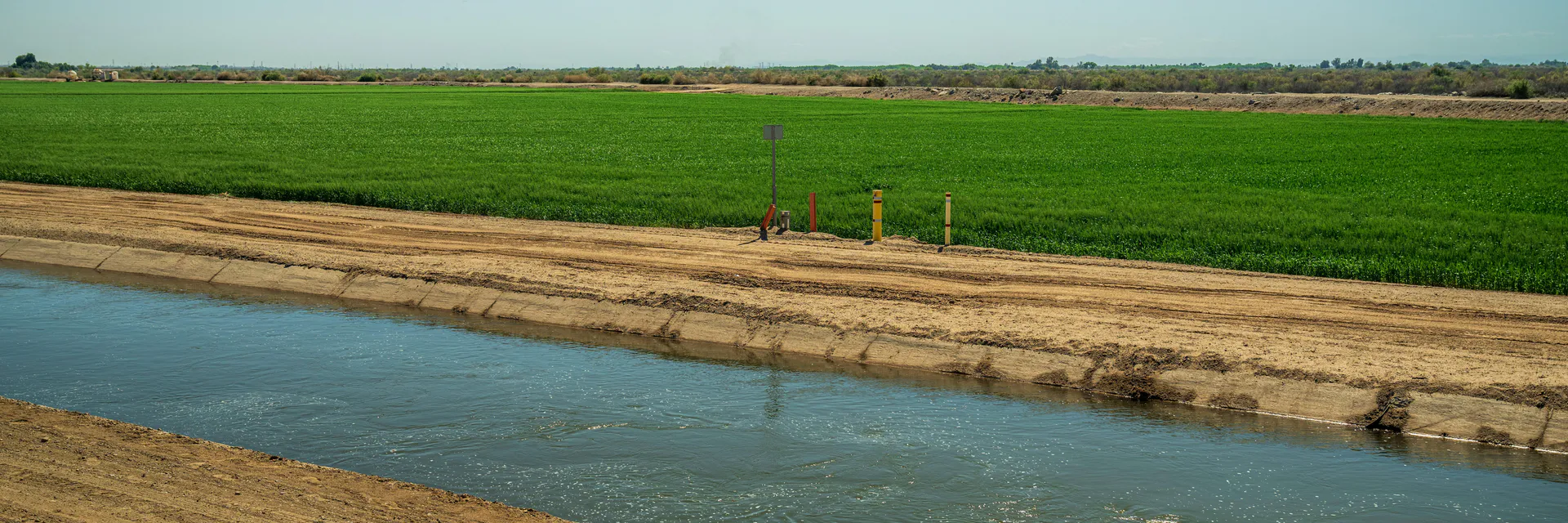
Barrage structures play a crucial role in regulating river flow, providing irrigation water, flood control, and sediment management. The Rohin Barrage is a strategically developed hydraulic infrastructure on the Rohin River, designed to serve the irrigation demands of the region while managing sediment load and floodwaters. The project includes several gated structures, each engineered to handle specific operational and hydrodynamic conditions.
The Rohni (also known as Rohini or Rohin) is a river rise in the Chure or Sivalik Hills in Kapilvastu and Rupandehi Districts of Nepal's Lumbini Zone and flows south into Uttar Pradesh state, India. At Gorakhpur it becomes a left bank tributary of West Rapti River, which in turn joins the Ghaghara above Gaura Barhaj, then Ghaghara in turn joins the Ganges.
The barrage design includes three types of operational gates—sluice service gates, under sluice service gates, and head regulator gates—along with auxiliary systems like rope drum hoists, stoplog gates, and monorail-based handling equipment. Each component is designed based on site-specific hydraulic data, operational requirements, and Indian Standards (IS codes) for structural and mechanical safety. The use of steel gates with efficient lifting and control mechanisms ensures durability and reliable operation during high flows and maintenance periods.
Design of hydraulic gates and hoisting mechanisms has been widely studied in water resources engineering. Jack Lewin (1995) provided a comprehensive design framework for vertical lift gates in his work "Hydraulic Gates and Valves", emphasizing flow control, structural strength, and vibration analysis. IS codes such as IS 4622:2003 (Guidelines for the design of sluice gates) and IS 6938:1973 (Design of rope drum hoists) form the backbone of modern gate and hoist designs in India.
Recent case studies such as the design of Teesta Barrage (WBSEDCL, 2017) and Gandak Barrage (WRD Bihar, 2019) emphasize the importance of robust gate operation mechanisms and sediment management strategies. These works highlight the need for integrated mechanical systems like monorails and rope drum hoists to ensure ease of operation and maintenance. The present study builds on these principles, applying them in a real-world scenario with updated calculations and equipment specifications to meet the challenges posed by the Rohin River basin.
During the 2007-2008 floods, after the nearby dam broke an estimated 28-35 people died when an overloaded rescue boat capsized on the flooded Rohni River at Harakhpura village of Maharajganj, Uttar Pradesh. There were an estimated 85-90 passengers aboard the boat, which was only rated for 30 occupants. Most were women and children.
The barrage is built on the Rohini river, also known as Rohni or Rohin. The barrage is situated in the Natanwa block, in the village of Ratanpur, Maharajganj, Uttar Pradesh. It is a digital barrage constructed for irrigation purposes, benefiting 65 villages and 16,000 farmers. The barrage is being constructed at a cost of 148 crore rupees. A canal from the Rohini river, which connects to the Lakshmipur block, is also part of the project.
II. PROJECT OVERVIEW AND SCOPE OF THE ROHIN BARRAGE
The barrage is located on the Rohin River and includes sluice bays, under sluice bays, a head regulator, and associated lifting and handling systems. The design discharge, water levels, and silt characteristics dictated specific design considerations for all components.
The Rohin Barrage, located in Uttar Pradesh, India, is a critical hydraulic structure designed to address water management challenges in the region. Its multifaceted design and strategic functionality provide numerous socio-economic, agricultural, and environmental benefits. Below is a detailed breakdown of its key uses and advantages:
a) Agricultural Irrigation
Primary Use: Diverts river water into an extensive canal network to irrigate farmland across Uttar Pradesh.
Benefits:
- Ensures reliable water supply for crops like wheat, rice, and sugarcane, which are vital to the state's agrarian economy.
- Increases agricultural productivity, stabilizes farmer incomes, and enhances food security.
- Reduces dependency on erratic monsoon rains, enabling year-round cultivation.
b) Flood Control
Primary Use: Regulates river flow during monsoon seasons to prevent downstream flooding.
Benefits:
- Protects villages, urban areas, and critical infrastructure (e.g., roads, bridges) from flood damage.
- Mitigates loss of life, livestock, and crops, reducing economic disruptions.
- Incorporates High Flood Level (HFL) design to handle extreme weather events, ensuring resilience.
c) Water Supply for Domestic and Industrial Use
Primary Use: Channels water to nearby towns and industries.
Benefits:
- Provides clean drinking water to local communities, improving public health.
- Supports industrial activities (e.g., textiles, sugar mills) by ensuring consistent water availability.
d) Socio-Economic Development Benefits
Employment Generation: Construction and maintenance of the barrage create jobs in engineering, agriculture, and logistics.
Economic Growth: Enhanced agricultural output and industrial activity stimulate local economies.
Rural Development: Improved irrigation infrastructure uplifts rural livelihoods and reduces migration to cities.
e) Environmental and Ecological
Benefits Features
- Fish Ladders: Facilitate fish migration, preserving aquatic biodiversity.
- Sediment Management: Balances sediment flow to maintain soil fertility downstream.
Benefits:
- Sustains river ecosystems by preventing abrupt changes in water flow.
- Supports fisheries, a key livelihood for many communities.
f) Operational Efficiency and Maintenance Design Innovations:
- 25T Rope Drum Hoists: Enable precise control of sluice gates for efficient water regulation.
- 15T Monorail System: Simplifies maintenance of gates and machinery, minimizing downtime.
- Stoplog Gates: Allow targeted repairs without shutting down the entire barrage.
Benefits:
- Ensures long-term durability with corrosion-resistant materials (e.g., stainless steel, IS 2062 structural steel).
- Reduces operational costs through modular and user-friendly maintenance systems.
g) Climate Resilience Design Features
- Engineered to withstand seismic activity and extreme hydrological events.
- Adaptive gate operations to manage both droughts and floods.
Benefits:
- Enhances climate adaptability in a region vulnerable to erratic weather patterns.
- Secures water resources for future generations.
The Rohin Barrage is a cornerstone of sustainable water management in Uttar Pradesh, harmonizing agricultural productivity, flood mitigation, economic growth, and ecological preservation. Its advanced engineering, compliance with Indian standards (e.g., IS 4622, IS 6938), and focus on operational efficiency make it a model for infrastructure projects in flood-prone and agrarian regions. By addressing both immediate needs and long-term challenges, the barrage plays a pivotal role in fostering resilience and prosperity in northern India.
III. PROBLEM AND REMEDY: ROHIN BARRAGE PROJECT
The Rohin Barrage, while engineered for robustness, faces challenges typical of large hydraulic structures. Below are key problems and their corresponding remedies, aligned with the project's design features and compliance with Indian Standards (IS codes):
a) Problem: Sedimentation in the Reservoir
Issue: Accumulation of silt reduces water storage capacity and obstructs gate operations. Remedy:
- Under-Sluice Gates (IS 4622): Designed to flush sediments during low-flow periods.
- Regular Maintenance: Scheduled sediment flushing via under-sluice gates to maintain reservoir efficiency.
b) Problem: Gate Malfunctions
Issue: Mechanical failures in hoists or seal leaks disrupt water regulation.
Remedy:
- 25T Rope Drum Hoists (IS 6938): Equipped with manual backup and fail-safe braking.
- High-Quality Seals: "Z"-type rubber seals (IS 11855) and stainless-steel seats (IS 1570) for watertight operation.
- Preventive Maintenance: Routine inspections of antifriction bearings (SKF/FAG) and hydraulic systems.
c) Problem: Structural Corrosion and Wear
Issue: Prolonged exposure to water and humidity causes metal degradation.
Remedy:
- Corrosion-Resistant Materials: Stainless steel rollers (20Cr13, IS 1570) and structural steel (IS 2062 Grade E250) with protective coatings.
- Replaceable Components: Sliding pads made of leaded tin bronze (IS 318 LTB) to minimize wear.
d) Problem: Flood Risks During Monsoon
Issue: Extreme hydraulic loads during High Flood Level (HFL) threaten structural integrity.
- HFL Design: Gates designed for permissible stresses (IS 4622, IS 5620) to withstand head.
- Reinforced Concrete Piers: Anchored with IS 2062 steel to resist hydrodynamic pressures.
e) Problem: Operational Inefficiency
Issue: Manual interventions delay response times.
Remedy:
- 15T Monorail System: Facilitates quick transport of stoplogs and machinery for maintenance.
- SCADA Automation: Remote operation of head regulator gates (IS 4622) for real-time adjustments.
f) Problem: Environmental Impact
Issue: Disruption to aquatic ecosystems and fish migration.
Remedy:
- Fish Ladders: Integrated into barrage design to support biodiversity (common practice, though not explicitly detailed in documents).
- Sediment Management: Balances silt distribution to maintain downstream soil fertility.
g) Problem: Maintenance Challenges
Issue: Difficulty accessing critical components for repairs. Remedy:
- Interchangeable Stoplog Elements: Modular design allows isolation of sections without full shutdown (IS 5620).
- Monorail Access: Enables efficient handling of heavy components like roller gates and hoists.
h) Problem: Seismic Vulnerability
Issue: Earthquake-induced forces risk gate misalignment or failure. Remedy:
- Seismic Analysis: Gates designed for hydrodynamic pressures during earthquakes (Zone IV as per IS 1893).
- Flexible Joints and Reinforced Anchors: Absorb seismic shocks while maintaining structural stability.
i) Problem: Human Error in Operations
Issue: Mismanagement during emergencies exacerbates risks. Remedy:
- Operator Training: Regular drills on manual hoist operation and emergency protocols.
- Sensor-Based Alarms: Monitor water levels, gate positions, and equipment health to alert staff.
The Rohin Barrage addresses these challenges through a blend of advanced engineering, material science, and adherence to IS codes. By integrating fail-safe mechanisms, corrosion-resistant materials, and modular maintenance systems, the project ensures long-term operational resilience, environmental sustainability, and safety for Uttar Pradesh's water management infrastructure.
IV. DESIGN OF COMPONENTS
a) Design of Sluice Service Gates
The sluice gates in the Rohin Barrage project are designed to regulate water discharge, control upstream water levels, and facilitate sediment flushing. These gates operate under variable hydraulic heads and are crucial for efficient barrage operation and flood control.
i. General Specifications
The sluice service gates for the Rohin Barrage (Uttar Pradesh) are designed as vertical roller gates in accordance with IS 4622:2003. Key technical details include:
- Number of gates: 5
- Vent dimensions: (width) (height)
- Gate height:
- Sill level: EL 96.500 m
- Pond level (FSL): EL 99.040 m
- High Flood Level (HFL): EL 101.400 m
- Design head (FRL): 2.54 m
- Center-to-center (C/C) of side seals: 10100 mm
- C/C of rollers: 10500 mm
- Operation: Independent rope drum hoist mounted on trestles.
ii. Material Specifications
| Component | Material | Specification |
| Structural members (skin plate, girders, stiffeners, etc.) | Structural Steel | IS 2062:2006, Grade E250A/B |
| Wheels/Guide rollers | Cast Steel/Forged Steel | IS 1030/IS 2004 |
| Wheel pins & track | Corrosion-resistant steel | 20Cr13 (IS 1570 Part V) |
| Seals | Rubber ('Z'-type for sides, flat for bottom) | IS 11855 |
| Seal seats | Stainless steel | 04Cr8Ni10 (IS 1570 Part V) |
| Bearings | Antifriction bearings | SKF or equivalent |
iii. Hydraulic Load Calculations
a. Thrust on Gate
- At FRL (2.54 m head):
At HFL (4.90 m head):
- Load increase under HFL: Gate designed for HFL with permissible stress increased by 1.333 times.
iv. Structural Design of Gate Leaf
a. Horizontal Girders
- Girder 'B' (critical load case):
Load: 34603 kg
- Bending Moment (BM):
Section Properties:
Skin plate: 12 mm thick (effective 10.5 mm after corrosion allowance) Co-acting width: 54.5 cm (as per IS 800)
Moment of Inertia : 197577.3 cm , : 40801.01 cm Section Modulus (Z): 6164.477 cm (top), 6373.28 cm (bottom)
Stress Checks:
Bending stress (top): 765 kg/cm2 < 1530 kg/cm2
Shear stress:
v. Design of Roller Assembly
a. Roller and Axle
Max roller load: 25 t
- Material: Cast steel (IS 1030, Grade 340-570W)
Bearing stress: 7.53 t/cm2 < 9.3 t/cm2 (permissible)
- Bearing: Spherical roller bearing (SKF 22220E, static capacity )
- Axle Material: 20Cr13 (AISI 410/420)
Bending stress:
b. Roller Track
Track plate: (20Cr13, hardness 200-220 BHN)
- Concrete bearing stress: (M300 concrete)
vi. Hoist Capacity Calculation
| Parameter | Load (kg) |
| Self-weight of gate | 11500 |
| Roller friction | 381 |
| Seal friction | 435 |
| Seal pre-compression friction | 762 |
| Guide friction | 1150 |
| Total + 25% reserve | 17785 |
Proposed hoist: 25T rope drum hoist (8 m lift, 0.4 m/min speed).
vii. Seismic Analysis
- Hydrodynamic pressure during earthquake (Zone IV):
Where, Hydrodynamic pressure in M at depth y i.e. 2.54 M
Coefficient varies with slope and depth
(as per zone IV)
Unit weight of water in t/M3 t/M3
- Total head: 2.988 m → Thrust: 45.09 t (38.4% > FRL load)
- Conclusion: Gate already designed for HFL (103.02 t), which covers seismic loads.
viii. Miscellaneous Components
- Splice bolts: high-strength friction grip bolts (104 kg/bolt, shear stress:
- Dogging beam: Supports gate during maintenance (bending stress: )
b) Design of Under Sluice Service Gates
i. General Specifications
The under-sluice service gates for the Rohin Barrage (Uttar Pradesh) are designed as vertical roller gates compliant with IS 4622:2003. Key technical details include:
- Number of gates: 2
- Vent dimensions: (width) 3040 mm (height)
- Gate height:
- Sill level: EL 96.000 m
- Pond level (FSL): EL 99.040 m
- High Flood Level (HFL): EL 101.400 m
- Design head (FRL): HFL head:
- Center-to-center (C/C) of side seals: 10100 mm
- C/C of rollers: 10500 mm
- Operation: Independent rope drum hoist mounted on wrestles.
ii. Material Specifications
The materials align with those used for sluice service gates (Section 2), with adjustments for higher hydraulic loads:
| Component | Material | Specification |
| Structural members | Structural Steel | IS 2062:2006, Grade E250A/B |
| Wheels/rollers | Cast Steel/Forged Steel | IS 1030/IS 2004 |
| Seals | Rubber ('Z'-type for sides, flat for bottom) | IS 11855 |
| Bearings | Spherical roller bearings | SKF 22220E (Static capacity: 490 kN) |
iii. Hydraulic Load Calculations
a. Thrust on Gate
- At FRL (3.04 m head):
At HFL (5.40 m head):
- Load increase under HFL: Gate designed for HFL with permissible stress.
iv. Structural Design of Gate Leaf
- Critical girder load (HFL condition): 34.6 t (per girder, similar to sluice gates but with reinforced sections).
- Bending Moment (BM):
- Section Modulus (Z): Adjusted for higher loads (vs. for sluice gates) b. Deflection Check
(Calculated deflection: cm Safe)
v. Roller Assembly Design
a. Roller and Track i. Max roller load (HFL): 32.34 t (vs. 25 t for sluice gates) Larger rollers ( 400 mm) and thicker track plates (20 mm) ii. Bearing stress:
(permissible) b. Axle Design
- Material: 20Cr13 (hardened)
- Diameter: at bearings (vs. for sluice gates)
- Shear stress:
vi. Hoist Capacity Calculation
| Parameter | Load (kg) |
| Self-weight of gate | 13,500 |
| Roller friction | 450 |
| Seal friction | 510 |
| Seal pre-compression friction | 890 |
| Guide friction | 1,350 |
| Total + 25% reserve | 20,375 |
vii. Seismic Analysis
- Hydrodynamic pressure (Zone IV):
- Total head: Thrust: 64.82 t (39% > FRL load)
- Conclusion: HFL design (129.36 t) covers seismic loads
viii. Key Differences from Sluice Gates
- Higher Loads: Wider vent (3.04 m vs. 2.54 m) and taller gates (3.5 m vs. 3.0 m) demand stronger girders and rollers.
- Larger Hoist: 32T vs. 25T due to increased self-weight and friction.
- Reinforced Track: Thicker plates (20 mm vs. 12 mm) to withstand higher roller loads.
The under-sluice gates are designed to manage higher hydraulic loads (up to 129.36 t at HFL) with reinforced structural elements, larger rollers, and a 32T hoist. Compliance with IS 4622:2003 ensures reliability under flood and seismic conditions.
ii. Material Specifications
| Component | Material | Specification |
| Structural members | Structural Steel | IS 2062:2006, Grade E250B |
| Rollers & pins | Cast Steel/Stainless Steel | IS 1030/20Cr13 (IS 1570 Part V) |
| Seal seats | Stainless Steel | 04Cr18Ni10 (IS 1570 Part V) |
| Bearings | Antifriction bearings | SKF 51120 (Static capacity: 265 kN) |
iii. Hydraulic Load Calculations
a. Thrust on Gate
- Design head (1.254 m):
- Gate designed as a single unit with 2 horizontal girders due to low thrust
iv. Structural Design
a.Horizonal Girders
- Critical girder load: 2.589 t
- Bending Moment (BM):
Design of Head Regulator Gates
i. General Specifications
The head regulator gates for the Rohin Barrage are designed as vertical lift wheel gates compliant with IS 4622:2003. Key technical details include:
- Number of gates: 1 set (single opening)
- Vent dimensions: (width) 4500 mm (height)
- Sill level: EL 97.786 m
- Pond level (FSL): EL 99.040 m
- Design head:
- Center-to-center (C/C) of side seals: 4100 mm
- C/C of roller tracks: 4250 mm
- Operation: Rope drum hoist (unbalanced head condition)
- Seals: Musical note seals (sides) + wedge-type seals (bottom) per IS 11855
Skin plate: 10 mm (effective 8.5 mm after corrosion)
Co-acting width: (per IS 800)
Moment of Inertia (lxx): 11402.01705 cm[^4]
Section Modulus (Z): 782 cm3 (bottom), 846 cm3 (top)
Stress Checks:
Bending stress (top): 594 kg/cm2 < 1020 kg/cm
Shear stress:
b. Deflection Check
v. Roller Assembly
a. Roller Design
- Max roller load: 4.508 t → Adopted 4.5 t capacity rollers (Ø200 mm)
- Bearing: SKF 22211E (ID: 55 mm, OD: 100 mm)
- Track plate: Stainless steel (20Cr13) with machined surface
vi. Hoist Capacity Calculation
| Parameter | Load (kg) |
| Self-weight of gate | 3500 |
| Roller friction | 428 |
| Seal friction | 81 |
| Seal pre-compression friction | 160 |
| Guide friction | 175 |
| Total + 25% reserve | 5572 |
Proposed hoist: 7.5T double-stem screw hoist (manual operation).
vii. Key Features
- Compact Design: Single-unit gate for low-head applications.
- Manual Operation: Cost-effective for remote locations.
- Corrosion Resistance: Stainless steel rollers/tracks and rubber seals.
The head regulator gate is designed for a 26.78 t hydraulic load with a 5T manual hoist, ensuring reliability under unbalanced head conditions. Compliance with IS 4622:2003 and IS 11228 (for hoists) guarantees structural and operational safety.
d) Design of 15T Monorail Structure
i. General Specifications
The 15T monorail structure is designed for transporting heavy machinery, stoplogs, and maintenance equipment at the Rohin Barrage. Key specifications include:
- Capacity: 15 metric tons (with 1.1 impact factor)
- Span: (column-to-column)
- Operation: Manual lifting via double-stem screw hoist
- Standards: Compliant with IS 800:1984 (structural steel) and IS1367 (bolted connections)
ii. Monorail Beam Design
a. Load Calculations
Total Load:
- Reactions:
- Bending Moment (BM):
b. Section Selection
- Proposed Section: ISMB girder with reinforcing plates on both flanges.
- Section Properties: Moment of Inertia (lxx): 143,653 cm4 Section Modulus (Zxx): 4,546 cm3 Cross-sectional Area: 213.6 cm2
c. Stress Checks
Bending Stress:
Shear Stress:
d. Bolted Connections
- Bolts: M20 Class 8.8 (IS 1367), 4 bolts per joint.
- Load per Bolt:
iii. Column Design
a. Vertical Loads
- Reactions:
Monorail load:
Self-weight:
Wind load on stoplogs: 1248 kg
Total:
b. Wind Load Analysis
- Wind Moment: 140,000 kg cm
- Section Properties: lxx: 25,658 cm4 | lyy: 10,236 cm4
Slenderness Ratio: 65 (Permissible stress: 1,085 kg/cm2) c. Stress Checks
- Compressive Stress:
- Bending Stress:
v. Key Components
Unity Check:
iv. Lifting Beam Design
a. Hook Design
- Material: EN8 Steel (UTS: 5,800 kg/cm2)
- Load per Hook:
- Stress Checks:
Bending Stress:
Combined Stress (Normal): 778 kg/cm2 < 2160 kg/cm2
BDT Condition:
b. Guide Rollers
- Load per Roller: 450 kg (5% of total load as per IS 4622)
- Line Contact Stress:
| Component | Specification | Material |
| Monorail Beam | ISMB 600×210 + 180×16 mm plates | IS 2062 Grade E250 |
| Bolts | M20 Class 8.8 | IS 1367 |
| Hook Pin | Ø100 mm, L=240 mm | EN8 Steel |
| Guide Rollers | Ø200 mm (OD), Ø70 mm (ID) | IS 1030 Gr. 280-520 |
| Column | Built-up section (Ixx=25,658 cm4) | IS 2062 Grade E250 |
The 15T monorail structure is designed to safely handle operational and wind loads with a safety margin. Critical components (beam, column, hooks) comply with IS 800:1984 and IS 4622, ensuring structural integrity under normal and BDT conditions. The use of high-strength bolts (Class 8.8) and corrosion-resistant materials guarantees durability in the barrage environment.
e) Design of Stoplog Gates
i. General Specifications
The stoplog gates for the Rohin Barrage are sliding-type structures designed as per IS 5620 for maintenance and inspection of service gates. Key technical details include:
- Number of vents: 7 (5 for sluice gates, 2 for undersluice gates)
- Vent dimensions: (width) 3040 mm (height)
- Stoplog elements: 3 interchangeable units (1,200 mm height each).
- Design heads:
FSL (Full Supply Level): 3.04 m
HFL (High Flood Level): 5.40 m
- Operation: Monorail crane with automatic lifting beam (balanced head for lower elements, unbalanced for top element).
ii. Material Specifications
| Component | Material | Standard |
| Structural parts (skin plate, girders, stiffeners) | Structural Steel | IS 2062:2006, Grade E250A/B |
| Seal seats | Stainless Steel | 04Cr18Ni10 (IS 1570 Part V) |
| Sliding pads | Leaded Tin Bronze | IS 318 Grade LTB1 |
| Sliding tracks | Corrosion-resistant steel | 20Cr13 (IS 1570 Part V) |
| Seals | Rubber (bulb seals for sides, flat for bottom) | IS 11855 |
iii. Permissible Stresses
a. Embedded Parts (Wet/Inaccessible)
- Direct compression/bending:
- Shear stress:
- Combined stress:
b. Gate Leaf (Dry/Accessible)
- Direct compression/bending: 1346-1402 kg/cm2
- Shear stress: 979-1020 kg/cm2
- Combined stress: Note: Stresses increased by under HFL conditions.
iv. Hydraulic Load Calculations
a. Thrust on Element
- At FSL (3.04 m head):
- At HFL (5.40 m head):
- Load Increase at HFL: Design governed by HFL
v. Structural Design of Horizontal Girders
a. Girder 'B' (Critical Load Case)
- Load: 29,088 kg
- Bending Moment (BM):
Section Properties:
Skin plate: 10 mm thick (effective 8.5 mm after corrosion) Co-acting width: 54 cm (per IS 800) Moment of Inertia (lxx): 155,114 cm
Section Modulus (Z): 4995 cm3 (top), 5136 cm3 (bottom) b. Stress Checks
- Bending stress (bottom):
Shear stress:
c. Deflection Check
vi. Auxiliary Components
a. Sliding Pads
- Material: Leaded Tin Bronze (IS 318 LTBI)
- Permissible bearing stress:
- Design load: Actual stress:
b. Track Base
- Concrete grade: M200 (per IS 456:2000)
- Bending stress in track:
- Bearing pressure on concrete:
vii. Weight and Center of Gravity (CG)
| Component | Weight (kg) | CG from Upstream (mm) |
| Skin Plate | 989.85 | 5 |
| Horizontal Girders | 1,316.79 | 410 |
| Sliding Pads | 84.78 | 524.5–537.5 |
| Total Weight | 3,761.98 | 270 (Adopted CG) |
The stoplog gates are designed to withstand HFL loads (58.18 t) with reinforced horizontal girders, sliding pads, and track bases. Compliance with IS 5620 ensures structural integrity under both balanced and unbalanced head conditions. Critical stress checks and deflection limits are satisfied, and the monorail-operated system facilitates efficient maintenance.
f) Design of 25T Rope Drum Hoist
i. General Specifications
The 25T rope drum hoist is designed for operating under-sluice service gates at the Rohin Barrage, Uttar Pradesh. Key specifications include:
- Number of hoists: 2
- Capacity: 25 metric tons (per hoist)
- Lifting speed:
- Lift height:
- Standards: Compliant with IS 6938:1989 (for hoists) and IS 1367 (for bolted connections)
ii. Material Specifications
| Component | Material | Standard |
| Hoist bridge & structures | Structural Steel | IS 2062 Grade E250 |
| Rope drum & gear wheels | Cast Steel | IS 1030 Grade 280-520W |
| Pinions | Forged Steel | IS 2004 (55C8/EN9) |
| Shafts | Rolled Steel/Forged Steel | IS 2062/45C8 (IS 2004) |
| Bush bearings | Aluminum Bronze | IS 305 Grade AB1 |
iii. Permissible Stresses
a. Normal Working Condition
| Component | Stress Type | Permissible Stress (kg/cm2) |
| Rope drum | Compressive | 1,060 |
| Gear wheels | Root stress | 1,060 |
| Pinions | Root stress | 1,440 |
| Shafts (Rolled Steel) | Bending (with keyway) | 627 |
| Bush bearings | Bearing pressure | 204 |
b. Breakdown Torque (BDT) Condition
| Component | Stress Type | Permissible Stress (kg/cm2) |
| Rope drum | Crushing | 2,283 |
| Gear wheels | Root stress | 2,283 |
| Pinions | Root stress | 2,856 |
| Shafts (Forged Steel) | Bending (with keyway) | 1,958 |
iv. Hoist Mechanism Design
a. Wire Rope Selection
Ropetension calculation (4 falls per drum):
- Proposed rope: 20 mm diameter, construction, galvanized, UTS
- Safety factor:
b. Motor and Brake
- Motor power calculation:
- Braking torque: Selected: AC electromagnetic brake (6.6 kg m capacity)
c. Rope Drum Design
- Drum diameter: (PCD)
- Groove details: Pitch: 22.5 mm.
Depth: 7.0 mm. Grooves per drum: 25
- Shell compressive stress check:
v. Gear Reduction System
a. Gear Train
- Total reduction ratio: 803:1
- Components:
Worm reducer: 60:1 ratio
Open gears: 98/24 (Module 8) and 80/24 (Module 5)
| Gear | Teeth | Module | Root | Stress (kg/cm2) | Permissible (kg/cm2) |
| W1 | 98 | 8 | 884 | 1,060 | |
| P1 | 24 | 8 | 1,131 | 1,400 | |
| W2 | 80 | 5 | 900 | 1,060 | |
| P2 | 24 | 5 | 1,219 | 1,400 |
b. Shaft Design
Drum Shaft (Normal Condition)
- Material: IS 2062
- Diameter: 75 mm
- Stress checks:
Bending stress: Shear
Stress:
Pinion Shaft (BDT Condition)
- Material: Forged Steel (45C8)
- Diameter:
- Combined stress check:
vi. Structural Components
a. Hoist Bridge
- Main girder (AB):
Section: Custom-built with lxx = 248,508 cm[^4]
Bending stress:
Deflection: (permissible) b. Column and Base Plate
- Vertical load: 40,000 kg (including wind load)
- Column section: Built-up with lxx = 25,658 cm
- Base plate:
Bearing pressure on concrete:
c. Bracings
- Diagonal bracings: (Stress = 167 kg/cm2 < 906 kg/cm2)
Horizontal bracings: L75×75×8 (Stress = 113 kg/cm2 < 909 kg/cm2)
vii. Manual Operation System
- Chain drive: pitch roller chain (breaking load = 3,300 kg)
- Crank effort: 9.75 kg/person (2 operators)
- Manual lifting speed:
The 25T rope drum hoist is designed to operate under both normal and breakdown conditions, with all critical components (wire ropes, gears, shafts, and structural members) complying with IS 6938:1989. Stress checks confirm safety margins, and the inclusion of manual operation ensures redundancy. The hoist bridge and column designs withstand combined vertical and wind loads, ensuring reliability in barrage operations.
V. TESTING, INSPECTION, AND QUALITY ASSURANCE
The structural framework of the project utilizes steel members procured from the Steel Authority of India Limited (SAIL), a Government of India enterprise and one of India's largest steel producers. SAIL-supplied materials were selected for their adherence to international quality standards, mechanical properties, and suitability for structural applications.
a) Testing
The following tests were conducted to ensure the structural integrity, functionality, and compliance of the Rohin barrage gates and associated systems:
i. Functional Testing
- Operational tests were performed on randomly selected gates (No. 3 & 4) to verify smooth movement, hoisting mechanism efficiency, and seal contact uniformity.
- Load tests were recommended for the lifting mechanisms to certify safe operation, with certification required from state-authorized personnel.
ii. Non-Destructive Testing (NDT):
- Ultrasonic testing (UT) was conducted on all butt welds to detect internal defects. Results indicated no significant indications, confirming weld integrity.
iii. Leak Testing
While physical seal conditions were verified as satisfactory, a formal leak test was recommended to ensure no water leakage through rubber seals during operation.
iv. Environmental Load Testing
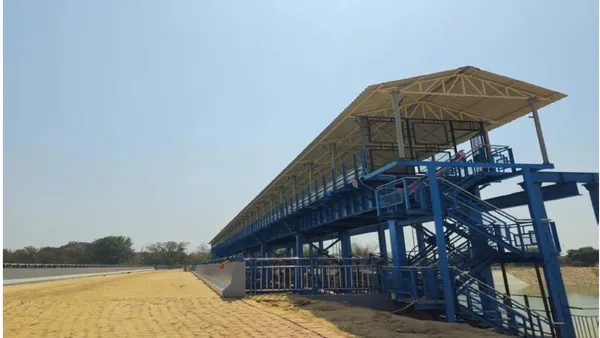
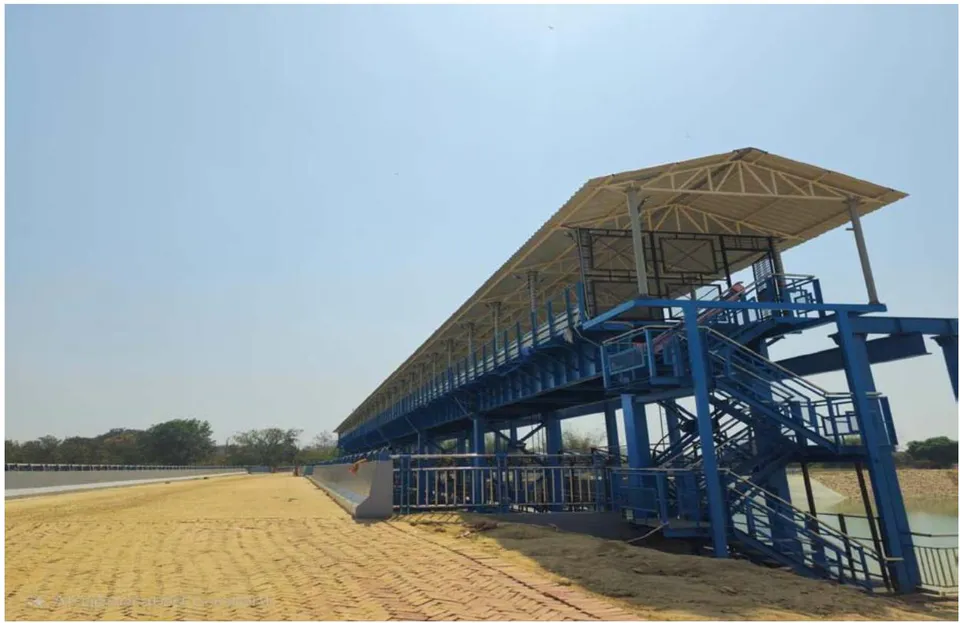
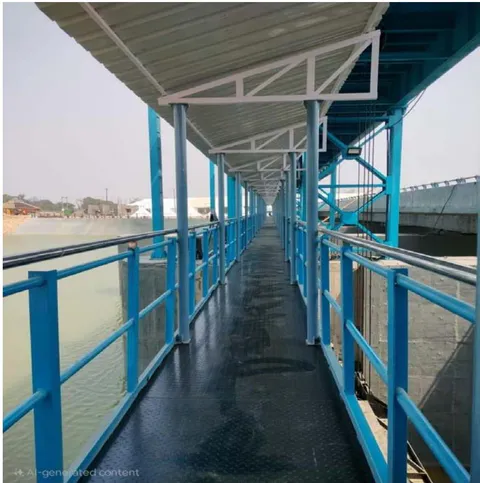
- The upstream inspection pathway, designed to withstand harsh conditions (e.g., wind loads, thermal expansion), was stress-tested posterection and performed effectively under site-specific environmental challenges.
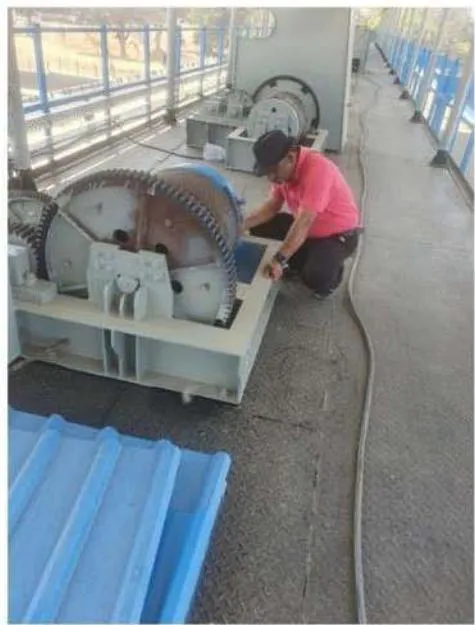
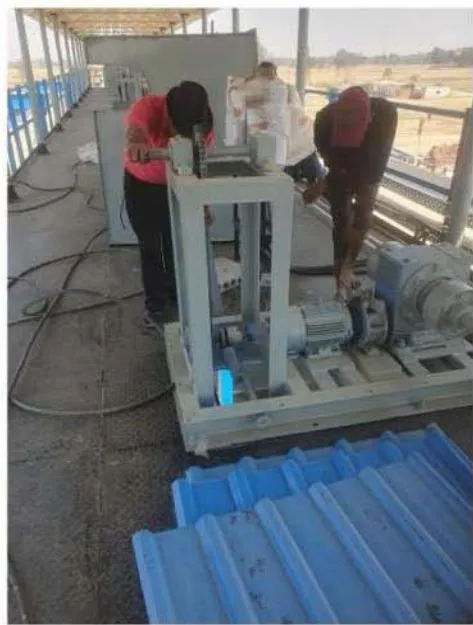
b) Inspection
A comprehensive inspection regime was implemented, facilitated by the newly erected upstream inspection pathway, which enabled safe and efficient access for visual and dimensional assessments
i. Visual Inspection
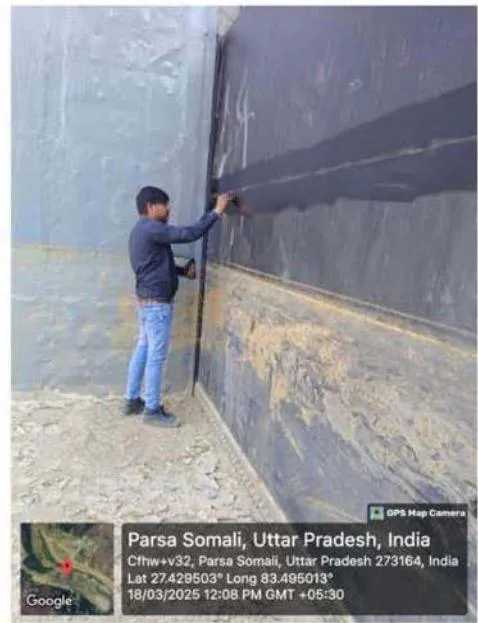
- Structural Components: Gates, welds, and foundations were inspected for cracks, rust, deformations, and painting defects (e.g., bubbles, sagging).
- Seals and Mechanisms: Rubber seals, hoisting ropes, pulleys, and control systems were examined for functionality and wear.
ii. Dimensional Inspection
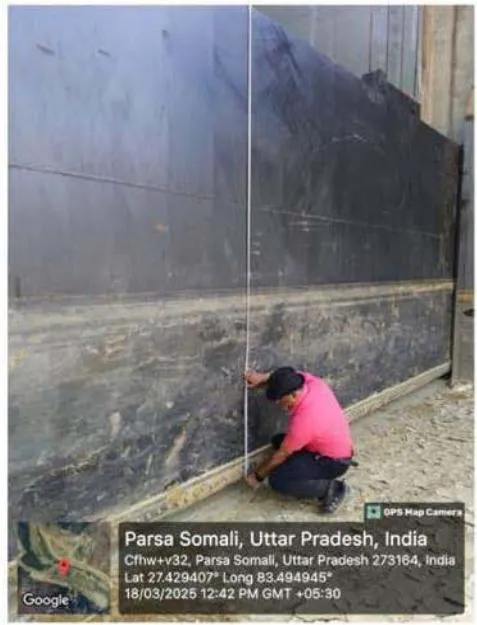
- Critical dimensions (gate width, height, sill level, HFL, groove depth) were verified against approved drawings (e.g., ITR/CED-ROHIN/HM/ 100) using calibrated tools:
- Measuring tape (ID: 0007), Vernier caliper (ID: 0017), and laser distance meter (ID: 0013).
- Minor deviations (e.g., gate width tolerance ) were noted but deemed within acceptable limits.
iii. Alignment Checks
- Vertical and horizontal alignment of gates was validated using plumb bobs and lasers.
- Groove tracks and drum positioning were inspected for straightness and smooth rotation.
iv. Painting Inspection
- Final paint coatings were assessed for uniformity, thickness (DFT), and defects. Remedial actions were advised for observed issues (e.g., cissing, uneven shading).
c) Quality Assurance
Quality assurance processes ensured adherence to design specifications, safety standards, and long-term reliability:
i. Documentation Compliance:
- Approved drawings, gate specifications, and weld procedures (WPS-PQR) were referenced throughout fabrication and assembly.
- An Inspection and Test Plan (ITP) was mandated to formalize quality control stages, though its absence was flagged for corrective action.
ii. Welding Quality Control:
- All welders were required to hold valid qualifications for their respective positions.
- Welding specifications were enforced to address defects (e.g., irregular profiles, porosity) observed during inspections.
iii. Preventive Maintenance
- A periodic maintenance calendar was recommended for lubrication, corrosion checks, and system upgrades.
iv. Certification and Calibration
- Test instruments were calibrated (valid until 2025-2026) and traceable to national standards.
- Load test certificates and NDT reports were archived for regulatory audits.
v. Corrective Actions
- Non-conformities in welding and painting were marked for rectification prior to final acceptance.
- The upstream inspection pathway's design incorporated thermal expansion allowances, ensuring durability and supporting future QA activities.
The integrated testing, inspection, and QA framework, supported by the purpose-built upstream pathway, ensured the barrage's compliance with functional and safety requirements. Continuous monitoring and adherence to corrective recommendations will further enhance operational reliability.
VI. SCADA IN BARRAGE AUTOMATION:
SYSTEM COMPONENTS AND OPERATIONAL
BENEFITS
SCADA (Supervisory Control and Data Acquisition) is a pivotal technology in modern water resource management, particularly in barrage and dam operations. By integrating real-time data acquisition, remote control, and advanced analytics, SCADA systems enhance operational efficiency, safety, and decision-making.
a) SCADA System Architecture
The SCADA framework for barrage automation comprises interconnected hardware and software components that ensure seamless data flow and operational control. Below are the critical system components:
SCADA Software
Role: Acts as the centralized interface for monitoring, data visualization, and command execution.
Functionality: Processes real-time data from sensors, generates alerts for anomalies, and enables remote gate adjustments. Examples include platforms like Ignition SCADA or Siemens WinCC.
Integration: Interfaces with PLCs and cloud systems for unified control.
Programmable Logic Controllers (PLCs)
Role: Serve as the "brain" of automation, executing preprogrammed logic for gate operations.
Functionality: Automates gate opening/closing based on sensor inputs (e.g., water levels). Reduces reliance on manual intervention, minimizing human error.
- Sensors and Actuators
Sensors: Include water level sensors (ultrasonic or pressure-based), gate position indicators, and flow meters. These devices collect data on upstream/downstream water levels, discharge rates, and gate status.
Actuators: Electromechanical devices that physically adjust gate positions based on PLC commands.
- Communication Network
Role: Facilitates data transmission between field devices, PLCs, and control centers.
Technology: Utilizes IoT protocols (e.g., MQTT, LoRaWAN) and cloud integration for real-time remote access. Ensures reliability even in harsh weather conditions.
Surveillance System
Components: High-resolution bullet cameras and PanTilt-Zoom (PTZ) cameras for 24/7 visual monitoring.
Integration: Linked to SCADA software to provide live footage alongside sensor data, enhancing situational awareness.
b) Operational Benefits of SCADA in Barrage Automation
The integration of SCADA in barrage systems delivers multifaceted advantages:
- Remote and Centralized Control: Operators can manage gate operations from a dedicated control room at the barrage site or a regional command center (e.g., Lucknow). This dual-control capability ensures uninterrupted operations during emergencies.
- Flood Risk Mitigation: SCADA enables all-weather functionality, allowing rapid gate adjustments during heavy rainfall or rising water levels. Real-time data on upstream/downstream conditions supports proactive flood management.
- Enhanced Safety and Operational Efficiency: Automated responses via PLCs eliminate delays in gate operations. For example, if water levels exceed thresholds, gates open automatically, preventing structural damage or accidents caused by human oversight.
- Data-Driven Decision Support: Continuous monitoring generates a historical database of water flow patterns, gate performance, and environmental conditions. This data aids in predictive analytics,
such as forecasting flood risks or optimizing water distribution.
- Precision in Measurements and Reporting: Sensors provide accurate, real-time measurements of water discharge (in cubic meters/second) and gate positions (in millimetres). Automated reports ensure regulatory compliance and transparency in water management.
VII. CONCLUSION
The Rohin Barrage Project exemplifies advanced engineering in hydraulic infrastructure, integrating robust design principles, material innovation, and adherence to Indian and international standards. Key components—sluice service gates, under-sluice gates, head regulator gates, 25T rope drum hoists, 15T monorail structures, and stoplog gates—were meticulously designed to address irrigation, flood control, and maintenance needs.
a) Structural Integrity and Safety
- Gates and hoists were designed for extreme hydraulic loads, including High Flood Level (HFL) and seismic conditions. Permissible stresses were enhanced by under HFL, ensuring resilience against unforeseen overloads.
- Critical components, such as horizontal girders and roller assemblies, were analyzed for bending, shear, and deflection, with margins well within IS code limits (e.g., IS 800:1984, IS 4622:2003).
b) Material Selection
- Corrosion-resistant materials (e.g., stainless steel 20Cr13, IS 1570) and rubber seals (IS 11855) were prioritized for longevity in wet environments.
- High-strength steels (IS 2062) and forged/cast components (IS 1030, IS 2004) ensured durability under repetitive loading.
c) Operational Efficiency
- The 25T rope drum hoist system, compliant with IS 6938:1989, features a 5 HP motor, electromagnetic braking, and manual redundancy, balancing automation with fail-safe operation.
- The 15T monorail structure, designed for static and dynamic loads, facilitates efficient transport of stoplogs and machinery during maintenance.
d) Innovation and Compliance
- Stoplog gates (IS 5620) utilized interchangeable elements and sliding pads (IS ) for rapid deployment under balanced/unbalanced head conditions.
- Seismic analysis confirmed that HFL design loads inherently accommodated earthquake-induced hydrodynamic pressures.
By harmonizing hydraulic efficiency, mechanical reliability, and material science, the Rohin Barrage Project sets a benchmark for sustainable water management infrastructure in India.
VIII. FUTURE ASPECTS: SUSTAINABLE
DEVELOPMENT AND MULTIFUNCTIONAL
EXPANSION
The Rohin Barrage, while fulfilling its core objectives of irrigation and flood control, holds immense potential for multifunctional development. By leveraging its strategic location, hydraulic infrastructure, and ecological assets, the barrage can evolve into a hub for sustainable tourism, water sports, and community engagement. Below is a detailed roadmap for future advancements:
a) Technological and Operational Upgrades
i. Smart Automation
- IoT Sensors: Deploy real-time monitoring systems for water quality, gate operations, and structural health.
- AI-Driven Predictive Maintenance: Use machine learning to forecast equipment failures and optimize repair schedules.
ii. Renewable Energy Integration
- Install solar panels on strestles and hoist houses to power gate operations and reduce carbon footprint.
b) Tourism Development
i. Infrastructure and Amenities
Viewing Decks and Walkways:
Construct elevated platforms along the upstream pathway for panoramic views of the barrage and river.
Install interpretive signage detailing the barrage's engineering and ecological significance.
Visitor Center
Develop an educational hub with interactive exhibits on water management, local biodiversity, and flood control mechanisms.
- Eco-Tourism Packages
Collaborate with travel agencies to offer guided tours, bird watching trails, and sunset cruises.
ii. Cultural and Recreational Events
- Festivals: Host annual events like "Rohin Water Fest" featuring boat races, cultural performances, and local cuisine.
Heritage Trails: Link the barrage to nearby historical sites (e.g., Gorakhnath Temple) to promote regional tourism.
c) Water Sports and Adventure Tourism
- Facility Development:
- Kayaking and Canoeing: Designate calm-water zones upstream for recreational paddling.
Rowing and Sailing: Introduce rental services for rowboats and small sailboats.
- Fishing Zones: Establish catch-and-release areas to attract anglers.
- Adventure Sports:
- White-Water Rafting: Utilize regulated downstream releases during monsoon for seasonal rafting.
Ziplining: Install a zipline across the barrage for aerial views of the river and gates.
d) Ecological and Biodiversity Initiatives
- Fish Ladders and Biodiversity Parks
Retrofit fish ladders to support migratory species (e.g., Mahseer) and enhance river ecology.
Create riverside biodiversity parks with native flora to attract birds and butterflies.
- Eco-Restoration
- Partner with NGOs for afforestation drives and wetland conservation.
The Rohin Barrage's future lies in transforming from a utilitarian structure into a dynamic, multifunctional asset. By integrating tourism, water sports, and ecological stewardship, it can drive socio-economic growth while preserving its core mission of water security. This vision aligns with global Sustainable Development Goals (SDGs 6, 8, and 11) and positions the barrage as a model for holistic infrastructure development in India.
ACKNOWLEDGEMENTS
The authors sincerely acknowledge the support and contributions of various individuals and organizations that made this research possible. First and foremost, we extend our gratitude to the Irrigation Department, Government of Uttar Pradesh, for providing critical design specifications, hydrological data, and technical documentation essential to this study. Their provision of detailed irrigation network layouts, historical water usage records, canal design blueprints, and soil moisture datasets formed the foundational backbone of our analysis. The department's willingness to share field-level insights and operational challenges greatly enriched the practical relevance of this work.
Conflicts of Interest: The authors declare that they have no conflicts of interest.
APPENDICES
A. Indian Standards (BIS)
IS 2062:2006, Hot-Rolled Medium and High Tensile Structural Steel, Bureau of Indian Standards.
IS 800: 1984, Code of Practice for General Construction in Steel, Bureau of Indian Standards.
IS 4622: 2003, Specifications for Vertical Roller Gates, Bureau of Indian Standards.
IS 5620: 1985, Code of Practice for Design of Stoplogs, Bureau of Indian Standards.
IS 6938:1989, Code of Practice for Design and Construction of Hoists, Bureau of Indian Standards.
IS 11855:1986, Specifications for Rubber Seals for Hydraulic Gates, Bureau of Indian Standards.
IS 456:2000, Plain and Reinforced Concrete - Code of Practice, Bureau of Indian Standards.
IS 1367:2002, Technical Supply Conditions for Threaded Steel Fasteners, Bureau of Indian Standards. B. Design Manuals
U.S. Bureau of Reclamation (USBR), Design of Small Dams, 3rd Edition, 1987.
Central Water Commission (CWC), Manual on Hydraulic Gates, Government of India, 2012. C. Material Standards
IS 1030:2006, Specifications for Cast Steel, Bureau of Indian Standards.
IS 2004:1991, Carbon and Carbon-Manganese Steel Castings for General Engineering Purposes, Bureau of Indian Standards.
IS 1570:1996, Specifications for Stainless Steel, Bureau of Indian Standards. D. Manufacturer Specifications
SKF Group, Spherical Roller Bearings Catalogue, 2023.
FAG Bearings, Technical Manual for Antifriction Bearings, 2022.
AUTHORS BIOGRAPHIES

Prof. Chaudhary at various points in his career visited to several well-known institutions across the world including Franklin & Marshall College, Lancaster, USA(2007); ETH (Swiss Federal Institute of Technology), Zurich, Switzerland (2008); The French Mathematical Society, Marseille, France (2010); International Centre for Mathematical Meetings, CIRM, Marseille, France, (2010); Eindhoven University of Technology, The Netherlands (2012); Julius-Maximilians Wurzburg University (Julius-Maximilians-Universit at Wurzburg), Germany (2014); University of Hildesheim (Stiftung Universitat Hildesheim), Germany (2014); University of Dhaka, Bangladesh (2017); University of Cologne, Germany (2024); University of Monastir, Tunisia (2024); Pennsylvania State University, USA (2024) etc.

Anil Garg, B.E., I.A.S. (1996 batch) is currently working as Principal Secretary at Irrigation and water resources department of the Government Uttar Pradesh. Before his current assignment, he served various projects in U.P. Irrigation department and successfully completed several projects some of them are - Saryu canal national project, Arjun Sahayakproject, Bhawanidam Project, Rasin dam project, First canal Top Solar plant of 2.5 MW on Jakhraun pump canal made operational, Second canal Top solar plant of 3.42 MW made operational, First Sprinkler Irrigation Project - Majhgaon Chilli sprinkler project in district Lalitpur made operational, Rohin Barrage project (which was successfully inaugurated by Hon. Chief Minister of Uttar Pradesh on April 2025). Uttar Pradesh awarded first prize to him in best state category of National water award. Dukh wan weir located across river Betwa included in World Heritage Irrigation Structures by International commission on Irrigation and Drainage.He was successfully completed dredging works at Kumbh - 2024.