Design for a Sustainability of a Commercial Product: A Case Study of a Dynamic Loudspeaker

§ Auchi Polytechnic, Auchi

Send Message

To: Author

Design for a Sustainability of a Commercial Product: A Case Study of a Dynamic Loudspeaker

Article Fingerprint

ReserarchID

REP9436

Design for a Sustainability of a Commercial Product: A Case Study of a Dynamic Loudspeaker Banner

Key Research Insights

Synthesized scholarly intelligence & interactive research assistant
  • English
  • Afrikaans
  • Albanian
  • Amharic
  • Arabic
  • Armenian
  • Azerbaijani
  • Basque
  • Belarusian
  • Bengali
  • Bosnian
  • Bulgarian
  • Catalan
  • Cebuano
  • Chichewa
  • Chinese (Simplified)
  • Chinese (Traditional)
  • Corsican
  • Croatian
  • Czech
  • Danish
  • Dutch
  • Esperanto
  • Estonian
  • Filipino
  • Finnish
  • French
  • Frisian
  • Galician
  • Georgian
  • German
  • Greek
  • Gujarati
  • Haitian Creole
  • Hausa
  • Hawaiian
  • Hebrew
  • Hindi
  • Hmong
  • Hungarian
  • Icelandic
  • Igbo
  • Indonesian
  • Irish
  • Italian
  • Japanese
  • Javanese
  • Kannada
  • Kazakh
  • Khmer
  • Korean
  • Kurdish (Kurmanji)
  • Kyrgyz
  • Lao
  • Latin
  • Latvian
  • Lithuanian
  • Luxembourgish
  • Macedonian
  • Malagasy
  • Malay
  • Malayalam
  • Maltese
  • Maori
  • Marathi
  • Mongolian
  • Myanmar (Burmese)
  • Nepali
  • Norwegian
  • Pashto
  • Persian
  • Polish
  • Portuguese
  • Punjabi
  • Romanian
  • Russian
  • Samoan
  • Scots Gaelic
  • Serbian
  • Sesotho
  • Shona
  • Sindhi
  • Sinhala
  • Slovak
  • Slovenian
  • Somali
  • Spanish
  • Sundanese
  • Swahili
  • Swedish
  • Tajik
  • Tamil
  • Telugu
  • Thai
  • Turkish
  • Ukrainian
  • Urdu
  • Uzbek
  • Vietnamese
  • Welsh
  • Xhosa
  • Yiddish
  • Yoruba
  • Zulu
Reading Preferences
Font Size
Line Spacing
Background
This converted HTML version may contain rendering inconsistencies. Please refer to the PDF for the authoritative version, or click here to provide feedback.

Abstract

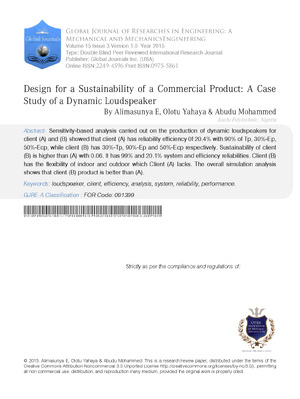
Sensitivity-based analysis carried out on the production of dynamic loudspeakers for client (A) and (B) showed that client (A) has reliability efficiency 0f 20.4% with 90% of Tp, 30%-Ep, 50%-Ecp, while client (B) has 30%-Tp, 90%-Ep and 50%-Ecp respectively. Sustainability of client (B) is higher than (A) with 0.06. It has 99% and 20.1% system and efficiency reliabilities. Client (B) has the flexibility of indoor and outdoor which Client (A) lacks. The overall simulation analysis shows that client (B) product is better than (A).

References

35 Cites in Article
  1. Chinese desktop personal computer.
  2. W Fan,X Liu,W Wang (2010). Application of Reverse Engineering Technology in the Green Remanufacture Engineering.
  3. J Fresnor (1998). Cleaner production as a means for effective environmental management.
  4. J Guinée (2002). Handbook on life cycle assessment operational guide to the ISO standards.
  5. T Markeset,U Kumar (2003). Integration of RAMS and risk analysis in product design and development work processes: a case study.
  6. R Nave (2006). HyperphysicsJanuary-last updateAtlanta: Georgian State University.
  7. C Oduoza (2013). Sustainability and Life Cycle Management Material Utilization Principle.
  8. S Olayinka Energy Efficiency and Conservation Measures: Tools for Sustainable Energy Development in Nigeria.
  9. M Paul (2011). Unknown Title.
  10. Basilio Pueo,Miguel Roma,Jos Escolano,José Lopez (2009). A Pedagogical Software for the Analysis of Loudspeaker Systems.
  11. S Sakai,T Kamakura (2008). Dynamic single sideband modulation for realizing parametric loudspeaker AIP Conference Proceeding.
  12. Narendra Singh,S Davar (2004). Noise Pollution-Sources, Effects and Control.
  13. M Telsang (2006). Industrial engineering and production management.
  14. (2004). WilsonAudio's Alexandria x-2.
  15. W Akmam,M Shahjahan,M Islam (2008). Inculcation of environment-friendly ethics as a prerequisite for sustainable development in Bangladesh.
  16. H Arnold,I Crandall. (1917). The Thermophone as a Precision Source of Sound.
  17. R Coleman,J Mabis,J Hinson (1977). Fundamental frequency-sound pressure level profiles of adult male and female voices.
  18. S Davis,P Mermelstein (1980). Comparison of parametric representations for monosyllabic word recognition in continuously spoken sentences.
  19. M Gander (2012). Dynamic linearity and power compression in moving-coil loudspeakers.
  20. Y Hironaka,S Adachi,F Nagayama (2007). TRANSMITTER/RECEIVER.
  21. S Irrgang,W Klippel,U Seidel (2012). Loudspeaker Testing at the Production Line.
  22. Hai-Yong Kang,Julie Schoenung (2005). Electronic waste recycling: A review of U.S. infrastructure and technology options.
  23. A Kunst,C Looman,J Mackenbach (1993). Outdoor air temperature and mortality in the Netherlands: a time-series analysis.
  24. E Larsen,R Aarts,J Wiley (2004). Audio bandwidth extension: application of psychoacoustics, signal processing and loudspeaker design.
  25. W Li,K Xia,L Gao (2013). Lifecycle Sustainable Information Management for Waste Electrical and Electronic Equipment.
  26. A Martin,M Przybocki (2000). The NIST 1999 speaker recognition evaluation-An overview.
  27. F Murayama,Y Homma (1990). Environmentally resistant loudspeaker.
  28. Shinichi Sakai,Tomoo Kamakura,Bengt Enflo,Claes Hedberg,Leif Kari (2008). Dynamic single sideband modulation for realizing parametric loudspeaker.
  29. H Shapiro,E Rosenquist (2004). Public/private partnerships in agroforestry: the example of working together to improve cocoa sustainability.
  30. Y Shen,X Wang,Z Wu (2012). Accelerated Power Test Analysis Based on Loudspeaker Life Distribution.
  31. Narendra Singh,S Davar (2004). Noise Pollution-Sources, Effects and Control.
  32. M Singla,D Dwivedi,L Singh,V Chawla (2009). Development of aluminium based silicon , 10.
  33. N Vincent,R Knudson,D Leith,P Macklem,J Mead (1970). Factors influencing pulmonary resistance.
  34. Paul Williams (1998). Waste Treatment and Disposal.
  35. Lin Xiao,Zhuo Chen,Chen Feng,Liang Liu,Zai-Qiao Bai,Yang Wang,Li Qian,Yuying Zhang,Qunqing Li,Kaili Jiang,Shoushan Fan (2008). Flexible, Stretchable, Transparent Carbon Nanotube Thin Film Loudspeakers.

Funding

No external funding was declared for this work.

Conflict of Interest

The authors declare no conflict of interest.

Ethical Approval

No ethics committee approval was required for this article type.

Data Availability

Not applicable for this article.

How to Cite This Article

Alimasunya E. 2015. "Design for a Sustainability of a Commercial Product: A Case Study of a Dynamic Loudspeaker". Global Journal of Research in Engineering - A : Mechanical & Mechanics GJRE-A Volume 15 (GJRE Volume 15 Issue A3).
Download Citation

Journal Specifications

Crossref Journal DOI 10.17406/gjre

Print ISSN 0975-5861

e-ISSN 2249-4596

Keywords
Classification
GJRE-A Classification FOR Code: 091399
Version of record

v1.2

Issue date
November 17, 2015

Language
English
Order Article Reprint
Experiance in AR

Explore published articles in an immersive Augmented Reality environment. Our platform converts research papers into interactive 3D books, allowing readers to view and interact with content using AR and VR compatible devices.

Read in 3D

Your published article is automatically converted into a realistic 3D book. Flip through pages and read research papers in a more engaging and interactive format.

Article Matrices
Total Views: 1.9K
Total Downloads: 164
All Trends

Request Access

Please fill out the form below to request access to this research paper. Your request will be reviewed by the editorial or author team.
X

This is the heading

Lorem ipsum dolor sit amet, consectetur adipiscing elit. Ut elit tellus, luctus nec ullamcorper mattis, pulvinar dapibus leo.


High-quality academic research articles on global topics and journals.

Design for a Sustainability of a Commercial Product: A Case Study of a Dynamic Loudspeaker

Alimasunya E
Alimasunya E Auchi Polytechnic, Auchi