I. INTRODUCTION
The risk factors for developing diabetes are numerous and growing rapidly. Diabetes is an unexpected, severe disease that is expanding throughout the world. 90 million of India estimated 1391.99 million people have diabetes, according to a November 14, 2019 article in The Hindu. Additionally, the ninth edition of the Atlas, published by the International Diabetic Foundation (IDF), forecast that there will be 134 million diabetics worldwide by 2045. This study article discusses how to create and develop a framework to use machine learning approaches to prevent future complications as well as to identify type-1, type-2, gestational, and pre-diabetic. A clinical dataset model that uses data gathered from digital surveys and hospitals to predict type-1, type-2, and prediabetic diabetes. The main purpose of study is to enhance people's lives and make them more relaxed. The Python Data Analysis Library (PANDA), or data wrangling, was used to make the csv, csv, or sql database useable based on the clinical data set that was obtained. Machine learning (algorithms) approaches are used on the processed data. Slight variations with various datasets can aid to lead the accuracy as different ML algorithms are used to various data sets to determine accuracy. A framework that predicts diabetes will be created using training and testing that is based on maximal accuracy. We are talking about how to create a framework model using clinical data that has been gathered from surveys and hospital path labs that may predict if a patient will acquire type-1, type-2, or pre-diabetes as well as future risk factors.
The risk factors for developing diabetes are numerous and growing rapidly. Diabetes is an unexpected, severe disease that is expanding throughout the world. 90 million of India's estimated 1391.99 million people have diabetes, according to a November 14, 2019 article in The Hindu. Additionally, the ninth edition of the Atlas, published by the International Diabetic Foundation (IDF), forecast that there will be 134 million diabetics worldwide by 2045. This study article discusses how to create and develop a framework to use machine learning approaches to prevent future complications as well as to identify type-1, type-2, gestational, and pre-diabetic. A clinical dataset model that uses data gathered from digital surveys and hospitals to predict type-1, type-2, and prediabetic diabetes. The main purpose of study is to enhance people's lives and make them more relaxed. The Python Data Analysis Library (PANDA), or data wrangling, was used to make the csv, csv, or sql database useable based on the clinical data set that was obtained. Machine Learning Algorithms approaches are used on the processed data. Slight variations with various datasets can aid to lead the accuracy as different ML algorithms are used to various data sets to determine accuracy. A framework that predicts diabetes will be created using training and testing that is based on maximal accuracy. We are talking about how to create a framework model using clinical data that has been gathered from surveys and hospital path labs that may predict if a patient will acquire type-1, type-2, or pre-diabetes as well as future risk factors.
Support Vector Machines (SVM) are used to provide substantial accuracy in N-dimensional space with less computeability, clearly classifying the data points. To determine the margins of the data set from the plan, hyper planes are employed as decision boundaries. Support Vector Machine is design to make strong by the assistance of cost function and gradient in determining the margin between plane and data sets. When the presence of diabetes is predicted and confirmed based on clinical data and symptoms, this research technique provides a complete solution by registering patients. Step-by-step solutions are provided by this system, including testing, consultation with a doctor, and the prescription of medicine. For this presentation, only SVM will be used however, there will be a sequence of all algorithms which will be used to design ge With various libraries like Matplotlib, Pyplot, and others, we use Python programming for backend coding. Python Panda is used for data analytics, and CSS is used for the front end. The author has the right to retain the idea. This study is ongoing, thus it must not be replicated or copied.
This essay is structured as follows: Section 1 presents the past research on diabetes done by various researchers. In part 3, problem identification is completed. Goal of the issue statement in Section 4. Section 5 provides a suggested technique for employing several ML algorithms to handle diabetes challenges. The accuracy rate, error rate, and other metrics are computed, and the SVM's results for predicting diabetes are provided in section 6.
II. EXISTING WORK
a) Literature of Diabetic Complication
First, we looked at a number of articles and talks on current hot topics in the healthcare machine learning. If diabetes is not treated promptly, a number of long-term complications have been described by the Mayo Clinic USA. The risk of problem increases with the duration of diabetes and the degree to which your blood sugar is under control. Diabetes problems might eventually become incapacitating or even fatal. Among the potential issues[1].
i. Cardiovascular Disease
Diabetes may raises the risk of a amount of cardiovascular issues, such as coronary artery disease with chest discomfort (angina), heart attacks, strokes, and arterial constriction (atherosclerosis). Diabetes increase your risk of initial heart disease or stroke[5].
ii. Nerve Damage (Neuropathy)
The walls of the tiny blood arteries (capillaries) may feed nerves that can get damaged by too much sugar, mainly in your legs. The tingling, numbness, burning, or pain that may result from this typically starts at the tips of the toes or fingers and progressively moves upper. If uncared for, the afflict limbs can go fully numb. Problems with nausea, vomiting, diarrhoea, or constipation can outcome from damage to the nerves that control digestion. It could cause erectile dysfunction in males.
iii. Kidney Damage (Nephropathy)
The kidneys' millions of glomeruli, or groups of small blood vessels, filter waste from your blood. This sensitive filtration mechanism can be harmed by diabetes. A kidney transplant or dialysis may be necessary if there is severe damage that results in kidney failure or irreversible end-stage kidney disease.
iv. Eye Damage (Retinopathy)
Diabetes can cause diabetic retinopathy, which can damage the retina's blood vessels and result in blindness. Diabetes also raises the risk of glaucoma and cataracts, two devastating eye diseases.
v. Foot Damage
Various foot issues are more likely to occur when there is nerve injury in the feet or insufficient blood supply to the feet. Blisters and injuries that go untreated can get seriously infected and heal badly. An eventual toe, foot, or limb amputation may be necessary due to these illnesses.
vi. Skin Conditions
Diabetes patients are more likely to experience hearing issues.
vii. Hearing Impairment
Hearing problems are more common in people with diabetes.
viii. Alzheimer's Disease
Alzheimer's disease and other forms of dementia may be more likely in people with type 2 diabetes. The danger seems to increase as your blood sugar control declines. There are suggestions about how these conditions could be related, but none have been shown.
ix. Depression
Diabetes patients, both type 1 and type 2, frequently experience depressive symptoms. Diabetes control may be impacted by depression (mayoclinic.org, USA).
b) Previous Studies on Diabetic using Machine Learning
If the case study of the long-term consequence had not been examined utilising machine learning, our list of references would be lacking. In one debate during the 2019 IEEE International Conference on Deep Learning and Machine Learning in Turkey, it was suggested to use a generalised additive model to predict severe Retinopathy of Prematurity. Without the medical literature pertaining to our case study, severe retinopathy of prematurity, our list of references would be lacking (RoP). Retinopathy in infants, particularly those who weigh less than 1500 grams at birth, can result in blindness if disease progresses to stages 4 and beyond. Thus, routine examinations by nurses, neonatologists, and ophthalmologists guarantee that therapy is administered if RoP exceeds a certain threshold, such as a diagnosis of severe RoP[2].
Another international conference, ICITACEE, conducted in Indonesia, discussed the application of machine learning techniques such the Gray Level Occurrence matrix, Support Vector Machine, and K Nearest Neighbor to predict diabetes using iridology.
The procedure starts with data gathering in the form of iris image acquisition and blood glucose level monitoring, after which image processing is carried out. Pre-image processing, image processing, and classification are the main three steps that the iris image processing process goes through. Image augmentation, image localisation, and image normalisation are all parts of the pre-image processing step. While feature extraction and ROI segmentation make up the image processing step. We also included references to four outstanding studies for a more comprehensive overview of diabetes and its long-term complications.
In-depth explanations of renal damage caused by uncontrolled diabetes were provided by Linta Antony, who also provided an algorithm.
For more general discussion on diabetic and its long-term complication we have also referred four excellent papers.
Linta Antony explained in detailed the about kidney disease because of diabetic unmanaged and has given an algorithm.
Algorithm 1: Proposed Method Pseudo-Code
BEGIN
- Import the data for model
- Impute the missing values for correctness
- Encode texts to integer values
- Scale the data for correct fit
- Store various scaling methods in a variable `Feature_Selection'
- Set name as name of feature selection methods
- FOR name, feature selection methods in Feature_Selection:
- Select best features from methods
- Append the best features in list
- Count the happening of the features
- Select the features with occurrence. >3
- PRINT selected features
END FOR
- Store somany models in sinle variable called `unsupervised_models'
- Set name as name of models
- Set the scoring to different validation scores
- Set the parameters of the models
- FOR name, unsupervised models in unsupervised_model:
- Cluster the data
- Classify the clusters in to CKD and non CKD
- Calculate validation scores for future prediction
- Save the results as csv_file to use to generate model
END FOR
END [5].
| Variables/Values | |||||
| Attributes | Ins1 | Inst2 | Inst3 | Inst4 | Inst5 |
| Gender | M | M | M | M | M |
| Family | N | N | N | N | N |
| Diabetic | |||||
| High BP | Y | Y | N | N | Y |
| Physical | 1HR | <1HR | 1HR | <1HR | 1HR |
| Alcohol | N | N | N | N | Y |
| BMI | 29 | 28 | 24 | 23 | 27 |
| Sleep | 8 | 8 | 8 | 8 | 10 |
| Sound Sleep | 6 | 6 | 6 | 6 | 10 |
| Regual | Y | N | Y | N | Y |
| Medicine | |||||
| Junk Food | OCA | V OFN | OCA | OCA | OCA |
| BP Level | NOR | NOR | NOR | NOR | H |
| Pregnancy | 0 | 0 | 0 | 0 | 0 |
| P Diabetic | 0 | 0 | 0 | 0 | 0 |
| Urination | NOT M | NOTM | NOTM | NOTM | NOTM |
| Diabeti | N | N | N | N | Y |
III. PROBLEM IDENTIFICATION
With 1,393 million people, India has the second-largest population in the world and may surpass China as the most populous country by the middle of the decade due to people's busy lives and lack of time to care for or assess their own health. According to IDF USA, India has one in six diabetics, making it the country with the second-highest number of diabetics worldwide with an estimated 77 million and a startling 134 million in 25 years[23].
Because of the nation's population, economy, and demographics, major illnesses frequently progress into a variety of problems, and people tend to wait until something goes wrong before seeking care. As this diabetic causes rapid harm to families, societies, and countries, it may have an impact on how those entities develop, either directly or indirectly.
This is a major issue that affects the younger generation as well, therefore it has to be identified quickly, treated effectively, and maintained with user-friendly systems (ML). If discovered at a critical time, identifying long-term complications is another significant issue[23].
IV. OBJECTIVE
My long-term goals with this research study are to make it easy to identify long-term complications and determine if a person has diabetes if symptoms are recognised. I'll achieve this objective by achieving the following goals:
Determine if the person with diabetic of with what type, based on feed dataset through system.
Determine a trained dataset based on feed to act upon.
Assess healthy habit procedure.
Compare whether or not diabetic managed based on periodic feed dataset.
Determine long term complications of diabetic through system.
Assess diagnostic medical procedure.
V. PROPOSED METHODOLOGY
To understand a person with diabetes and the sort of machine learning algorithms and ANN that play a crucial part in fines, much study is necessary. Since accuracy is determined by how well the selected actions mirror the proper ones, machine learning is the process of teaching computers to adjust or adapt their actions (whether these actions are generating predictions or commanding a robot) in order to become more accurate.
Imagine playing Scrabble (or another game) against a machine. CASE STUDY: In the beginning, you might win every time, but after several games, it starts to defeat you, until eventually you never do. Either you're becoming worse, or the Scrabble-winning machine is getting smarter. This is a sort of generalisation because once it figures out how to defeat you, it may continue to apply the same tactics against other players rather than starting over with every new opponent[24].
a) Types of Machine Learning
i. Supervised Learning
The method generalises to respond appropriately to all potential inputs based on a training set of examples with the right answers (targets), which is supplied. This is also known as imitation learning.
ii. Unsupervised Learning
The algorithm instead looks for commonalities between the inputs such that inputs that share anything are grouped together, rather than providing correct answers. Density estimation is a statistical method used in unsupervised learning.
iii. Reinforcement Learning
Between supervised and uncontrolled learning, this falls. Although the algorithm is informed when the solution is incorrect, it is not informed how to make it right. It must investigate and test out several options before figuring out how to provide the correct response. Because the monitor only assigns a score and makes no suggestions for improvement, reinforcement learning is sometimes referred to as learning with a critic.
iv. Evolutionary Learning
It is possible to think of biological evolution as a learning process whereby organisms make adjustments to increase their chances of reproduction and survival. We'll examine how this may be computer-modeled using the concept of fitness, which is equivalent to a rating for how effective the present solution is.
The majority of learning takes place in supervised learning, which will be the subject of the following several chapters. We'll examine what it is and the sorts of issues it may be used to tackle before we get started[24].
b) ML Algorithms
i. Logistic Regression Method
Logistic regression is a type of supervised learning techniques which deals the details of dependent variable and independent variable can be understood using sigmoid function. Actually logistic regression not used for regression problems rather is a type of machine learning classification problem where the dependent variable is dichotomous (0/1, -1/1, true/false) and independent variable can binomial, ordinal, interval or ratio-level[9]. The sigmoid/logistic function is given as
Where, is the output that the result of weighted sum of input variables . If output is greater than 0.5, the result is 1 else the result is 0 [5][7].
Where, is the result which is the result of weighted sum of input variables . If the result is greater than 0.5, the result is 1 else the result is 0.
ii. -Nearest Neighbor Classifier
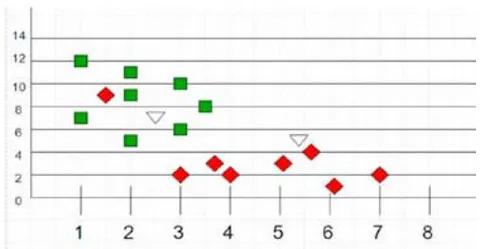
K-Nearest Neighbor (KNN) techniques are used to solve problems related to regression as well as classification, conversely it is being used to solve classification problems in business. Its main advantage is simplicity of translation and less computation time. In figure 2, (KNN example) the points (3.5, 6) and (4.5, 5.5) will be allocated in any one of the clusters. (Neha Prerna Tiggaa et. Al., 2019). The K nearest neighbor uses Euclidean distance function to calculate distances with existing data points and any new data point. Thus, (3.5, 6) will belong to the green cluster, whereas, (4.5, 5.5) will belong to the red cluster [6][13].
iii. Support Vector Machine (SVM)
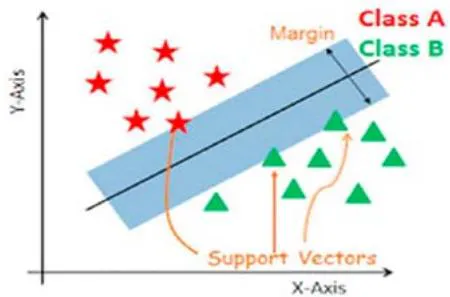
In machine learning techniques, SVM is a supervised classifier that may be applied to both classification and regression. It is mostly used to address classification-related issues. SVM attempts to categorise data points in a multidimensional space using the proper hyperplane. A decision boundary for classifying data points is a hyperplane. With the widest possible gap between the classes and the hyperplane, the hyperplane classifies the data points. Support vector machine classification is shown in Figure 3[7][22].
iv. Naïve Bayes Classification Method
Naive bayes classification method is a probabilistic machine learning algorithm based on Bayes theorem described in probability. Even with its simplicity it outperforms other classifiers; hence, it is one of the best classifiers. The Bayes theorem for calculating posterior probability is given below[6][22].
Where,
v. Decision Tree Classification
Method A Decision Tree is works on the principle of decision making. It can be described in form of tree and provides high accuracy and stability[6].
c) The Machine Learning Process
It briefly examines the process by which machine learning algorithms can be selected, applied, and evaluated for the problem.
i. Data Collection and Preparation
Target data is also necessary for supervised learning, which may need consulting subject-matter experts and making large time commitments. The quantity of data must also be taken into account. Machine learning methods require large quantities of data, ideally without too much noise, but as dataset sizes grow, so do computational costs, and it is typically hard to estimate the exact point at which there is enough data but not too much computer overhead.
ii. Feature Selection
We examined potential traits that may be advantageous for coin identification. It entails determining the characteristics that are most beneficial for the issue at hand. In the case of the coins example above, human common sense was used to select some potentially beneficial qualities and to ignore others; this generally needs previous knowledge of the issue and the data.
Algorithm Selection This book should be able to prepare you for selecting an acceptable algorithm (or algorithms) given the dataset since understanding the fundamental concepts of each algorithm and examples of how to apply them is exactly what is needed for this. Selection of Parameters and Models There are several algorithms that contain parameters that need to be manually specified or that need testing to get the right values.
Given the dataset, method, and parameters, training should consist of nothing more complicated than the application of computer resources to create a model of the data in order to forecast the results on fresh data.
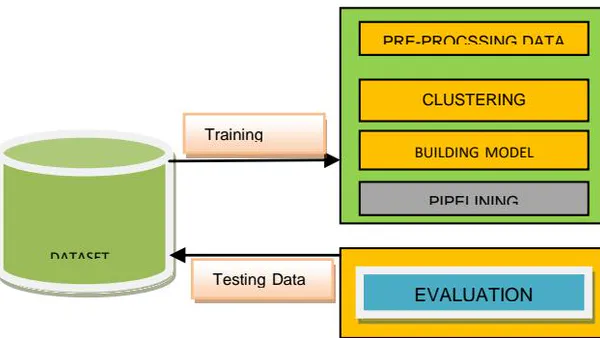
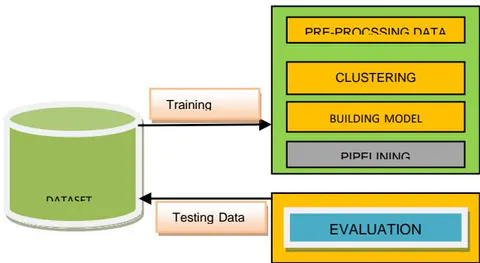
Evaluation A system must be tested and assessed for correctness before it can be put into use, as shown in Fig. 4. demonstrates the process of diagnosing diabetes using data on which it was not trained.
Architecture diagram for diabetes prediction model. This model has five different modules.
These modules include-
- Dataset Collection
- Data Pre-processing
- Clustering
- Build Model
VI. EVALUATION
There are total 952 people, which include 372 women and 580 men, are chosen for study who are 18 years of age or older. A questionnaire that was self-prepared based on the required dataset for generating the model that might help to predict diabetes was given to the participants and is provided in Table 1, as base but based on this dataset further questionnaire may be prepared to calculate future prediction. The same tests were carried out on a different database called the PIMA Indian Diabetes database in order to confirm the model's validity. A sample dataset obtained using a questionnaire is shown in Figure 5. [9][24].
Architecture diagram for diabetes prediction model. This model has five different modules. These modules include-
- Dataset Collection
- Data Pre-processing
- Clustering
- Build Model & Evaluation
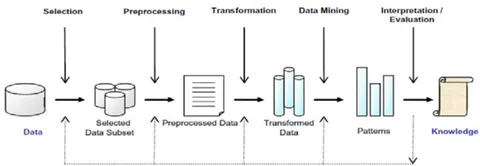
In this study, total 952 participants are selected aged 18 and above, out of which 580 are males and 372 are females. The participants were asked to answer a questionnaire shown in Table1 which was self-prepared based on the constraints that could lead to diabetes. In order to verify the validity of model same experiments were performed on another database called PIMA Indian Diabetes database shown in Table1. Figure 5 shows sample dataset collected through questionnaire[6].
VII. EXPECTED OUTCOME OF THE PROPOSED WORK
Following the use of several machine learning algorithms on the dataset, the accuracy results are as follows. The maximum accuracy is achieved with logistic regression (96%).
The following measure specified in the equation may be computed using the confusion matrices that were collected. True Negative (TN), False Positive (FP), False Negative (FN), and True Positive were the results of these matrices (TP). Because there are more nondiabetic cases than diabetic ones in both datasets, the TN is greater than the TP. As a result, all strategies provide worthwhile outcomes. The following measurements have been computed using the provided formulae in order to determine the precise accuracy of each approach.
| Algorithms | Accuracy |
| SVM | 99% |
Only support vector machine algorithm has been analysed on PIMA dataset further more will be analysed on primary dataset with different algorithm.
VIII. CONCLUSION
Because diabetes is a severe condition that can impair any part of the body if not detected early or treated promptly, the goal of this effort is to raise awareness of it and provide a framework to minimize risk of developing it. In the literature, only the PIMA dataset has been analyzed, whereas in this paper, the primary dataset has been collected and worked on machine learning technology that has involved to predict diabetic at any stage with certain parameters. Here, only the support vector machine algorithm has been used on PIMA as well as the primary dataset are used at the early phase of research to know the person is diabetic or undiabetic with accuracy, and further many ML algorithms on PIMA and research survey primary dataset.