Determinants Impacting Impulse Buying of Green Beauty Products

α
Takrima Jannat
Takrima Jannat
α Bangladesh University of Professionals Bangladesh University of Professionals

Send Message

To: Author

Determinants Impacting Impulse Buying of Green Beauty Products

Article Fingerprint

ReserarchID

V9Z41

Determinants Impacting Impulse Buying of Green Beauty Products Banner

AI TAKEAWAY

Connecting with the Eternal Ground
  • English
  • Afrikaans
  • Albanian
  • Amharic
  • Arabic
  • Armenian
  • Azerbaijani
  • Basque
  • Belarusian
  • Bengali
  • Bosnian
  • Bulgarian
  • Catalan
  • Cebuano
  • Chichewa
  • Chinese (Simplified)
  • Chinese (Traditional)
  • Corsican
  • Croatian
  • Czech
  • Danish
  • Dutch
  • Esperanto
  • Estonian
  • Filipino
  • Finnish
  • French
  • Frisian
  • Galician
  • Georgian
  • German
  • Greek
  • Gujarati
  • Haitian Creole
  • Hausa
  • Hawaiian
  • Hebrew
  • Hindi
  • Hmong
  • Hungarian
  • Icelandic
  • Igbo
  • Indonesian
  • Irish
  • Italian
  • Japanese
  • Javanese
  • Kannada
  • Kazakh
  • Khmer
  • Korean
  • Kurdish (Kurmanji)
  • Kyrgyz
  • Lao
  • Latin
  • Latvian
  • Lithuanian
  • Luxembourgish
  • Macedonian
  • Malagasy
  • Malay
  • Malayalam
  • Maltese
  • Maori
  • Marathi
  • Mongolian
  • Myanmar (Burmese)
  • Nepali
  • Norwegian
  • Pashto
  • Persian
  • Polish
  • Portuguese
  • Punjabi
  • Romanian
  • Russian
  • Samoan
  • Scots Gaelic
  • Serbian
  • Sesotho
  • Shona
  • Sindhi
  • Sinhala
  • Slovak
  • Slovenian
  • Somali
  • Spanish
  • Sundanese
  • Swahili
  • Swedish
  • Tajik
  • Tamil
  • Telugu
  • Thai
  • Turkish
  • Ukrainian
  • Urdu
  • Uzbek
  • Vietnamese
  • Welsh
  • Xhosa
  • Yiddish
  • Yoruba
  • Zulu

Abstract

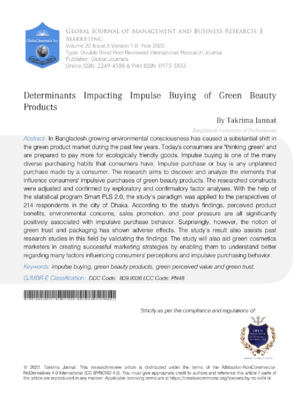
In Bangladesh growing environmental consciousness has caused a substantial shift in the green product market during the past few years. Today’s consumers are “thinking green” and are prepared to pay more for ecologically friendly goods. Impulse buying is one of the many diverse purchasing habits that consumers have. Impulse purchase or buy is any unplanned purchase made by a consumer. The research aims to discover and analyze the elements that influence consumers’ impulsive purchases of green beauty products. The researched constructs were adjusted and confirmed by exploratory and confirmatory factor analyses. With the help of the statistical program Smart PLS 2.0, the study’s paradigm was applied to the perspectives of 214 respondents in the city of Dhaka. According to the study’s findings, perceived product benefits, environmental concerns, sales promotion, and peer pressure are all significantly positively associated with impulsive purchase behavior. Surprisingly, however, the notion of green trust and packaging has shown adverse effects. The study’s result also assists past research studies in this field by validating the findings. The study will also aid green cosmetics marketers in creating successful marketing strategies by enabling them to understand better regarding many factors influencing consumers’ perceptions and impulsive purchasing behavior.

References

45 Cites in Article
  1. Aysen Akyuz (2018). Determinant Factors Influencing Impulse Buying Behavior of Turkish Customers in Supermarket Setting.
  2. R Bapna,A Umyarov (2015). Do your online friends make you pay? A randomized field experiment on peer influence in online social networks.
  3. Joël Berger (2019). Signaling can increase consumers' willingness to pay for green products. Theoretical model and experimental evidence.
  4. Melissa Bublitz,Laura Peracchio (2015). Applying industry practices to promote healthy foods: An exploration of positive marketing outcomes.
  5. A Cahyorini,E Rusfian (2012). The effect of packaging design on impulsive buying.
  6. Arjun Chaudhuri,Morris Holbrook (2001). The Chain of Effects from Brand Trust and Brand Affect to Brand Performance: The Role of Brand Loyalty.
  7. Y.-S Chen (2010). The drivers of green brand equity: Green brand image, green satisfaction, and green trust.
  8. F Chowdhury (2020). The Impact of Socio-Cultural Factors in Impulse Purchasing Behaviour of Clothes in Bangladesh.
  9. Fairuz Chowdhury,Melita Mehjabeen (2021). The Impact of Culture on Impulse Buying Behavior in Bangladesh.
  10. A Davison,D Hinkley,G Young (2003). Recent Developments in Bootstrap Methodology.
  11. X Deng (2009). Consumer response to visual aspects of packaging and product design.
  12. Paul Driessen,Bas Hillebrand,Robert Kok,Theo Verhallen (2013). Green New Product Development: The Pivotal Role of Product Greenness.
  13. Claes Fornell,David Larcker (1981). Evaluating Structural Equation Models with Unobservable Variables and Measurement Error.
  14. P Foroudi,A Nazarian,U Aziz (2020). The effect of fashion e-Blogs on women's intention to use Digital and Social Media Marketing.
  15. Carrie Heilman,Kent Nakamoto,Ambar Rao (2002). Pleasant Surprises: Consumer Response to Unexpected In-Store Coupons.
  16. J Henseler,C Ringle,R Sinkovics (2009). The use of partial least squares path modeling in international marketing New challenges to international marketing.
  17. Rey Hernández-Julián,Christina Peters (2018). Physical appearance and peer effects in academic performance.
  18. S Hoe (2008). Issues and procedures in adopting structural equation modelling technique.
  19. Lovepreet Kaur,Ajeet Singh,Amar Singh,Taranjit Kaur (2021). A review on herbal cosmetics.
  20. A Khare (2015). Antecedents to green buying behaviour: a study on consumers in an emerging economy.
  21. H Khraim (2011). The influence of brand loyalty on cosmetics buying behavior of UAE female consumers.
  22. Jae‐eun Kim,Jieun Kim (2012). Human factors in retail environments: a review.
  23. Young Kim,Jaideep Srivastava (2007). Impact of social influence in e-commerce decision making.
  24. Stephen Kline,Nathan Rosenberg (2010). An Overview of Innovation.
  25. P Kotler,G Armstrong (2010). Principles of Marketing.
  26. John Kozup,Elizabeth Creyer,Scot Burton (2003). Making Healthful Food Choices: The Influence of Health Claims and Nutrition Information on Consumers’ Evaluations of Packaged Food Products and Restaurant Menu Items.
  27. P Lim,R Yazdanifard (2015). Factors That Influence Impulsive Buying Behavior at Sociolla.
  28. Michael Luchs,Minu Kumar (2017). “Yes, but this Other One Looks Better/Works Better”: How do Consumers Respond to Trade-offs Between Sustainability and Other Valued Attributes?.
  29. X Luo (2004). Group dynamics of impulse buying: an extended social facilitation perspective.
  30. K Mubarak (2020). An analysis of factors impacting consumer purchase intention on herbal products.
  31. Z Munir,O Muehlstein,V Nauhbar (2015). Bangladesh: The surging consumer market nobody saw coming.
  32. G Muruganantham,R Bhakat (2013). A review of impulse buying behavior.
  33. C Nagadeepa,A Pushpa (2015). Apparel Attributes: a Reinforcer on Impulse Buying Behavior of College Students in Bangalore City.
  34. Phuong Nguyen,Vinh Nguyen,Nguyen Vo (2019). Key Determinants of Repurchase Intention toward Organic Cosmetics.
  35. J Nunnally (1994). Psychometric theory 3E: Tata McGraw-hill education.
  36. Dennis Rook,Robert Fisher (1995). Normative Influences on Impulsive Buying Behavior.
  37. J Sewwandi,P Dinesha (2022). The impact of green marketing tools on green product purchase behavior: the moderation effect of consumer demographics.
  38. Piyush Sharma,Bharadhwaj Sivakumaran,Roger Marshall (2010). Impulse buying and variety seeking: A trait-correlates perspective.
  39. Samantha Smith,Angela Paladino (2010). Eating Clean and Green? Investigating Consumer Motivations towards the Purchase of Organic Food.
  40. Hawkins Stern (1962). The Significance of Impulse Buying Today.
  41. Debabrata Talukdar,Charles Lindsey (2013). To Buy or Not to Buy: Consumers’ Demand Response Patterns for Healthy versus Unhealthy Food.
  42. Saeed Tarabieh (2021). The impact of greenwash practices over green purchase intention: The mediating effects of green confusion, Green perceived risk, and green trust.
  43. Bryan Usrey,Dayananda Palihawadana,Charalampos Saridakis,Aristeidis Theotokis (2020). How Downplaying Product Greenness Affects Performance Evaluations: Examining the Effects of Implicit and Explicit Green Signals in Advertising.
  44. Ellen Van Loo,My Diem,Zuzanna Pieniak,Wim Verbeke (2013). Consumer attitudes, knowledge, and consumption of organic yogurt.
  45. Wenhao Wu,Lin Zhou,Hsiaoping Chien (2019). Impact of Consumer Awareness, Knowledge, and Attitudes on Organic Rice Purchasing Behavior in China.

Funding

No external funding was declared for this work.

Conflict of Interest

The authors declare no conflict of interest.

Ethical Approval

No ethics committee approval was required for this article type.

Data Availability

Not applicable for this article.

How to Cite This Article

Takrima Jannat. 2026. \u201cDeterminants Impacting Impulse Buying of Green Beauty Products\u201d. Global Journal of Management and Business Research - E: Marketing GJMBR-E Volume 22 (GJMBR Volume 22 Issue E3): .

Download Citation

Green beauty product purchase insights.
Issue Cover
GJMBR Volume 22 Issue E3
Pg. 35- 46
Journal Specifications

Crossref Journal DOI 10.17406/GJMBR

Print ISSN 0975-5853

e-ISSN 2249-4588

Keywords
Classification
GJMBR-E Classification: DDC Code: 809.9336 LCC Code: PN48
Version of record

v1.2

Issue date

January 9, 2023

Language
en
Experiance in AR

Explore published articles in an immersive Augmented Reality environment. Our platform converts research papers into interactive 3D books, allowing readers to view and interact with content using AR and VR compatible devices.

Read in 3D

Your published article is automatically converted into a realistic 3D book. Flip through pages and read research papers in a more engaging and interactive format.

Article Matrices
Total Views: 1364
Total Downloads: 48
2026 Trends
Related Research

Published Article

In Bangladesh growing environmental consciousness has caused a substantial shift in the green product market during the past few years. Today’s consumers are “thinking green” and are prepared to pay more for ecologically friendly goods. Impulse buying is one of the many diverse purchasing habits that consumers have. Impulse purchase or buy is any unplanned purchase made by a consumer. The research aims to discover and analyze the elements that influence consumers’ impulsive purchases of green beauty products. The researched constructs were adjusted and confirmed by exploratory and confirmatory factor analyses. With the help of the statistical program Smart PLS 2.0, the study’s paradigm was applied to the perspectives of 214 respondents in the city of Dhaka. According to the study’s findings, perceived product benefits, environmental concerns, sales promotion, and peer pressure are all significantly positively associated with impulsive purchase behavior. Surprisingly, however, the notion of green trust and packaging has shown adverse effects. The study’s result also assists past research studies in this field by validating the findings. The study will also aid green cosmetics marketers in creating successful marketing strategies by enabling them to understand better regarding many factors influencing consumers’ perceptions and impulsive purchasing behavior.

Our website is actively being updated, and changes may occur frequently. Please clear your browser cache if needed. For feedback or error reporting, please email [email protected]

Request Access

Please fill out the form below to request access to this research paper. Your request will be reviewed by the editorial or author team.
X

Quote and Order Details

Contact Person

Invoice Address

Notes or Comments

This is the heading

Lorem ipsum dolor sit amet, consectetur adipiscing elit. Ut elit tellus, luctus nec ullamcorper mattis, pulvinar dapibus leo.

High-quality academic research articles on global topics and journals.

Determinants Impacting Impulse Buying of Green Beauty Products

Takrima Jannat
Takrima Jannat Bangladesh University of Professionals

Research Journals