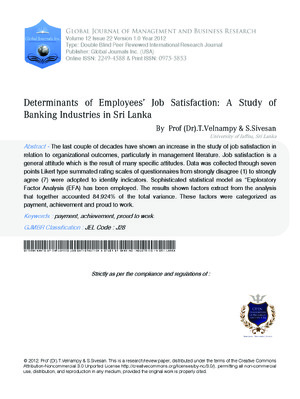
Determinants of Employeesa Job Satisfaction: A Study of Banking Industries in Sri Lanka

§ University of Jaffna, Sri Lanka.

Send Message

To: Author

Determinants of Employeesa Job Satisfaction: A Study of Banking Industries in Sri Lanka

Article Fingerprint

ReserarchID

MBR0Y8PN

Determinants of Employeesa Job Satisfaction: A Study of Banking Industries in Sri Lanka Banner

AI TAKEAWAY

Connecting with the Eternal Ground
  • English
  • Afrikaans
  • Albanian
  • Amharic
  • Arabic
  • Armenian
  • Azerbaijani
  • Basque
  • Belarusian
  • Bengali
  • Bosnian
  • Bulgarian
  • Catalan
  • Cebuano
  • Chichewa
  • Chinese (Simplified)
  • Chinese (Traditional)
  • Corsican
  • Croatian
  • Czech
  • Danish
  • Dutch
  • Esperanto
  • Estonian
  • Filipino
  • Finnish
  • French
  • Frisian
  • Galician
  • Georgian
  • German
  • Greek
  • Gujarati
  • Haitian Creole
  • Hausa
  • Hawaiian
  • Hebrew
  • Hindi
  • Hmong
  • Hungarian
  • Icelandic
  • Igbo
  • Indonesian
  • Irish
  • Italian
  • Japanese
  • Javanese
  • Kannada
  • Kazakh
  • Khmer
  • Korean
  • Kurdish (Kurmanji)
  • Kyrgyz
  • Lao
  • Latin
  • Latvian
  • Lithuanian
  • Luxembourgish
  • Macedonian
  • Malagasy
  • Malay
  • Malayalam
  • Maltese
  • Maori
  • Marathi
  • Mongolian
  • Myanmar (Burmese)
  • Nepali
  • Norwegian
  • Pashto
  • Persian
  • Polish
  • Portuguese
  • Punjabi
  • Romanian
  • Russian
  • Samoan
  • Scots Gaelic
  • Serbian
  • Sesotho
  • Shona
  • Sindhi
  • Sinhala
  • Slovak
  • Slovenian
  • Somali
  • Spanish
  • Sundanese
  • Swahili
  • Swedish
  • Tajik
  • Tamil
  • Telugu
  • Thai
  • Turkish
  • Ukrainian
  • Urdu
  • Uzbek
  • Vietnamese
  • Welsh
  • Xhosa
  • Yiddish
  • Yoruba
  • Zulu
Font Type
Font Size
Font Size
Bedground

Abstract

The last couple of decades have shown an increase in the study of job satisfaction in relation to organizational outcomes, particularly in management literature. Job satisfaction is a general attitude which is the result of many specific attitudes. Data was collected through seven points Likert type summated rating scales of questionnaires from strongly disagree (1) to strongly agree (7) were adopted to identify indicators. Sophisticated statistical model as “Exploratory Factor Analysis (EFA) has been employed. The results shown factors extract from the analysis that together accounted 84.924% of the total variance. These factors were categorized as payment, achievement and proud to work.

References

29 Cites in Article
  1. N Ali,Z Akhtar (1999). Job satisfaction as related to organisational climate among bank officers.
  2. D Bracken (1992). Benchmarking employee attitudes.
  3. A Brayfield,H Rothe (1951). An index of job satisfaction.
  4. A Brief (1998). Attitudes in and around organizations.
  5. W Cascio (1986). Managing human resources: Productivity, quality of work life, profits.
  6. C Cook,P Hunsaker (2001). Management and organizational behavior.
  7. Cary Cooper,Judi Marshall (1976). Occupational sources of stress: a review of the literature relating to coronary heart disease and mental ill health.
  8. J Drever (1964). A dictionary of psychology.
  9. David Emsley (2003). Multiple goals and managers' job-related tension and performance.
  10. D Hellriegel,J Slocum (1974). Organizational Climate: Measures, Research and Contingencies..
  11. F Herzberg,B Mausner,R Peterson,D Capwell (1957). Job Attitudes: Review of Research and Opinion.
  12. M Iaffaldano,P Muchinsky (1985). A Meta-analysis of the Relationships between Individual Job Satisfaction and IndividualPerformance.
  13. L James,A Jones (1974). Organizational Climate: A review of structural dimensions and their conceptual relationship with individual attitudes and behaviour.
  14. Timothy Judge,Carl Thoresen,Joyce Bono,Gregory Patton (2001). The job satisfaction–job performance relationship: A qualitative and quantitative review..
  15. C Jurgensen (1978). Job preferences (What makes a job good or bad?).
  16. Stacey Kohler,John Mathieu (1993). Individual characteristics, work perceptions, and affective reactions influences on differentiated absence criteria.
  17. K Kovach (1995). Employee motivation: Addressing a crucial factor in your organization's performance.
  18. Edwin Locke,A (1969). What is job satisfaction?.
  19. (1996). learner, n..
  20. T Ramayah,M Jantan,S Tadisina (2001). Job satisfaction: empirical evidence for alternatives to JDI.
  21. P Smith,L Kendall,C Hulin (1969). The measurement of satisfaction in work and retirement.
  22. Barry Staw,Jerry Ross (1985). Stability in the midst of change: A dispositional approach to job attitudes..
  23. Thiruchelvam,Velnampy T (2009). Organizational environment and employee psychological empowerment in the international non governmental sector.
  24. T Velnampy (2008). Job Attitude and Employees Performance of Public Sector Organizations in Jaffna District, Sri Lanka.
  25. T Velnampy,Sivesan (2009). impact of the performance evaluation on job satisfaction Jaffna district Sri Lanka.
  26. Terry Wagar (1998). Determinants of Human Resource Management Practices in Small Firms: some Evidence from Atlantic Canada.
  27. S Weiner (2000). Worldwide technical recruiting in IBM: Research and action.
  28. D Weiss,R Dawis,G England,L Lofquist (1967). Manual for the Minnesota Satisfaction Questionnaire.
  29. H Weiss,R Cropanzano (1996). Affective events theory: A theoretical discussion of the structure, causes, and consequences of affective experiences at work.

Funding

No external funding was declared for this work.

Conflict of Interest

The authors declare no conflict of interest.

Ethical Approval

No ethics committee approval was required for this article type.

Data Availability

Not applicable for this article.

How to Cite This Article

S.Sivesan, Prof (Dr).T.Velnampy, S.Sivesan. 1970. "Determinants of Employeesa Job Satisfaction: A Study of Banking Industries in Sri Lanka". Global Journal of Management and Business Research GJMBR Volume 12 (GJMBR Volume 12 Issue 22).

Download Citation

Journal Specifications

Crossref Journal DOI 10.17406/GJMBR

Print ISSN 0975-5853

e-ISSN 2249-4588

Keywords
Classification
GJMBR Classification JEL Code: J28
Version of record

v1.2

Issue date
December 22, 2012

Language
English
Experiance in AR

Explore published articles in an immersive Augmented Reality environment. Our platform converts research papers into interactive 3D books, allowing readers to view and interact with content using AR and VR compatible devices.

Read in 3D

Your published article is automatically converted into a realistic 3D book. Flip through pages and read research papers in a more engaging and interactive format.

Article Matrices
Total Views: 5.7K
Total Downloads: 446
All Trends

Request Access

Please fill out the form below to request access to this research paper. Your request will be reviewed by the editorial or author team.
X

This is the heading

Lorem ipsum dolor sit amet, consectetur adipiscing elit. Ut elit tellus, luctus nec ullamcorper mattis, pulvinar dapibus leo.


High-quality academic research articles on global topics and journals.

Determinants of Employeesa Job Satisfaction: A Study of Banking Industries in Sri Lanka

S.Sivesan
S.Sivesan University of Jaffna, Sri Lanka.
Prof (Dr).T.Velnampy
S.Sivesan
S.Sivesan