
1. Introduction
Generative artificial intelligence (AI) has rapidly changed higher education. Since the release of tools such as ChatGPT, Google Gemini, and Perplexity, educators have had to reconsider teaching, learning, and assessment as students increasingly use AI in their academic work (Batista et al., 2024; Cotton et al., 2024; Kasneci et al., 2023; Holmes & Miao, 2023). Although generative AI can improve engagement, support personalized learning, and increase instructional efficiency (Grewal et al., 2025), it also raises concerns about academic integrity, misinformation, student overreliance on AI-generated content, and possible declines in critical thinking (Conti et al., 2026; Dwivedi et al., 2023). As a result, recent scholarship has focused less on whether AI should be used in higher education and more on how instructors can design learning experiences that help students engage with it critically and responsibly (Bhullar et al., 2024; Kasneci et al., 2023; Holmes & Miao, 2023).
These concerns are especially important in marketing education, where AI is already becoming part of everyday professional practice. Marketing professionals increasingly use generative AI for content creation, market research, customer relationship management, advertising, analytics, and strategic decision-making (Chintalapati & Pandey, 2022; Guha et al., 2024). As a result, marketing graduates need more than technical familiarity with AI tools. They also need to learn how to evaluate AI-generated information critically, recognize its limitations, and apply sound professional judgment (Bearman et al., 2024).
Despite the rapid growth of research on AI in higher education, relatively little empirical work has examined teaching approaches that treat AI-generated content as something students should evaluate critically. Most existing studies have focused on academic integrity, technology adoption, or student attitudes toward AI, while far fewer have examined classroom interventions aimed at developing students’ critical AI literacy and evaluative judgment through structured engagement with AI-generated information (Bhullar et al., 2024; Sevnarayan & Potter, 2024).
To address this gap, an undergraduate Marketing and E-Commerce course at a private university in the northeastern United States was redesigned around a structured AI-supported learning model. Across four assignments delivered over three consecutive semesters, students generated AI-produced memoranda on course topics and then compared those responses with presentations by recognized marketing experts. In doing so, they identified strengths, omissions, inaccuracies, and differences in interpretation, and then reflected on the educational value and limitations of the AI-generated content. In this design, AI was used not as a substitute for learning but as a prompt for inquiry, comparison, and critical evaluation.
Accordingly, this study examined undergraduate students’ perceptions of the instructional approach and whether they viewed it as enhancing their learning while supporting critical evaluation of AI-generated information. The study was guided by the following research question:\
How do students perceive an instructional approach that requires them to use and critically evaluate generative AI in an undergraduate marketing course?
By shifting attention from AI adoption to instructional design, this study contributes to the emerging literature on AI in marketing education by evaluating a classroom model aimed at developing critical AI literacy and evaluative judgment while preserving the analytical reasoning and independent thinking essential for future marketing professionals.
2. Literature review
2.1. Generative AI in higher education
The emergence of generative AI has led educators to reconsider traditional approaches to teaching, learning, and assessment. Although AI technologies offer opportunities to personalize learning, strengthen student engagement, and improve instructional efficiency (Grewal et al., 2025), they also present significant pedagogical challenges, including concerns about academic integrity, misinformation, student overreliance on AI-generated content, and possible declines in critical thinking (Batista et al., 2024; Conti et al., 2026; Cotton et al., 2024).
As research on generative AI has developed, the conversation has shifted from whether AI belongs in higher education to how it should be used: Early discussions focused on plagiarism, assessment security, and institutional policy (Dehouche, 2021; Wahle et al., 2022). More recent scholarship suggests that educational outcomes depend less on the technology itself than on instructional approaches that require students to engage critically with AI-generated information (Bhullar et al., 2024; Dwivedi et al., 2023; Kasneci et al., 2023; Holmes & Miao, 2023). In this view, AI is not a replacement for learning but a tool whose value depends on instructor guidance, structured reflection, and opportunities for critical evaluation.
2.2. Generative AI in marketing education
These developments matter especially in marketing education because generative AI is already woven into modern marketing practice. AI tools now support content creation, market research, customer relationship management, advertising, analytics, search engine optimization, and strategic decision-making (Chintalapati & Pandey, 2022; Guha et al., 2024). As a result, marketing graduates need more than technical skill with AI tools; they also need the judgment to assess AI-generated information critically before using it in business decisions.
Recognizing these changes, scholars have argued that marketing curricula should move beyond simply teaching students how to use AI and instead focus on higher-order analytical skills. Guha et al. (2024) suggest that AI should support assignments in which students critique, revise, and justify AI-generated work rather than merely produce marketing content. Likewise, Lo (2023), Southworth et al. (2023), and Veldhuis et al. (2025) each emphasize that effective AI instruction requires students to assess the credibility, limitations, and potential biases of AI-generated information. Together, this literature suggests that successful AI integration in marketing education depends on instructional designs that intentionally develop critical analysis and professional judgment.
2.3. Developing critical AI literacy through evaluative judgment
Recent scholarship increasingly defines effective AI education in terms of critical AI literacy and evaluative judgment. Instead of accepting AI-generated information at face value, students need to learn how to assess its credibility, spot inaccuracies and biases, decide when verification is necessary, and recognize when human expertise should take priority (Southworth et al., 2023; Holmes & Miao, 2023; Veldhuis et al., 2025).
Bearman and Ajjawi (2023) define evaluative judgment as learners’ ability to assess the quality and suitability of information in authentic contexts. In the context of generative AI, this suggests that students build stronger evaluative skills when they compare AI-generated responses with authoritative sources, explain their reasoning, and reflect on differences across sources of information. Mollick and Mollick (2023) make a similar point, arguing that students should remain the “human in the loop,” using AI as a learning partner rather than a replacement for independent thinking.
Experiential learning theory also supports this instructional approach: Schön (1959) highlighted reflective practice as a process through which professionals evaluate evidence and revise their understanding during real-world problem solving. Kolb (1984) similarly argued that learning develops through recurring cycles of experience, reflection, conceptualization, and application. Together, these perspectives suggest that instructional approaches requiring students to compare AI-generated information with expert knowledge, reflect on discrepancies, and apply those insights across repeated learning experiences can strengthen both critical AI literacy and evaluative judgment.
2.4. Research gap
Although research on generative AI in higher education has grown quickly, important gaps remain. Most studies have focused on academic integrity, technology adoption, assessment challenges, and student attitudes toward AI (Bhullar et al., 2024; Sevnarayan & Potter, 2024). In marketing education, some scholars have recommended instructional approaches that encourage students to critique AI-generated information and apply professional judgment (Guha et al., 2024; Veldhuis et al., 2025), but there is still limited empirical research on structured classroom interventions designed specifically to build these skills.
Furthermore, while students generally see AI as useful for brainstorming, summarizing information, and improving efficiency, they are less convinced that it supports deeper learning or critical thinking (Ravšelj et al., 2025). These findings suggest that the educational value of generative AI depends not just on access to the technology, but on instructional approaches that intentionally require students to critically evaluate AI-generated information.
To address this gap, the present study examines a structured AI-supported instructional model used in an undergraduate Marketing and E-Commerce course across three consecutive semesters. Rather than simply asking students to produce AI-generated content, the approach required them to compare AI-generated memoranda with expert presentations, identify strengths and limitations, and reflect on the credibility and educational value of the information produced. In doing so, the study evaluates a teaching approach designed to strengthen critical AI literacy and evaluative judgment in marketing education.
3. Methodology
3.1. Course context
The study took place in an undergraduate Marketing and E-Commerce course at a private university in the northeastern United States. The course focuses on the strategic use of digital technologies in modern marketing, including online consumer behavior, digital marketing strategy, e-retailing, social media, information search, emerging technologies, and the expanding role of generative AI in marketing practice.
Recognizing the growing use of AI across the marketing profession, the course was redesigned to include structured AI-supported learning activities. Rather than using AI as a substitute for traditional coursework, the approach emphasized responsible use, critical evaluation, and independent judgment. The goal was to help students assess the accuracy, completeness, and practical value of AI-generated information while continuing to rely on authoritative course materials and expert perspectives.
3.2. Instructional design
The assignment replaced a traditional written memorandum assignment with a structured AI-supported learning activity aimed at helping students critically evaluate AI-generated content.
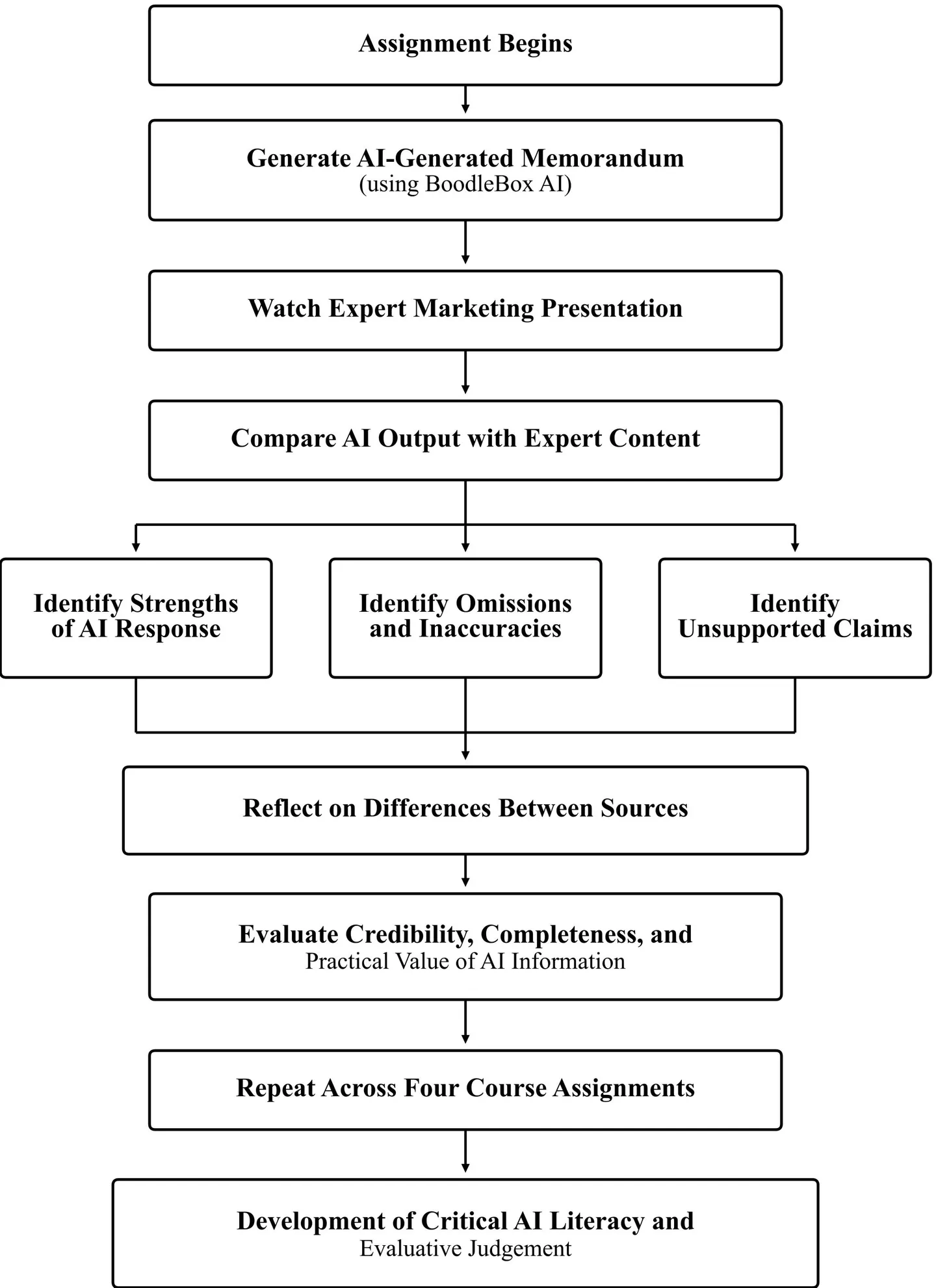
At the start of each assignment, students used the collaborative AI platform BoodleBox to generate a memorandum on an assigned marketing topic. Before students began prompting independently, the instructor demonstrated example prompts in class to illustrate how a broad question could be refined by specifying the task, context, desired depth, and output format. As an example, students were shown how to move from a general prompt such as "Explain market segmentation" to a more structured prompt such as "Explain the concept of market segmentation for an undergraduate marketing student, identify the major bases for segmentation, provide a brief example of how a company might apply each approach, and organize the response as a short memorandum." These demonstrations were intended to model effective prompt construction rather than prescribe a required template; the selected example prompt involved a marketing concept not required by the assignment to ensure they did not simply resuse the example prompt. Students were free to develop and revise their own prompts, refine the AI’s responses when needed, and submit the final memorandum before reviewing any additional course materials related to the topic.
Students then watched a video presentation by a recognized marketing or e-commerce expert and compared it with the AI-generated memorandum. Instead of deciding whether the AI response was simply right or wrong, they identified its strengths, omissions, inaccuracies, unsupported claims, and differences in depth or interpretation. They then wrote a reflection assessing the educational value, credibility, and practical usefulness of the AI-generated content.
As shown in Fig. 1, the instructional sequence was repeated across four assignments over the semester, each focused on a different marketing or e-commerce topic. Repeating the process gave students multiple chances to compare AI-generated content with expert knowledge, reflect on the differences between the two, and build their ability to evaluate AI-generated information through ongoing practice.
3.3. Participants
Participants were undergraduate students enrolled in the Marketing and E-Commerce course during the three semesters when the instructional intervention was used. All students completed the four AI-supported assignments as part of the course, and they were later invited to complete an anonymous questionnaire about their experience with the instructional approach.
Out of the 66 students enrolled in the course over the three semesters, a total of 61 participated in the study, yielding an overall response rate of 92.4%. Because respondents could omit responses to individual questions, the number of valid responses varied slightly across survey items. Additionally, as the study focused on students’ perceptions of the instructional approach rather than demographic differences, no individual-level demographic data were collected. Institutional enrollment records showed that 43 of the 66 (65.2%) enrolled students were female and 51 of the 66 (77.3%) were White/Caucasian; these figures describe the overall composition of the enrolled population only. Cohort-level differences across the three semesters were not evaluated as the instructional intervention was part of an institutionally developed AI pilot initiative, and the questionnaire was developed by the institution for the pilot rather than specifically for this study.
Participation was voluntary, responses were anonymous, and the survey data were reported only in aggregate. The questionnaire was administered after the instructional intervention was completed as part of a university AI pilot initiative.
3.4. Data collection and analysis
Data were collected through an anonymous questionnaire administered after students completed the four AI-supported assignments. Developed as part of the university’s AI pilot initiative, the questionnaire included closed-ended items using multiple response formats to assess students’ perceptions of AI use in the course. These included four- and five-point Likert-type response scales measuring overall experience, perceived impact on learning, clarity of instructor expectations, and the reliability and usefulness of the AI tools; a select-all-that-apply item assessing specific ways in which AI affected students’ learning; and an item asking whether students would recommend expanding the AI pilot to additional courses. The questionnaire also included an open-ended question asking students to describe the most helpful or frustrating aspects of using AI in the course.
Quantitative data were analyzed descriptively using frequencies, percentages, means, and standard deviations. To assess whether student perceptions were consistent across the three semester cohorts (Cohort 1, n = 24; Cohort 2, n = 18; Cohort 3, n = 19), independent-samples Kruskal-Wallis tests were conducted on the survey measures. This nonparametric approach was selected because the survey responses used ordinal categories and the cohorts represented independent groups. The analyses examined differences across cohorts in students’ overall AI experience, perceived impact of AI on learning, clarity of instructor expectations regarding AI use, and perceptions of AI reliability and usefulness. No statistically significant differences were identified across the three cohorts for overall AI experience, H(2) = 2.544, p = .280; perceived impact of AI on learning, H(2) = 0.422, p = .810; clarity of instructor expectations regarding AI use, H(2) = 0.021, p = .990; or perceptions of AI reliability and usefulness, H(2) = 3.266, p = .195. These findings indicate that response patterns were generally consistent across the three semesters.
Responses to the open-ended questions were analyzed using an inductive thematic approach (Fereday & Muir-Cochrane, 2006). The comments were reviewed multiple times to identify recurring ideas and then organized into broader themes reflecting students’ perceived benefits, challenges, and recommendations. Representative quotations are included in the Results section to illustrate these themes while maintaining participant anonymity.
4. Results
4.1. Overall student perceptions
Student perceptions of the AI-supported instructional approach were generally positive, as summarized in Table 1. Nearly two-thirds of respondents reported a favorable overall experience, and almost three-quarters indicated that AI contributed positively to their learning. Instructor expectations for AI use were also viewed as clear, with 96.7% of respondents describing expectations as mostly or very clear. Nearly two-thirds viewed the AI platform as reliable and useful, while approximately two-thirds of respondents providing a definitive response recommended expanding similar AI-supported activities to other courses.
Table 1. Overall Student Perceptions of AI-Supported Instruction
| Perception Dimension | Positive Response (%) | Valid n |
|---|---|---|
| Overall Favorable Experience | 65.0% | 60 |
| Contributed Positively to Learning | 73.8% | 61 |
| Clear Instructor Expectations | 96.7% | 61 |
| Platform Reliability and Usefulness | 63.3% | 60 |
| Recommend Expanding to Other Courses | 67.9% | 56 |
Note: Positive-response percentages are based on valid responses for each item. For ordinal items, percentages represent the two most favorable response categories combined. For the recommendation item, the percentage represents valid responses of "Yes." Missing or noncodable responses were excluded from the calculations.
4.2. Perceived effects on learning
As shown in Table 2, students identified several ways in which AI supported their learning. The most commonly reported benefit was help with generating ideas or getting started on assignments (63.9%). Other students reported that AI helped them organize or improve their work, understand course concepts, and complete assignments more efficiently. A minority of respondents (16.4%) indicated that AI did not meaningfully help their learning, while less than 5% reported that it made their learning worse.
Table 2. Perceived Educational Benefits and Critical Literacy ()
| Perceived Benefit / Impact | Respondents Selecting | % |
|---|---|---|
| Helped Generate Ideas or Get Started | 39 | 63.9% |
| Helped Organize or Improve Work | 27 | 44.3% |
| Helped Understand Course Concepts | 25 | 41.0% |
| Helped Complete Assignments More Efficiently | 18 | 29.5% |
| Did Not Meaningfully Help Learning | 10 | 16.4% |
| Made Learning Worse | 3 | 4.9% |
Note: Respondents could select more than one response option; therefore, percentages do not sum to 100%. Percentages represent the proportion of the 61 respondents who selected each option.
4.3. Qualitative findings
Analysis of the open-ended responses revealed four main themes: AI as a learning support tool, critical evaluation of AI-generated content, implementation challenges, and the future use of AI in the classroom.
4.3.1. AI as a learning support tool
Many students viewed AI as a useful resource that helped them better understand course concepts and generate ideas. One respondent commented, “It was helpful since AI expands our research. Hence, expanding our overall knowledge.” Another noted that AI “helped with understanding concepts,” suggesting that students viewed AI primarily as a learning aid rather than a replacement for course materials.
4.3.2. Critical evaluation of AI-generated content
Students also recognized the importance of evaluating AI-generated information critically. Several respondents acknowledged that AI responses could be inaccurate or incomplete and emphasized the need to verify information before relying on it. As one student explained, “AI often responded with incorrect information so I had to be very careful to check everything.” These comments suggest that the instructional approach encouraged students to question AI-generated information rather than accept it uncritically.
4.3.3. Implementation challenges
Although students’ overall perceptions were positive, they also identified several areas for improvement: Some respondents wanted clearer guidance on how to use AI, while others felt parts of the assignment were too time-consuming or questioned the value of learning an additional technology. These responses suggest that refining the assignment design and providing more explicit instructor guidance could strengthen future implementations.
4.3.4. Future use of AI
Students generally supported the continued use of generative AI within the curriculum but emphasized that it should serve as a learning aid rather than replace independent thinking. One respondent summarized this perspective by stating, “AI is useful as a tool for people who want to use it but should not be a requirement.”
4.4. Summary of findings
Overall, students responded positively to the structured AI-supported instructional approach. Both the quantitative and qualitative findings suggest that students saw generative AI as a useful learning resource while also recognizing the need to critically evaluate AI-generated information before using it in academic or professional settings. Taken together, the results indicate that incorporating AI into structured learning activities that emphasize comparison, reflection, and evaluation can support student learning while promoting critical AI literacy.
5. Discussion
5.1. AI as a tool for learning rather than content generation
Students responded favorably to an instructional approach that framed generative AI as a learning resource rather than a replacement for independent thinking. Most participants reported that AI helped with idea generation, organizing their work, and understanding course concepts, and they generally supported using similar activities in other marketing courses. These findings also align with prior research suggesting that the educational value of generative AI depends less on the technology itself than on how it is used within the learning process (Kasneci et al., 2023; Lo, 2023; Holmes & Miao, 2023).
5.2. Developing critical AI literacy
Perhaps the most important finding was that students recognized the need to critically evaluate AI-generated information before relying on it. Although they viewed AI as a useful learning resource, qualitative responses consistently noted that its outputs could be inaccurate, incomplete, or misleading. Rather than accepting AI responses at face value, students emphasized the importance of checking that information against authoritative sources.
These findings support recent discussions of critical AI literacy, which emphasize that students need skills that go beyond simply knowing how to use AI tools (Southworth et al., 2023; Holmes & Miao, 2023; Veldhuis et al., 2025). They also align with Bearman and Ajjawi’s (2023) concept of evaluative judgment, which highlights learners’ ability to assess the credibility and appropriateness of information in real-world contexts.
The instructional model in this study put these principles into practice by having students generate AI-produced content, compare it with expert knowledge, identify discrepancies, and reflect on those differences. Repeating this process across four assignments gave students multiple opportunities to practice evaluating AI-generated information rather than simply consuming it. This iterative approach also aligns with Kolb’s (1984) experiential learning theory, which holds that learning develops through repeated cycles of experience, reflection, conceptualization, and application.
Collectively, these findings suggest that one of the most valuable educational benefits of generative AI lies not in its ability to produce content, but in its capacity to prompt critical analysis when used within thoughtfully designed instructional activities.
5.3. Implications for marketing education
The findings have several implications for marketing educators. First, if AI is used in the classroom, it should be built into assignments that ask students to evaluate, revise, and justify AI-generated information. As AI becomes more embedded in professional marketing practice, graduates will need to judge when AI-generated information is appropriate, when it should be verified, and when human expertise should take priority (Guha et al., 2024; Veldhuis et al., 2025).
Second, repeated AI-supported learning activities may offer more educational value than one-off classroom exercises. By involving students in multiple rounds of AI generation, comparison, and reflection, instructors can strengthen both disciplinary knowledge and critical AI literacy over time.
Finally, successful implementation depends on clear expectations and active instructor guidance. Although students generally responded positively to the instructional approach, qualitative feedback suggested that more guidance on assignment procedures and AI use could improve the learning experience. These findings align with broader recommendations that responsible AI implementation should emphasize transparency, meaningful human oversight, and carefully designed assessment rather than unrestricted AI use (Cotton et al., 2024; Mikalef et al., 2022).
5.4. Limitations and future research
Several limitations should be acknowledged: First, the study focused on a single undergraduate Marketing and E-Commerce course at one private university, which limits how broadly the findings can be generalized. Replicating the study across different institutions, disciplines, and student populations would provide a clearer picture of the instructional model’s wider applicability.
Second, the study centered on student perceptions rather than objective measures of learning. Although those perceptions offer useful insight into how acceptable the instructional approach was, future research should examine whether similar interventions actually improve critical AI literacy, evaluative judgment, or academic performance using objective assessment measures.
Third, the instructional intervention was part of an institutionally developed AI pilot initiative and the questionnaire was created by the institution for that pilot rather than specifically for this study. Consequently, the instrument did not collect information on students’ prior experiences with generative AI, their technical backgrounds, or on other characteristics that could have differed across the three cohorts and influenced their perceptions. These unmeasured cohort and individual differences represent a potential confounding factor in this research.
Fourth, the study used a descriptive evaluation without a comparison group due to the structure of the AI pilot initiative. Consequently, the study cannot determine whether students’ perceived gains in critical AI literacy or evaluative judgment resulted specifically from the structured comparison of AI-generated memoranda with expert presentations, from the use of generative AI more generally, or from other features of the instructional experience. Because the findings were based on self-reported perceptions, responses may also have been influenced by novelty effects, particularly given students’ relatively new exposure to generative AI as a formal component of coursework. Social desirability bias is also possible, as students may have been inclined to evaluate an instructor- and institution-supported initiative favorably despite the anonymity of the questionnaire. Future research should compare structured AI-supported instruction with traditional memo assignments and unguided AI use and incorporate objective measures of learning to better isolate the effects of the expert-comparison activity.
Finally, because generative AI is evolving so quickly, future research should examine whether instructional approaches built around comparison, reflection, and critical evaluation remain effective as these tools continue to improve.
5.5. Conclusion
Generative AI is rapidly changing marketing education, which means instructors need to help students not only use AI tools but also critically evaluate the content those tools produce. Rather than treating AI as either a threat to academic integrity or a substitute for traditional learning, this study examined a structured instructional approach that used AI as a starting point for inquiry, comparison, and reflection.
The findings suggest that students responded positively to the approach while also recognizing the need to verify AI-generated information against authoritative sources. By asking students to compare AI-generated memoranda with expert presentations and reflect on the differences, the instructional model appeared to support the development of critical AI literacy, evaluative judgment, and disciplinary knowledge at the same time.
As generative AI becomes more embedded in marketing practice, the key question for marketing educators is no longer whether AI belongs in the curriculum, but how to use it in ways that strengthen students’ analytical reasoning, professional judgment, and critical evaluation skills. The instructional model presented here offers one way to pursue those goals while incorporating AI into marketing education in a responsible and pedagogically meaningful way.