

I. INTRODUCTION
Medications play a vital role in the management of diseases and its prevention. Medications are manufactured and marketed with potential of a wide range of safety. However, a rare class or group of medications, called as high risk or high alert medications (HRM), are known to have a risk in causing significant patient harm, disability or death if they are unintentionally misused or improperly administered. The term "high-risk" medications was initially coined by the Institute for Safe Medication Practices (ISMP) in 1998 for those drugs which are linked or related to most dangerous preventable adverse drug events (PADEs). Medication errors may not occur more often with high risk drugs but the consequences or impacts from them could be more dangerous for the patients. Therefore, various risks or hampers that could take place while prescribing, storing, dispensing, and finally administering a high risk drug should be carefully overseen at each phase of the medication management process.
According to the American Pharmaceutical Association, eight categories were listed as high-risk medications that include high concentration electrolytes, chemotherapeutic agents, opiates, anticoagulants, narcotics, neuromuscular blocking agents, benzodiazepines and cardiovascular drugs. The process of drug dispensing or administration to patients at a hospital involves multifarious phases that in turn is based on a series of inter related actions and decisions overcoming daily obstacles. Nonetheless, this management process may not be satisfactorily safe every time, due to which the faults arising may or may not cause damage to the patient. These faults or mistakes, typically said as medication errors, arising in the administration pathway can be considered as preventable adverse events. In 2003, ISMP performed a study for assessment of knowledge on high risk medications for distinguishing variances between pharmacy and nursing perspectives, most of the participants responded their agreement on which medications were considered high risk. This survey was repeated by ISMP in 2007 and 2012. In all the three surveys, it was noted that the pharmacists were not able to identify medications as high risk, as often as nurses did.
It is projected that a hospitalized patient is identified to be exposed to at least one error per day related to drug. According to ISMP, an estimate of as low as 450,000 medication errors result in injury to patients in the United States per year, with around 25% of these errors meant to be avoidable. In addition, 7,000 deaths each year are recognized to be because of medication errors. In the field of community pharmacy, a few studies have been found to report the occurrence of injury to the patient caused by medication errors that are preventable. Ghandi TK and colleagues (2003) mentioned that adverse events that were preventable occurred in 5% of ambulatory patients with medications that were dispensed from community pharmacies. Also, Gurwitz JH and colleagues (2000) identified that one-half of life-threatening, serious or fatal adverse drug events resulted from medications dispensed from pharmacies that were preventable.
The study was thus aimed to prepare and develop instruments prior in labeling, handling, storage and dispensing of HRM for the pharmacists who would be further implemented with the important process of validation and reliability. As documented in several studies, validation has always been an important factor as the measurement of accuracy and consistency in research instruments. However, in various health and social science research taking place in developing countries, validation of instruments is not being commonly performed. This has been linked to the shortage of information on how validation should be carried out to certain degree of conclusion. As per a review article from a Nigerian researcher Bolarinwa OA (2015) , highlighted that the literary and technical meanings of instruments were both reflected by validation and reliability making them an important procedures to be done in research works. They elaborated numerous forms and methods of analyzing validation and reliability of an instrument, the main goal of which was to improve knowledge of these tests among young researchers in developing countries.
According to an international literature published by Sampaio F and colleagues (2014) , an instrument that was proven to be valid and reliable was developed for assessment of knowledge in nurses regarding HRM. The validity consisted of content, construct and face validity whereas the reliability of the instrument was measured through internal consistency using Kuder-Richardson reliability 20 (KR 20) formula. In the same manner, considering the importance of assessment of knowledge of HRM to the community pharmacist, in this research, the instrument as educative materials, has been developed and validated by deep and vigorous study from various experts. Finally, the same was done with measurement of reliability with KR 20 for its internal consistency. This study was aimed to prepare and validate an instrument as learning modules to boost community pharmacists' knowledge on high risk medications (HRM), which will help in minimizing serious consequences arising due to mishandling of HRM.
II. METHODS
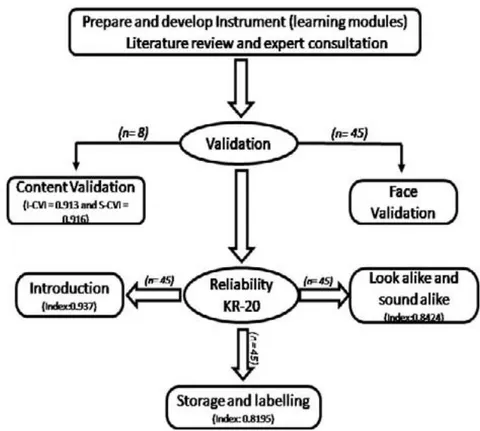
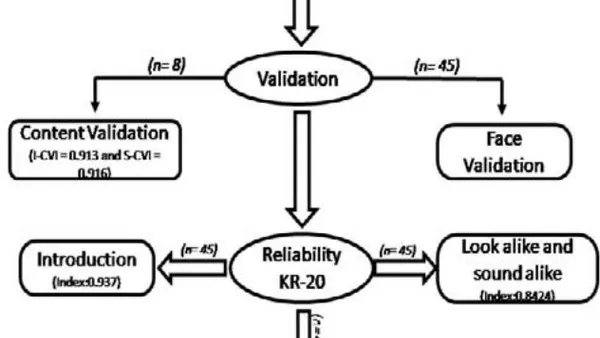
The study was a prospective interventional methodological program. This study attempted on methods of preparation of an instrument in the form of suitable educative video materials, following with organization and analysis of data collected for the main purpose of validation of the research instruments and techniques. The summarized study methodology is represented in Figure 1.
a) Preparation and development of an instrument
For collection of data, the setting of HRM management in the particular area was needed to be known. So, a visit was made to various pharmacies for the same. With the respect to Indian pharmacy practice environment, training materials were suitably prepared on the information from global guidelines and practice for HRM management. Three informative and revealing chapters on management of HRM were prepared from various sources and literatures. The materials were prepared in such a way that they become easily understandable and comprehensive. The materials were both accessible in high resolution PC formats and size compressed mobile formats such that the acceptability of the material by the participants would highly be favored. It was reaffirmed that the training materials would be helpful as a knowledge material in the Indian setup. The training material in the form of hard copy was validated (already accomplished) out of the objective of the study. After which, the hard copy materials were converted to scripts in the form of narrations for the purpose of recording it and preparing as convenient video materials. The language of the script was ascertained for easy understandability.
b) Development of an instrument in the form of video materials
A suitable female artist was chosen for the recording the script; considering factors like voice, tone, clarity of pronunciation, speech flow and finally delivery of the speech. The whole process was carried out in a studio environment under the supervision of a technical team having hands-on experience in recording and editing such videos. The processing of the video materials involved the following five crucial steps viz (i) Recording the scripts using appropriate voice software into individual sound tracks and then joining up the same into one single audio file. (ii) Collaborating the slides of power point presentations with their specific audio files to produce a video file. (iii) Adjustment of time intervals. (iv) Addition of suitable background tracks to the collaborated file. (v) Converting the file into high resolution PC format as well as in compressed mobile format. The software such as Audio Recorder by Green Apple Studio.[Version 1.9.45], Audacity. The free, Cross- Platform Sound editor by Audacity Development Team. [Version 2.1.3] and Corel Video Studio Ultimate X1 was utilized for the purpose of recording the scripts and collaborating it with the slides of the power point materials. The videos were finally ensured to be checked for synchronization and clarity.
c) Validation of the Instrument
Various literature evidences implicated the importance of the validation as a degree to which a measurement measures what it purports to measure. A validation technique can be either logical or rational. Validation illustrates the estimate of how much a measure or a dimension represents each and every single component of a hypothesis. The content validity (8 experts involving senior consultants and community pharmacist) and face validity (45 community pharmacy practitioners) were performed in this study. The prepared instrument (Learning modules) was ensured to be important, relevant, reactive and appropriate with the help of content and face validation and was then confirmed to be sensitive enough to distinguish knowledge levels of community pharmacists.
A total of 45 pharmacists (15 hospital pharmacists and 30 community pharmacists) were involved for the process of reliability. For the collection of data from the participant's responses regarding the training material, a form containing scoring columns for various aspects related to the material such as contents, clarity of the video and audio as well as various diagrammatic illustrations was distributed. The final scoring and feedbacks were evaluated and the appropriateness and reliability of the material was finally measured with KR 20.
i. Content Validity
The percentage of agreement among specialists as to the instrument assessment and its item was obtained by means of the calculation of content validity index (CVI). This index permits for the analysis of each item individually, and subsequently, the instrument as a whole. Lynn MR (1986) through rigorous research illustrated that the researchers follow CVIs of two types based on the agreement of experts on the content of the instrument. It involves the Item-Content Validity Index (I-CVI) and Scale level- Content Validity Index (S-CVI). For I-CVI, the settlement among reviewers concerning each item of the instrument was measured by means of a Likert scale, with scores that range from score 1 to 4 (where, 1=irrelevant, 2=slightly relevant, 3=fairly relevant and 4=extremely relevant) Item that obtained scores of 1 or 2 were reviewed or eliminated. The calculation of the I CVI for each item consisted of the division between the numbers of answers that were fairly and extremely relevant by the total number of answers. The study also recommended an I-CVI > 0.78 for analyses of instrument by six or more judges.
The S-CVI involves the mean proportion of items rated as fairly and extremely relevant across various experts. This description of the CVI for scales was referred as S-CVI/average as for the purpose of convenience. This was interpreted as the combination of the number of items that were rated fairly and extremely relevant by all experts and to then which the total number of all the ratings is divided. It is also theorized that the S-CVI/ average is the mean or average I-CVI value because it happens to concentrate on mean or average item quality rather than on average enactment by the experts. Waltz CF and colleagues (2005) stated that for mean congruity, the standard value to be considered is 0.90.
ii. Face validity
Face validation consists of the subject experts observing thoroughly at the items in the instrument (learning modules) and approving that the test is a valid measure of the conception which is being evaluated just on the face of it. In simple words, they are assessing each aspect of the measuring items if they really match with the theoretical domain of the model. The approval of the design of the learning modules was strongly highlighted when face validation was performed and the importance of the issues to community pharmacy profession was thus emphasized as the experts understood all the components of the training material providing them with a secure atmosphere.
iii. Reliability
The demand of reliability for measurement of internal consistency of a test is that it is needed to be estimated after only one test administration which therefore helps to escape the issues associated with testing over multiple time periods. By KR-20 formula, an index score for reliability was calculated as shown in the Formula 1.
Where, is the Kuder-Richardson formula 20; k is the total number of test items indicates to sum; p is the proportion of the test takers who pass an item; q is the proportion of test takers who fail an item; is the variation of the entire test.
III. RESULTS
As illustrated in Table 1, the mean I-CVI was figured out to be 0.913. Lynn MR (1986) also suggested that when there is participation of five or fewer experts, there should be a universal agreement on the content validity for their rating to be said as an equitable representation. As per definition, the
S-CVI/average is the combination of number of items rated either extremely or fairly relevant by all experts (Y), divided by the total number of all the possible ratings. Therefore, the S-CVI/ average was found to be 0.916 (Table 1). The overall reliability for all three chapters are shown in Table 2. In this study the overall sample observations used for the reliability (n=45) was documented in excel sheet and the correct score per slide for the respective chapters was obtained as shown in Tables 3, 4 and 5 respectively. The mean sum of product of proportion passed and proportion failed was calculated to apply standard deviation for each individual slide of all the three chapters and finally KR-20 reliability formulae was applied. The individual chapters were considered for their reliability, from which the index was obtained as 0.937, 0.8424 and 0.8195 for chapter 1, chapter 2 and chapter 3 respectively.
IV. DISCUSSION
a) Content Validity
The content validity index was reported only in methodological studies because it has focus only for explaining the process of content validations.
i. Item-level content validity Index (I-CVI)
I-CVI is used commonly by researchers to obtain information on guiding themselves in reviewing, erasing, or replacing items. However, the researchers do not generally provide information about I-CVI values in their reports, as I-CVIs are meant only to be reported in procedural research which mainly concentrates on clarifications of the overall content validity process. I-CVI is calculated as the total number of experts giving a fair or extreme rating of either 3 or 4 (thus dichotomizing the normal scale into either relevant or not relevant), divided by the total number of experts. In simple words, the I-CVI should be exactly 1.00 when there are five or fewer experts giving their ratings. The standard value could be a little relaxed when there are six or more raters, but I-CVIs should not be lower than 0.78. For example, there could be one "not relevant" rating (I-CVI i.e. 0.83) with six raters and there could be two not relevant ratings with nine raters. Thus, the mean I-CVI which we obtained could be considered as an ideal value.
ii. Scale-level content validity Index (S-CVI)
The S-CVI/ average is constantly identical to the average congruency percentage (ACP). Rubio D and colleagues (2003) demonstrated their content validity procedure, while evolving the Caregiver Well-Being Scale, in which they used the averaging approach for the S-CVI based on ratings of relevance by six judges. This method for the calculation of S-CVI was approached in particular with a concern that while performing universal approach with more than 6 raters the content validity index would be slightly depressed, because universal approach demands agreement among all experts. Similarly, Waltz and colleagues (2005) stated a recommendation on the standard value for the acceptability of S-CVI as 0.90 but not 0.80.
b) Reliability
While instituting the quality of a settled instrument wholly, Kuder and Richardson developed a formula known as KR-20. In estimating the reliability of a test based on internal consistency, also called as reliability coefficient, KR-20 has been the most widely used formula. It requires only a single administration of a test. The internal consistency by KR-20 is obtained by evaluating the consistency of the material within a test based on the total number of items in the test as a whole, the proportion of participants giving correct answers for each item and the standard deviation of total score obtained. The value could range from 0 to 1. The closer the score is to 1, the more reliable the test. A study stated when KR-20 formula is in use, the internal consistency estimates ranges from 0.75 as an acceptable mark to an excellent 0.97 mark.
A KR20 value range of 0.86 to 0.94 was reported by Lin and colleagues (1999) , for the analysis of internal consistency while doing item analysis of a multiple choice test questionnaire which was then used in licensure examination for registered nurses. Also, Sampaio F and colleagues (2014) , used KR reliability for their true and false tests in development of valid instrument to assess nurses' knowledge of High risk medication in a tertiary care hospital, and got a value of 0.74, which indicated acceptable reliability. While, Priscila P and colleagues (2015) did the Brazilian transformation of the work done by Taiwanese researchers , where they too computed KR 20 formulae for their instrument to assess nurses' knowledge and obtained a value of 0.74 respectively. Similarly, Farhan B (2018) designed an instrument for students to observe tests involved in the research of a string ensemble course for music students and while examining its reliability, they used KR 20 formula, therefore the value of which was obtained as 0.717. Also, a study developed an Instructor-Mediated Performance Assessment Test, for which they did reliability and obtained an index of 0.95.
V. CONCLUSION
This study was an effort to prepare suitable informative materials in the form of videos that would benefit community pharmacists on their perspective about HRM and its management. The insufficiency of basic knowledge on this topic in the Indian setting of community pharmacy was highly reflected when pharmacists were evaluated previously with a set of questionnaire regarding various aspects of HRM management, out of the objective. With this concern, instrument in the form of learning modules consisting of demanding information on various aspects of high risk medication management was prepared and finally validated. The validation done by content validity received an I-CVI of 0.913 and S-CVI of 0.916, which were considered as ideal values. Similarly, reliability followed with KR 20 formula analysis. The reliability index was obtained as 0.937, 0.8424 and 0.8195 for chapter 1, chapter 2 and chapter 3 as parts of the learning modules. The prepared instrument thus can be concluded as valid and reliable source to benefit community pharmacists for management of HRM and finally for better patient care.
ACKNOWLEDGEMENT
The author sincerely thanks to Dr K Ramesh, Director, Karnataka College of Pharmacy, Bengaluru for his valuable contribution and consistent encouragement.
| Chapters | Expert1 | Expert2 | Expert3 | Expert4 | Expert5 | Expert6 | Expert7 | Expert8 | Number in Agreement | Item CVI(I-CVI) |
| Introduction to HRM | Y | Y | Y | Y | Y | Y | Y | N | 7 | 0.87 |
| LASA | N | Y | Y | Y | Y | Y | Y | Y | 7 | 0.87 |
| Storage and labelling | Y | Y | Y | Y | Y | Y | Y | Y | 8 | 1.00 |
| Mean I-CVI= 0.913 Mean S-CVI= 0.916 | ||||||||||
| *I-CVI = Item-level content validity index. *S-CVI = Average scale- level content validity*Y = Agreement on the content by the expert, *N = Disagreement on the content by the expert | ||||||||||
| Chapter No. | Chapter Name | Index | Reliability |
| 1. | Introduction to High risk medications | 0.937* | Homogenous |
| 2. | Look-alike and sound-alike medications | 0.8424* | Homogenous |
| 3. | Storage and labelling | 0.8195* | Homogenous |
| Slide Number | Correct Score | Proportion Passed | Proportion Failed | p*q |
| 1 | 26 | 0.57 | 0.43 | 0.245 |
| 2 | 32 | 0.7 | 0.3 | 0.21 |
| 3 | 26 | 0.57 | 0.43 | 0.24 |
| 4 | 31 | 0.68 | 0.32 | 0.2176 |
| 5 | 15 | 0.33 | 0.77 | 0.2541 |
| 6 | 30 | 0.66 | 0.34 | 0.2244 |
| 7 | 21 | 0.46 | 0.54 | 0.2484 |
| 8 | 11 | 0.24 | 0.76 | 0.1824 |
| 9 | 23 | 0.51 | 0.49 | 0.2499 |
| 10 | 25 | 0.55 | 0.45 | 0.2475 |
| 11 | 27 | 0.6 | 0.4 | 0.24 |
| 12 | 30 | 0.66 | 0.34 | 0.2244 |
| 13 | 29 | 0.64 | 0.36 | 0.2304 |
| 14 | 36 | 0.8 | 0.2 | 0.16 |
| 15 | 15 | 0.33 | 0.77 | 0.2541 |
| 16 | 35 | 0.77 | 0.33 | 0.2541 |
| 17 | 30 | 0.66 | 0.44 | 0.4224 |
| 18 | 25 | 0.55 | 0.45 | 0.2475 |
| 19 | 28 | 0.62 | 0.38 | 0.2356 |
| 20 | 30 | 0.66 | 0.34 | 0.2244 |
| Mean Sum of p*q: 5.0663; Standard deviation squared: 46.0648Index value : 0.937 | ||||
| Slide Number | Correct Score | Proportion Passed | Proportion Failed | p*q |
| 1 | 35 | 0.77 | 0.33 | 0.2541 |
| 2 | 32 | 0.71 | 0.29 | 0.2059 |
| 3 | 33 | 0.73 | 0.27 | 0.1971 |
| 4 | 34 | 0.75 | 0.25 | 0.1875 |
| 5 | 26 | 0.57 | 0.43 | 0.2451 |
| 6 | 29 | 0.64 | 0.36 | 0.2304 |
| 7 | 24 | 0.53 | 0.47 | 0.2491 |
| 8 | 35 | 0.77 | 0.33 | 0.2541 |
| 9 | 32 | 0.71 | 0.29 | 0.2059 |
| 10 | 33 | 0.73 | 0.27 | 0.1971 |
| 11 | 34 | 0.75 | 0.25 | 0.1875 |
| 12 | 28 | 0.62 | 0.38 | 0.2356 |
| 13 | 22 | 0.48 | 0.52 | 0.2496 |
| 14 | 29 | 0.64 | 0.36 | 0.2304 |
| 15 | 26 | 0.57 | 0.43 | 0.2451 |
| 16 | 29 | 0.64 | 0.36 | 0.2304 |
| 17 | 33 | 0.73 | 0.27 | 0.1971 |
| 18 | 19 | 0.42 | 0.58 | 0.2436 |
| 19 | 20 | 0.44 | 0.56 | 0.2464 |
| 20 | 22 | 0.48 | 0.52 | 0.2496 |
| 21 | 29 | 0.64 | 0.36 | 0.2304 |
| Mean Sum of p*q: 4.8962; Standard deviation squared: 21.8146Index value : 0.8424 | ||||
| Slide Number | Correct Score | Proportion Passed | Proportion Failed | p*q |
| 1 | 27 | 0.6 | 0.4 | 0.24 |
| 2 | 25 | 0.55 | 0.45 | 0.2475 |
| 3 | 23 | 0.51 | 0.49 | 0.2499 |
| 4 | 30 | 0.66 | 0.34 | 0.2244 |
| 5 | 24 | 0.53 | 0.47 | 0.2491 |
| 6 | 28 | 0.62 | 0.38 | 0.2356 |
| 7 | 34 | 0.75 | 0.25 | 0.1875 |
| 8 | 36 | 0.8 | 0.2 | 0.16 |
| 9 | 33 | 0.73 | 0.27 | 0.1971 |
| 10 | 30 | 0.66 | 0.34 | 0.2244 |
| 11 | 30 | 0.66 | 0.34 | 0.2244 |
| 12 | 31 | 0.68 | 0.32 | 0.2176 |
| 13 | 34 | 0.75 | 0.25 | 0.1875 |
| 14 | 34 | 0.75 | 0.25 | 0.1875 |
| 15 | 33 | 0.73 | 0.27 | 0.1971 |
| 16 | 30 | 0.66 | 0.34 | 0.2304 |
| 17 | 30 | 0.66 | 0.34 | 0.2304 |
| 18 | 31 | 0.68 | 0.32 | 0.2172 |
| 19 | 24 | 0.53 | 0.47 | 0.2491 |
| 20 | 34 | 0.75 | 0.25 | 0.1875 |
| Mean Sum of p*q: 4.3442; Standard deviation squared: 19.6144Index value : 0.8195 | ||||