
I. INTRODUCTION
Erectile dysfunction or the inability to achieve or maintain an erection sufficient for satisfying sexual activity, often becomes a real problem for men. According to the WHO information every 10th managed older 21 has the erectile disorder and after the age of 60 years every third man is not able to perform sexual intercourse. About of men aged 40 to 70 years suffering from partial or total inability to achieve erection [1].
To date, effective approaches of pharmacological correction of disorders of sexual function in men have been developed. Depending on the indications for use, these drugs should have separately or in combination neurotropic, vasodilating, anti-inflammatory, antimicrobial, antihypoxic, immunotropic effect [1]. The basis of drug therapy for erectile dysfunction, as a rule, is made up of phosphodiesterase inhibitors: vardenafil, sildenafil, tadalafil [1]. However, all of these drugs are available with a doctor's prescription. At the same time, significant advances in the prevention and treatment of male genital pathology can be achieved with the use of over-the-counter herbal remedies. Compared to synthetic ones, natural components have a milder and more versatile effect due to the variety of components actively affecting the body and, as a rule, rarely cause side effects [1]. Most of the herbal remedies for correcting erectile dysfunction are presented in the form of biologically active additives.
Today the market of dietary supplements for the correction of erectile dysfunction mainly offers complex drugs of a certain functional orientation, most often combining herbal ingredients with a pronounced stimulating effect on sexual function and a general tonic effect [1].
When reviewing the literature, it was found that one of the types of plant raw materials that have a beneficial effect on the function of the prostate is the seeds of Nigella sativa [2], and of the microelement – zinc [3, 4].
Based on the analysis of the pharmaceutical market of the manufactured dosage forms, we have selected hard gelatin capsules as the rational dosage form for the medicinal preparation under development. Capsules represent a prospective solid dosage form with a number of advantages. For instance, they are attractive in appearance, easy to swallow, contain accurate dose, protect encapsulated medications against light, air and moisture since capsule shells provide a high level of airtightness, can quickly swell up, dissolve and get absorbed in the gastrointestinal tract, have high bioavailability [5].
The aim of the research is to develop the composition and technology for obtaining dietary supplements with specified characteristics using plant raw materials - seeds of Nigella sativa and a microelement – zinc.
II. MATERIALS AND METHODS
Seeds of Nigella sativa, zinc sulphate, their mixture, their mixtures with different excipients and capsules on their base were selected as the materials of research. The technological properties of the materials that determine the composition, technology and the quality of the finished product and the capsule disintegration were studied using conventional methods, described in [6, 7, 8]. In order to select the optimal composition for the capsules "Nigelit" a mathematical method of experimental design, the Latin square was used. The experimental results were processed using mathematical methods of statistical and variance analysis, involving the Fisher statistic (F statistic) and the generalized desirability function [9, 10, 11, 12]. In order to create granules moisture activated dry granulation (MADG) was used [13, 14, 15].
III. RESULTS AND DISCUSSION
For the development of the dietary supplement, firstly, a suitable dose of the microelement – zinc and plant raw material containing biologically active substances were calculated, based on the study of their safety and potential properties. Then the technological properties of the mixture of active components were studied. It was established that the mixture of active components has unsatisfactory technological properties in particular flow ability. This makes obtaining capsules of an acceptable quality from such a material impossible. In order to eliminate these disadvantages, and to produce good-quality capsules, it is necessary to incorporate excipients, and to use granulation, which prevents the segregation (stratification) of the mixture [16].
In order to choose the most rational composition and the encapsulation technology for the capsules "Nigelit", we took advantage of a mathematical method of experimental design, the method of the Latin square and performed analysis of variance. The use of this method makes it possible to significantly reduce the experimental error and to quantify the effect of various factors on the optimization parameters [9, 10, 11, 12]. In this case, flowability, bulk density, angle of repose of the granular materials and disintegration time of capsules were selected as the optimization parameters (see table 1); while fillers, antiaderents (antisticking agents), disintegrants and glidants were selected as factors affecting optimization parameters (see table 2). Technological properties of the granular materials and the capsule disintegration were studied using conventional methods [6, 7, 8]. In order to create granules moisture activated dry granulation (MADG) was used [13, 14]. This method allows for simultaneous mixing and of ingredients, as well as forming of a product with homogeneous dispersion [13]; minimization grinding of such issues with wet granulation as the need for a significant amount of granulating liquid, the duration and energy intensity of the process of mixing the wet mass, sensitivity of individual components of the mixture to high moisture levels, the necessity of using granule-forming apparatus in most cases, the long-lasting stage of drying the granules, accompanied by the unfavorable effect of temperature on active pharmaceutical ingredients, as well as the cumbersome equipment required for the air preparation and air purification processes [15]. The main advantage of this granulation method is that the resulting granules do not need to be dried - this speeds up the technological process, reduces labor and energy costs. Moreover, the resulting granules do not need additional grinding due to the characteristic homogeneous particle-size distribution [13]. Purified water was used as the moisturizing liquid for granulation.
| Optimization parameters (Y) | |||
| Y1 | Y2 | Y3 | Y4 |
| Flowability (10-3kg/s) | Bulk density (kg/m3) | Disintegration (min.) | Angle of repose (°) |
| Name of the capsules | Factors | |||
| A - fillers | B - antiadherents | C - disintegrants | D - glidants | |
| a1 - starch | b1 - magnesium stearate | c1 - CMC | d1 - starch | |
| "Nigelit" | a2- Prismalac 60 | b2- calcium stearate | c2-MCC Arbocel A 300 | d2-aerosil |
| a3-MCC Arbocel A 300 | b3-stearic acid | c3-UAP | d3-talc | |
| a4-dextrin | b4- kaolin | c4-Na-CMC | d4-PEG-400 | |
In order to select the optimal composition for capsules "Nigelit" various mixtures of active components and excipients were designed and prepared according to the formulations presented in table 3. Each mixture prepared according to the formulations was granulated using moisture activated dry granulation method. Then the technological properties of these mixtures and the disintegration of the capsules prepared on their base were studied (see table 3).
(Symmetric fractional factorial experiment, 16 out of 256, 1/16 fraction)
| Experiment number | Factors | Optimization parameters | D | ||||||
| A | B | C | D | , | , | , min. | , ° | ||
| 1 | 4,5 | 387 | 30 | 40 | 0,47 | ||||
| 2 | 4,3 | 386 | 32 | 43 | 0,44 | ||||
| 3 | 5,0 | 400 | 33 | 42 | 0,48 | ||||
| 4 | 4,1 | 385 | 38 | 46 | 0,33 | ||||
| 5 | 4,1 | 380 | 32 | 41 | 0,42 | ||||
| 6 | 4,3 | 381 | 28 | 41 | 0,47 | ||||
| 7 | 4,8 | 392 | 35 | 42 | 0,43 | ||||
| 8 | 3,9 | 380 | 40 | 46 | 0,29 | ||||
| 9 | 5,5 | 390 | 20 | 38 | 0,69 | ||||
| 10 | 4,8 | 377 | 25 | 43 | 0,54 | ||||
| 11 | 5,1 | 380 | 28 | 44 | 0,52 | ||||
| 12 | 4,7 | 378 | 30 | 46 | 0,46 | ||||
| 13 | 4,4 | 388 | 27 | 43 | 0,51 | ||||
| 14 | 5,2 | 400 | 25 | 40 | 0,61 | ||||
| 15 | 4,5 | 386 | 30 | 46 | 0,45 | ||||
| 16 | 4,8 | 390 | 33 | 43 | 0,46 | ||||
Then the results of studying the optimization parameters (table 3) were subjected to analysis of variance which allows us to test the null hypothesis (all means are equal) against the alternative hypothesis (at least one mean is different) with a specified value of alpha (in our case the value of alpha or the level of significance is equal to 0.05 or ) and probability (in our case the value of probability (P) is equal to0.95 or . In other words analysis of variance allows us to determine the significance of the studied factors A, B, C, D for the optimized parameters (table 4) at a given level of significance[11, 17].
It should be mentioned that if the F test statistic (observed) is greater than the F critical value, i.e.
, then the hypothesis of similarity or the null hypothesis is rejected, and the hypothesis of the difference or the alternative hypothesis is accepted with a level of significance or . This means that the factor significantly affects the change in the output data - the values of the optimization parameter and the data depend on the factor with a probability of or . If the test statistic (observed) is less than the F critical value, i.e. , then the hypothesis of similarity or null hypothesis is accepted, and the hypothesis of difference or alternative hypothesis is rejected with a level of significance or . This means that the factor does not significantly affect the output data - the values of the optimization parameter with a probability of ( ) or ( ).
(Four-factor analysis of variance without replication)
| Optimization parameters | Source of variance | Degrees of freedom (df) | Sum of squares (SS) | Mean square (MS) | Fstatistic | Fcritical |
| Y1-Flowability, 10-3kg/s | Factor A | 3 | 1.26 | 0.42 | 3.02 | 3.49 |
| Factor B | 3 | 0.45 | 0.15 | 0.74 | 3.49 | |
| Factor C | 3 | 0.73 | 0.24 | 1.34 | 3.49 | |
| Factor D | 3 | 1.66 | 0.55 | 5.23 | 3.49 | |
| Y2-Bulk density, kg/m3 | Factor A | 3 | 268.5 | 89,5 | 2.26 | 3.49 |
| Factor B | 3 | 78.5 | 26.17 | 0.47 | 3.49 | |
| Factor C | 3 | 156.5 | 52.17 | 1.07 | 3.49 | |
| Factor D | 3 | 467.5 | 155.83 | 6.79 | 3.49 | |
| Y3-Disintegration, min. | Factor A | 3 | 174.75 | 58.25 | 3.41 | 3.49 |
| Factor B | 3 | 172.25 | 57.42 | 3.32 | 3.49 | |
| Factor C | 3 | 182.25 | 60.75 | 3.69 | 3.49 | |
| Factor D | 3 | 66.75 | 22.25 | 0.85 | 3.49 | |
| Y4-Angle of repose,° | Factor A | 3 | 0.5 | 0.17 | 0.02 | 3.49 |
| Factor B | 3 | 51.5 | 17.17 | 5.49 | 3.49 | |
| Factor C | 3 | 51.5 | 17.17 | 5.49 | 3.49 | |
| Factor D | 3 | 48.5 | 16.17 | 4.79 | 3.49 |
The results of the analysis of variance (table 4) allow us to state the following:
The selected types of fillers (Factor A) does not have a significant effect on the flowability , bulk density , angle of repose of the granular materials as well as the disintegration of capsules ;
The selected types of antiadherents (Factor B) has a significant effect on the angle of repose of the granular materials and does not have a significant effect on the flow ability , bulk density of the granular materials as well as the disintegration of capsules ;
The selected types of disintegrants (Factor C) has a significant effect on the disintegration of capsules and the angle of repose of the granular materials and does not have a significant effect on the flow ability , bulk density ;
The selected types of glidants (Factor D) has a significant effect on the flow ability , bulk density , angle of repose of the granular materials and does not have a significant effect on the disintegration of capsules .
The overall (generalized) evaluation of the optimization parameters - the disintegration of capsules and the technological properties of the granular materials (model mixtures)- was carried out using a desirability function [11, 18]. In order to generalize the values of the optimization parameters that have different units of measurement, we used the well-known and widely accepted Harrington's desirability function, first introduced by him in solving quality control problems of mass production. The Harrington's scale establishes a correspondence between linguistic evaluations of desirability of the values of the indicator and the numerical intervals (table 5) [11, 19].
| Linguistic evaluation | Intervals of the desirability function values d(x) |
| Very good | 1.00 - 0.80 |
| Good | 0.80 - 0.63 |
| Satisfactory | 0.63 - 0.37 |
| Bad | 0.37 - 0.20 |
| Very bad | 0.20 - 0.00 |
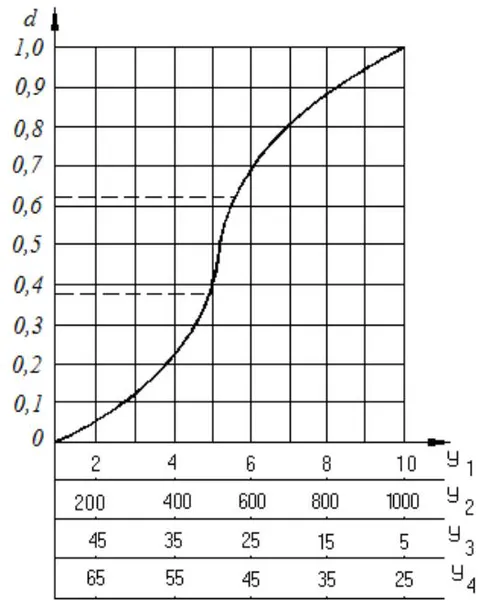
In order to construct the desirability function scale of the optimization parameters for the capsules "Nigelit"(Fig. 1), the method of quantitative analysis was used with the range of desirability values between 0 and 1 (Table 5). The value corresponds to the best value of the optimization parameters, while to their worst value of ones. The intermediate values of the desirability function reflect specific levels of the product quality: very bad (0.00 - 0.20), bad (0.20 - 0.37), satisfactory (0.37 - 0.63), good (0.63 - 0.80) and very good (0.80 - 1.00). Conversion of the natural values (Y) into individual desirability values (d) with a one-sided limit or was performed using the following equation:
where . The coefficients and were calculated by assigning the corresponding desirability values for two of the property values, preferably selected within the range . The desirability curve (Fig. 1) were plotted in the coordinates based on the equation of the desirability function. At the same time, or on the dimensional scales corresponded to 0 (zero) on the dimensionless scale . The desirability scale (Fig. 1) was used to convert the response values into the dimensionless desirability function , i.e. to find individual desirability values for the measured values of the optimization parameters .
Then the overall (generalized) desirability function values were calculated using the formula (2) as the geometric mean of individual desirability values found. It should be noted, this is a more successful approach towards optimization of the parameters for finished products (in our case capsules):
where is overall (generalized) desirability function value; - individual desirability function values.
The values of the overall (generalized) desirability function for the capsules "Nigelit" are presented in table 3.
Based on the generalized evaluation of the optimization parameters - the disintegration of capsules and the technological properties of the granular materials (model mixtures), carried out using a desirability function, the excipients can be arranged in the order of preference as follows:
The type of fillers (Factor A) ;
The type of antiadherents (Factor B) - ;
The type of disintegrants (Factor C) ;
The type of glidants (Factor D) .
The optimal composition for capsules "Nigelit" was formulated based on the results of the mathematical method of experimental design and using a desirability function.
The most optimal combination of levels of factors - composition of the excipients that ensure the required indicators for the capsules "Nigelit" (table 3, composition No. 9) was selected based on the values of the overall (generalized) desirability function of the optimization parameters. The excipients included in this composition are listed in table 6.
| Name of the capsules | No. of the optimal composition | Excipients included in the optimal composition |
| "Nigelit" | composition No. 9 in table 3 | MCC Arbocel A 300 (filler - a3) Magnesium stearate(antiadherent - b1) MCC Arbocel A 300 (disintegrant - c2) talc(glidant - d3) |
Based on the results of the mathematical method of experimental design, we recommend the following formulation and technology:
Formulation:
Nigella sativa seeds ground -350mg
Zinc sulphate -20 (equal to
MCC Arbocel A 300 -22mg
Talc -4mg
Magnesium stearate -4 mg
Average net weight of capsule -00 mg
Technological process: A moisturizing liquid (water) is sprayed into the dry mixture during the mixing process of seeds ground of Nigella sativa and zinc sulphate with "granule-forming" excipient- MCC Arbocel A 300(filler)in order to form agglomerates - granules. The "drying" of granules is accomplished by adding a "drying" excipient--the rest amount of MCC Arbocel A 300 (disintegrant) into the mixer, during the continuous mixing process. Since the final moisture content of the product obtained by this granulation method usually does not exceed the final moisture content of the granules obtained by traditional wet granulation, we did not perform additional thermal drying of the granules. In the final stage, talc (glidant) and magnesium stearate (antiadherent) are added to the granules. The resulted compact granules have good technological properties which are presented in table 7.
| No. | Studied indicators | Unit of measurement | Obtained results |
| 1 | Appearance | Dark brown granules with a strong, agreeable aromatic odor and a spicy, pungent taste | |
| 2 | Particle-size distribution: +2500 -2500+1000 -1000+500 -500+250 -250 | μm,% | 1.5 23.0 47.5 20.8 7.2 |
| 3 | Bulk density untapped | kg/m3 | 390 |
| 4 | Bulk density tapped | kg/m3 | 455 |
| 5 | Flowability | 10-3kg/s | 5.5 |
| 6 | Angle of repose | ° | 38 |
| 7 | Residual moisture | %, 70 °C | 4.2 |
As evidenced by the data in Table 7, in contrast to the mixture of active components, the granular material prepared according to the selected composition and technology has satisfactory technological properties.
Taking into account the amount of granular material to be encapsulated, it's density, empty capsule volume capacity and the requirements for uniformity of the capsule contents the capsule size 00E was chosen to encapsulate the calculated dosage. [17, 20]. The process of filling the capsules with the granular material was performed using the capsule-filling machine MF 30.
IV. CONCLUSION
Thus, based on the results of study of technological properties of the the mixture of active components and the granular material prepared according to the selected composition and technology and using the mathematical method of the experimental design, the Latin square, an optimal composition was formulated and the rational encapsulation technology for the capsules "Nigelit" with an average net weight of capsule (weight of core material) was developed.