Development of Elastic Nanovesicles for Enhanced Transdermal Delivery of Nebivolol Hydrochloride

α
Aparanjitha.R
Aparanjitha.R
σ
Sunitha Reddy.M
Sunitha Reddy.M
ρ
Sarangapani.M
Sarangapani.M
α Kakatiya University

Send Message

To: Author

Development of Elastic Nanovesicles for Enhanced Transdermal Delivery of Nebivolol Hydrochloride

Article Fingerprint

ReserarchID

53EF3

Development of Elastic Nanovesicles for Enhanced Transdermal Delivery of Nebivolol Hydrochloride Banner

AI TAKEAWAY

Connecting with the Eternal Ground
  • English
  • Afrikaans
  • Albanian
  • Amharic
  • Arabic
  • Armenian
  • Azerbaijani
  • Basque
  • Belarusian
  • Bengali
  • Bosnian
  • Bulgarian
  • Catalan
  • Cebuano
  • Chichewa
  • Chinese (Simplified)
  • Chinese (Traditional)
  • Corsican
  • Croatian
  • Czech
  • Danish
  • Dutch
  • Esperanto
  • Estonian
  • Filipino
  • Finnish
  • French
  • Frisian
  • Galician
  • Georgian
  • German
  • Greek
  • Gujarati
  • Haitian Creole
  • Hausa
  • Hawaiian
  • Hebrew
  • Hindi
  • Hmong
  • Hungarian
  • Icelandic
  • Igbo
  • Indonesian
  • Irish
  • Italian
  • Japanese
  • Javanese
  • Kannada
  • Kazakh
  • Khmer
  • Korean
  • Kurdish (Kurmanji)
  • Kyrgyz
  • Lao
  • Latin
  • Latvian
  • Lithuanian
  • Luxembourgish
  • Macedonian
  • Malagasy
  • Malay
  • Malayalam
  • Maltese
  • Maori
  • Marathi
  • Mongolian
  • Myanmar (Burmese)
  • Nepali
  • Norwegian
  • Pashto
  • Persian
  • Polish
  • Portuguese
  • Punjabi
  • Romanian
  • Russian
  • Samoan
  • Scots Gaelic
  • Serbian
  • Sesotho
  • Shona
  • Sindhi
  • Sinhala
  • Slovak
  • Slovenian
  • Somali
  • Spanish
  • Sundanese
  • Swahili
  • Swedish
  • Tajik
  • Tamil
  • Telugu
  • Thai
  • Turkish
  • Ukrainian
  • Urdu
  • Uzbek
  • Vietnamese
  • Welsh
  • Xhosa
  • Yiddish
  • Yoruba
  • Zulu

Abstract

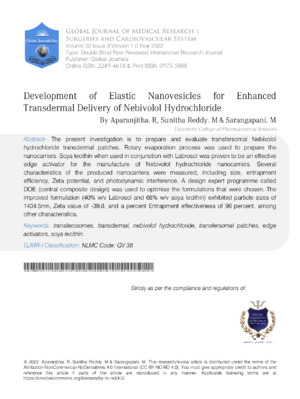
The present investigation is to prepare and evaluate transfersomal Nebivolol hydrochloride transdermal patches. Rotary evaporation process was used to prepare the nanocarriers. Soya lecithin when used in conjunction with Labrosol was proven to be an effective edge activator for the manufacture of Nebivolol hydrochloride nanocarriers. Several characteristics of the produced nanocarriers were measured, including size, entrapment efficiency, Zeta potential, and photodynamic interference. A design expert programme called DOE (central composite design) was used to optimise the formulations that were chosen. The improved formulation (40% w/v Labrosol and 68% w/v soya lecithin) exhibited particle sizes of 1434.5nm, Zeta value of -39.8, and a percent Entrapment effectiveness of 96 percent, among other characteristics.

References

25 Cites in Article
  1. W Charman,C Porter (1996). Lipophilic prodrugs designed for intestinal lymphatic transport.
  2. V Madhumitha,S Sangeetha (2020). Transfersomes: A Novel Vesicular Drug Delivery System for Enhanced Permeation through Skin.
  3. Annette Zur Mühlen,Cora Schwarz,Wolfgang Mehnert (1998). Solid lipid nanoparticles (SLN) for controlled drug delivery – Drug release and release mechanism.
  4. S Swarnlata,J Gunjan,D Chanchal,S Shailendra (2011). Development of novel herbal cosmetic cream with Curcuma longa extract loaded transfersome for anti-wrinkle effect.
  5. Mustafa Elsayed,Ossama Abdallah,Viviane Naggar,Nawal Khalafallah (2007). Deformable liposomes and ethosomes: Mechanism of enhanced skin delivery.
  6. M Uner,G Yener (2007). Importance of solid lipid nanoparticles (SLN) in various administration routes and future perspectives.
  7. Minoo Azimi,Mahvash Khodabandeh,Abdolkhalegh Deezagi,Fatemeh Rahimi (2019). Impact of the Transfersome Delivered Human Growth Hormone on the Dermal Fibroblast Cells.
  8. G Balata,M Faisal,H Elghamry,S Sabry (2020). Preparation and characterization Characterization of Ivabradine HCl Transfersomes for Enhanced Transdermal Deliver.
  9. Marilou Cramer,Samuel Saks (1994). Translating Safety, Efficacy and Compliance into Economic Value for Controlled Release Dosage Forms.
  10. Shaila Lewis,S Pandey,N Udupa (2006). Design and evaluation of matrix type and membrane controlled transdermal delivery systems of nicotine suitable for use in smoking cessation.
  11. Miroslav Backonja,M Wallace,E Blonsky,B Cutler,P Malan,Jr,R Rauck (2008). High‐concentration capsaicin for the treatment of post‐herpetic neuralgia and other types of peripheral neuropathic pain.
  12. Takaaki Komatsu,Tsukasa Sakurada (2012). Comparison of the efficacy and skin permeability of topical NSAID preparations used in Europe.
  13. Namrata Vora,S Lin,P Madan (2013). Development and in-vitro evaluation of an optimized carvedilol transdermal therapeutic system using experimental design approach.
  14. L Kavya,G Murthy,C Roosewelt (2014). Doxycycline Hyclate Tablets.
  15. Shiow-Fern Ng,Jennifer Rouse,Dominic Sanderson,Gillian Eccleston (2010). A Comparative Study of Transmembrane Diffusion and Permeation of Ibuprofen across Synthetic Membranes Using Franz Diffusion Cells.
  16. Sheo Datta Maurya,Shweta Aggarwal,Vijay Kumar Tilak (2010). Enhanced Transdermal delivery of indinavir sulfate via transfersomes.
  17. M Gamal,M Ei Maghraby,A Williams,B Barry (1999). Skin delivery of oestradiol from deformable and traditional liposomes.
  18. M Gavali,S Pacharane,Jadhav Rk,J Kadam (2011). Transferosome: A new technique for transdermal drug delivery.
  19. S Pandey,M Goyani,V Devmurari,J Fakir (2009). Transferosomes: A Novel Approach for Transdermal Drug Delivery.
  20. Chomchan Amnuaikit,Itsue Ikeuchi,Ken-Ichi Ogawara,Kazutaka Higaki,Toshikiro Kimura (2005). Skin permeation of propranolol from polymeric film containing terpene enhancers for transdermal use.
  21. P Gavali,A Gaikwad,P Radhika,T Sivakumar (2010). Design and development of hydroxypropyl methylcellulose (hpmc) based polymeric film ofenalapril maleate.
  22. R Shivaraj,Panner Selvam,P,Tamiz Mani,T Sivakumar,T (2010). Design and evaluation of transdermal drug delivery of ketotifen fumarate.
  23. V Sankar,Johnsondb,V Sivanand,S Ravichandran,Chandrasekaran,A Rajasekar (2003). Design and evaluation of nifedipine transdermal patches.
  24. B Mathews (1999). Regulatory aspects of stability testing in Europe.


  25. Mona Qushawy,Ali Nasr,Mohammed Abd-Alhaseeb,Shady Swidan (2018). Design, Optimization and Characterization of a Transfersomal Gel Using Miconazole Nitrate for the Treatment of Candida Skin Infections.

Funding

No external funding was declared for this work.

Conflict of Interest

The authors declare no conflict of interest.

Ethical Approval

No ethics committee approval was required for this article type.

Data Availability

Not applicable for this article.

How to Cite This Article

Aparanjitha.R. 2026. \u201cDevelopment of Elastic Nanovesicles for Enhanced Transdermal Delivery of Nebivolol Hydrochloride\u201d. Unknown Journal GJMR-I Volume 22 (GJMR Volume 22 Issue I3): .

Download Citation

Flexible, detailed research on elastic nanovesicles for drug delivery systems.
Journal Specifications
Keywords
Classification
GJMR-I Classification: NLMC Code: QV 38
Version of record

v1.2

Issue date

January 5, 2023

Language
en
Experiance in AR

Explore published articles in an immersive Augmented Reality environment. Our platform converts research papers into interactive 3D books, allowing readers to view and interact with content using AR and VR compatible devices.

Read in 3D

Your published article is automatically converted into a realistic 3D book. Flip through pages and read research papers in a more engaging and interactive format.

Article Matrices
Total Views: 1240
Total Downloads: 60
2026 Trends
Related Research

Published Article

The present investigation is to prepare and evaluate transfersomal Nebivolol hydrochloride transdermal patches. Rotary evaporation process was used to prepare the nanocarriers. Soya lecithin when used in conjunction with Labrosol was proven to be an effective edge activator for the manufacture of Nebivolol hydrochloride nanocarriers. Several characteristics of the produced nanocarriers were measured, including size, entrapment efficiency, Zeta potential, and photodynamic interference. A design expert programme called DOE (central composite design) was used to optimise the formulations that were chosen. The improved formulation (40% w/v Labrosol and 68% w/v soya lecithin) exhibited particle sizes of 1434.5nm, Zeta value of -39.8, and a percent Entrapment effectiveness of 96 percent, among other characteristics.

Our website is actively being updated, and changes may occur frequently. Please clear your browser cache if needed. For feedback or error reporting, please email [email protected]

Request Access

Please fill out the form below to request access to this research paper. Your request will be reviewed by the editorial or author team.
X

Quote and Order Details

Contact Person

Invoice Address

Notes or Comments

This is the heading

Lorem ipsum dolor sit amet, consectetur adipiscing elit. Ut elit tellus, luctus nec ullamcorper mattis, pulvinar dapibus leo.

High-quality academic research articles on global topics and journals.

Development of Elastic Nanovesicles for Enhanced Transdermal Delivery of Nebivolol Hydrochloride

Aparanjitha.R
Aparanjitha.R Kakatiya University
Sunitha Reddy.M
Sunitha Reddy.M
Sarangapani.M
Sarangapani.M

Research Journals