I. INTRODUCTION
In recent decades, rapid climate change has created a new challenge to obstruct expansion development throughout the world. It is extensively recognized that the impacts of climate-change intensify unfavorable climatic and environmental situations, particularly in developing countries. Drought studies are important because which manipulate on the society and the economy of any country. Drought is a weather-related natural disaster. It affects vast regions for months or years. It is a regular characteristic of the climate and occurs in virtually all-climatic zones. These characteristics vary significantly in different regions. Drought is linked to shortage of precipitation over an extended period of time, usually for a season or more. This scarcity results in a water shortage for some activity, cluster or ecological division. Drought is too linked to the timing of precipitation. Otherwise climatic factors such as high temperature, high wind speed and low humidity are often related with drought.
The most vulnerable countries to climate change which is facing climate change induced hazards such as rising sea levels and storm surges, heat stress, extreme precipitation, inland and coastal flooding, landslides, salinity intrusion, drought, increased aridity, water scarcity and air pollution[1]. It is the fifth most affected country by extreme weather events in the last 20 years. That means, it is the worst hit victim of global climate change and most probably will continue being so in the future. Among the different types of natural disasters that the country experiences, the most frequent events are: (i) floods and river erosion (ii) cyclones and tropical storms (iii) extreme temperature and drought. Climate change is already a painful reality in different country: farmers and peasants are facing losses of their harvest every year due to continual reduced rainfall. Different physical effects of climate change include increased temperature and precipitation, increased salinity and extreme weather events such as floods, cyclones and droughts have profound negative impacts on different country water resources [2]. The variability of weather patterns can lead to flooding and drought as direct results and indirect impacts such as reduced availability and quality of freshwater. In the northern part of Bangladesh floods in the monsoon season and drought in the dry season and other associated stressors like upstream river diversion and damming, can have severe implications for water resources and agricultural yields [3]. The socio-economic effects of climate change arise from interactions between climate and society and which in turn affect the both natural and managed environments. Traditionally, climatic variations have provided opportunities (resources) and imposed costs (hazards), depending on how society modified to the environment. Thus, a bountiful floodplain rice-growing system, finely tuned to seasonal climate variations, is often disrupted by floods, droughts, and cyclones. Agriculture is still the main source of economic activities in the most of different country in the world. Agricultural sectors are frequently affected by natural disasters such as droughts, excessive rainfall, floods, flashflood, heavy fog, earthquakes, storm, cyclones, salinity and landslides [4]. In order to increase crop production and protecting crops, human life, and ecosystem there is an increasing demand from the policy makers for a reliable prediction, and in particular, the rainfall. The crop yielding depends on the rainfall amount and rain duration. The crop production uncertainty is generally defined by the variability of climate and especially for rainfall variability. So the rainfall variability, regional distribution and predictions and to adopt needful events is extreme importance to alleviate the problems due to rainfall in an agrarian country. Otherwise, drought -as an environmental phenomenon, is an integral part of climatic variability. Droughts are the result of acute water shortage causing severe and sometimes disastrous economic and social consequences. Out of all common natural disasters, droughts affect more people and larger areas than any other. It is generally considered to be occurring when the rainfall in monsoon is insufficient. Shortage of rainfall in the monsoon may reduce crop productions, creates shortage of drinking water and also may affect the socio-economic life. Generally, the amount of rainfall absorbed in any region provides idea about the occurrence of drought of that region.
In the last 50 years, many countries have suffered about 20 or more drought conditions. A part from loss to agriculture, droughts have significant effect on land dreadful conditions, live reserve population, employment and health. Past droughts have typically affected about 47 percent of the country and 53 percent of the population [5]. Climate variability and droughts are commonly known important stress factors in developing counties, where rural households have adapted to such factors for decades and in extreme dry regions households have even moved beyond climate dependence. Many countries have already showed an increased incidence of droughts in recent years [2]. Meteorological drought is directly related to the weather parameter rainfall, but agricultural drought in is the consequence of meteorological drought [6]. The drought
Ref
Ref condition in some counties in the recent decades had led to a short fall of crop production. The biophysical, environmental and health issues were concerning drought occurrence in many countries. The analysis exposed that, during the drought period, rainfall as the main factor of supplying surface water and normalizing the dryness of the nature was almost 46% lower than the previous (normal) years [7]. Many countries and regions are particularly vulnerable to droughts [8]. However the drought has attracted less scientific attraction than flood or cyclone, several authors found that the impact of drought can be more unprotected than flood and cyclone [9].
The Standardized Precipitation Index (SPI) provides the forecasting of drought. The primary reason for using SPI is that SPI is based on rainfall only so that drought assessment is probable even if other hydro meteorological measurements are not accessible. The SPI is distinct more than different timescales, which allows it to explain the condition of drought over a range of meteorological, hydrological and agricultural applications. Another advantage of SPI comes from its standardization, which ensures that the frequencies of extreme events at any location and on any time scale are consistent. The SPI also detects wetness scarcity more rapidly which has a response time scale of approximately 3, 6, 12, 24, 48 months. On the other hand, fuzzy logic can be used to focus on modeling problems characterized by imprecise or ambiguous information. The underlying power of fuzzy set theory is that linguistic variables are used in it rather than quantitative variables to represent imprecise concepts. Fuzzy logic is successful in two kinds of situation: (i) very complex models where understanding is strictly limited or in fact quite judgmental and (ii) processes where human reasoning, human perception or human decision making is inextricably involved. Drought is a creeping occurrence where the above illustrated factors play vital roles. It also needs a complete understanding of the drought causing factors, severity classification and to interpret the drought forecasted output variables. Several studies used SPI for real time monitoring and analysis of drought [10]. SPI was applied to monitor the concentration and spatial extension of droughts at different time scales in different country [11]. In a study, severity and spatial pattern of meteorological drought are analyzed by using multi-temporal SPI. The maximum SPI value are found -2.27 for 6 month time scale, the -2.17 for 12 months time scale and -1.85 for 3 months time scale respectively [12]. Fuzzification is a method for determining the degree of membership that a value has to a exacting fuzzy set. This is determined by evaluating the membership function of the fuzzy set for the value [13]. In standard models variables have real number values, the relationships are defined in terms of mathematical functions and the outputs are crisp numerical values [14]. The Mamdani fuzzy inference system has been used to estimate the average rainfall behaviour in the many countries. The rules of fuzzy-logic principles were used to make operations for both the cases of fuzzification operation and defuzzification operation. In study fuzzy logic based rainfall prediction method by using the Mamdani fuzzy inference system may be successively used for different environmental problem estimation to mitigate unexpected meteorological problems [15]. Fuzzy rule based system is use to predict rainfall. Fuzzy inference is the actual procedure of mapping with a given set of input and output from side to side a set of fuzzy systems. Fuzzy levels and membership functions obtained after minimum composition of inference part of the fuzzifications done for temperature and wind speed were considered as they represent the environmental condition enhance a rainfall occurrence [16]. [17] used fuzzy inference model for predicting rainfall. The ability of fuzzy logic model predicted outputs were compared with the actual rainfall data [18]. [19] used a model based on fuzzy rules and neural networks using large-scale climatic signals to predict rainfall in the western Iran. [20] used fuzzy logic for rainfall prediction. The fuzzy logic method is used to model and to predict confined rainfall data. Since drought is closely associated with crop productions and thus food security; hence, the study on drought hazards, particularly drought monitoring is important to decrease its impact in any country. Therefore, the study aims at developing a drought assessment procedure in meteorological and agricultural contexts and to develop a fuzzy rule based drought forecasting method.
II. METHODS
The SPI calculation for any location is based on the long-term rainfall record for a desired period.
Where, is the seasonal precipitation at the i-th rain gauge station and j-th observation, is the long-term seasonal mean and is its standard deviation. A fuzzy logic based drought forecasting method was developed employing the SPI. The fuzzy ranks from 1 to 7 were assigned based on SPI ranges with respective drought classification. The ranges and the ranks assigned for each drought classification are shown in the table 1 below.
| Drought Classification | SPI Values | Fuzzy Ranks |
| Extremely dry | -2 and less | 1 |
| Severely dry | -1.5 to -1.99 | 2 |
| Moderately dry | -1 to -1.49 | 3 |
| Normal | -0.99 to 0.99 | 4 |
| Moderately wet | 1 to 1.49 | 5 |
| Very wet | 1.5 to 1.99 | 6 |
| Extremely wet | 2 and above | 7 |
Fuzzy Set: Let X be a universal set. Then A is called a (fuzzy) subset of X if A is a set of ordered pairs.
where is the membership function of A, is the grade of the membership of x in A.
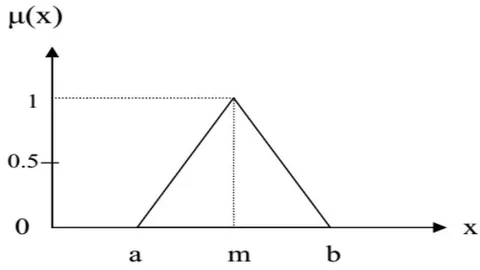
The linguistic expression for the variables and their membership functions are evaluated from the following triangular membership functions and it is defined over .
where m is the midpoint of .
The value of the membership function , ranges from 0 to 1, with 0 denoting no membership, 1 for full membership and values in between has partial membership as shown in Figure 1.
At the aggregation stage, output fuzzy sets of each rule are aggregated to form a single fuzzy set. The fuzzy max function is presented for use of forecasting of drought:
III. RESULTS
In this study, the number of linguistic terms extremely dry (ED), severely dry (SD), moderately dry (MD), normal (N), moderately wet (MW), severely wet (SW), and extremely wet (EW) referred to as fuzzy sets, is assigned to variable rainfall. These fuzzy sets overlap and cover the necessary range of variation for that variable. The degree of membership (from 0 to 1) of a real valued input (SPI) to a particular fuzzy set A (ED, SD, MD, N, MW, SW, EW) is given by a membership function . This transformation of real valued inputs into a degree of membership in a particular fuzzy set is called fuzzification. Fuzzification of linguistic variables is classified into linguistic labels by assigning membership functions for each of the variable.
The definite membership functions of these linguistic values are given as follows:
Notes
The computed SPI values are converted into fuzzy membership values ranging from 0 to 1. This fuzzy set is denoted as Set 'A'. The fuzzy set 'A' can be divided into '7' number of subsets according to the drought index considered in the study. Based on SPI drought classifications, fuzzy set 'A' is defined using triangular fuzzy function as shown in Figure 2.
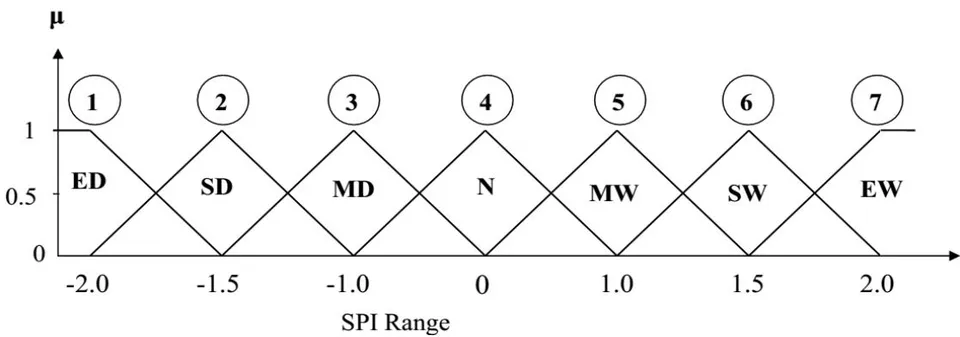
The drought forecasting measures in the form of fuzzy ranks were identified for each year. These values were obtained after the SPI values were transferred to the triangular fuzzy membership function (figure 2). The particular SPI value falling on the respective set(s) was identified. If a value falling in the SPI range from -2.0 to -1.5, the maximum value of fuzzy membership function will be considered and the value is assigned that particular set rank. Similarly, all the fuzzified ranks were identified for each SPI values. The fuzzified ranks were used for forecasting the drought severity class for different years.
IV. DISCUSSION AND CONCLUSION
The forecasting of drought is performed employing SPI and fuzzy logic. The analysis and drought classification using SPI and forecasting the SPI for immediate time step by applying the proposed drought forecasting methods using fuzzy logic are discussed. The SPI values are calculated based on monthly rainfall values with annual time scale for all the rain gauge stations of Bangladesh. The actual fuzzy membership functions are determined on the basis of SPI. Fuzzy ranks are assigned on the basis of SPI ranges and membership values as shown in Figure 2. The SPI values and fuzzy ranks for each year of the study are identified as the drought forecasting measures for different years. Finally, it can be concluded that the fuzzy logic based drought forecasting method using SPI can be successively used for drought analysis, forecasting and to mitigate unexpected meteorological problems.