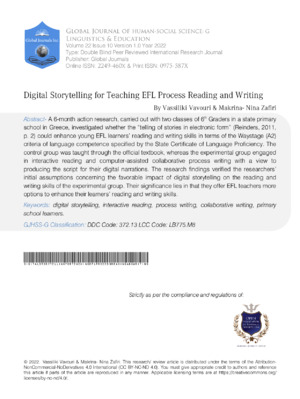
Digital Storytelling for Teaching EFL Process Reading and Writing

Article ID

93K5B

Enhanced ESL reading and writing skills through digital storytelling techniques in language learning.

Digital Storytelling for Teaching EFL Process Reading and Writing

Vassiliki Vavouri
Vassiliki Vavouri
Makrina- Nina Zafiri
DOI

Abstract

A 6-month action research, carried out with two classes of 6 th Graders in a state primary school in Greece, investigated whether the “telling of stories in electronic form” (Reinders, 2011, p. 2) could enhance young EFL learners’ reading and writing skills in terms of the Waystage (A2) criteria of language competence specified by the State Certificate of Language Proficiency. The control group was taught through the official textbook, whereas the experimental group engaged in interactive reading and computer-assisted collaborative process writing with a view to producing the script for their digital narrations. The research findings verified the researchers’ initial assumptions concerning the favorable impact of digital storytelling on the reading and writing skills of the experimental group. Their significance lies in that they offer EFL teachers more options to enhance their learners’ reading and writing skills.

Digital Storytelling for Teaching EFL Process Reading and Writing

A 6-month action research, carried out with two classes of 6 th Graders in a state primary school in Greece, investigated whether the “telling of stories in electronic form” (Reinders, 2011, p. 2) could enhance young EFL learners’ reading and writing skills in terms of the Waystage (A2) criteria of language competence specified by the State Certificate of Language Proficiency. The control group was taught through the official textbook, whereas the experimental group engaged in interactive reading and computer-assisted collaborative process writing with a view to producing the script for their digital narrations. The research findings verified the researchers’ initial assumptions concerning the favorable impact of digital storytelling on the reading and writing skills of the experimental group. Their significance lies in that they offer EFL teachers more options to enhance their learners’ reading and writing skills.

Vassiliki Vavouri
Vassiliki Vavouri
Makrina- Nina Zafiri

No Figures found in article.

Vassiliki Vavouri. 2026. “. Global Journal of Human-Social Science – G: Linguistics & Education GJHSS-G Volume 22 (GJHSS Volume 22 Issue G10): .

Download Citation

Journal Specifications

Crossref Journal DOI 10.17406/GJHSS

Print ISSN 0975-587X

e-ISSN 2249-460X

Issue Cover
GJHSS Volume 22 Issue G10
Pg. 9- 43
Classification
GJHSS-G Classification: DDC Code: 372.13 LCC Code: LB775.M8
Keywords
Article Matrices
Total Views: 1605
Total Downloads: 30
2026 Trends
Research Identity (RIN)
Related Research
Our website is actively being updated, and changes may occur frequently. Please clear your browser cache if needed. For feedback or error reporting, please email [email protected]

Request Access

Please fill out the form below to request access to this research paper. Your request will be reviewed by the editorial or author team.
X

Quote and Order Details

Contact Person

Invoice Address

Notes or Comments

This is the heading

Lorem ipsum dolor sit amet, consectetur adipiscing elit. Ut elit tellus, luctus nec ullamcorper mattis, pulvinar dapibus leo.

High-quality academic research articles on global topics and journals.

Digital Storytelling for Teaching EFL Process Reading and Writing

Vassiliki Vavouri
Vassiliki Vavouri
Makrina- Nina Zafiri

Research Journals