I. INTRODUCTION
English Grade (Efraimidou, Zoe-Reppa & Frouzaki, 2009), which is the textbook prescribed and provided by the Greek Institute of Pedagogical Policy as the core material in state primary schools. In the absence of an official syllabus to translate the abstract goals of the foreign language curriculum, into concrete objectives and specify the content to be covered, the textbook is, in effect, the syllabus. The post-use micro-evaluation of the reading and writing tasks reveals that the product approach, which is adopted by the textbook, is not consistent to the process-oriented and learner-centered guidelines of the Integrated Foreign Languages Curriculum (IFLC, 2016), which constitutes the common framework for the teaching and learning of the obligatory or elective languages in the Greek primary and secondary educational system (Presidential Decree-FEK, 2016). Moreover, the textbook does not systematically promote learning outcomes related to the interaction with, production of, and communication through various context-appropriate multimodal texts (FEK, 2016), which integrate audio-visual, linguistic and spatial modalities.
II. LITERATURE REVIEW
a) Reading
Reading comprehension has been researched and interpreted through three general models: the bottom-up, the top-down (Aebersold & Field, 1997) and the interactive (Stanovic, 2000). The bottom-up model heavily relies on such lower-level, data-driven comprehension processes as word recognition, syntactic parsing, and semantic proposition formation to extract the information from the page with minimal interference from the reader's background knowledge (Grabe & Stoller, 2013). Conversely, the top-down model makes use of such higher-level, concept-driven comprehension processes as the reader's (sociocultural, topic and genre) knowledge and inferencing abilities to create an internal summary of the main ideas of the text (ibid).
The interactive reading model associates reading comprehension to the efficient coordination of bottom-up processes, such as the rapid and automatic parsing of lexical, grammatical, and syntactic elements and top-down concepts such as inferencing and schematic knowledge. Sadoski's (2009) interactive model of reading comprehension advances that the visual representation of key information improves verbal processing.
The interactive models of reading comprehension influenced the process-oriented approaches, which focus on the creation of meaning through the reader's interaction with the text, that is from the literal interpretation of the propositional meaning, to inferring the implied meanings and to the critical analysis of the meaning (Thomas, 2013).
b) Writing
The writer-oriented or process approach to writing (Hyland, 2016) identifies writing as a "non-linear, exploratory, and generative process, whereby writers discover and reformulate their ideas as they attempt to approximate meaning" (Zamel, 1983, p. 165).
According to Flower and Hayes (1981) the interactive, recursive, and potentially simultaneous cognitive actions involved in writing, namely "planning", "translating" and "reviewing" operate under the control of the "monitor" function (Flower & Hayes, 1981, p. 369), which also provides access to the writer's long-term memory, wherein knowledge pertinent to the topic, the audience and various writing plans (for instance, informal letters or tweets) is stored (Becker, 2006).
Bereiter and Scardamalia's (1987) "knowledge-transforming" model suggests that skilled writers devote considerable intellectual resources to the analysis and resolution of the complexities of the writing task, such as content, form, audience, style, organization, and their own goals for writing (Hyland, 2016). The developing knowledge, which may have been changed or regenerated as a result of new insights that occurred during the act of writing, interacts with the text and transforms the ideas. Writing thereby extends and deepens learning rather than serves as a demonstration of vocabulary, syntactical, and grammatical knowledge (Raimes, 1993).
For White and Arndt (1991) the process writing teaching session typically involves the generation of ideas through instructional activities, such as, whole-class, small group or pair discussions, brainstorming, making notes, asking questions, and fast writing. Having focused on selected ideas and established a viewpoint, the writers produce a rough draft. Then they structure (i.e. group and reorder) their information, consider the expectations of the target audience, the culture- and text-specific writing conventions as well as their own purposes for writing and individually or collaboratively produce their first drafts. Following a preliminary self-evaluation, the drafts are shared and subjected to peer review. The feedback as to the extent to which the text coheres with the writers' goals and their intended meaning informs the second drafts which are further edited, evaluated and published (ibid).
c) Digital storytelling
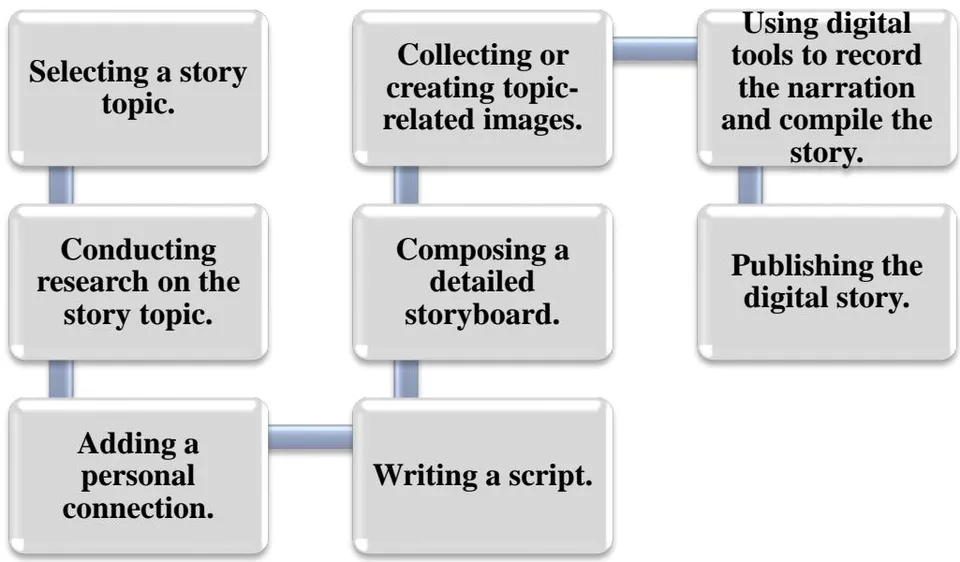
Pioneered by Lambert, Atchley and Mullen at Berkeley University in 1994, digital storytelling represents the evolution of the ancient art of storytelling, which was used to transmit knowledge, myths and values. Digital stories are brief (2-5 minute) multimedia artifacts which combine the recorded audio narration of the storytellers' voice with images, video segments, music and text (Gregori-Signes, 2008, 2014; Pardo, 2014). Figure 1 illustrates the process of creating digital stories:
d) Digital storytelling and the EFL class
Digital storytelling as an educational strategy affords many advantages to EFL pedagogy.
i. Motivation
Digital storytelling seems to entwine "the personal and individual dimension with mass digital dissemination" (Gregori-Signes, 2008, p. 238). The up-to-date, interactive, attractive and user-friendly digital storytelling tools (Pardo, 2014) appeal to the young learners (Yoon, 2013) and enhance their interest in learning English (Guzman Gamez & Moreno Cuellar, 2019; Shamsulbahri & Aziz, 2020). Digital stories can motivate mixed-ability classes and EFL teachers alike (Robin & McNeil, 2012), increase engagement (Di Blas & Ferrari, 2012) and confidence (Smeda et al., 2014) as well as improve in-class behavior (Robin, 2016).
ii. Learner-centeredness
Digital storytelling represents a learner-centered instructional approach, in which the use of multimodality can help the marginalized learners who are struggling to express themselves (Anderson, Stewart & Katchorsky, 2017; Bull & Kajder, 2004; Lotherington, 2017; Reinders, 2011), and to improve their psychology and interpersonal relationships (Smeda et al., 2014).
The technological novelties may cause the teachers to cooperate with (DiBlas & Ferrari, 2012) or relegate their authority to the learners and assume the role of facilitators of the learning process (Bumgarner, 2012). These reversals of roles can smooth the transition from teacher- to learner-centered instructional paradigms.
iii. Differentiated teaching and learning
The different and intrinsically motivating aspects of digital storytelling facilitate differentiated instruction and cater for the learners' diverse learning styles (Kieler, 2010), denoting their preferred or habitual modes of processing information. Lynch and Fleming (2007) suggest that the multiple sensory components of digital stories may actuate the learners' individual blends of intelligences (Gardner, 1983). Digital storytelling can also accommodate the learners' individual learning paces and short attention span and it can individualize the EFL syllabus (Sadik, 2008).
iv. Collaboration
Authentic problem-solving tasks, such as digital storytelling, can provide ample opportunities to small heterogeneous groups of learners to pool their intellectual resources (Yoon, 2013). Donato (1993) asserts that the collaborative construction of knowledge involving interaction with more advanced learners can also scaffold the learner's transition from their current level of cognitive development to the next. Moreover, it can also foster the development of problem-solving skills, accountability and interdependence (Fung, 2010).
v. Experiential learning
Constructing multimedia artifacts, such as digital stories, increases the learners' skills to "transform information into knowledge" (Cradler et al., 2002, p. 48). Digital storytelling promotes a constructivist and experiential approach to EFL teaching and learning (Herrera-Ramirez, 2013). The learners can inductively discover and actively "construct their own understanding or experience in a content area" (Kieler, 2010). Yoon (2013) argues that crafting storylines fosters the learners' cognitive maturity, as it helps them to "make sense of the complex and unordered world of experience" (Gils, 2005) and produce their own interpretations of it (Gregori-Signes, 2014). DiBlas and Ferrari, (2014) affirm that digital stories can help the learners retain their knowledge longer and transfer it to other contexts.
vi. Interactivity
Digital storytelling can be a highly interactive activity (Anderson & Chua, 2010; Robin, 2016; Yoon, 2013), in which learners create, share, respond to, critique and participate in collaborative activities revolving around their stories. The learners can test their hypotheses concerning the target language through the comprehensible input (Krashen, 1985) they receive and through the comprehensible output (Swain, 1985) they produce (Ellis, 1985). Digital storytelling thereby seems to activate the unconscious mental processes responsible for the restructuring of the learners' internal representations (interlanguage) of the target language system (Selinker, 1972). Furthermore, participation in small supporting workshops can lower the learners' affective filter (Krashen, 1985), a psychological impediment to L2 comprehension.
vii. Lower-and higher-order thinking skills
Utilizing the most appropriate modes of expression and sources of information to create digital stories can help the learners develop lower-order thinking skills, such as remembering content knowledge (DiBlas & Ferrari, 2014) as well as higher-order thinking skills, such as understanding, applying, analyzing, revising, and creating the new knowledge (Yoon 2013). Digital storytelling can therefore enhance academic achievement (Aktaş & Yurt, 2017), meta-cognitive reflection and problem-solving abilities (Robin, 2016).
viii. Self-directed learning and autonomy
Kieler (2010) suggests that digital storytelling promotes deep learning, which according to Barett and Wilkerson (2004) is "reflective, developmental, integrative, self-directed and lifelong". Peer feedback and conscious reflection on both product and the learning processes can encourage the learners to assume ownership of their own learning and to develop autonomy and personal initiative (Jitpaisarnwattana, 2018).
ix. Authentic learning
In line with the principles of situated learning (i.e., contextualized learning) (Herrington & Oliver, 2000), digital storytelling projects simulate realistic contexts (Abdallah, 2015), in which learners can engage in authentic and purposeful interaction and retrieve resources from authentic cultural and linguistic environments (situational authenticity) in order to create meaningful digital artifacts and share them with real-life audiences (Yoon, 2013). Digital stories can also provide an authentic electronic documentation of the learners' knowledge and understanding of the educational themes (Foley, 2013) as well as their learning progress to multiple audiences.
x. New and foundational literacies
The systematic integration of digital storytelling into the EFL class, affords expanded opportunities for the learners to use their new literacies, which Robin (2008) describes as the combination of global, digital, media, technology, visual, and information skills, to support their foundational literacies.
Digital storytelling can increase the learners' participation and their reading skills of narrative texts (Abdallah, 2019; Alkhili, 2018; Anggeraini & Afifah, 2017; Apriltya et al., 2016; Hamdy, 2017). The visual presentation of the information in digital stories (Adyguzel & Kumkale, 2018) can enhance understanding of their content (Choo et al., 2017) and may also increase reading motivation (Radaideh et al., 2020; Yoon, 2012). Moreover, digital storytelling can improve vocabulary learning, which is an important component of the reading ability (Habibi & Widyantoro, 2019; Leong et al., 2019).
Digital storytelling improved the learners' narratives(Campbell, 2012; Joko Saputro, 2013; Shamsulbahi & Aziz, 2010; Tsigani & Nikolakopoulou, 2018)through their engagement in process writing in a collaborative learning environment(Castaneda, 2013; Kieler, 2010; Rahimi & Yadollahi, 2017; Yee & Kee, 2017). Further studies reported improvements in terms of the number of words, text appropriacy, organization, accuracy, fluency, and vocabulary range(Guzman Gamez & Moreno Cuellar, 2019; Quiroga & Toro Nieto, 2015; Rahimi & Yadollahi, 2017; Yamac & Ulusoy, 2016; Zakaria et al., 2016). Collaborative digital storytelling projects can enhance understanding of peer assessment strategies(Quiroga & Toro Nieto, 2015), while the expanded audience seems to increase the learners' participation and awareness of the expectations of real audiences. Digital storytelling can introduce novelty and entertainment in the writing class(Kieler, 2010)and positively affect their perceptions of themselves as competent writers as well as their motivation to complete their writing assignments(Foley, 2013).
Rahimi and Yadollahi (2017) integrated reading as a source of comprehensible input and writing as a means to process and interpret the written text and noted the positive effects of digital storytelling on both skills. Kesler, Gibson, and Turansky (2016) showed that responding to literary works through collaborative digital storytelling projects enhanced the young learner's analytic thinking and comprehension. Shelby-Caffey, Ubeda, and Jenkins (2014) integrated digital with conventional literacies through digital storytelling and helped their learners understand and apply reading and writing skills and strategies.
e) The
The research targeted two classes (n= 26) of 6th Graders, attending a state primary school located in a rural town in central Greece. With the exception of one coordinate male learner of Albanian origin in the control group, the 11-12-year-old learners were monolingual speakers of Greek and shared a similar socioeducational background. They were taught English as a foreign language in three forty-five-minute sessions weekly at school and they also attended private foreign language centers, which almost exclusively prepared them for EFL certification exams. Their language proficiency ranged from A1 to A2 (CEFR, 2018). Two male learners in the experimental group experienced undiagnosed learning difficulties and one male learner was a highly functional autistic.
III. METHODOLOGY: ACTION RESEARCH
The progressivist IFLC guidelines enable EFL teachers to use the scales of descriptors as a tool to set their own class-specific goals, select the most appropriate methods and techniques, and develop their own sur-measure differentiated syllabi and lesson plans (FEK, 2016, p. 30322). Therefore, action research, defined by Frost (2002, p. 25) as a "process of systematic reflection, enquiry and action", sought to explore the extent to which the integration of digital storytelling can improve the 6th Graders' reading and writing performance, in terms of the Waystage criteria, which are set by the Greek State Certificate of Language Proficiency. Having been randomly assigned as the control and experimental group, the control group (5 female and 5 male learners) received tuition in English through the official textbook, while the experimental group (7 female and 9 male learners) was exposed to the digital storytelling treatment.
Conforming to Mertler's (2013) cyclical methodological procedure, the researchers/teachers (Burns, 2015) planned, observed and recorded the events and processes, collected and analyzed numerical data related to the subjects' reading and writing performances, reflected on the intended or unintended outcomes of the actions undertaken and developed the next cycle of action.
The research pursued the following questions:
What is the contribution of digital storytelling in the teaching of English as a foreign language in the Grade?
What is the impact of digital storytelling on the reading performance of EFL Graders?
What is the impact of digital storytelling on collaborative process writing of narrative texts?
a) Data collection instruments and analysis procedure
Capitalizing on the strengths and minimizing the weaknesses of both research approaches, a mixed methods approach to research, integrated quantitative (pre-, while-, and post- KPG tests) and qualitative (the teachers' diaries and the semi-structured interviews) strategies to achieve triangulation and extract valid conclusions (Mik-Meyer, 2020).
i. Pre-, while-, and post-tests
Tests from the KPG exams (The KPG exams (uoa.gr)), were administered to both groups prior to the intervention (KPG, 2017), after two digital stories had been completed (KPG, 2018), and at the end of the intervention (KPG, 2017) provided a quantitative (numerical) assessment of the outcomes of the treatment.
ii. Semi-structured interviews
The individual semi-structured interviews explored and provided qualitative data on the subjects' pre- and post-intervention attitudes, experiences, and opinions towards the instructional intervention (Harrell & Bradley, 2009). The interview questions (see Appendices A and B), which were worded in the subjects' mother tongue (Cohen et al., 2007), were divided into axes to highlight "the relationships between concepts and categories" (Vollstedt & Rezat, 2019, p. 87). Their open format allowed the subjects to vocalize their perspectives in their own terms.
iii. Teachers' diary
The teachers' real-time and systematic entries (see Appendix C) on objective (factual) and subjective (ideas and feelings) issues in their diary (Dornyei, 2007) generated detailed and reliable interpretations of the intervention interactions and processes (Latham, 2010). The systematic description of the teaching and learning process stimulated retrospective reflection (Medina, 2013) and assisted in the analysis and interpretation of trends and recurring patterns (Bazir, 2016).
iv. The digital tools
The following digital tools were also utilized in the instructional intervention.
v. The Webex platform
The emergency remote teaching (16/11/2020-23/12/2021) through the Webex platform simulated the face-to-face educative processes and enabled the experimental group to continue the construction of the digital stories.
vi. Google Docs
Google Docs, the online word-processing tool, enabled the subjects to access and edit collaborative documents as well as, the synchronous or asynchronous monitoring and provision of feedback. Its word-processing capabilities, which were familiar from similar applications, assisted in introducing process writing into the text-based instructional context under consideration (See Appendix D).
vii. The digital storytelling authoring tool
The free version of Adobe Spark (https://spark.adobe.com/sp/), a Web-based design tool, supported the asynchronous collaborative creation of digital stories due to its compatibility with the operating systems in use at school (Ubuntu), and domestically (MS Windows) as well as, with Google Docs.
b) The research procedure
Examples of digital stories were presented in one introductory workshop (Pardo, 2014; Sadik 2008) but the technical instruction focused only on basic operations so that the subjects would not lose sight of the educational objectives (Robin & McNeil, 2012; Gils, 2005).
In view of the lack of computers for all the learners as well as, the challenge of effectively managing multiple individual projects, the subjects were asked to form four groups sharing one computer. The groups were expected to assign specialized roles to their members according to their language proficiency, abilities and interests and to create a digital story of 25-28 slideshows, comprising written inserts, images, audio narration, and music. Interventions to thwart the formation of the homogeneous groups and rotations (Widodo, 2013) at the end of each digital story enabled subjects of different reading and writing abilities to cooperate.
The intervention conformed to an adapted version of Yang & Wu's (2012) pre-, while-, and postproduction and distribution digital storytelling framework.
In the pre-production stage, the subjects were expected to read extracts from popular pre-adolescent books, produce a summary of the main events, and engage in the computer-assisted collaborative process of synchronously or asynchronously composing the scripts for their digital narratives on Google Docs.
Because effective reading comprehension combines both linguistic and schematic knowledge (Hedge, 2000), an interactive approach to the reading instruction (Garton & Pratt, 1989; Grabe & Stoller, 2013) informed the design of the proposed lesson plans.
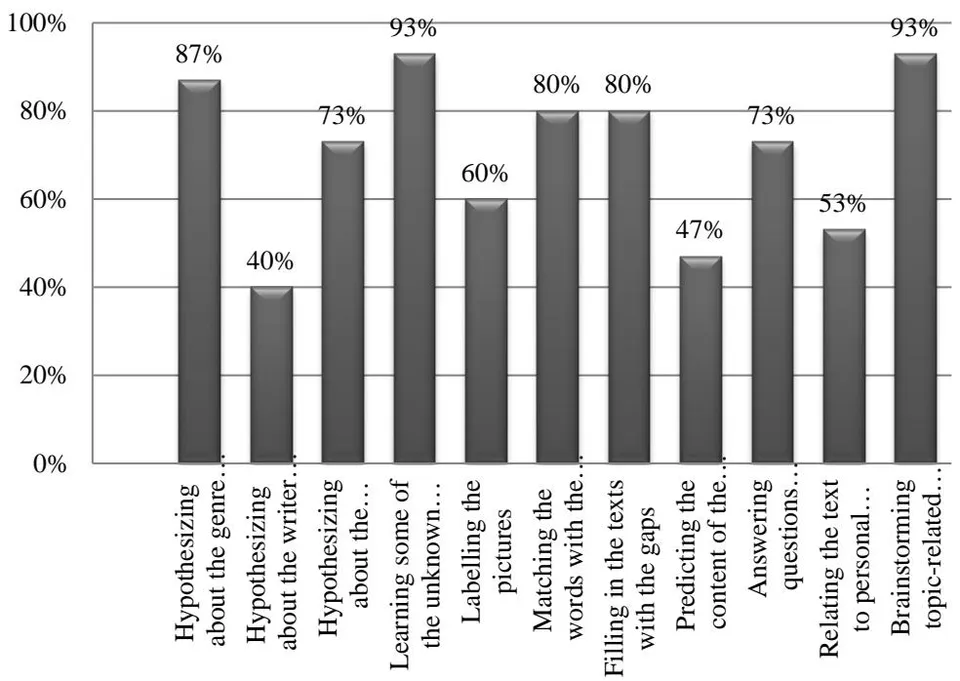
In the pre-reading stage, pair/group activities, aiming at the pre-teaching or revision of key vocabulary (labeling pictures, brainstorming topic-related vocabulary, matching lexical items with their definitions and completing the gaps in sentence) enhanced the comprehensibility of the upcoming reading text and enabled the learners to construe the meaning of less frequent lexical items from the overall or immediate context (Anderson, 1994). Rapid word recognition eased the cognitive load on the processing capabilities of the EFL learners (Hedge, 2000) and released attentional resources for higher-level cognitive operations (Laufer, 1997; Walter, 2003). Furthermore, the "myth of perfect comprehension" (Urquhart & Weir, 1998, p. 86) during lexical processing was gradually replaced with more realistic reading goals, such as tolerance of ambiguity, educated guessing or a reasonable interpretation of the overall meaning.
Previews, questions, or predictions, concerning the content or the themes of the text, on the evidence offered by the textual and visual (illustrations) clues, activated the subjects' content schemata as well as their formal schemata, that is their prior knowledge of the genre-specific characteristics. Associated with top-down processing, this constructive and creative approach to comprehension as a process invited critical reflection, inferencing, and educated guesses, and elicited multiple or alternative interpretations.
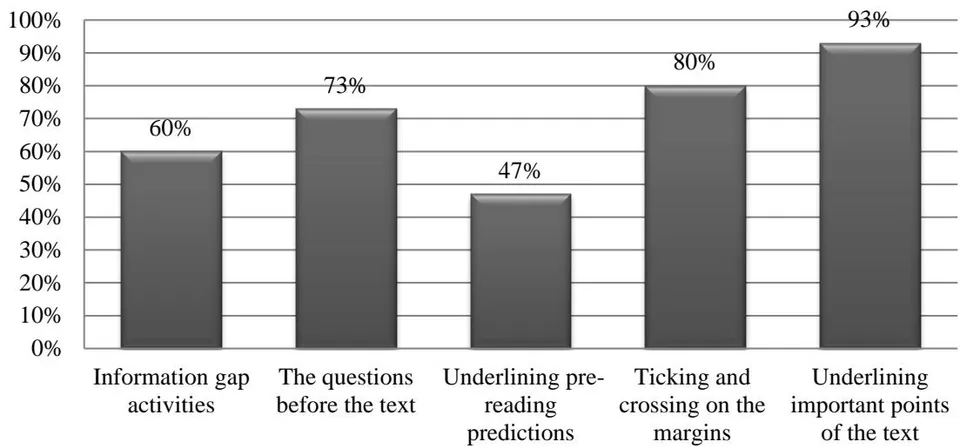
In the while-reading stage, the information gap activities provided further opportunities for active interaction with the text and the collaborative construction of meaning. The learners, in pairs, read intensively, and exchanged the information which was absent from their texts with the other pairs in their group. Alternatively, confirming the pre-reading hypotheses against the actual text, and annotating on the margins of the text, motivated purposeful reading, and expressed the learners' approval (or lack thereof) of the characters' actions or attitudes. The learners also hypothesized at strategic points as to what would happen next and answered questions that required making educated guesses and inferences.
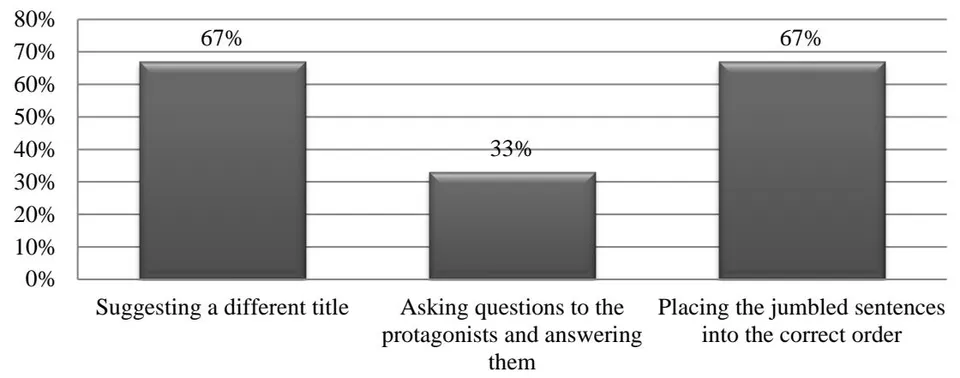
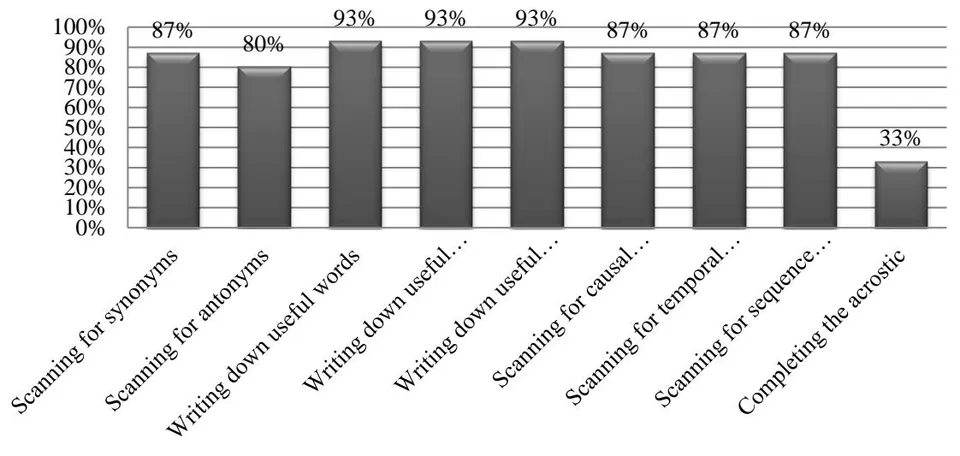
The post-reading tasks encouraged the pairs or groups of learners to provide appropriate titles or place the jumbled sequence of events into the correct order to signify global comprehension. Constructing questions which challenged the main characters' attitudes or actions and answering them from the character's perspective (Clarke, 1989b, as cited in Hedge, 2000) induced the basic readers to exercise their judgment and critically analyze the implicit messages in the text, scanning the texts for synonyms and antonyms of given lexical items, evaluating the most useful vocabulary, completing the acrostic, and categorizing the temporal, cause and sequence cohesive markers, reviewed, expanded, and consolidated the new vocabulary.
Lastly, the subjects' comprehension of the reading texts was indirectly evaluated through the transfer, resynthesis, and extension of their content into the collaborative writing of the scripts of the digital stories. (Kesler et al., 2016; Rahimi & Yadollahi, 2017; Reinders, 2011; Shelby-Caffey et al., 2014; Tatum, 2009).
The writing lessons proposed recursive cycles of writing (Flower & Hayes, 1981), personalized instruction, within workshops (White & Arndt, 1991), and transformed knowledge through writing (Bereiter & Scardamalia, 1987). The writing instruction, which was also divided into stages, marked a shift towards a more interactive and process-focused writing behaviour and the abstraction of transferable writing strategies.
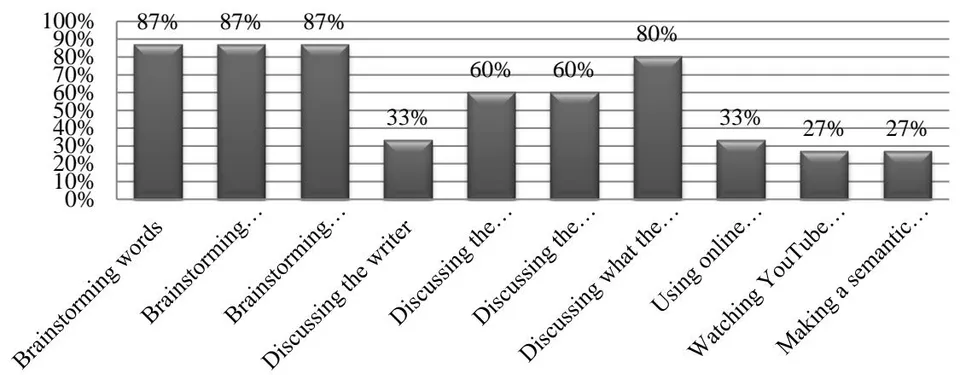
In the pre-writing stage, a whole-class discussion on the benefits of computer-assisted, collaborative process writing as well as, a series of YouTube instructional videos, familiarized learners with the process approach to writing and sensitized them to the benefits accruing from collaborative work in learning networks. The collaborative brainstorming activities helped the learners to recall and display content-related background knowledge and previously learned vocabulary (words, phrases or sentences).
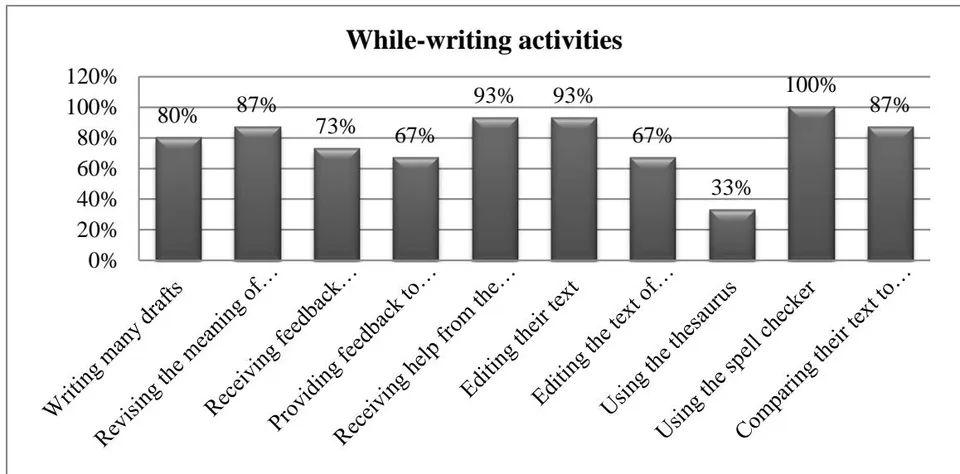
In the while-writing stage, the subjects summarized the basic points of the reading texts and collaboratively synthesized the rough draft of their story on Google Docs. Knowledge pertinent to the task environment, such as the topic, their own purposes or goals for writing, their target audience and uses of the text (Hyland, 2016) were also retrieved from their long-term memory (Flower & Hayes, 1981). In line with Nystrand's (1989) argument that meaning is co-created through the interaction between readers and writers, the young writers also attempted to predict and respond to the "rhetorical demands" of their immediate audiences, meaning their processing needs, expectations and interests structured their texts accordingly (White & Arndt, 1991). An authentic sample text (Scrivener, 2005) afforded feedback on the structure of the learners' drafts, which is relevant to genre-specific conventions (Calfoglou, 2004) and cross-cultural variations in discourse structure (Kaplan, 1966), that is, the ways the given and new information are structured to form texts. Categorizing the highlighted cohesive markers in the text and brainstorming more, sensitized the young learners to the ways a text is held together through coherence, denoting the consistent interplay amongst the writer, the reader and the text (Carrell, 1982), and the effective use of the lexical cohesive (relationship) markers (Graham & Perin, 2007). Following the collaborative composition and the preliminary self-evaluation of the first draft of their story, the learners addressed potential inconsistencies between the content of their text and their writing goals (Hayes & Flowers, 1980; Sommers, 1982) and affected changes. Then another group reviewed their draft, detecting and correcting meaning-related defects such as, lack of clarity and information that need to be added, omitted, or reordered and appropriated ideas, which were likely to improve their texts. The processing capabilities of Google Docs facilitated in-depth modifications at any stage of the composition (Beatty, 2010; Eldouma, 2018). Consequently, the increased time and attention to "higher-order" processes (Bangert-Drowns, 1993, p. 72), such as planning, monitoring, evaluation and revision seemed to enhance the quantity, quality, and complexity of the texts (Pennington, 1996; Piper, 1987).
Conferences with each group (White & Arndt, 1991) enabled the teachers/researchers to gain access to the writers' still evolving texts, monitor their progress, and respond to problems with alternative and text-specific solutions (Florio-Ruane & Dunn, 1985; Genesee & Upshur, 1996). Following the incorporation of the feedback suggested by their peers or the teachers into their scripts, a list (Frank, 1990, as cited in Calfoglou, 2004) related to the mechanical demands of writing (usage, spelling, punctuation and capitalization) in conjunction with the integrated spell-checking system, helped the subjects to compose the final draft of their stories. Additionally, an online thesaurus and dictionaries strategically scaffolded the diversification of the developing writers' vocabulary (Eldouma, 2018).
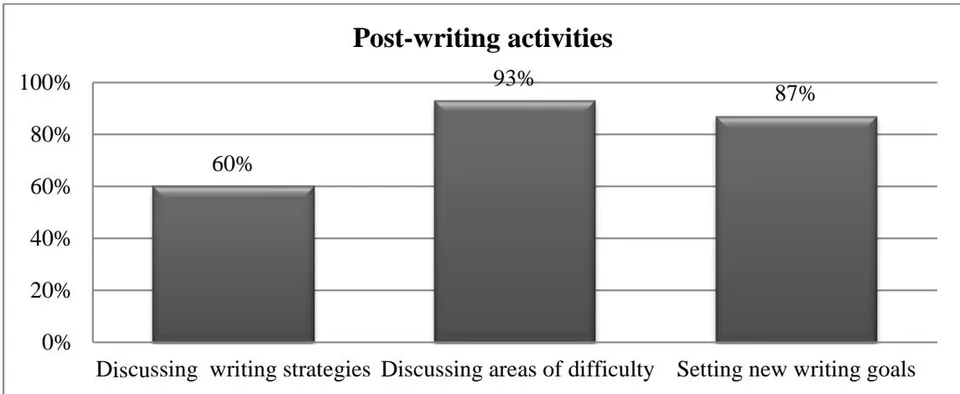
In the post-writing stage, the teachers/ researchers attempted to create a blended learning environment by pointing out the potential for synchronous or asynchronous modifications (Tsigani, 2021). Self-evaluation questions stimulated discussions on issues such as, computer-assisted composition, collaborative process writing, and writing strategies.
Individual strengths, weaknesses, and areas of difficulty, were also discussed and new writing goals were established. Retrospective meta-cognitive reflection on one's learning processes (Brewster et al. 1992) seemed to promote learner independence (Cameron, 2001; Johnson et al., 1998) and allowed the teachers/ researchers to ascertain their learners' instructional needs (Chamot, 1999) and modify the design of subsequent writing sessions.
In the production stage, to avert navigational disorientation, the storyboards, that is the "written and graphical overview of the elements to be included in the digital stories" (Robin, 2016, pp. 23-24), were compiled on the same Google Docs as their scripts. Storyboarding helped the subjects to visualize and communicate their ideas to their classmates more concretely and also to identify problems and weaknesses in advance. Finally, license-free melodies from the Adobe Library or commercial soundtracks embellished and added depth to the narrations (Robin, 2016).
In the post-production stage, a list of criteria guided the collaborative assessment of the process as well as the product of digital storytelling (Reinders, 2011; Sadik, 2008). The online publication of the digital stories (My edublog (vassilikisedublog.blogspot.com) provided an authentic purpose for writing, motivated extensive content and form-related revisions and recorded the subjects' progress (Gregori-Signes, 2008).
IV. REPORT OF THE FINDINGS
A 6-month action research investigated the impact of digital storytelling on the teaching and learning of reading and writing on two classes of 6th Graders in a state primary school in Greece.
a) The pre-intervention interview findings
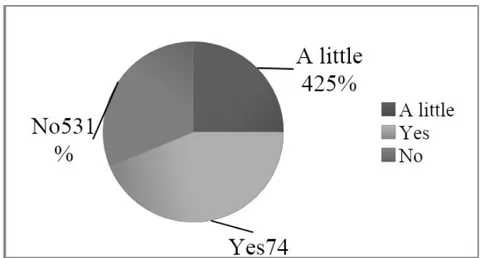
The subjects' responses to the first axis (item 16), of the pre-intervention interviews indicated that all had been receiving ICT instruction since the first grade (item 17), while of them claimed to have pre-school ICT knowledge (Figure 2).
However, their current knowledge of information and communication technologies, which was limited to surfing the web, exchanging messages on social networks, and playing computer games (items 21-26), served for personal entertainment only, and passive consumption, rather than the creation of content (Kennedy & Fox, 2013). The subjects' instrumental motivation (Gardner, 1979) to acquire a certificate in English (item 17) related to practical purposes such as social mobility, international communication and professional advancement.
With regard to what they lack in English (item 19), Figure 3 suggests that of the participants felt confidence in their speaking abilities (barring their pronunciation) and in their knowledge of vocabulary . However, only evaluated their knowledge of grammar positively, and the same applied to their writing, and spelling skills, whereas they evaluated their reading and listening skills even less .
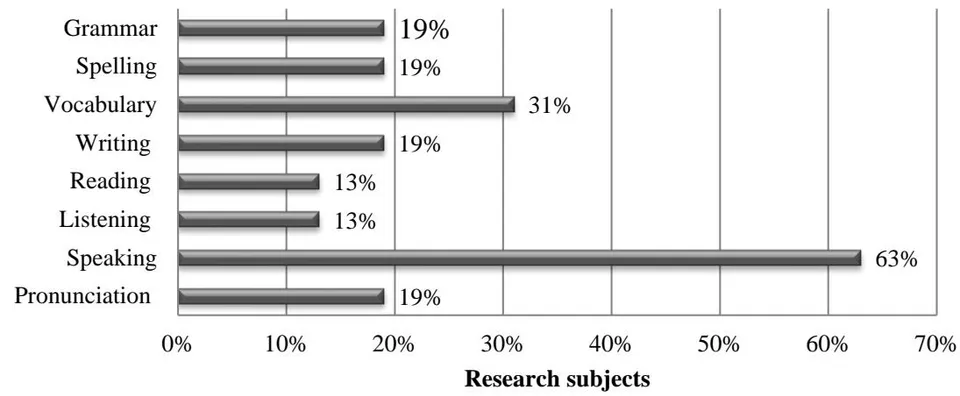
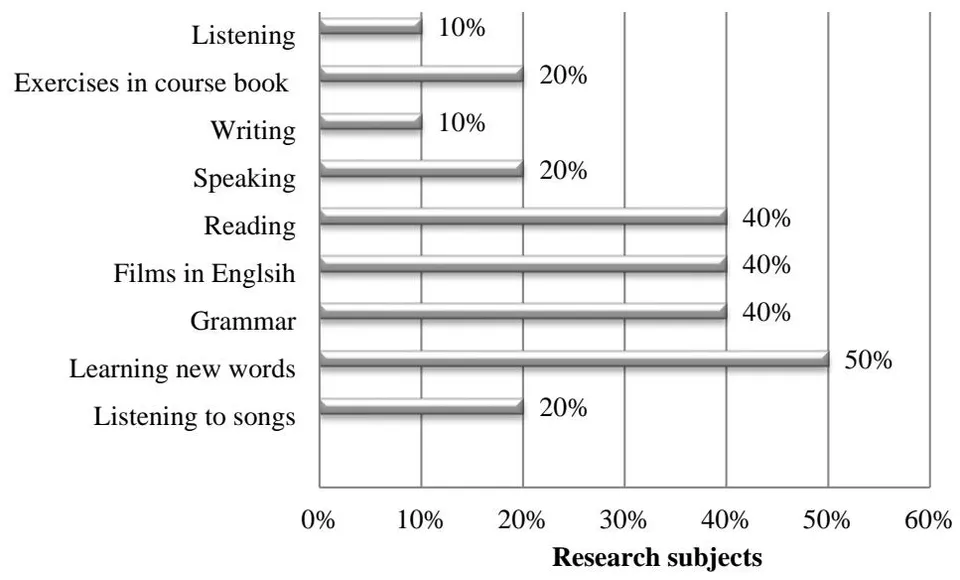
Figure 4 indicates that approximately the subjects preferred to enhance their competence in English (item 31) through reading and grammar instruction as well as, by watching films, through listening to songs, doing exercises and speaking, and only through writing and listening.
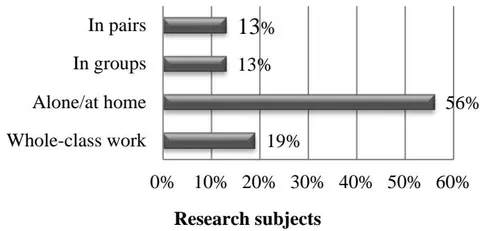
Regarding their preferred modes of work, Figure 5 shows that of the participants preferred to work alone or at home, to attend the lesson with the rest of the class, while only were aware of the advantages of pair or group collaboration.
Preferred modes of work
b) The post-intervention interview findings
The subjects' responses to items 3 and 21-30 of the first axis, post-intervention interview, showed that digital storytelling motivated increased participation
(93%) in the reading of the texts (Radaideh et al, 2020) and interest in the process of reading (80%) and the reading activities (Adyguzel & Kumckale, 2018: Yoon, 2012). According to the participants (Figure 6):
S6:
"I got interested in reading, because we had to understand the text, in order to use it in our digital story."
S3:
- "...because these activities helped me to learn to read better and to use what I learned in the digital story."
S11:
- "...because these activities helped me to understand the text."
Figure 6: Increased interest in reading
Digital storytelling led to improvements (93%) in the subjects' reading skills (Abdallah, 2019; Alkhili, 2018; Anggeraini, & Afifah, 2017; Aprillya et al., 2016; Hamdy, 2017), which was attributed to the collaborative reading of the texts (items 5-8) as well as, the efficient processing acquisition and diversification of vocabulary (items 11-13, 19-20) (80%) (Habibi & Widyantoro, 2019; Leong et al., 2019). Figure 7 elaborates:
"I cooperated with my classmates...and we learned many new words."
"I learned a lot, a thousand more words than what I knew, I used some of the words that I already knew, I improved my vocabulary, I enriched it."
Their responses to items 31-34 also implied that summarizing, as well as the combination of images, and text, increased (93%) reading comprehension (Adyguzel
& Kumkale, 2018; Choo et al., 2017; Mayer, 2009). In their own words (Figure 8):
S14
- "[The digital stories] had both images and texts and the images helped me understand the text."
S2:
- "Maybe because they included the most useful parts of the text...whereas the [original] text may, at points, have contained redundant details."
S4:
- "...because we brought [the texts] closer to our generation,...we could understand them better."
S9:
- "Because in order to make the digital stories, we had to read [the texts] many times..."
S10:
- "...because I learned new words."
Figure 8: Improvements in reading comprehension
Summarizing the critical information of the texts (93%), and reacting to the messages conveyed (80%) expanded (93%) the participants' critical thinking skills (Gregori-Signes, 2008; Sadik, 2008; Yang & Wu, 2012), and encouraged the expression of their personal views. The subjects' responses to items 41-44 in Figure 9 elaborate:
S9:
- "...because we read long texts but, in the digital stories, we had to include only the most important parts."
S1:
- "It helped me distinguish right from wrong and the important from the unimportant."
S11:
- "...because I thought more about what I read."
Figure 9: Critical thinking skills
Items 57-58 and 91-94 of the second axis revealed that digital storytelling increased interest (93%) (Campbell, 2012; Castañeda, 2013; Kieler, 2010; Rahimi & Yadollahi, 2017; Yee & Kee, 2017), participation (80%) in the process of writing (Bumgarner, 2012), and the writing activities (Herrera-Ramirez, 2013), and motivated the participants to complete their assignments (Foley, 2013). According to the subjects themselves (Figure 10):
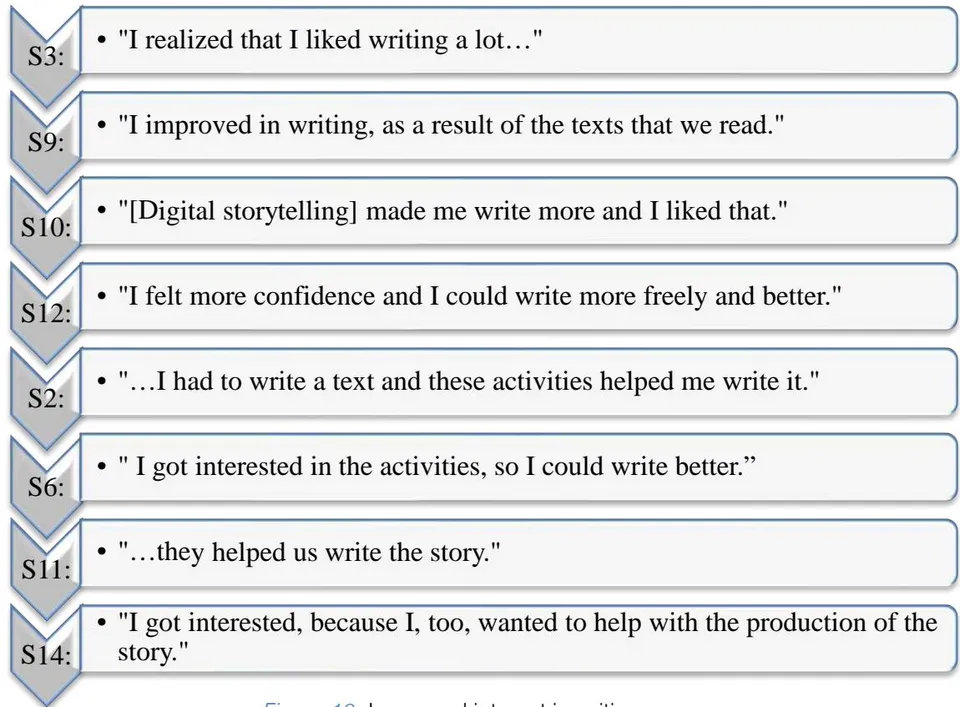
Digital storytelling created a collaborative (Campbell, 2012; Tsigani & Nikolakopoulou, 2018) and supportive learning context (items 67-70), which positively affected the quality of the participants' digital narratives (Joko Saputro, 2013), and their writing competence (Campbell, 2012; Rahimi & Yadollahi, 2017; Shamsulbahri & Aziz, 2020). In their own words (Figure 11):
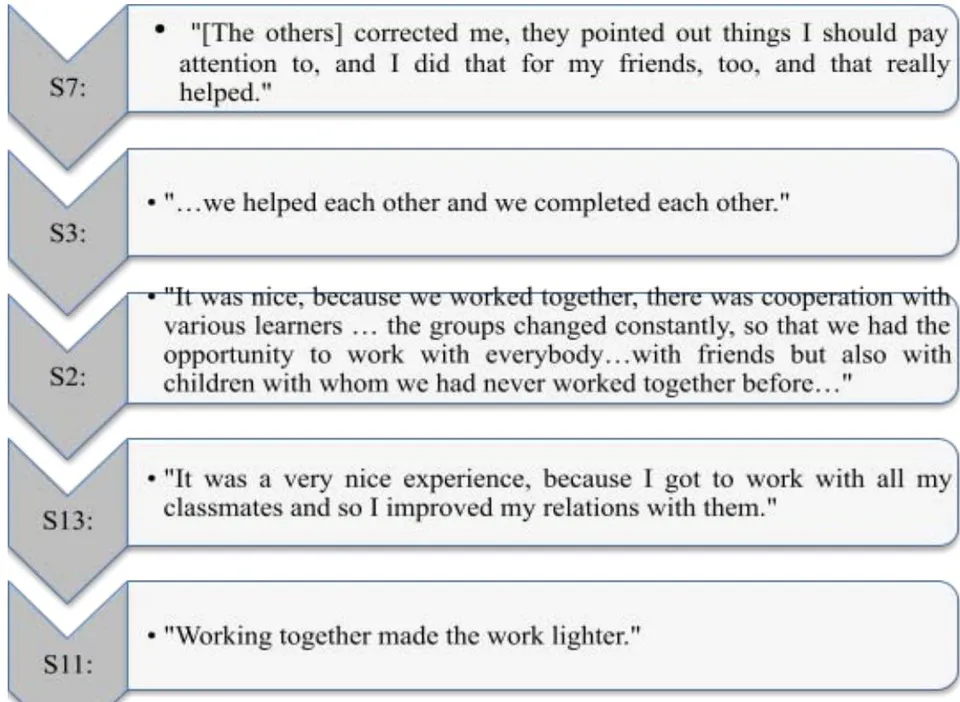
The low achieving participants attributed their lack of participation in the writing activities to their limited language proficiency and inability to detect errors (items 72-79) but claimed to have paid close attention to the strategies deployed by more advanced peers (Fung, 2010).
Digital storytelling encouraged the participants' engagement in computer-assisted process writing (Castaneda, 2013; Kieler, 2010; Rahimi & Yadollahi, 2017; Yee & Kee, 2017). Figure 12 explains:
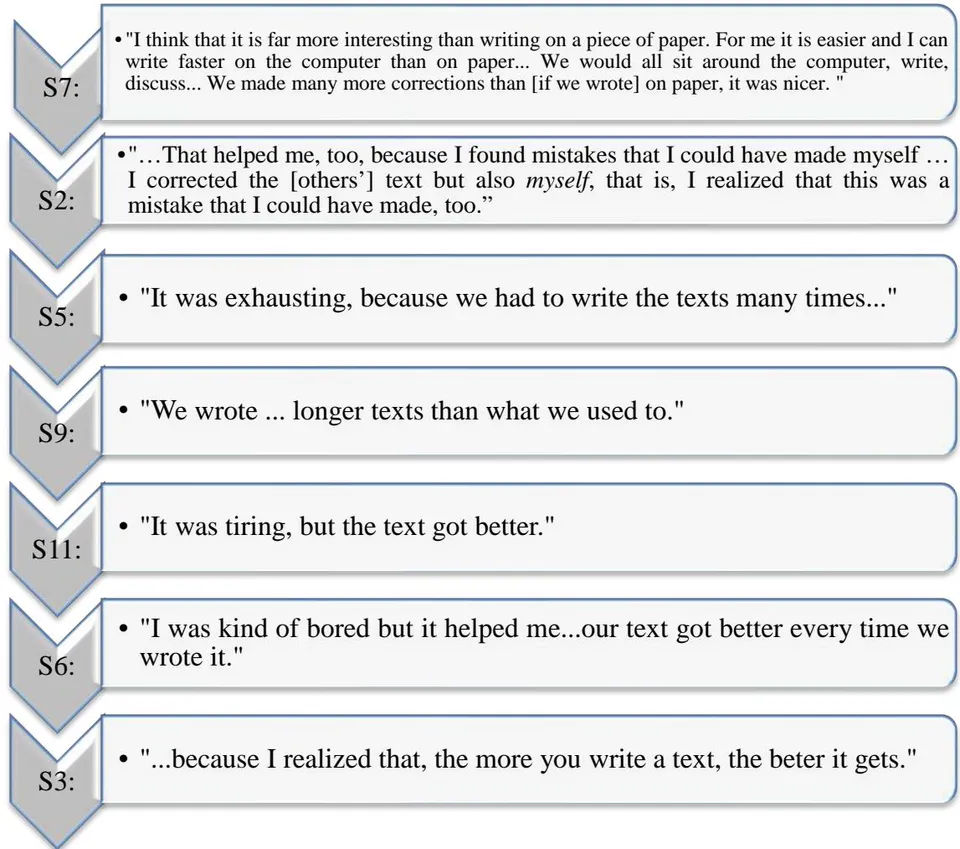
Although digital storytelling raised awareness of peer assessment strategies (Quiroga & Toro Nieto, 2015), it seems that the participants prioritized the revisions (87%) and editing (93%) of their own texts over the revising (60%) and editing (67%) the text of another group (items 81xii and 81xxi). Multiple collaborative proofreading also increased the processing and understanding of the reading texts (Kesler, Gibson & Turansky, 2016), as well as the expression of personal points of view (Kieler, 2010).
The publication of the participants' digital stories (items 80xiii, 96) elicited equal measures of pride and anxiety, enhanced sensitivity to the rhetorical expectations of real-world local audiences and motivated revisions and editing (Yamac & Ulusoy, 2016; Yoon, 2013; Castaneda, 2013). Figure 13 reveals:
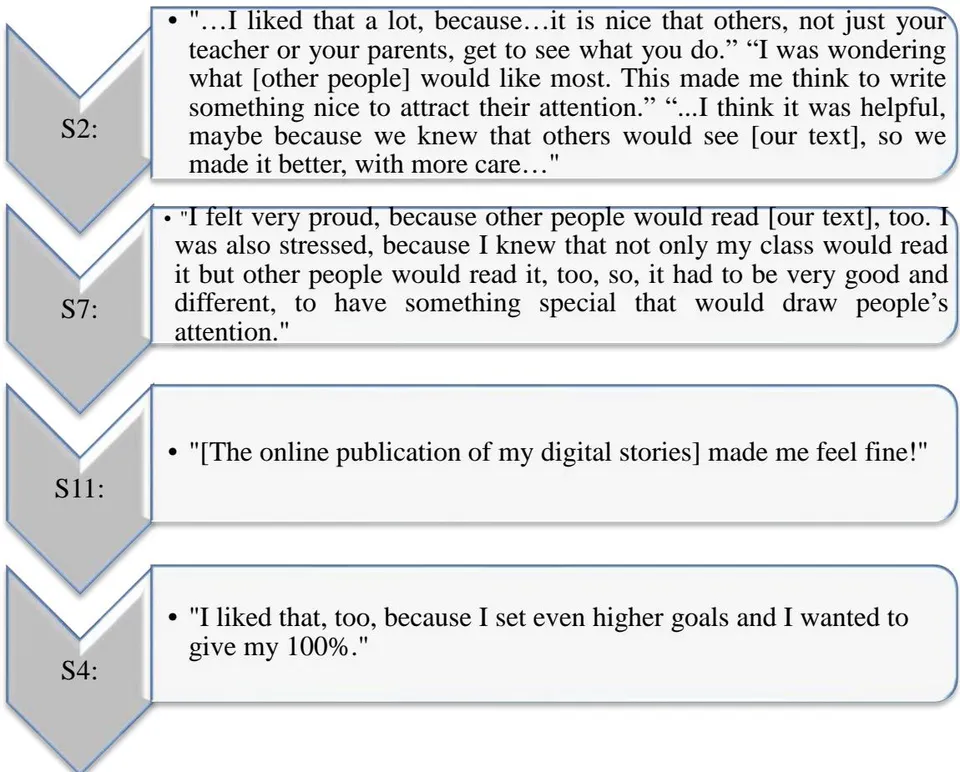
The participants' increasing (67%) reliance on their groups (item 81xiii), relates to research findings concerning enhanced independence in learning
(Jitpaisarnwattana, 2018), as a result of digital storytelling (Figure 14).
S13:
- "Yes. Because she [the teacher] helped me in many things...Whenever I did not understand [something], she explained it better..."
S12:
- "...when the entire group... could not find the answer to a question, then, yes."
"No, because I wanted to do everything with my friends, with my group, everything."
Items 119-122 of the third axis suggested that digital storytelling introduced novelty and entertainment into the EFL instruction (Mutilib et al., 2011). The participants' responses to items 109-117 (Figure 16) revealed their positive attitudes and increased engagement (Smeda et al., 2014):
S7:
- "...when we started to make the digital stories, it was something so different, [something] that we never expected to happen in the English class, and it was fantastic..."
S11:
"We learned and had fun at the same time."
S1:
- "...because we spent our time creatively and learned new things at the same time."
S3:
- "Yes,... I liked it, because I worked with my friends and classmates, with whom I had never worked before, and I also liked the fact that we had computers in the English class".
S9:
- "Yes, because I realized that it is not just books that you can learn English from."
S5:
- "...because I engaged more in the lesson and dedicated more time, so that the digital story would turn out as good as possible."
S11:
"Yes. Yes, because it was fun and the other children helped me."
S3:
- "Yes, [digital storytelling] made me like the [English] class more. Before that... I was kind of bored... but it made it that more interesting."
Figure 16: Novelty, entertainment, increased engagement
Moreover, the participants claimed (items 129- competence (Herrera-Ramirez, 2013) in many ways, as 132) that digital storytelling improved their EFL elaborated in Figure 17:
S3:
- "Making all these digital stories, I learned new words, I learned to read [better], I learned many things!"
S4:
- "...because we learned new words, which was helpful."
S8:
"...because we read the text together."
"Listening to the recordings, I could understand the words better, the texts, the pronunciation."
S16:
- "...because, as I wrote the texts, I came across new words and I learned to read better."
Figure 17: Increased language competence
Multimedia authoring helped the participants, with reading and writing difficulties, to express themselves (Anderson et al., 2014; Bull & Kajder, 2004; Bumgarner, 2012). The participants' group pride (Castaneda, 2013; Sadik, 2008), in their digital stories (item 104), seemed to have connected the class (which thus seemed to have formed a more stronger bond) (Figure 18), and improved their psychology and interpersonal relationships (Smeda et al., 2014):
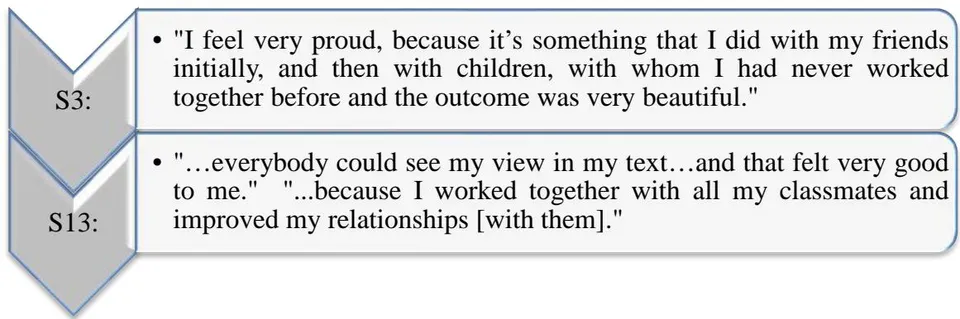
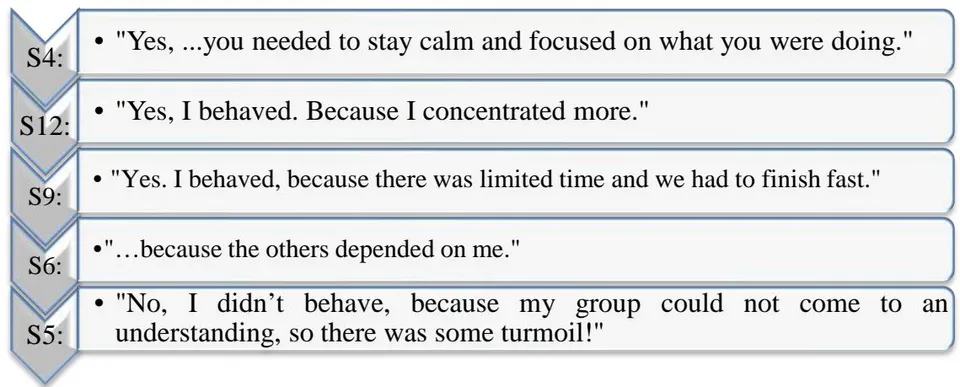
The participants' responses (Figure 19) implied that there was a development of individual and group responsibility and interdependence (Fung, 2010), as concerning their collaborative projects. Figure 19 (items (134-137) suggests improved (93%) behavior and cooperation (Robin, 2016):
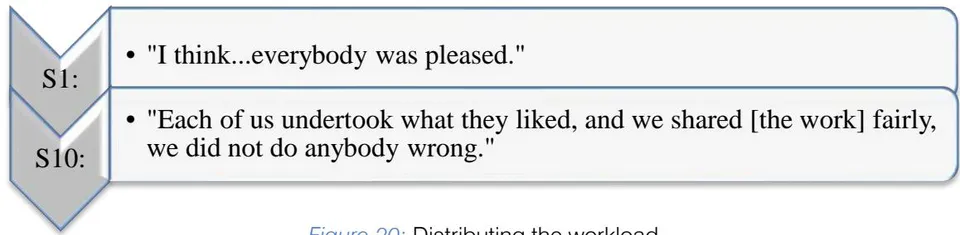
The participants' responses (item 143) concerning the uneven sharing of the work (Sadik, contradicted the teachers' entries in their diaries 2008). Figure 20 suggests:
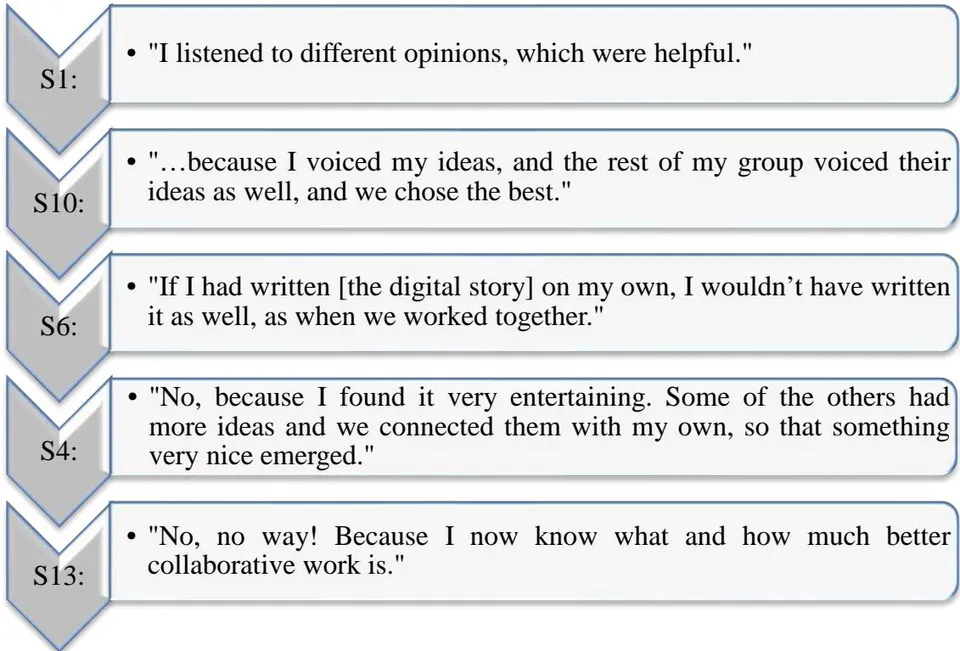
The participants also seemed to have acknowledged (93%) the benefits from the collaborative construction of knowledge (items 147-151), and peer feedback (Herrington & Oliver, 2004), as evidenced by their overall unwillingness to work individually (item 154). In their own words (Figure 21):
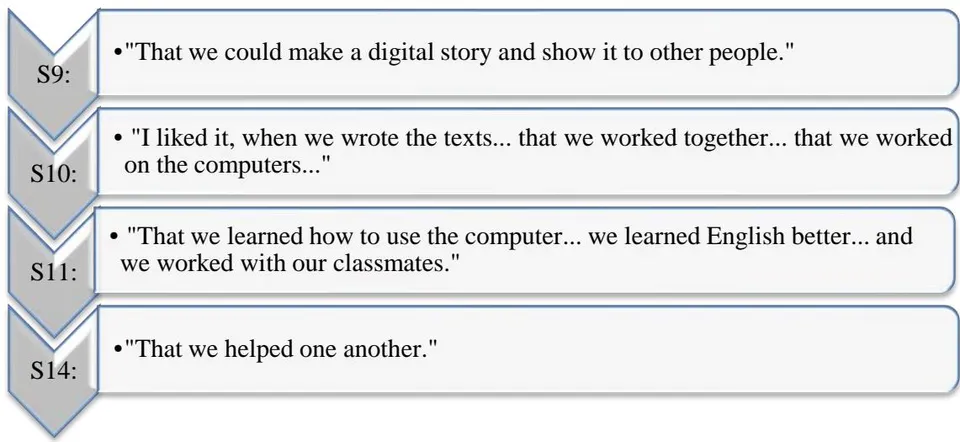
Peer collaboration, improvements in language competence, the connection of the EFL class with real-world audiences, and with technology, were cited (item
157) as the most positive features of digital storytelling (Figure 22):
The main difficulties associated with digital storytelling (items 106-107) related to computer malfunctions, poor internet connection, limited access to the computer lab (Image 1), time management and difficulty in locating appropriate images.
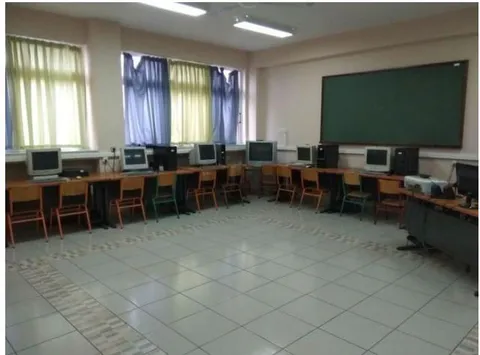
Image 1: The computer lab
The participants' unwillingness (item 163) to continue being taught through the textbook contrasted starkly with their favorable pre-intervention descriptions (Figure 23):
S3:
- "I don't like it at all, because, after all these things that we've done, the English textbook seems to me so very dull and without interest."
S11:
"I don't like it that we have returned to the textbook. Because I liked digital storytelling better."
S13:
- "...boredom, to be honest, because it has no relevance, I wish we could continue [with digital storytelling]."
Lastly, the participants expressed (items 160, 164-166) their eagerness to engage in digital storytelling either in class (100%) or on their own (73%).
c) The teachers' diaries
The teachers' entries in their diary describe digital storytelling as a highly interactive activity, which lends itself to blended or emergency remote teaching through the Webex platform during the quarantine (11/16/2020-12/23/2021). The "Breakout sessions" option on Webex resolved tensions between the methodology based on face-to-face, group, and computer-mediated interaction. The participants' intrinsic motivation, engagement (Tsigani & Nikolopoulou, 2018), and responsibility in learning (Guzman Gamez & Moreno Cuellar, 2019), is corroborated by their high attendance rates (94%), as well as the fact that all the groups dedicated considerable out-of-class time to complete their assignments. The more advanced participants sidelined their competitive and individualistic attitudes, compensated each other's' weaknesses and assisted the less proficient members of their groups (Widodo, 2013). The teachers' observations confirm Donato's (1994) insight that peer interaction and the collaborative co-construction of knowledge through digital storytelling projects facilitated the subjects' transition to the next level of cognitive development and afforded ample opportunities for the formulation and testing of the FL hypotheses receptively, through reading, and productively, through writing. Even though the participants' limited repertoire of interactional strategies caused them to code-switch extensively, the use of the L1 scaffolded the development of their L2 critical skills (Canas et al., 2018).
In relation to the teaching and learning of reading, the multilayered literary texts provided content for the writing of the scripts of the digital stories (Kesler, Gibson & Turansky, 2016; Shelby-Caffey et al., 2014) and modeled language structures (Lazar, 1994; Khan & Alasmari, 2018; Seo & Kim, 2020). Despite being slightly beyond the participants' current levels of language proficiency, the quick succession of events retained their interest and motivated them to read strategically and creatively (Bakar, 2019), retell the main events of the stories (Bereiter & Scardamalia, 1987) but also draw inferences and incorporate their opinions (Kesler et al., 2016; Janssen et al., 2010; Sadik, 2008). The warm-up activities established links between learners' topic-related pre-knowledge or past experiences, which are organized as scripts or content schemata in their long-term memory (Hyland, 2016; Grabe & Stoller, 2013), and the text. The key vocabulary which was pre-taught alleviated the learner's cognitive difficulties in processing the text (Grabe & Stoller, 2013). Similarly, the learners' formal schemata, that is, their knowledge of discourse-specific characteristics, such as the structure, language features, and purpose (Grabe & Stoller 2013), were also activated. Furthermore, the nature, use, and application of the cognitive and meta-cognitive strategies (O' Malley & Chamot, 1990) for repairing gaps, in reading comprehension, were methodically and explicitly modeled or practiced. For instance, pair or group interaction, the expression of personal attitudes, preferences or feelings and the articulation of collaborative rationales were encouraged. The learners were also given opportunities to anticipate the text content based on textual and visual cues, to summarize its main points, to generate questions, or draw inferences from explicitly stated information (Duke et al., 2010).
In relation to the teaching and learning of writing, the production of multiple drafts, wherein the teachers' suggested changes, questions, and text- specific strategies as well as, peer feedback which was incorporated (Zamel, 1985), sensitized the greater part of the young learners to the cyclical or reiterative cognitive processes (drafting, reviewing, editing, and evaluating) thus underlying real-world writing and helping them to reinforce their narrative writing skills. Writing came to be perceived as a collaborative endeavor and the developing writers were familiarized with the interactive processes involved in the co-construction and revision of a written text by multiple authors. The generation of diverse ideas and perspectives from their background knowledge and experiences and the collaborative decisions concerning the content, structure and language of their texts fostered a sense of co-ownership in the texts produced (Storch, 2005, p. 154). However, the teachers noted that the more advanced members, in each group, actively collaborated in writing the scripts (Sadik, 2008), whereas the less proficient or engaged members cooperated in subtasks (Beatty & Nunan, 2004), such as retrieving audiovisual resources, which do not seem to promote language acquisition.
d) The KPG test results
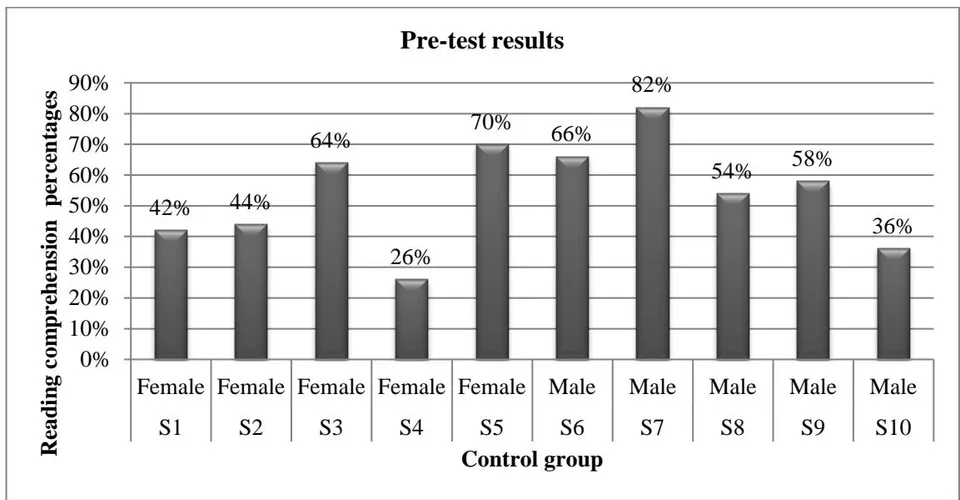
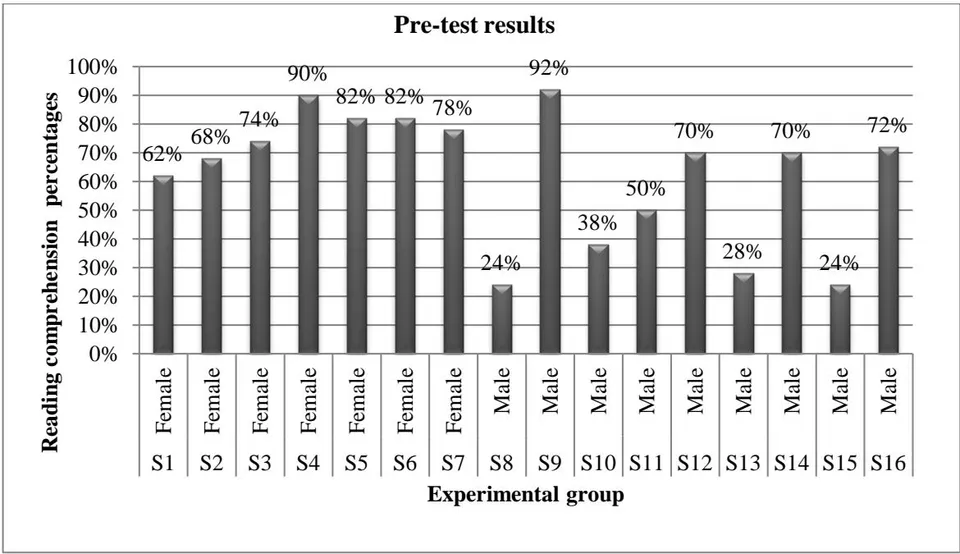
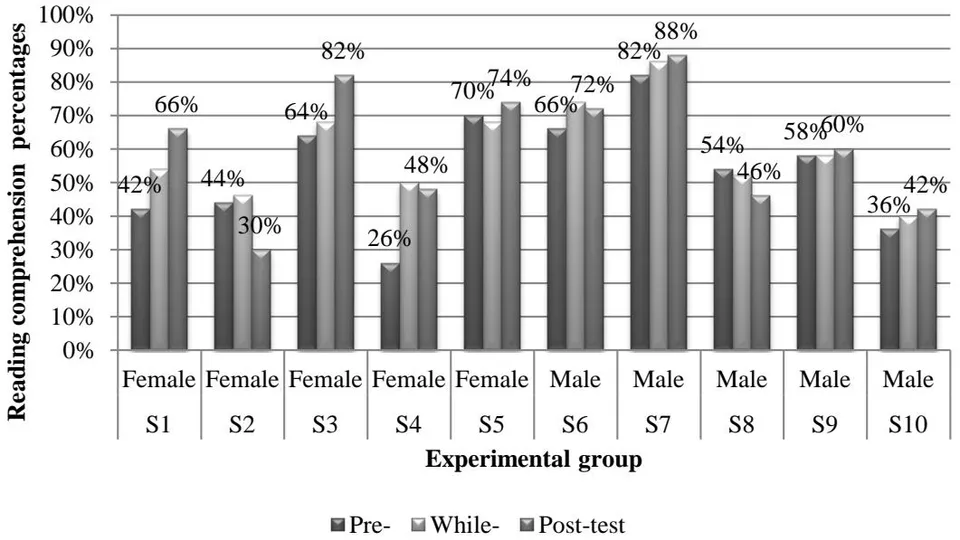
The KPG (2017) pre-test diagnosed an difference in the average reading performance of the control and the experimental group . Figure 24 and Figure 25 show that one male and one female participant from the control group as well as four male participants from the experimental group, two of which experience learning difficulties, did not complete their tests.
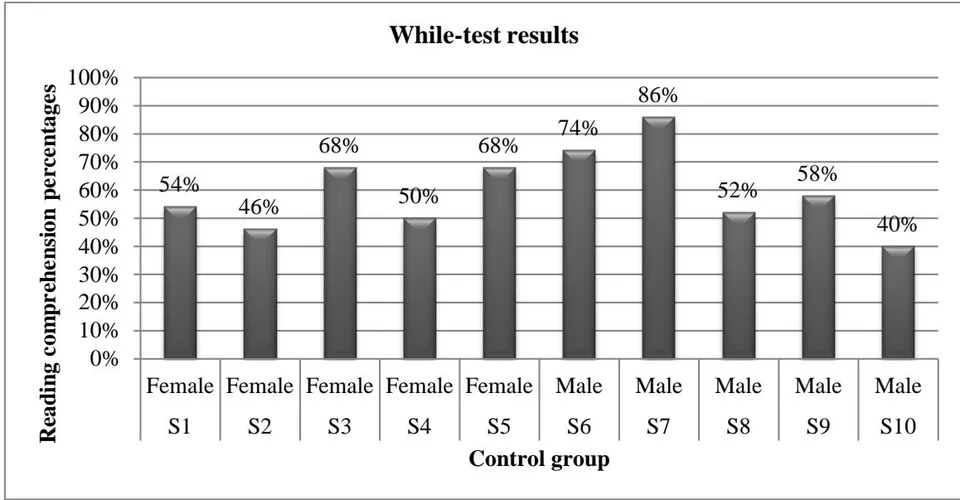
The KPG (2018) while-test showed that the slightly decreased , while that of the experimental average reading performance of the control group group improved (Figure 26 and Figure 27).
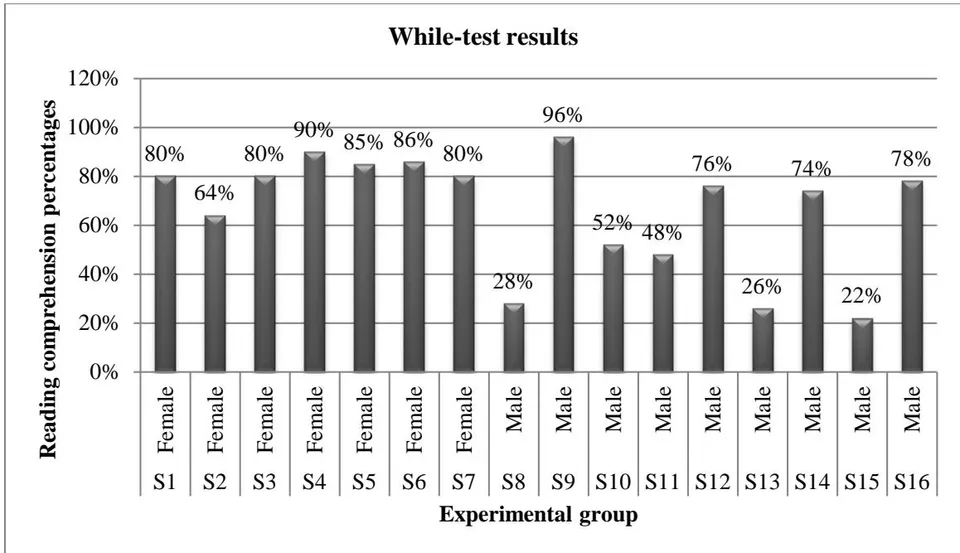
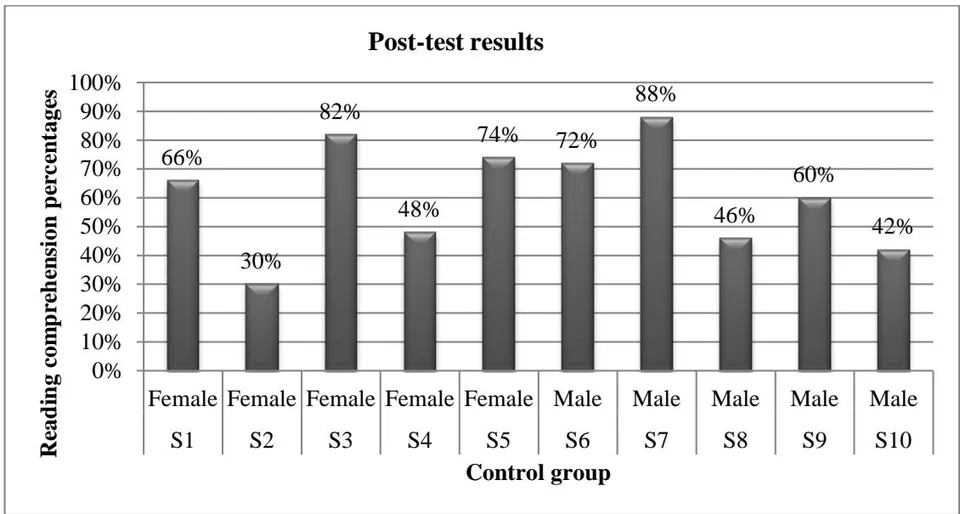
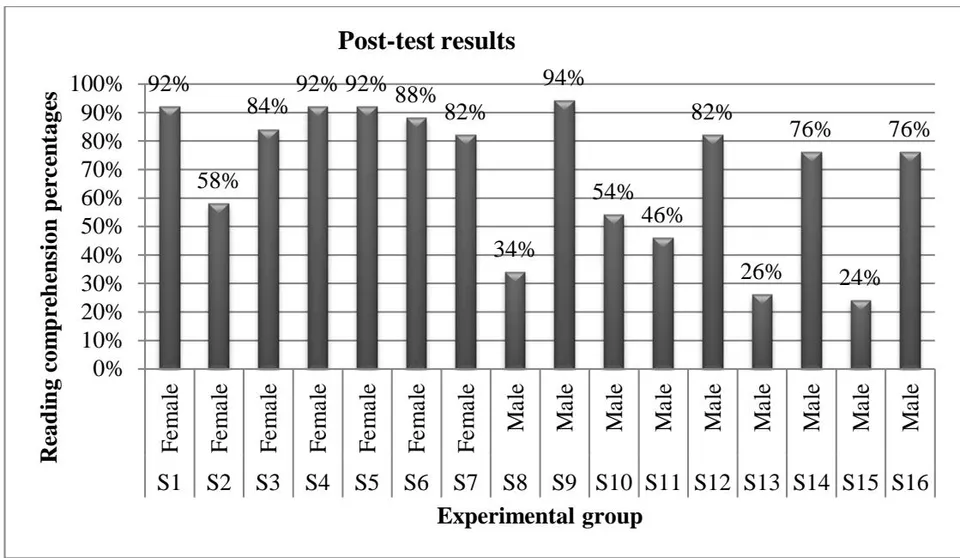
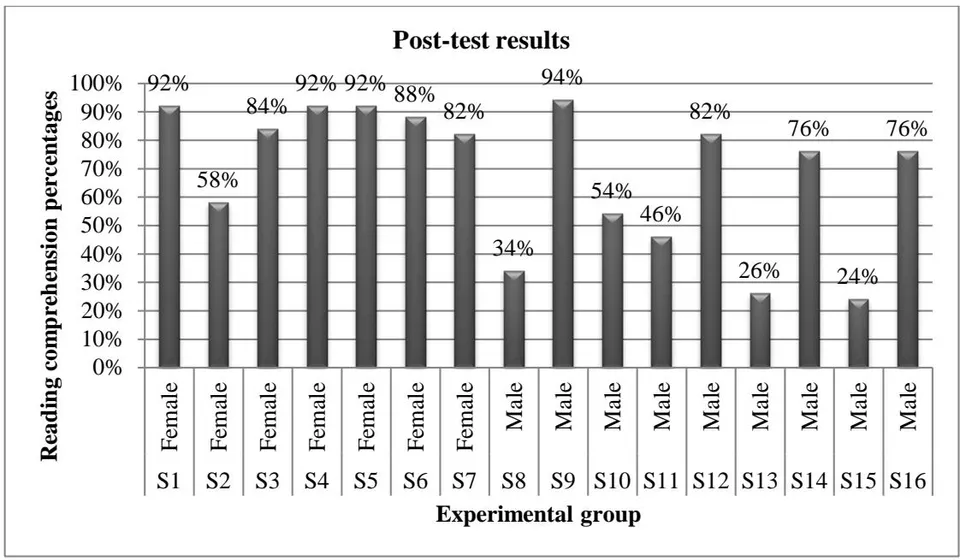
The KPG (2017) post-test results indicated that the average reading performance of the experimental group (69%) surpassed that of the control group (50%) (Figure 28 and Figure 29).
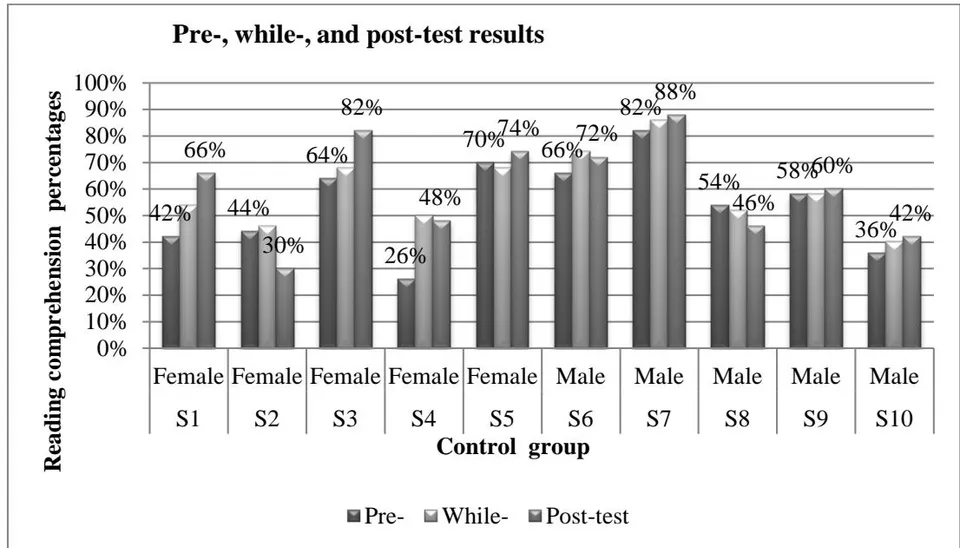
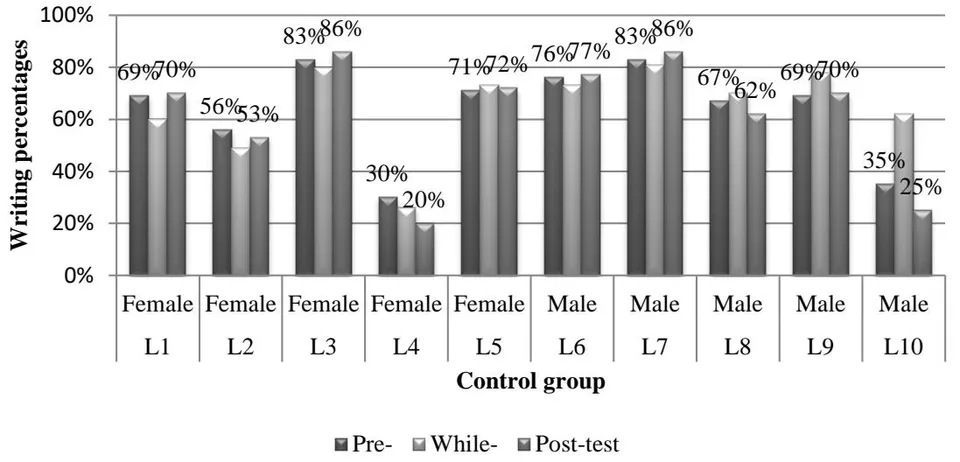
The independent samples t-test comparative analysis of the pre-, while-, and post-tests (Figure 30 and Figure 31), according to the t-criterion, revealed that there is no statistical significance in the means variations of the reading performance between the control and the experimental group and that the independent samples were homogeneous (Table 1 and Table 2).
Group Statistics Variation Group N Mean Standard. Deviation Standard. Error Mean Control group 10 6,60 12,186 3,853 Experimental group 16 6,00 9,151 2,288 Independent Samples Test Variation Levene's Test for Equality of Variances t-test for Equality of Means F Sig. t df Sig. (2-tailed) Mean Difference Standard. Error Difference 95% Confidence Interval of the Difference Lower Upper Equal variances assumed ,713 ,407 ,143 24 ,887 ,600 4,190 -8,047 9,247 Equal variances not assumed ,134 15,320 ,895 ,600 4,481 -8,934 10,134
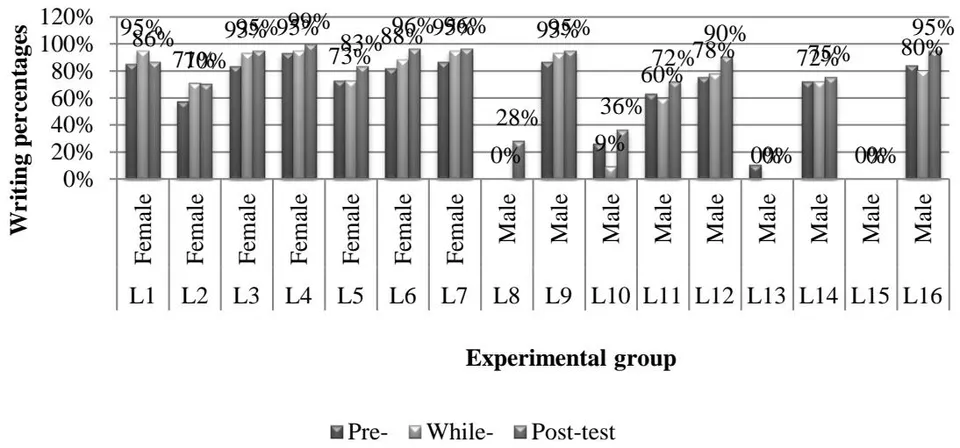
The KPG (2017) pre-test measured a difference in the average writing performance of the control and the experimental group . Figure 32 and Figure 33 show that four male participants from the experimental group did not complete the test.
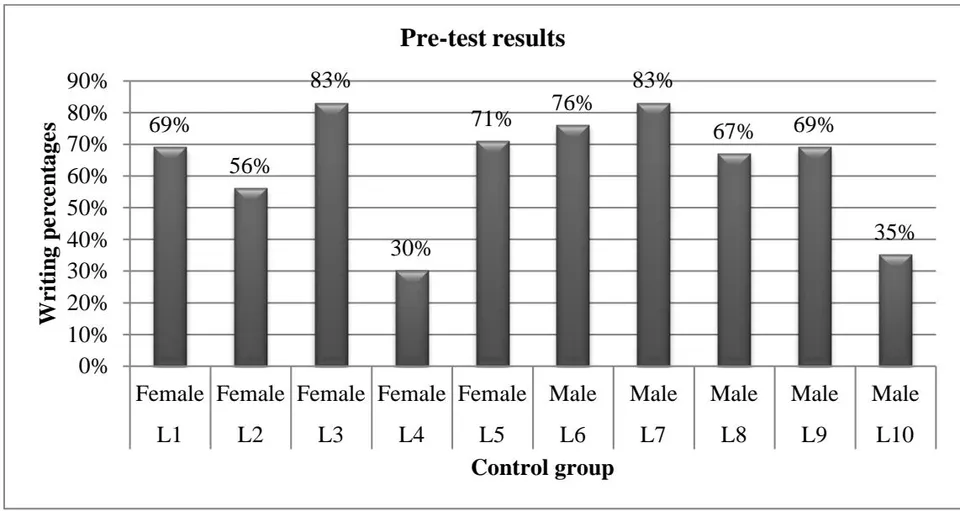
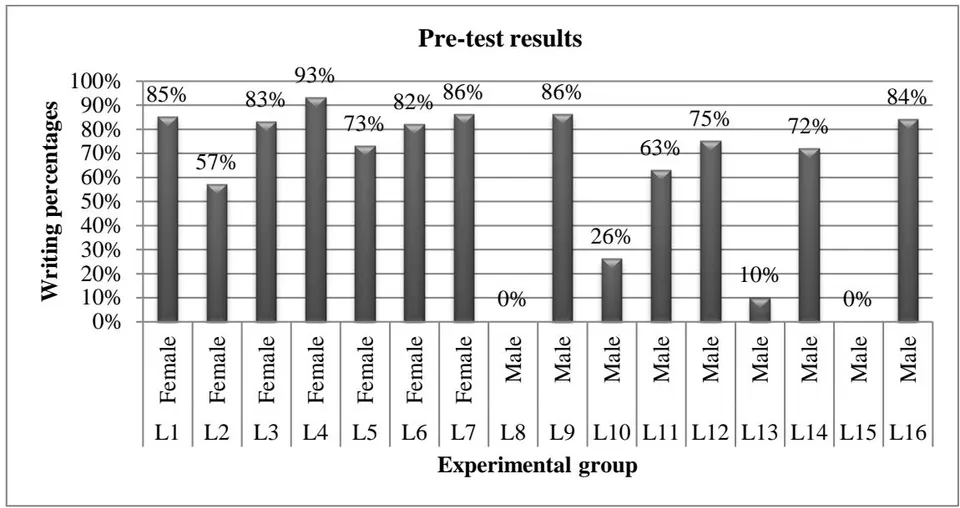
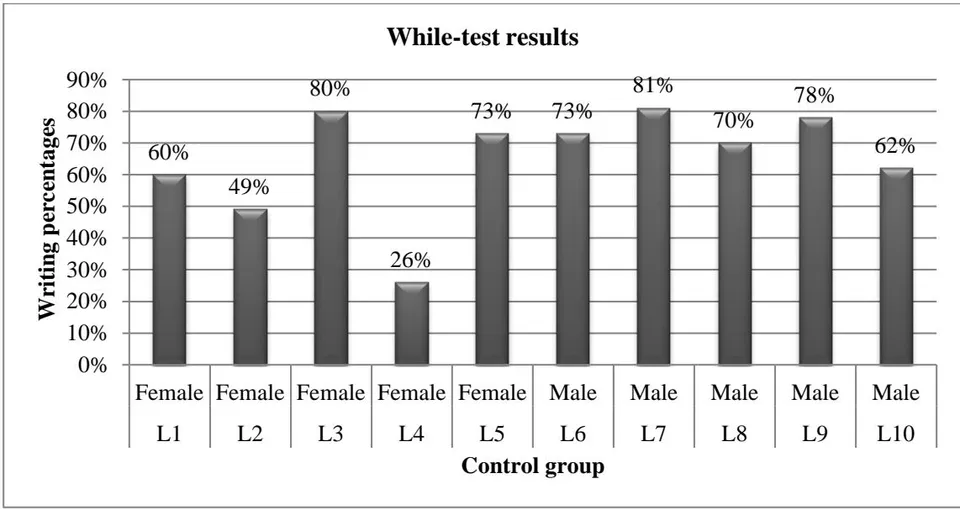
The KPG (2018) while-test measured improvements (Figure 34 and Figure 35) in the average writing performance of the control and the experimental group .
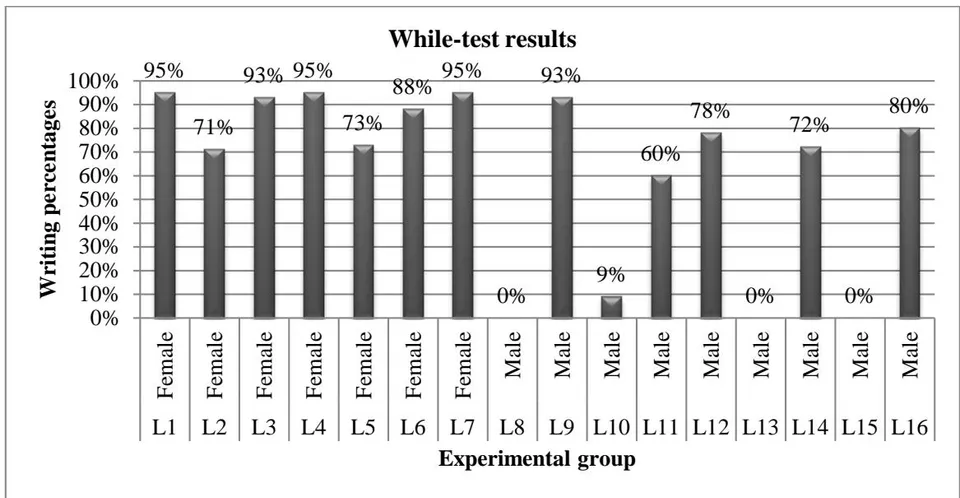
The KPG (2017) post-tests results (Figure 36 and Figure 37) indicated that the average writing performance of the experimental group surpassed that of the control group .
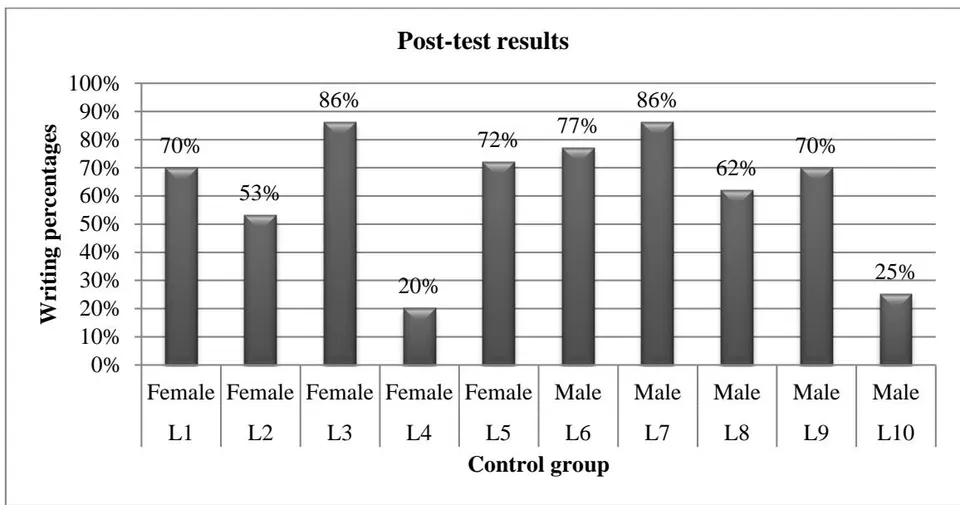
According to the Independent Samples Test table, the samples were homogeneous. The examination of the means, according to the t-criterion showed that the performance of the learners' writing performance was significantly connected to both groups. More specifically, the experimental group , outperformed the control group , , , (Table 3 and Table 4).
Group Statistics Variation Group N Mean Standard. Deviation Standard. Error Mean Control group 10 -1,80 4,984 1,576 Experimental group 16 8,81 8,183 2,046 Independent Samples Test Variation Levene's Test for Equality of Variances t-test for Equality of Means F Sig. t df Sig. (2-tailed) Mean Difference Standard. Error Difference 95% Confidence Interval of the Difference Lower Upper Equal variances assumed ,471 ,499 -3,680 24 ,001 -10,613 2,884 -16, 564 -4,661 Equal variances not assumed -4,109 23,999 ,000 -10,613 2,583 -15,943 -5,282
V. DISCUSSION OF THE FINDINGS
Regarding the first research question, "How effective is digital storytelling in the teaching of English as a foreign language in the 6th Grade", the review and analysis of the findings from the KPG tests, the teachers' diaries and the interviews showed that digital storytelling seemed to develop the participants' language competence. The intervention seems largely congruent with the participants' preferences to learn English through reading, learning new words, and watching films in English, and indirectly catered for their listening and pronunciation deficiencies. The dynamic integration of technology as well as, the interplay with other learners, and the teacher, motivated and scaffolded their participation in transformative processes, during which the new cognitive schemata were structured or accommodated on the basis of their background knowledge, experiences and the course content and increased their autonomy (Jitpaisarnwattana, 2018). The collaborative construction of digital narratives modified the young learners' preferred modes of work, by helping them acknowledge the benefits of collaborative reading and writing and promoted learner autonomy. Digital storytelling also seemed to have created an inclusive and supporting learning environment (Campbell, 2012, Herrera-Ramirez, 2013; Tsigani & Nikolakopoulou, 2018), which afforded opportunities for self-expression (Bumgarner, 2012) even for participants with difficulties in reading and writing (Anderson et al., 2011; Bull & Kajder, 2004). The different and intrinsically motivating aspects of these collaborative projects introduced novelty and entertainment (Mutalib et al., 2011), catered for diverse learning styles and multiple intelligences (Lynch & Fleming, 2007) and accommodated the young participants' short attention span and individual learning styles (Robin, 2016) and, thereby, diversified and personalized the learning outcomes for each participant (Kesler et al., 2016).
Regarding the second research question, "What is the impact of digital storytelling on the teaching and learning of reading in the 6th Grade", even though the KPG exams do not reveal significant variations in the participants' reading abilities (See Appendix E), digital storytelling increased their interest and participation in an interactive, process-oriented approach to reading comprehension. The recursive cycles of strategy instruction (Chamot, 1999) sensitized the participants to the fact that "textual comprehension is a constructive process in which readers are actively trying to make sense of what they read" (Janssen et al., 2010, p. 46) as well as, to the nature and effective use of reading strategies (Shelby-Caffey et al., 2014) (See Appendix F). However, further instruction and practice seem necessary, before the participants can independently transfer and apply their individual combinations of strategies to other contexts. The participants collaboratively proceeded from the literal interpretation of the meaning, of the texts, to inferring and critically analyzing their implied meanings (Thomas, 2013). Reformulating, redesigning, and transferring the original print-based narratives into another genre (multisensory digital narratives), whose form was more concrete and memorable (Reinders, 2011) seems to have further enhanced coherence and reading comprehension (Gregori-Signes, 2014; Mayer, 2009; Sadoski, 2009; Yoon, 2013).
Concerning the third research question, "What is the impact of digital storytelling on the teaching and learning of collaborative process writing for the creation of narrative texts in the 6th Grade", the test results (See Appendix E) show that the instructional intervention assisted the greater part of the participants in improving their writing performance in English in terms of the KPG criteria (Dendrinos & Karavas, 2013), namely, task completion, vocabulary, punctuation, and spelling, text organization, cohesion and coherence (Campbell, 2012; Guzman Gamez & Moreno Cuellar, 2019; Joko Saputro, 2013; Quiroga & Toro Nieto, 2015; Rahimi & Yadollahi, 2017; Shamsulbahri & Aziz, 2020; Yamac & Ulusoy, 2016; Zakaria et al., 2016). The digital storytelling intervention marked a shift from the decontextualized, form-focused writing-to-learn activities, or the study of the formal surface features (vocabulary and grammar), or discourse structure of specially-written model texts (Hyland, 2016), to the participation of learners in computer-assisted process writing (Bumgarner, 2012; Campbell, 2012; Castaneda 2012; Kieler, 2010; Rahimi & Yadollahi, 2017; Yee & Kee, 2017) (see Appendix G). It also prompted participants to discover the interactive, recursive, cognitive actions which are involved in process writing and the benefits accruing from collaborative work in learning networks (Herrera Ramírez, 2013). The expansion of the audience compelled the participants to analyze and resolve the complexities of the writing task, such as content, form, the expectations and interests of real-world audiences as well as, their own goals for writing (Bereiter & Scardamalia, 1987) and motivated peer reviewing sessions (Yamac & Ulusoy, 2016; Yoon, 2013; Castaneda, 2013). The self-regulated planning, monitoring, and evaluation of the participants' progress in achieving their writing goals seems to have enhanced the quantity, quality and complexity of their texts and honed their reflective and critical skills. The close observation and imitation of the reviewing strategies deployed by more advanced peers in response to writing problems (Fung, 2010; Herrera-Ramírez, 2013; Quiroga & Toro Nieto, 2015; Widodo, 2013), in conjunction with the real-time text-specific feedback (Zamel, 1985), reduced dependence on delayed teacher feedback and maximized its efficacy (Fregeau, 1999). Conferences with each group (White & Arndt, 1991) enabled the teachers to gain access to the writers' still evolving texts, monitor their progress, and respond to problems with alternative and text-specific solutions.
VI. IMPLICATIONS
Digital storytelling meets the participants' present and future literacy needs as well as the IFLC objective concerning the integration of technology into the EFL class. However, the current examination-oriented educational system has established educational objectives and practices which are no longer congruent with the 21st century exigencies (Kesler et al., 2016). Therefore, one important implication that arises is that digital storytelling be explicitly linked, with the IFLC, as one of the strategies which helps to improve the learners' reading and writing abilities in English. Moreover, the ICT infrastructures in schools need to be upgraded so that their learners can reap the benefits of technology-based initiatives, such as digital storytelling. Sustained training programs for in-service teachers, whose formal education had been completed prior to modern technological developments, should provide them with the technical and instructional support in selecting context-appropriate digital storytelling tools (Abdallah, 2019; Herrera-Ramirez, 2013), redesigning the syllabus around them (Bumgarner, 2012), and in taking on new roles in a technologically enhanced class.
VII. LIMITATIONS OF THE RESEARCH
The research findings are associated with a small population sample within a specific instructional setting over a limited timeframe. It is, therefore, questionable whether the same outcomes could extend or be replicated in other teaching contexts (Dornyei, 2007). The pandemic also posed significant challenges to its implementation. For instance, the shorter Webex teaching sessions hindered the administration of while-tests at the end of each digital story cycle.
Suggestions for further research
To measure the impact of digital storytelling with greater accuracy and to draw generalizable findings, longitudinal studies with larger samples across the EFL curriculum should be undertaken. It would also be interesting to combine digital storytelling with Web Quest.
VIII. CONCLUSION
Collaborative digital storytelling projects integrating reading, as a source of input, and writing, as a means to process and interpret the written text, confirmed the researchers' initial hypotheses. The incorporation of technology and the learners' digital literacies into the EFL class fostered motivation, learner-centeredness, collaboration, experiential learning, interactivity, autonomy, differentiated learning, and authenticity. It also enhanced reading comprehension, raised the 6th Graders' awareness of reading and writing strategies and also led to improvements in their narrative texts.
References in Greek
- Eφραμίδου, E., Φρούςκη, Φ. & Zωη-Pεπια, E. (2009). Aγλικά 6n Δημοτικόν: Bβλίο Maθητή. Yπουργείο Παιδείας, ἡρεύνας και Θρησκεύματων: Ivστιοῦτο Tεχνολογίας Yπολογιστών και Εκδόσεων «Διόφαντος».
- (2016) Φ.E.K. αρ. φύλλου 2871/ 9-9-2016. Αθήνα: Yπούργειο Παδείας, ἐρεύνας και Θρησκενματων.
Appendix A: Pre-intervention interview schedule (English version)
Available at: https://docs.google.com/document/d/1EQNotwjXiWBbhA4YIB_X02vDTr4GxnY6GeiatmA4z5l/edit?usp=sharing
Appendix B: Post-intervention interview schedule (English version)
Available at: https://docs.google.com/document/d/1J_M8HUc0hJR9XYhRmi0DkRHz0wOYgav1VMZK-FjYhME/edit?usp=sharing
Appendix C: The teachers' diary
Available at: https://docs.google.com/document/d/124v_W_Dv46hg3nDaYdUriC07GpnCTGqn_DdEZmA-bPA/edit?usp=sharing
Appendix D: Links to the Google Docs and storyboards
Available at: https://docs.google.com/document/d/1GV6mHq9G-C4JiR-F333N4Dw1mzV1Jnw555X1OILYZLU/edit?usp=sharing
Appendix E: Pre-, while-, and post-test results
| Reading comprehension: Pre-, while-, and post-test results of the control group | ||||||||
| Reasearch Sufbjects | Gender | Pre-test | While-test | Post-test | Variation | |||
| Subject 1 | Female | 21 | 42% | 27 | 54% | 33 | 66% | 24% |
| Subject 2 | Female | 22 | 44% | 23 | 46% | 15 | 30% | -14% |
| Subject 3 | Female | 32 | 64% | 34 | 68% | 41 | 82% | 18% |
| Subject 4 | Female | 13 | 26% | 25 | 50% | 24 | 48% | 22% |
| Subject 5 | Female | 35 | 70% | 34 | 68% | 37 | 74% | 4% |
| Subject 6 | Male | 33 | 66% | 37 | 74% | 36 | 72% | 6% |
| Subject 7 | Male | 41 | 82% | 43 | 86% | 44 | 88% | 6% |
| Subject 8 | Male | 27 | 54% | 26 | 52% | 23 | 46% | -8% |
| Subject 9 | Male | 29 | 58% | 29 | 58% | 30 | 60% | 2% |
| Subject 10 | Male | 18 | 36% | 20 | 40% | 21 | 42% | 6% |
| Reading comprehension: Pre-, while-, and post-test results of the experimental group | ||||||||
| Research Subjects | Gender | Pre-test | While-test | Post-test | Variation | |||
| Subject 1 | Female | 31/50 | 62% | 40/50 | 80% | 45/50 | 92% | 30% |
| Subject 2 | Female | 34/50 | 68% | 32/50 | 64% | 29/50 | 58% | -10% |
| Subject 3 | Female | 37/50 | 74% | 40/50 | 80% | 42/50 | 84% | 10% |
| Subject 4 | Female | 45/50 | 90% | 45/50 | 90% | 46/50 | 92% | 2% |
| Subject 5 | Female | 41/50 | 82% | 42/50 | 85% | 46/50 | 92% | 10% |
| Subject 6 | Female | 41/50 | 82% | 43/50 | 86% | 44/50 | 88% | 6% |
| Subject 7 | Female | 39/50 | 78% | 40/50 | 80% | 41/50 | 82% | 4% |
| Subject 8 | Male | 12/50 | 24% | 14/50 | 28% | 17/50 | 34% | 10% |
| Subject 9 | Male | 46/50 | 92% | 48/50 | 96% | 47/50 | 94% | 2% |
| Subject 10 | Male | 19/50 | 38% | 26/50 | 52% | 27/50 | 54% | 16% |
| Subject 11 | Male | 25/50 | 50% | 24/50 | 48% | 23/50 | 46% | -4% |
| Subject 12 | Male | 35/50 | 70% | 38/50 | 76% | 41/50 | 82% | 12% |
| Subject 13 | Male | 12/50 | 28% | 13/50 | 26% | 13/50 | 26% | -2% |
| Subject 14 | Male | 35/50 | 70% | 37/50 | 74% | 38/50 | 76% | 6% |
| Subject 15 | Male | 12/50 | 24% | 11/50 | 22% | 12/50 | 24% | 0% |
| Subject 16 | Male | 36/50 | 72% | 39/50 | 78% | 38/50 | 76% | 4% |
| Writing: Pre-, while-, and post-test results of the control group | ||||||||
| Research Subjects | Gender | Pre-test | While-test | Post-test | Variation | |||
| Subject 1 | Female | 13.8/20 | 69% | 12.6/20 | 60% | 14/20 | 70% | 0.2% |
| Subject 2 | Female | 11.2/20 | 56% | 9.8/20 | 49% | 10.6/20 | 53% | -0.6% |
| Subject 3 | Female | 16.6/20 | 83% | 16/20 | 80% | 17.2/20 | 86% | 0.6% |
| Subject 4 | Female | 6/20 | 30% | 5.2/20 | 26% | 4/20 | 20% | -2% |
| Subject 5 | Female | 14.1/20 | 71% | 14.8/20 | 73% | 14.4/20 | 72% | 0.3% |
| Subject 6 | Male | 15.2/20 | 76% | 14.6/20 | 73% | 15.4/20 | 77% | 0.2% |
| Subject 7 | Male | 16.6/20 | 83% | 16.2/20 | 81% | 17.2/20 | 86% | 0.2% |
| Subject 8 | Male | 13.4/20 | 67% | 14/20 | 70% | 12.4/20 | 62% | -1% |
| Subject 9 | Male | 13.8/20 | 69% | 15.6/20 | 78% | 14/20 | 70% | 0.2% |
| Subject 10 | Male | 7/20 | 35% | 12.4/20 | 62% | 5/20 | 25% | -2% |
| Writing: Pre-, while-, and post-test results of the experimental group | ||||||||
| Research Subjects | Gender | Pre-test | While-test | Post-test | Variation | |||
| Subject 1 | Female | 16.9/20 | 85% | 18.9/20 | 95% | 17.1/20 | 86% | 0.2 |
| Subject 2 | Female | 11.4/20 | 57% | 14.1/20 | 71% | 13.9/20 | 70% | 2.5 |
| Subject 3 | Female | 16.6/20 | 83% | 18.5/20 | 93% | 19/20 | 95% | 2.4 |
| Subject 4 | Female | 18.6/20 | 93% | 19/20 | 95% | 19.8/20 | 99% | 1.2 |
| Subject 5 | Female | 14.5/20 | 73% | 14.6/20 | 73% | 16.6/20 | 83% | 2.1 |
| Subject 6 | Female | 16.4/20 | 82% | 17.5/20 | 88% | 19.1/20 | 96% | 2.7 |
| Subject 7 | Female | 17.7/20 | 86% | 18.9/20 | 95% | 19.2/20 | 96% | 1.5 |
| Subject 8 | Male | 0/20 | 0% | 0/20 | 0% | 5.6/20 | 28% | 0 |
| Subject 9 | Male | 17.2/20 | 86% | 18.7/20 | 93% | 19/20 | 95% | 1.8 |
| Subject 10 | Male | 5.2/20 | 26% | 1.8/20 | 9% | 6.7/20 | 36% | 1.5 |
| Subject 11 | Male | 12.6/20 | 63% | 11.7/20 | 60% | 14.3/20 | 72% | 1.7 |
| Subject 12 | Male | 15/20 | 75% | 16.5/20 | 78% | 17.9/20 | 90% | 2.9 |
| Subject 13 | Male | 2/20 | 10% | 0/20 | 0% | 0/20 | 0% | -2 |
| Subject 14 | Male | 14.4/20 | 72% | 14.4/20 | 72% | 14.9/20 | 75% | 0.5 |
| Subject 15 | Male | 0/20 | 0% | 0/20 | 0% | 0/20 | 0% | 0 |
| Subject 16 | Male | 16.8/20 | 84% | 15.9/20 | 80% | 18.1/20 | 95% | 1.3 |