Introduction
Digital twins are among the key technologies in the industry 4.0 landscape, offering significant benefits by merging the physical and digital worlds to address industrial challenges, as described by Amthiou et al. Before the advent of Digital twins, understanding the behavior of physical systems relied solely on physical testing. Today, Digital twins are used not only for system representation but also for optimization, as explained by Bettinger et al., with a strong impact on productivity and cost reduction.
According to McKinsey, a Digital twin is a virtual replica of a physical object, person, or process that can be used to simulate its behavior to better understand how it works in real life. Digital twins are linked to real data sources from the environment, which means that the twin updates in real time to reflect the original version.
The Siemens simulation platform (SIMIT) enables extensive possibilities for developing and optimizing Digital twins, as it specializes in industrial simulation and virtualization. It allows engineers to create detailed digital models of equipment, incorporating physical properties, geometry, and operational parameters, as explained by Siemens.
As part of the relining process, the blast furnace was equipped with a bell-less top charging system, a system designed to distribute the ferrous burden and coke into the blast furnace, detailed by Geerdes et al. A comprehensive automation package was implemented to ensure a smooth start-up and optimal utilization of the new equipment. This package is anchored by a Basic Automation (Level 1) process control system, which works in close coordination with a Process Automation (Level 2) process optimization system. This optimization technology for the blast furnace process employs a closed-loop expert system, sophisticated process models, and artificial intelligence, all supported by an extensive knowledge base developed in collaboration with industry leaders, as mentioned by Primetals.
In this context, a Digital twin was developed to serve as a training and testing environment for operators and process specialists. A virtualized simulation platform was created to test application software and visualize results before deployment in production. By simulating process values, setpoints, actual values, position feedback, and speed feedback, the behavior of the plant and equipment could be replicated, enabling validation of control logic and system response. Equipment malfunctions could also be manually simulated to assess the automation system’s reaction. Additionally, the system proved effective for training operators and process engineers, allowing practice without risk or disruption to the actual plant.
Figure [fig:information-flow] illustrates the core concept proposed for the project. The Level 2 process optimization and specialist system calculates and sends setpoints to the Level 1 process control system. Level 1 then decomposes these targets into specific setpoints for individual equipment. These values are transmitted to Siemens SIMIT, where the simulation is executed. As a result, simulated feedback and actual field values are returned from SIMIT to Level 1, which in turn provides feedback to Level 2, thus closing the control and simulation loop.
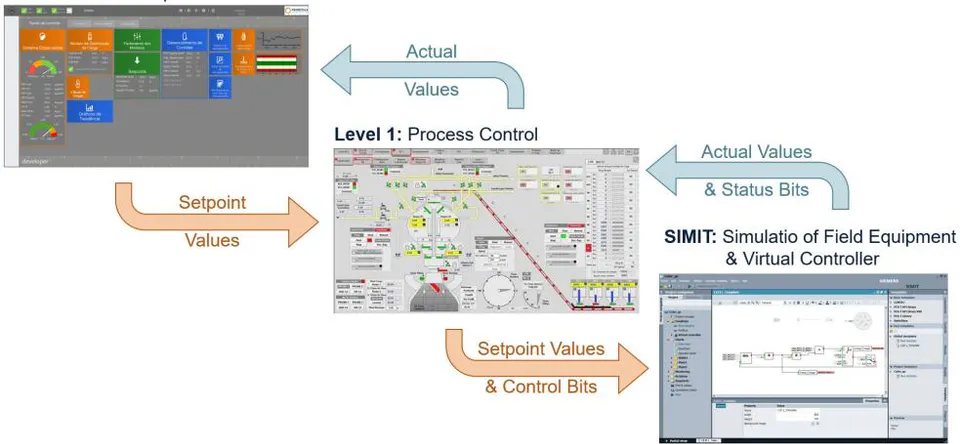
Basic flow of information between systems
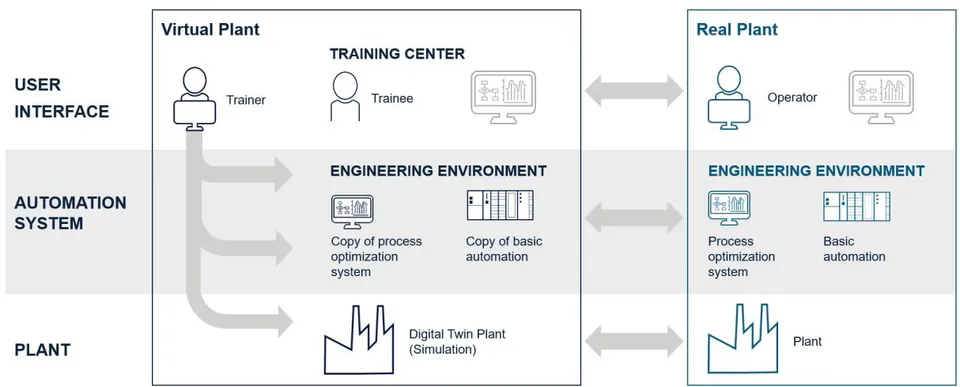
Digital twin structure
The structure of the Digital twin for test and training center is illustrated in Figure [fig:digital-twin-structure].
The functionalities of the Digital twin can be summarized as follows:
The test and training system prepares operators for blast furnace operation through simulated scenarios;
It provides hands-on training, simulates start-ups, emergency shutdowns, and abnormal situations;
Operators become familiar with the new bell-less top and practice decision-making under different conditions.
Development
The Digital twin concept involves the creation of a virtual environment in which operators can simulate material charging using different batch types and test the functionalities programmed into the process control and optimization systems. To implement this concept, the development within SIMIT focused on simulating device signals, equipment responses, and overall process behavior.
Devices signals simulation, equipment response and process simulation
The signal simulation covers the behavior of instruments and actuators and includes Field Level (Level 0) of the plant by simulating field devices and sensors in accordance with their expected operation. The following simulation strategies were employed:
Digital movement supervised by digital feedback was simulated through a time-delayed generation of the expected feedback signal (e.g., flaps, locks, latches, lifts);
Digital movement supervised by analog feedback was simulated using an integrative function block that generates increasing or decreasing feedback. In cases involving counter feedback, the signal was converted accordingly (e.g., pumps);
Analog movement supervised by digital feedback was simulated by integrating the movement and comparing the resulting value with predefined limit values (e.g., tanks);
Analog movement supervised by analog feedback was simulated using an integrative function block that generates increasing or decreasing feedback. The slope of the integration was determined by the analog setpoint value.
Process simulation was used to model material transport throughout the plant. The material position was generated based on the simulated actual speed, which served as input to an integrative function block.
Based on the material position, tracking sensors such as detectors and light barriers were simulated. In the case of pyrometers, a fixed temperature value was simulated while the material was present.
Configuration overview
Communication between the ControlLogix Process Programmable Logic Controller (PLC) and the SIMIT was established using the SIMIT External Ethernet/IP Coupling Add-on. This interface module facilitates the exchange of setpoints and actual values between the automation system and the simulation environment in SIMIT as illustrated in Figure [fig:configuration-overview].
In this configuration, the Digital twin virtual machine is hosted within the same virtualization cluster as the Level 1 and Level 2 servers and communicates through a dedicated Virtual Local Area Network (VLAN) with the Rockwell PLCs, operator stations, and engineering stations. Figure [fig:network-layout] illustrates a simplified view of the network architecture and its main components.
Level 1 automation
The Level 1 Process Control System for the Digital twin was composed of the following equipment:
Level 1 operator station with dual screen;
Level 1 server in a non-redundant configuration;
PLC for the stockhouse (material handling), and a separate non-redundant safety PLC;
PLC for the bell-less top (top Charging), and a separate non-redundant safety PLC.
There is no difference between the Level 1 software used in the production system (online system) and the Level 1 software used in the simulation system (offline system).
Stockhouse
The Digital twin solution within the Level 1 process control system for the stockhouse included the following process areas:
Material bins for minerals;
Material bins for coke;
Material discharge and tracking to Intermediate bins (BC1, BC2, TM1, TM2);
Intermediate bins weighing (BC1, BC2, TM1, TM2);
Material transport and tracking to top charging system (bell-less top BLT).
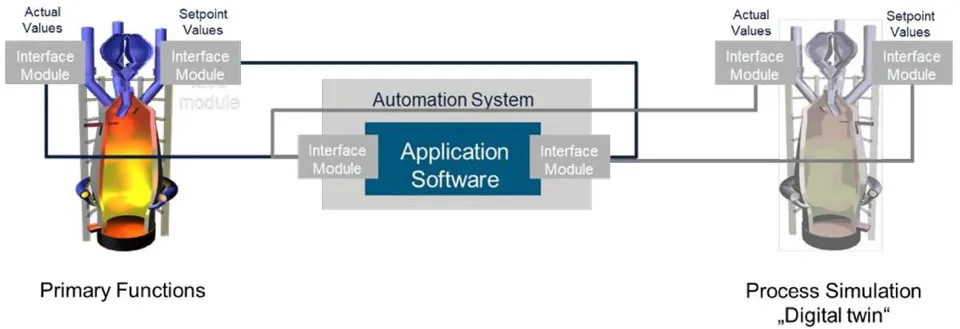
Configuration overview
Bell-less top
The Digital twin solution within the Level 1 process control system for the bell-less top includes the following process areas:
Tilting chute and tilting rocker;
Lock hopper systems 1 and 2 including material flaps and seal valves;
Equalizing system (pressurizing/depressurizing sequence);
Material flow gate;
Chute rotation and tilting mechanisms;
Nitrogen-cooled gearbox;
Water cooling system;
Hydraulic and Greasing system;
Burden level measurements (stock rods) for actual stockline.
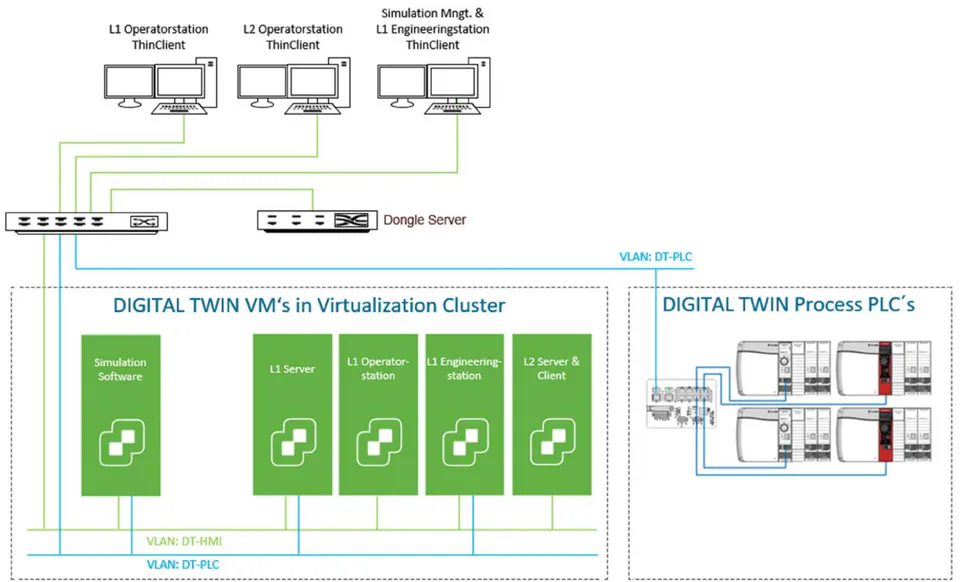
Network basic layout
Level 2 process models
The following process models were included in the Digital twin plant simulator solution:
Burden control model
The Burden Control model is typically used by operators and process engineers in the control room to calculate new setpoints for the charging system, as illustrated in Figure [fig:burden-control-matrix].
Burden distribution model
The Burden distribution model is used to simulate material distribution in the upper part of the blast furnace, based on charging conditions and burden parameters.
Shaft simulation model
The shaft simulation model is a background model used to automatically perform a mass balance of all materials charged within a single charge, including both coke and ore layers, as illustrated in Figure [fig:shaft-simulation].
Communication coupling to Level 1 and Level 2
Communication between the ControlLogix Process PLCs and the SIMIT simulation platform is based on the industrial standard OPC UA, using the Kepware OPC Connectivity Suite. A tag list containing all functional field I/O’s (e.g., digital inputs/outputs as well as analog inputs/ outputs) was exported from Rockwell Automation Studio 5000 and transferred to the SIMIT simulation platform.
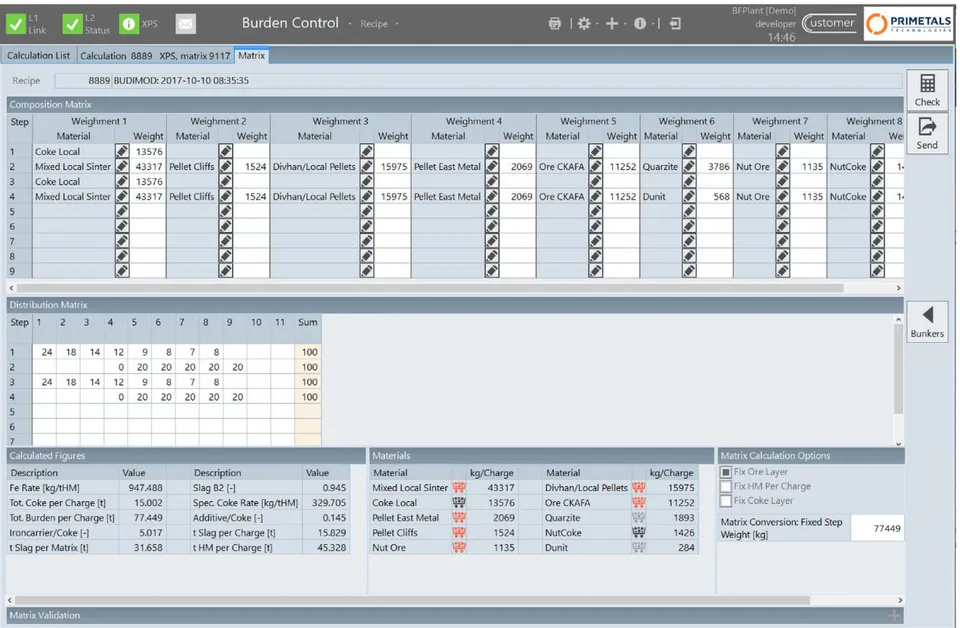
Burden Control Matrix
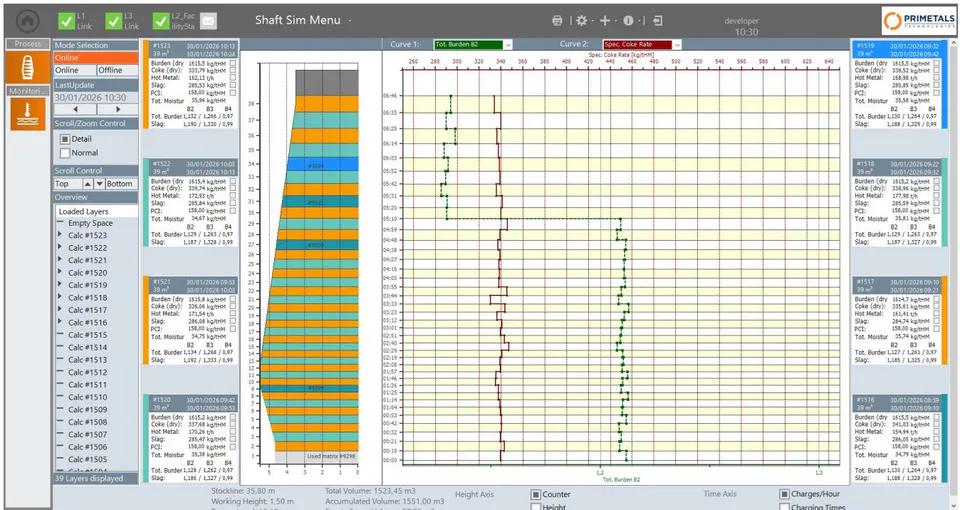
Shaft simulation model
Signal assignment between OPC and SIMIT
| OPC DA server (General) | OPC UA server (General) | OPC UA server (SIMIT) | SIMIT |
|---|---|---|---|
| BOOL, UI1 | Boolean | Boolean | binary |
| I1, I2, I4, I8, UI1, UI2, UI4, UI8 | SByte, Int16, Int32, Int64, Byte, UInt16, UInt32, UInt64 | Int32, Int64 | Integer |
| R4, R8 | Float, Double | Double | analog |
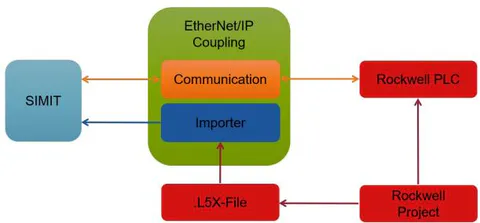
Ethernet/IP Coupling between SIMIT and Rockwell
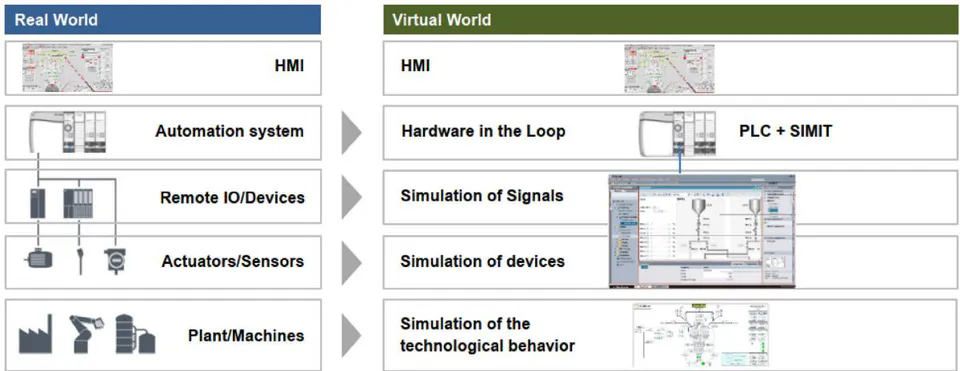
Software structure comparison between real and virtual world
Mapping of inputs and outputs based on OPC read/write access
| OPC | OPC UA server (SIMIT) | SIMIT |
|---|---|---|
| Readable | CurrentRead / Current-Write | Output |
| Writeable | CurrentRead | Input |
| readWriteable | CurrentRead | Input |
The same data link used by the Level 1 system was employed to exchange process data and setpoints with Level 2, as communication between Level 1 and Level 2 had already been established.
Mapping of signals and data types of an OPC server
SIMIT supports only binary, integer, and analog signal types, with both integer and analog signals having a data width of eight bytes. In contrast, an OPC server can provide signals in a broader range of data types. Table [tab:signal-assignment-between-opc-and-simit] presents the mapping between OPC data types and the corresponding data types used in SIMIT.
Signals from the OPC server can be configured as read-only, write-only, or read/write. In SIMIT, these signals are interpreted as inputs or outputs depending on their access type, as illustrated in Table [tab:mapping-of-inputs-and-outputs-based-on-opc-read-write-access].
A graphical user interface is provided to import tags from a Rockwell Logix Designer project exported as an L5X file, as illustrated in Figure [fig:ethernet-coupling]. Signals can be imported and selected either from an existing L5X file exported from Rockwell Logix Designer or via XML files.
During simulation, SIMIT periodically reads and writes the imported tags. The standard time slice used in the project was ms. Fast applications operated with a time slice of ms while slower or specialized applications used ms.
Software technical concept
For each control system, four simulation areas were prepared in SIMIT. In Figure [fig:software-structure], there is a comparison between the real and virtual environment software structure.
Controller
The Rockwell controllers installed in the hardware-in-the-loop configuration served as the interface between SIMIT and the plant’s human-machine interface (HMI). Through the controllers, all input and output signals (I/O signals) of the automation system were exchanged with SIMIT using OPC UA communication.
Field level
Simulation of drives, valves, and measuring points was performed, including components such as a relief valve, as illustrated in Figure [fig:valve-simulation].
Process level
Simulation of process values was performed, including examples such as a pressure signal, as illustrated in Figure [fig:pressure-simulation].
Control level
A graphical display of SIMIT elements at the field level was created based on the background picture of the HMI, as illustrated in Figure [fig:field-elements].
Results
The final system comprised controllers running a replica of the Level 1 software, virtual machines hosting the HMI visualization, Level 2, and Expert System. At the core of the Digital twin was an engineering station equipped with the simulation application.
This configuration enabled the engineering team and the customer to conduct a realistic Factory Acceptance Test (FAT), validating all agreed functionalities. Operators were able to configure and execute training scenarios using the same HMI screens as those in the actual plant, allowing early familiarization with the new control system months before start-up.
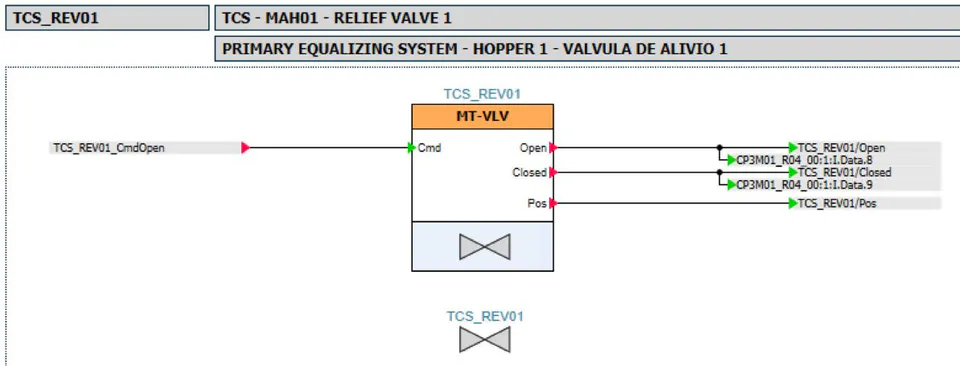
Chart example with a valve simulation
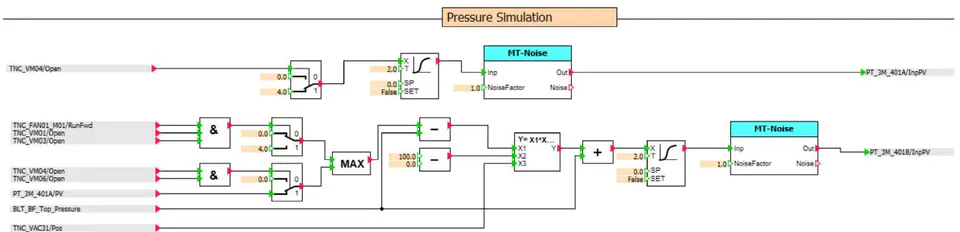
Chart example with a process pressure simulation
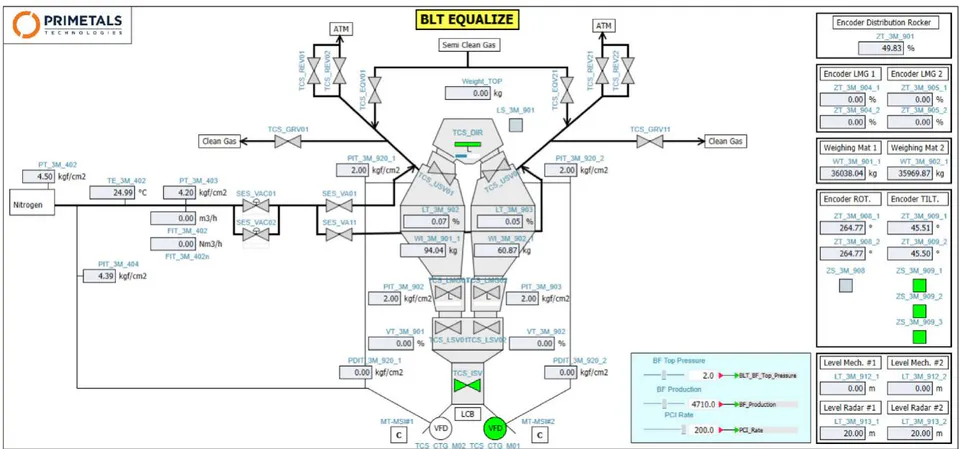
Graphic display of field-level elements
Since the simulation system mirrored the online software’s Level 1 and Level 2, both environments could be thoroughly tested. This also allowed the maintenance team to safely validate future modifications offline before deploying them to the live system.
During commissioning, the Digital twin was deployed at the customer’s plant and made accessible in the automation control room, enabling broader team engagement and training during cold commissioning.
The Digital twin also enabled the simulation of equipment and process failures—such as loss of weighing or tracking data—and the testing of new charging sequences, from material bins to the bell-less top. These capabilities contributed to smoother operation and more effective use of the system.
The main limitation observed was the difficulty in accurately reproducing the behavior of aging field equipment. Ore feeder units operate below nominal levels, with discrepancies in flow, speed, and weight affecting model calibration and validation. The second main limitation was to obtain the real equipment data from some suppliers. For those cases, theoretical models from literature were used to reproduce the equipment’s behavior.
By having the Digital Twin available several months prior to Blow-In, the customer successfully conducted comprehensive training for all operator shifts and production supervisors—over thirty personnel in total—on the newly installed bell-less top charging system. This level of preparation would not have been possible without the Digital Twin software.
The training program lasted more than three months, during which all shift operators were able to rigorously test the application. They became familiar with the new HMI, updated faceplates, newly integrated equipment, and the revised charging philosophy introduced by the bell-less top system. Operators also identified software limitations and proposed valuable improvements.
During the ramp-up phase, one of these insights led to a significant modification in the charging system software. The development and validation of this change took three weeks in the Digital Twin, and it was deployed directly into the production environment—without requiring a furnace shutdown. Without the Digital Twin, this modification would have necessitated at least 40 hours of software testing, impacting production continuity.
The benefits of the Digital twin can be listed into three key areas:
Faster initial start-up: Software testing and operator training prior to commissioning accelerated production ramp-up;
Reduced downtime during lifecycle changes: Efficient testing minimized shutdown durations;
Fewer unplanned shutdowns: Enhanced training improved operator response to critical situations;
Advantages before plant start-up:
The fully virtualized simulation system enabled comprehensive testing without the need for production controllers or field equipment, reducing commissioning time;
Realistic customer training during FAT contributed to a faster production ramp-up.
Advantages after start-up and throughout the lifecycle:
New process functions could be tested in a parallel, virtualized offline system without risk to the plant. Once validated, changes could be safely transferred to the online system;
The simulation system served as a “flight simulator” for both new and experienced operators, supporting training for normal operations and fault conditions.
Figure [fig:cumulative-benefits] illustrates the cumulative benefits expected from the system, highlighting not only the accelerated ramp-up but also the ongoing annual gains resulting from reduced shutdown frequency and duration.
By integrating these elements, blast furnace operators were better equipped to manage the new bell-less top charging system, ensuring reliable production, improved fuel efficiency, and consistent hot metal quality.
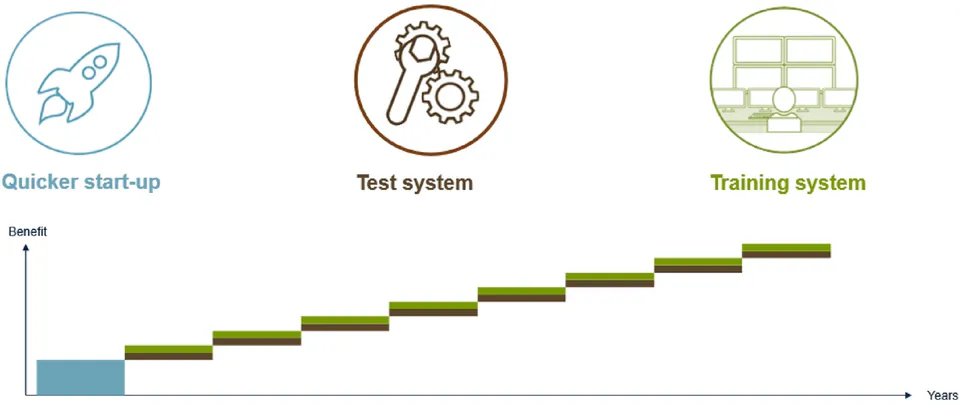
Cumulative benefits expected from the system
Future development opportunities include expanding the Digital Twin to other areas of the Blast Furnace, thereby enhancing its scope and operational relevance. Another key improvement involves strengthening the integration between the production system and the Digital Twin engineering environment, enabling seamless and real-time updates. Furthermore, the implementation of fault scenario simulations would allow operators to test and prepare for undesirable situations, contributing to improved decision-making and operational tests.
Conclusion
The implementation of a Digital twin for the blast furnace bell-less top charging system proved to be a highly effective strategy for enhancing operational readiness, system validation, and personnel training. By integrating Siemens SIMIT with Rockwell’s process control and Primetals’ Level 2 systems, the project team successfully created a virtual environment that mirrored real plant behavior with high fidelity.
This environment enabled comprehensive testing of control logic, simulation of equipment responses, and validation of process sequences well before commissioning. Operators and maintenance personnel were able to familiarize themselves with the new system, rehearse critical scenarios, and gain confidence in handling both routine and abnormal conditions months ahead of the actual start-up.
The Digital twin also facilitated a robust Factory Acceptance Test, ensuring that all functionalities were verified in a controlled setting. During commissioning, the system continued to serve as a valuable tool for training and troubleshooting, minimizing risks and reducing the learning curve.
The benefits of this approach are clear: faster and smoother start-up, reduced downtime during lifecycle changes, and improved preparedness for critical situations. As demonstrated, the Digital twin is not only a technological innovation but also a strategic enabler for safer, more efficient, and more reliable blast furnace operations.
Furthermore, the scalability of the Digital twin approach opens opportunities for broader adoption across other metallurgical processes and industrial systems, enabling predictive control, enhanced training, and continuous process optimization.