Resume- In the Brazilian Northeast, the state of Piauí exhibits gaps in bat species diversity, with limited knowledge about their ecology and zoonotic disease transmission. This study updated the distribution of Diphylla ecaudata in the region, exploring feeding behaviors and recording the presence of the rabies virus. Fieldwork in Picos, Pedro II, and Milton Brandão resulted in the capture of nine bats, following ethical protocols. Previous records from 2004 to 2008 were also noted. Research showed these bats' adaptability to various environments, including the Peruvian biome, and their diet flexibility beyond birds, their typical prey. Significantly, a rabies virus variant (AgV3), commonly found in Desmodus rotundus, and traces of human blood in Diphylla ecaudata feces were detected, raising public health concerns. These findings highlight potential risks for zoonotic disease transmission to humans, underscoring the need for ongoing monitoring in wildlife-human interactions. The broader relevance of this study lies in its implications for zoonotic disease surveillance across
diverse biomes, not just in Piauf. Bats are key reservoirs of pathogens, and their ability to adapt to different ecosystems suggests a wider risk for emerging zoonoses. This work emphasizes the importance of integrating ecological and health monitoring under the One Health approach, providing insights that can inform future research and guide public health and conservation strategies aimed at mitigating the spread of zoonotic diseases globally.
## I. INTRODUCTION
Knowledge about the chiropteran fauna in the state of Piauí is characterized by substantial gaps, despite significant advancements in the field of study in the Brazilian Northeast over the past two decades. Understanding the distribution of bats in the state is crucial for species conservation and habitat maintenance. In particular, focusing on the subfamily Desmodontinae, which includes only three monotypic genera (Desmodus, Diphylla, and Diaemus), highlights their important role in maintaining rabies in natural environments, an infection that affects the nervous system of mammals, including humans (Barreto et al. 2019).
Among hematophagous bats, the genus Diphylla stands out as a monotypic taxon, characterized by the absence of callosities on their anterior appendicular limbs. The epithet "hairy-legged bat" refers to the rudimentary femoral membrane covered in hair, which is a vestige of a lateral uropatagium (Vizotto and Taddei, 1973). The species Diphylla ecaudata (Spix, 1823), which means "tailless hairy leaf," ranks second in geographical distribution and capture frequency among blood-feeding bats, following Desmodus rotundus.
According to Uieda (1982), Diphylla ecaudata specializes in feeding on birds. however, Ruschi (1951) notes that in the absence of their usual prey, they may also attack pigs, cattle, and horses. This specialized diet makes hematophagous bats significant players in the spread of diseases such as rabies, a viral encephalitis with nearly $100\%$ lethality in both animals and humans worldwide (Streicker and Allgeier, 2016).
The association between $D$. ecaudata and the rabies virus is noteworthy, as these viruses primarily
affect mammals, even though these bats mostly prey on birds. This interaction can be explained by their shared habitats, particularly in caves with Desmodus rotundus, the primary reservoirs of the rabies virus variant AgV3, facilitating the exchange of viral particles (Albas et al. 2011). Since caves are also inhabited by nonhematophagous bats, positive findings for rabies extend to these species as well.
Updating the numbers for Brazil, there are records of seven variants of the Lyssavirus genus. Among these are variant 2 (AgV2), found in Phyllostomus discolor (Albas et al. 2011), and variants 4 and 6 (AgV4 and AgV6), found in the insectivorous bats Tadarida brasiliensis and Lasiurus cinereus, respectively (Brasil, 2023).
Regarding distribution, D. ecaudata has been recorded throughout much of the national territory, being present in all regions, with notable occurrences in the Southeast and Northeast of Brazil (Rocha et al., 2014). In the state of Piauí, Castilho et al. (2010) made the first record of D. ecaudata in the municipalities of São Miguel do Tapuio and Buriti dos Montes based on field research conducted in 2004. It was not until 2008 that Gregorin, Carmignotto, and Percequillo described its occurrence in the Serra das Confusões National Park (PNSC) in Gilbués, Piauí.
Understanding the distribution and ecology of Diphylla ecaudata not only addresses the gaps in knowledge about this species but also enhances our understanding of the broader chiropteran fauna in Piauí. This study aimed to update the geographical distribution of Diphylla ecaudata in the Brazilian Northeast, associating it with new foraging approaches and records of rabies virus occurrence in the region for this species. By highlighting these findings, the research contributes to ongoing conservation efforts and public health policies in the region, which aim to mitigate the risks associated with zoonotic diseases and promote biodiversity preservation.
## II. METODOLOGY
### a) Research Area
Located between $2^{\circ}44'$ and $10^{\circ}55'$ latitude South and $40^{\circ}22'$ and $45^{\circ}59'$ longitude West, the state of Piauí is bordered by the states of Ceará and Pernambuco to the east, Bahia to the south and southeast, Tocantins to the southwest, with the Parnaíba River marking the border with Maranhão to the west, and the Atlantic Ocean to the north (Lima et al., 2020). It occupies 251,755.481 km², which is 16.16% of the 1,558,000 km² of the Northeast region of Brazil. Piauí is the third-largest state in the Northeast, smaller only than Bahia and Maranhão, and the tenth-largest state in Brazil, accounting for 2.9% of the national territory (IBGE, 2022).
Piauí contains a wide variety of ecosystems, including stretches of the Cerrado and Caatinga biomes, which are known for their biodiversity and varying climatic conditions (Santos-filhoet al., 2018). These biomes, along with a significant number of cave systems and fragmented forest patches, provide ideal habitats for bat species (Pereira, 2022). The state's mosaic of natural environments, particularly cave habitats, supports both hematophagous and insectivorous bat populations. These bats play critical roles in ecosystem services such as pollination and seed dispersal but are also key reservoirs for zoonotic diseases, including rabies (Stoner-Duncan et al., 2014).
The choice of Piauí for this study was motivated by these unique ecological features and its role as a transition zone between the Cerrado and Caatinga biomes. This makes the region a hotspot for studying bat ecology and disease transmission. The presence of both preserved and disturbed habitats, including agricultural areas, increases the chances of interactions between bats and humans or livestock, which is relevant for understanding the dynamics of rabies transmission.
### b) Sampling
## i. Primary Data
Primary distribution data were obtained through passive sampling. Mist nets measuring three meters in height by nine and twelve meters in length were used, set up in strategic areas based on factors favorable for the flight routes of these animals and the presence of their usual prey. The traps were positioned at two collection points at 6 pm and dismantled at midnight of the following day, totaling a sampling effort of $4,968\mathrm{m}^2\mathrm{h}$ in the municipality of Picos, $864\mathrm{m}^2\mathrm{h}$ in the municipality of Pedro II, and $162\mathrm{m}^2\mathrm{h}$ in the municipality of Milton Brandão (Straube and Bianconi, 2002).
The animals were immediately removed from the mist nets upon capture and placed in pre-numbered cloth bags. The identification of the specimens was based on specialized literature cited in the work of Reis et al. (2017). The study was submitted to and approved by the System of Authorization and Information on Biodiversity (SISBio) under number 69264-7, and the Ethics Committee on Animal Use under number 002/CEUAIFPI/2021, with registration number AF78746 in the National System for the Management of Genetic Heritage and Associated Traditional Knowledge (SISGEN). The specimens were designated for the Natural History Collection of UFPI (CHNUFPI) in the municipality of Floriano-PI.
## ii. Secondary Data
Data were obtained through a review of specialized bibliography and digital platforms such as the Global Biodiversity Information Facility (GBIF), including references characterizing the biodiversity of
chiropterans in the state of Piauí and the occurrence of D. ecaudata in the regional context.
Vegetation characteristics, geographic boundary information, territorial distances, and biomes for each collection site were extracted from research conducted on the website of the Brazilian Institute of Geography and Statistics (IBGE). This information was processed using QGIS software version 3.34.1 for map plotting (Figure 3).
## III. RESULTS AND DISCUSSION
The geographical distribution of bats of the species $D$. ecaudata is quite broad, with faunal
individuals found throughout much of the American continent (Scheffer et al., 2015). The update of occurrence records in this study was achieved through field captures and secondary data, which indicated 13 specimens of $D$. ecaudata collected and identified in the state of Piauí up to the production of this study. These specimens originated from research focused on surveying diversity and/or studying zoonoses associated with chiropterans in Piauí. Figure 1 shows a photograph of a male specimen of Diphylla ecaudata captured in the northern region of the state, in the municipality of Pedro II.
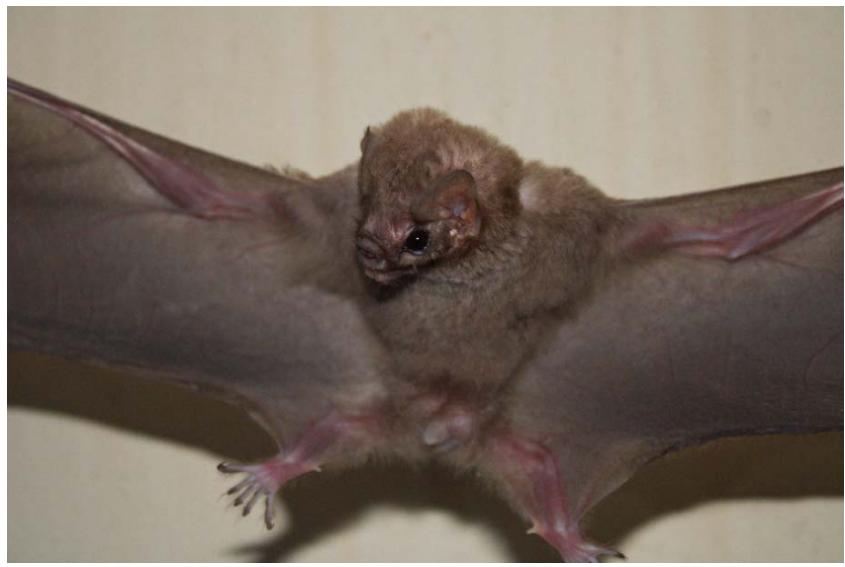
Source:Authors'archive Figure 1: Photograph of a faunal specimen of Diphylla ecaudata, collected in the municipality of Pedro II, Piauí
Note from Table 1 that in the village of Sertão de Dento located in Milton Brandão - PI, five specimens were collected, and these captures were prompted by a request from a local resident who reported several chicken deaths likely caused by bats. Subsequently, we
set up a mist net measuring $9 \times 3$ meters near the chicken roost. In Figure 2 (resting place of the chickens), we noted the height above ground level and marked it at $50 \mathrm{~cm}$.
Table 1. Compilation of Information on Captures of D. ecaudata in the State of Piaui, Northeast Brazil (2004-2023)
<table><tr><td>Location</td><td>Source</td><td>Coordinates</td><td>Quantity</td></tr><tr><td>Pedro II (Serra dos Matões)</td><td>Own work</td><td>S 4°24'2,3" W 41°26'44,6"</td><td>2</td></tr><tr><td>Milton Brandão (Sertão deuveatro)</td><td>Own work</td><td>S 4°47'03,2" W 041°28'54,2"</td><td>5</td></tr><tr><td>Picos</td><td>Own work</td><td>S 7°02'18,0" W 41°27'4,6"</td><td>2</td></tr><tr><td>Guaribas (PNSC)</td><td>Gregorin et al. (2008)</td><td>S 09°13'12" W 43°29'52"</td><td>1</td></tr><tr><td>São Miguel do Tapuio and Buriti dos Montes*</td><td>Castilho et al. (2010)</td><td>Not provided</td><td>3</td></tr></table>
Uieda (1982), in his experimental work with specimens of D. ecaudata, reports these animals' preference for preying on birds within a height range of 2 to 4 meters above the ground. However, observations made by our team throughout the night in a net set up near the birds' resting place show a behavioral change,
as predation occurred closer to the ground, at around 0.5 meters height, thereby expanding the spatial spectrum for predation (Figure 2). This demonstrates the flexibility in predation habits among these animals, indicating adaptations in foraging behavior.
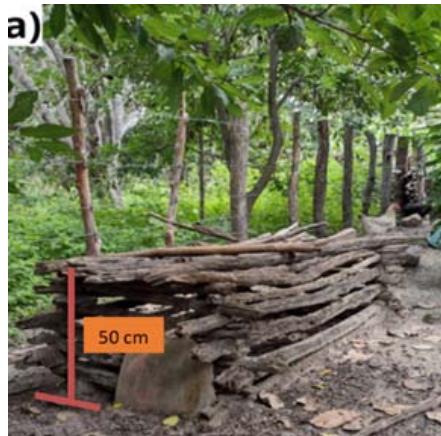
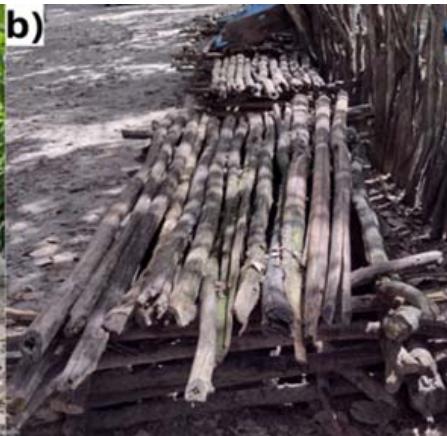
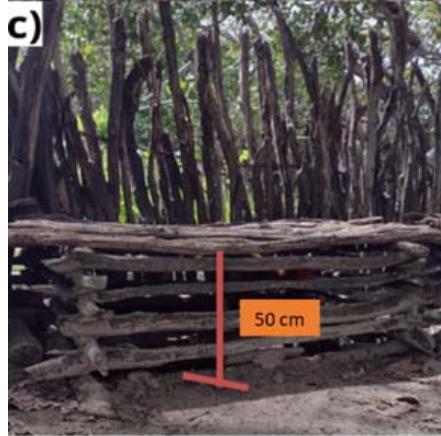
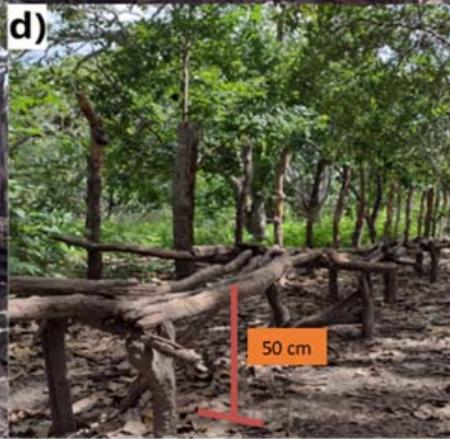
Figure 2: Images of Chicken Roosts in the Backyard of a Local Resident in the Village of Sertão de Dento, in the Municipality of Milton Brandão-PI, recorded in 2023
Source:Authors'archive
a) Chicken coop with dimensions of 1.5 meters in length x 0.5 meters in width and 0.5 meters in height from the ground at its highest point; b) Top view of the chicken coop; c) Front view of the chicken coop; d) Chicken roost.
Figure 3 presents the map of Piauí with the occurrence of faunal individuals of the genus Dyphylla recorded to date. The expansion of the taxon's geographical distribution is evident from records made in PNSC (Serra das Confusões National Park) in Gilbués-PI, in 2008 by Gregorin and colleagues, and in 2010 by Castilho and colleagues in the municipalities of São Miguel do Tapuio and Buriti dos Montes, in the northern part of the state of Piauí. The update on the quantity of D. ecaudata was conducted by our research team.
The Parna Serra das Confusões (PNSC) is located between coordinates $9^{\circ}27'$ to $9^{\circ}31'$ S and $43^{\circ}05'$ to $43^{\circ}56'$ W, encompassing the municipalities of Canto do Buriti, Tamboril do Piauí, Jurema, Alvorada do Gurguéia, Bom Jesus, Guaribas, and Cristino Castro.
The PNSC has a legal area of 823,843.08 hectares (or 8,238.43 km²), which is approximately equivalent to 763,000 soccer fields (Brazil, 2017).
The city of Picos - PI, characterized by typical Caatinga vegetation, is located 330 km from PNSC and 249 km from the Cerrado-Caatinga enclave that includes the municipalities of Pedro II - PI and Milton Brandão - PI, further north in the state, with a distance of 35 km between them. Close to these two municipalities are São Miguel do Tapuio and Buriti dos Montes, located in an interbiome area, with a distance of 54 km between them.
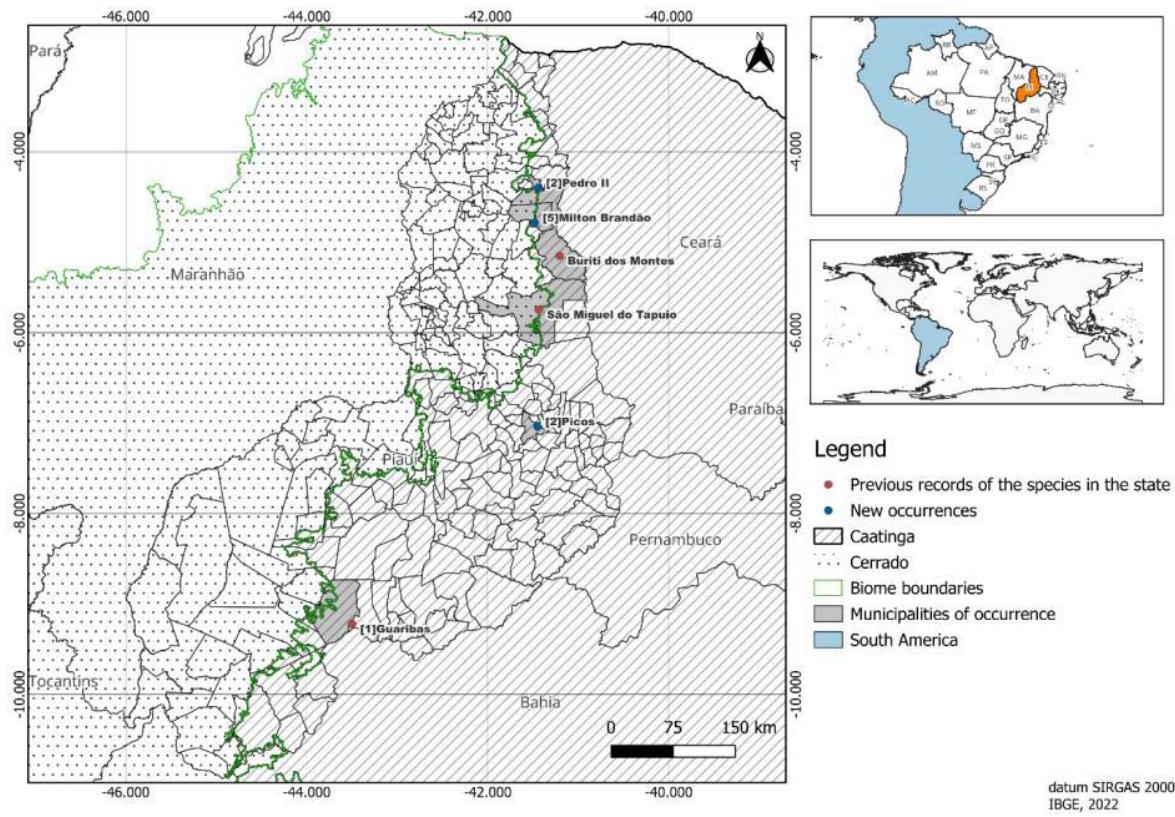
Source:Authors Figure 3: Map showing the occurrence of $D$. ecaudata in the state of Piauí, delineated by municipality and biomes, spanning from 2008 to 2023
Given its geographical position, the Cerrado and Caatinga biomes dominate the state of Piauí, with a significant presence of a Cerrado-Caatinga enclave, identified as a green line on the map (Figure 3), which can be characterized as a typical transition zone according to the latest update by IBGE (2019). It is highlighted that the updates for Diphylla ecaudata recorded in this study were conducted in areas delimited by the following domains: Caatinga (Picos - PI) and the Cerrado-Caatinga enclave (Pedro II - PI, Milton Brandão - PI, São Miguel do Tapuio-PI, Buriti dos Montes-PI, and PNSC - PI) (IBGE, 2024).
Studying the vegetation of different biomes, especially in transition areas, leads to a classification of domains that is still subject to change. In this regard, considering the municipalities studied, all exhibit characteristics of Savanna-Woodland, with highly branchedbranching generally provided with thorns. However, Guaribas - PI and Milton Brandão - PI also have patches of Deciduous Mountain Seasonal Forest and Shrub Savanna-Woodland, respectively, which designate these two biomes as dominant in the state of Piaui. It is also noted that the focus of occurrences was in zones with a semi-arid tropical climate, with an average temperature above $18^{\circ}\mathrm{C}$ and a maximum of $39^{\circ}\mathrm{C}$ (Brazil, 2024).
Understanding the ecosystem types allows for a more informed analysis of the biology of this bat group.
In this context, the Caatinga, confined to northeastern Brazil, is the least studied biome, with only about $2\%$ of its entire territory protected by conservation units. Unsustainable use of its resources has led to extensive environmental alteration and degradation, resulting in rapid loss of species diversity, elimination of unique species, key ecological processes, and desertification (Leal; Tabarelli; Silva, 2003).
The hairy-legged vampire bat is often associated with tropical zones in its distribution, being classified as the most specialized among hematophagous bats in feeding behavior, both in natural environments and in captivity (Uieda, 1992; Uieda, 1994). Conversely, Ito, Bernard, and Torres (2016) highlight the flexibility in the feeding habits of these bats due to the scarcity of usual prey, with regular records of feeding on human blood based on molecular analysis of D. ecaudata feces.
The report of the AgV3 variant in D. ecaudata by Castilho et al. (2010) in northern Piauí adds important information to be considered by competent health authorities. It indicates evidence of rabies virus circulation in a group of animals that are poorly sampled in the region, within an area recognized for underreporting or even lack of information. This complicates the establishment of an epidemiological framework regarding rabies transmission cycles,
particularly focusing on the sylvatic aerial cycle for this disease.
## IV. FINAL CONSIDERATIONS
The alert has been given! The information presented in this study brings new information regarding the behavior of D. ecaudata bats preying on birds close to the ground, different from what was experimentally portrayed, when D. ecaudata was observed preferring to prey on birds perched in higher roosts. In addition, it shows that these bats can attack different prey, such as mammals, including humans in search of maintaining their blood-eating diet.
The data point to the need for systematic, continuous and cooperative surveillance between researchers and bodies responsible for health and environmental surveillance agencies in order to converge proposals for improving and optimizing monitoring for this animal group with the aim of maintaining harmony and rapid response in cases of positivity of pathogens disseminated by this faunal group.
We understand that only joint efforts can act effectively to understand the epidemiological cycles provided by bats and their harbored microbiota. And may this essay serve as a guiding focus for further research in similar ecotonal areas and other biomes where this species of bat occurs. Establishing a working network based on the research model proposed here can be a positive factor in uncovering knowledge gaps about the spatial distribution of this taxon and keeping us connected regarding its biology amid current and future climate changes.
Generating HTML Viewer...
References
25 Cites in Article
A Albas,A Campos,D Araujo,C Rodrigues,M Sodré,E Durigon,S Favoretto (2011). Molecular characterization of rabies virus isolated from nonhaematophagous bats in Brazil.
F Barreto,W Rosa,D Batista Filho,B Sousa (2019). Raiva dos herbívoros no Piauí: uma retrospectiva até os dias atuais.
Análise Mapeamento,Espectro (2023). Temporal das Unidades De Conservação de Proteção Integral Da Administração Federal no Bioma Caatinga Parque Nacional Serra das Confusões.
Juliana Castilho,Pedro Carnieli,Rafael Oliveira,Willian Fahl,Rosangela Cavalcante,Antonio Santana,Wellington Rosa,Maria Carrieri,Ivanete Kotait (2010). A Comparative Study of Rabies Virus Isolates from Hematophagous Bats in Brazil.
Arthur Greenhall,Uwe Schmidt,Gerhard Joermann (1984). Diphylla ecaudata.
R Gregorin,A Carmignotto,A Percequillo (2008). Quirópteros do Parque Nacional da Serra das Confusões, Piauí, nordeste do Brasil.
F Ito,E Bernard,R Torres (2016). What is for dinner? First report of human blood in the diet of the hairy-legged vampire bat Diphylla ecaudata.
I Leal,M Tabarelli,J Silva (2003). Ecologia e conservação da Caatinga: uma introdução ao desafio.
M Lima,De,A Moraes,De,L Nunes,A Andrade Júnior (2020). Climas do estado do Piauí e suas relações com a conservação do solo.
Maria Vanessa Dias Da Silva,Murilo Branco Andrade Monteiro,André Bezerra De Sena,Petrônio José De Lima Martelli,Isabela De Lucena Heráclio (2022). Impactos da pandemia de COVID-19 sobre o tratamento para cessação do tabagismo.
Carlos Ramos,Luis Ramos (2019). DIVERSIDAD Y COMPOSICIÓN FLORÍSTICA DEL CONOCIMIENTO ETNOBOTÁNICO EN LA RESERVA COMUNAL AMARAKAERI, PROVINCIA DE MANU, MADRE DE DIOS, PERÚ.
(2024). Why QGIS?.
Avelino Albas,Angélica Campos,Danielle Araujo,Camila Rodrigues,Miriam Sodré,Edison Durigon,Silvana Favoretto (2024). Molecular characterization of rabies virus isolated from non-haematophagous bats in Brazil.
N Reis,M Fregonezi,A Peracchi,O Shibatta (2013). Unknown Title.
P Rocha,M Pedroso,A Feijó,N Filho,B Campos,S Ferrari (2014). Update on the distribution of Diphylla ecaudata Spix, 1823 (Mammalia, Chiroptera): new records from the Brazilian northeast.
A Ruschi (1951). Morcegos do Estado do Espírito Santo: Descrição de Diphylla ecaudata Spix e algumas observações a seu respeito.
Francisco Santos-Filho,; Soares,Suzianne Sousa,Valadares Raquel,Sales (2018). CI (PI) ÊNCIA: PANORAMA GERAL DOS ESTUDOS SOBRE BIODIVERSIDADE NO PIAUÍ.
K Scheffer,R De Barros,K Iamamoto,E Mori,K Asano,S Achkar,A Estevez Garcia,J Lima,Fahl (2015). Diphylla ecaudata y Diaemus youngi: biología y comportamento.
Benjamin Stoner-Duncan,Daniel Streicker,Christopher Tedeschi (2014). Vampire Bats and Rabies: Toward an Ecological Solution to a Public Health Problem.
F Straube,G Bianconi (2002). Sobre a grandeza e a unidade utilizada para estimar esforço de captura com utilização de redes-de-neblina.
D Streicker,J Allgeier (2016). Escolhas de forrageamento de morcegos vampiros em diversas paisagens: implicações potenciais alterações no uso da terra e transmissão de doenças.
Wilson Uieda (1992). Aspectos do comportamento alimentar das tres especies de morcegos hematofagos (Chiroptera, phyllostomidae).
Wilson Uieda (1982). Aspectos do comportamento alimentar das tres especies de morcegos hematofagos (Chiroptera, phyllostomidae).
W Uieda (1994). Comportamento alimentar de morcegos hematogafos ao atacar aves, cabrinos e suinos, em condições de cativeiro.
L Vizotto,V Taddei (1973). Chave para a determinação de quirópteros brasileiros.
No ethics committee approval was required for this article type.
Data Availability
Not applicable for this article.
How to Cite This Article
Marcelo Cardoso Da Ventura. 2026. \u201cDiphylla Ecaudata Spix, 1823 in the Caatinga-Cerrado Ecotone: From Feeding Plasticity to Rabies Propagation in Northeastern Brazil\u201d. Global Journal of Medical Research - G: Veterinary Science & Medicine GJMR-G Volume 24 (GJMR Volume 24 Issue G1): .
Explore published articles in an immersive Augmented Reality environment. Our platform converts research papers into interactive 3D books, allowing readers to view and interact with content using AR and VR compatible devices.
Your published article is automatically converted into a realistic 3D book. Flip through pages and read research papers in a more engaging and interactive format.
Our website is actively being updated, and changes may occur frequently. Please clear your browser cache if needed. For feedback or error reporting, please email [email protected]
Thank you for connecting with us. We will respond to you shortly.