Dispersion of Multidrug Resistant Bacteria and Fecal Bacteria into Field Soils of Japan through Compost Application

1
Watanabe Katsuji
Watanabe Katsuji
1 Fukuoka Institute of Technology

Send Message

To: Author

GJMR Volume 22 Issue K3

Article Fingerprint

ReserarchID

ZT2R5

Dispersion of Multidrug Resistant Bacteria and Fecal Bacteria into Field Soils of Japan through Compost Application Banner
  • English
  • Afrikaans
  • Albanian
  • Amharic
  • Arabic
  • Armenian
  • Azerbaijani
  • Basque
  • Belarusian
  • Bengali
  • Bosnian
  • Bulgarian
  • Catalan
  • Cebuano
  • Chichewa
  • Chinese (Simplified)
  • Chinese (Traditional)
  • Corsican
  • Croatian
  • Czech
  • Danish
  • Dutch
  • Esperanto
  • Estonian
  • Filipino
  • Finnish
  • French
  • Frisian
  • Galician
  • Georgian
  • German
  • Greek
  • Gujarati
  • Haitian Creole
  • Hausa
  • Hawaiian
  • Hebrew
  • Hindi
  • Hmong
  • Hungarian
  • Icelandic
  • Igbo
  • Indonesian
  • Irish
  • Italian
  • Japanese
  • Javanese
  • Kannada
  • Kazakh
  • Khmer
  • Korean
  • Kurdish (Kurmanji)
  • Kyrgyz
  • Lao
  • Latin
  • Latvian
  • Lithuanian
  • Luxembourgish
  • Macedonian
  • Malagasy
  • Malay
  • Malayalam
  • Maltese
  • Maori
  • Marathi
  • Mongolian
  • Myanmar (Burmese)
  • Nepali
  • Norwegian
  • Pashto
  • Persian
  • Polish
  • Portuguese
  • Punjabi
  • Romanian
  • Russian
  • Samoan
  • Scots Gaelic
  • Serbian
  • Sesotho
  • Shona
  • Sindhi
  • Sinhala
  • Slovak
  • Slovenian
  • Somali
  • Spanish
  • Sundanese
  • Swahili
  • Swedish
  • Tajik
  • Tamil
  • Telugu
  • Thai
  • Turkish
  • Ukrainian
  • Urdu
  • Uzbek
  • Vietnamese
  • Welsh
  • Xhosa
  • Yiddish
  • Yoruba
  • Zulu

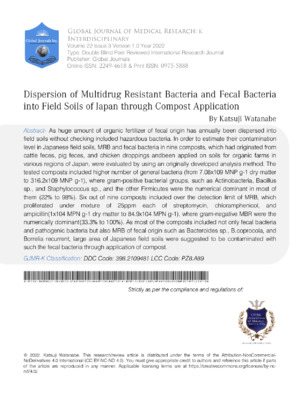
As huge amount of organic fertilizer of fecal origin has annually been dispersed into field soils without checking included hazardous bacteria. In order to estimate their contamination level in Japanese field soils, MRB and fecal bacteria in nine composts, which had originated from cattle feces, pig feces, and chicken droppings andbeen applied on soils for organic farms in various regions of Japan, were evaluated by using an originally developed analysis method. The tested composts included higher number of general bacteria (from 7.08×10⁹ MNP g-1 dry matter to 316.2×10⁹ MNP g-1), where gram-positive bacterial groups, such as Actinobacteria, Bacillus sp., and Staphylococcus sp., and the other Firmicutes were the numerical dominant in most of them (22% to 98%). Six out of nine composts included over the detection limit of MRB, which proliferated under mixture of 25ppm each of streptomycin, chloramphenicol, and ampicillin(1×10⁴ MPN g-1 dry matter to 84.9×10⁴ MPN g-1), where gram-negative MBR were the numerically dominant(33.3% to 100%). As most of the composts included not only fecal bacteria and pathogenic bacteria but also MRB of fecal origin such as Bacteroides sp., B.coprocola, and Borrelia recurrent, large area of Japanese field soils were suggested to be contaminated with such the fecal bacteria through application of compost.

Funding

No external funding was declared for this work.

Conflict of Interest

The authors declare no conflict of interest.

Ethical Approval

No ethics committee approval was required for this article type.

Data Availability

Not applicable for this article.

Watanabe Katsuji. 2026. \u201cDispersion of Multidrug Resistant Bacteria and Fecal Bacteria into Field Soils of Japan through Compost Application\u201d. Global Journal of Medical Research - K: Interdisciplinary GJMR-K Volume 22 (GJMR Volume 22 Issue K3): .

Download Citation

High-resolution image showing bacteria dispersion in soil. Focus on compost application and bacterial soil impact in Japan.
Journal Specifications

Crossref Journal DOI 10.17406/gjmra

Print ISSN 0975-5888

e-ISSN 2249-4618

Keywords
Classification
GJMR-K Classification: DDC Code: 398.2109481 LCC Code: PZ8.A89
Version of record

v1.2

Issue date

June 29, 2022

Language

English

Experiance in AR

The methods for personal identification and authentication are no exception.

Read in 3D

The methods for personal identification and authentication are no exception.

Article Matrices
Total Views: 1561
Total Downloads: 30
2026 Trends
Research Identity (RIN)
Related Research

Published Article

As huge amount of organic fertilizer of fecal origin has annually been dispersed into field soils without checking included hazardous bacteria. In order to estimate their contamination level in Japanese field soils, MRB and fecal bacteria in nine composts, which had originated from cattle feces, pig feces, and chicken droppings andbeen applied on soils for organic farms in various regions of Japan, were evaluated by using an originally developed analysis method. The tested composts included higher number of general bacteria (from 7.08×10⁹ MNP g-1 dry matter to 316.2×10⁹ MNP g-1), where gram-positive bacterial groups, such as Actinobacteria, Bacillus sp., and Staphylococcus sp., and the other Firmicutes were the numerical dominant in most of them (22% to 98%). Six out of nine composts included over the detection limit of MRB, which proliferated under mixture of 25ppm each of streptomycin, chloramphenicol, and ampicillin(1×10⁴ MPN g-1 dry matter to 84.9×10⁴ MPN g-1), where gram-negative MBR were the numerically dominant(33.3% to 100%). As most of the composts included not only fecal bacteria and pathogenic bacteria but also MRB of fecal origin such as Bacteroides sp., B.coprocola, and Borrelia recurrent, large area of Japanese field soils were suggested to be contaminated with such the fecal bacteria through application of compost.

Our website is actively being updated, and changes may occur frequently. Please clear your browser cache if needed. For feedback or error reporting, please email [email protected]
×

This Page is Under Development

We are currently updating this article page for a better experience.

Request Access

Please fill out the form below to request access to this research paper. Your request will be reviewed by the editorial or author team.
X

Quote and Order Details

Contact Person

Invoice Address

Notes or Comments

This is the heading

Lorem ipsum dolor sit amet, consectetur adipiscing elit. Ut elit tellus, luctus nec ullamcorper mattis, pulvinar dapibus leo.


High-quality academic research articles on global topics and journals.

Dispersion of Multidrug Resistant Bacteria and Fecal Bacteria into Field Soils of Japan through Compost Application

Watanabe Katsuji
Watanabe Katsuji Fukuoka Institute of Technology

Research Journals