I. INTRODUCTION
Denim is very strong, stiff and hard wearing woven fabric. Denim is cotton and twill weave fabric that uses colored warp and grey weft yarn. Denim is normally dyed with indigo, vat and sulphur dyes. Since denim constitutes the largest portion of the garments that are washed, the term 'wash' has come to mean the finishing of denim garments.
The most commonly denim washing methods are enzyme wash, bleach wash, acid wash, normal wash, stone wash, etc. Among the washing methods, bleach method is widely used method in industry especially for denim washing to achieve required color shade by hypochlorite bleaching. Denim Bleach is a process that can be used to decolorize indigo from denim. In this process a strong oxidative bleaching agent such as sodium hypochlorite or is added during the washing with or without stone addition. Discoloration produced is usually more apparent depending on strength of the bleach liquor quantity, temperature and treatment time. It is preferable to have strong bleach with short treatment time. Care should be taken for the bleached goods so that after washed with peroxide to minimize yellowing.
Bleaching agents essentially destroy chromophores (thereby removing the color), via the oxidation or reduction of these absorbing groups. Thus, bleaches can be classified as either oxidizing agents or reducing agents. Bleaching process is difficult to control i.e. difficult to reach the same level of bleaching in repeated runs. When desired level of bleaching reached the time span available to stop the bleaching is very narrow. Due to harshness of chemical, it may cause damage to cellulose resulting in severe strength losses and/or breaks or pinholes at the seam, pocket, etc.
Enzyme washing is a laundering process that uses enzymes to clean clothing or to finish fabric, especially in the case of denim and other garments with a worn-in look. Various enzymatic cleaners are available from stores that specialize in laundry supplies, and they can also be special ordered. For regular cleaning, enzymes carry many economic and environmental benefits. On an industrial scale, it has replaced laborious laundering techniques such as stonewashing, saving money and environmental impact for companies. The enzymes used in this technique are proteins produced by living organisms.
'GSM' means 'Gram per square meter' that is the weight of fabric in gram per one square meter. By this we can compare the fabrics in unit area which is heavier and which is lighter.
Stiffness is a special property of fabric. It is the tendency of fabric to keep standing without any support. It is a key factor in the study of handle and drape of fabric. Stiffness is the rigidity of an object — the extent to which it resists deformation in response to an applied force. The fabric bending property is apparently a function of the bending property of its constituent yarns. In other words, it reflects the difficulty with which a fabric can be deformed by bending. The higher the bending rigidity, the higher the fabric ability to resist when it is bent by an external force. In addition, the effect of density and fabric thickness are also very profound for this property.
Color fastness refers to the resistance of color to fade or bleed of a dyed or printed textile materials to various types of influences e.g. water, light, rubbing, washing, perspiration etc. The chemical nature of the fiber, for example, cellulosic fibers dyed with reactive or vat dyes will show good fastness properties. That is to say compatibility of dye with the fiber is very important. If the dye molecule is larger in size, it will be tightly entrapped inside the inter-polymer chain space of a fiber. Thus the fastness will be better. The manner in which the dye is bonded to the fiber or the physical form present. The amount of dye present in the fiber i.e. depth of shade. A deep shade will be less fast than a pale or light shade. Rubbing Fastness depends on:
i. Nature of the Color
ii. Depth of the Shade
iii. Construction of the Fabric.
In simpler terms tear resistance or tear strength is a measure of how well a material can withstand the effects of tearing. Tear strength is the tensile force required to rupture a pre-slit woven fabric sample under controlled conditions. Materials with low tear resistance tend to have poor resistance to abrasion and when damaged will quickly fail.
II. MATERIAL AND METHODOLOGY
100% cotton indigo dyed 380 GSM denim fabrics were washed through desizing using detergent and desizing agent. Then desized denim fabrics were processed using non chlorine & chlorine (KCl) bleach in bleach process & enzyme were used in enzymatic process. The physical and mechanical properties of treated denim were examined using testing equipment.
| 1. | M:L | 1:10 | 2. | Water | 100 L |
| 3. | Detergent (ID eco) | 60 gm | 4. | Soda Ash (HTS) | 100 gm |
| 5. | Temperature | 60°C | 6. | Time | 15 min |
| 7. | Rinse | 2 times |
| Recipe | Operation 1 (Light Enzyme) | Operation 2 (Heavy enzyme) | Operation 3 (Light bleach) | Operation 4 (Heavy bleach) | Operation 5 (Chlorine light bleach) | Operation6 (Chlorine heavy bleach) |
| M:L | 1:10 | 1:10 | 1:10 | 1:10 | 1:10 | 1:10 |
| Water | 50 L | 50 L | 50 L | 50 L | 50 L | 50 L |
| Cellulose enzyme Liquid Enzyme (Lacase) | 50 gm | 100 gm | - | - | - | - |
| Bleach (KCl/ Japan powder) | - | - | 25 gm | 150 gm | KCL 25 gm | KCL 150 gm |
| Sequestering agent (LP30) | 100 gm | 100 gm | - | - | - | - |
| Washing Time | 50 min | 50 min | 25 min | 25 min | 25 min | 25 min |
| Wash Temperature | 30°C | 30°C | 50°C | 50°C | 50°C | 50°C |
| Rinse | 2 times | 2 times | 2 times | 2 times | 2 times | 2 times |
| Neutralizing (H2O2)(Hypo)(china) | - | - | 50°C, 15 min | 50°C, 15 min | 50°C, 15 min | 50°C, 15 min |
| Hydro-extracting | 1.5~2 min | 1.5~2 min | 1.5~2 min | 1.5~2 min | 1.5~2 min | 1.5~2 min |
| Drying type | Gas dryer | Gas dryer | Gas dryer | Gas dryer | Gas dryer | Gas dryer |
| Drying time | 30~40 min | 30~40 min | 30~40 min | 30~40 min | 30~40 min | 30~40 min |
| Drying temperature | 80°C | 80°C | 80°C | 80°C | 80°C | 80°C |
a) Testing and Analysis
Washed denim fabrics were conditioned in 65% RH and 20°C for 24 h before testing.
GSM was calculated from raw and different washed fabric by using GSM cutter.
Stiffness was measured from the bending rigidity in fabric by Shirley stiffness tester.
Change in the original color shade of the fabric was rated using gray scale for color change.
Tearing strength was determined by GESTER GT-C10 tear tester.
Dimensional changes (shrinkage%) was calculated from the difference in fabric length and width before and after washed.
III. RESULT AND DISCUSSION
The physical and mechanical properties of denim fabrics treated at different cellulose concentrations were measured and the results are summarized in Table 3.
| Operations | GSM | Stiffness | Color fastness | Tearing Strength | Dimensional Change% | |||
| Warp wise Strength | Weft wise Strength | |||||||
| Dry | Wet | Length | Width | |||||
| Raw Denim | 380 | 3.7 | 5 | 4 | 62.5 | 62.0 | 0 | 0 |
| Operation 1: Light Enzyme | 377 | 3.3 | 4 | 3 | 62.0 | 58.0 | -6.0 | 0 |
| Operation 2: Heavy Enzyme | 372 | 3.2 | 4 | 2/3 | 60.0 | 58.0 | -6.2 | +1.0 |
| Operation 3: Light Bleach | 376 | 2.8 | 4 | 3/4 | 61.5 | 52.5 | -5.25 | 0 |
| Operation 4: Heavy Bleach | 367 | 3.4 | 4 | 3 | 60.0 | 52.0 | -6.44 | +0.5 |
| Operation 5: Chlorine Light Bleach | 366 | 3.0 | 5 | 4 | 62.0 | 57.5 | -6.0 | +0.75 |
| Operation 6: Chlorine Heavy Bleach | 361 | 2.6 | 4 | 4 | 61.5 | 56.0 | -6.3 | +1.0 |
a. Effect of
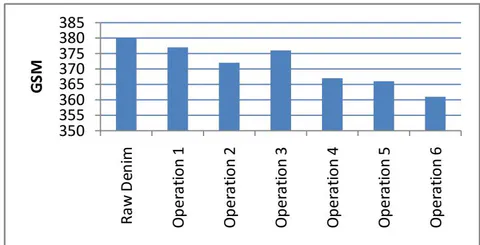
higher loss of weight. The weight of the fabric loss gradually from enzyme washes to non-chlorine bleaches then chlorine bleaches.
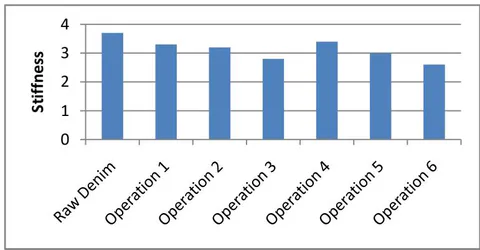
c. Effect of different wash on fabric colorfastness
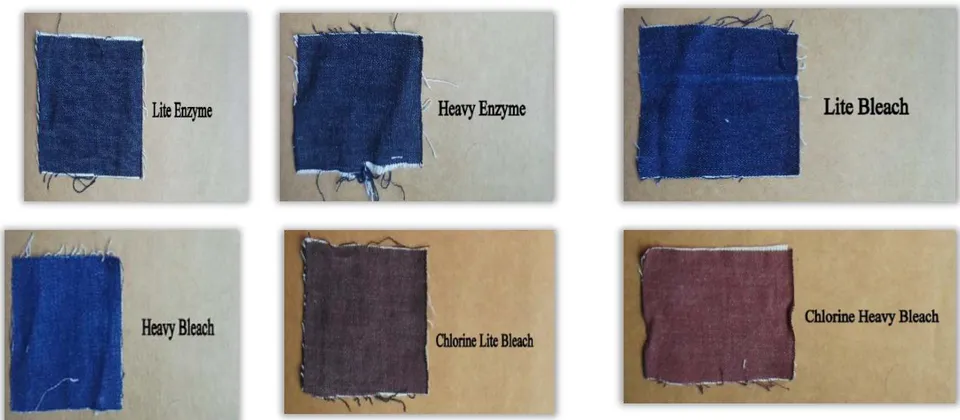
We also observe that, the non-chlorine bleach is reacting with cotton denim fabric not with the Indigo dye.
But in chlorine bleach, it reacts with cotton & indigo both and fully discolors the indigo. Create a new reddish shade on fabric as showed in figure: 1.
Denim fabric colors fading are monitored. In colorfastness, the denim act different fastness in various processes. The fastness is normally depending on indigo dyes. But we can get the different result from our test that shows in the Table: 3.
d. Effect of different wash on fabric tearing strength
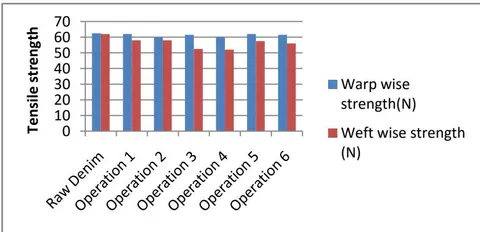
According to Table:3 it can be said that the fabric tearing strength fall after enzymatic wash. Enzyme eat the cotton wall gradually and higher the concentration higher the strength loss. Bleach wash also do the same. But bleach are more effective than enzyme as it cause of chemical reaction that break the polymer bond rapidly. The bleach effect on fabric depend on bleaching concentration with time. By increase of hardness and time, the fabric loses its physical stability. So it loose strength and become soft.
e. Effect of
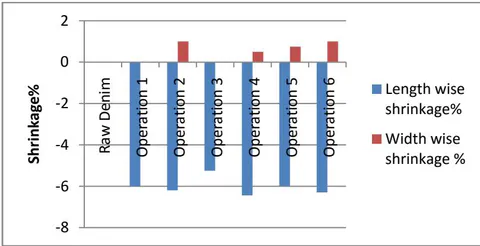
It is observed from table that fabric is dimensionally decreased much more at length wise (warp direction) for all the operation and in some cases slightly increase at width wise (weft direction). During weaving cotton denim fabrics were subjected to considerable tensions, particularly in the warp direction. In subsequent finishing processes such as calendaring this stretch was increased and temporarily set in the fabric. The fabric is then in a state of dimensional instability. Subsequently when the denim garment was thoroughly wetted in enzymatic or bleach washing, it tended to revert its more stable dimensions which results in the contraction of the yarns. This effect is usually greater in the warp direction than in the weft direction. This is known as relaxation shrinkage. Due to relaxation shrinkage, PPI (picks per inch) was increased than untreated denim fabrics, as a result fabric weight loss is slightly minimized. Although decomposition occurred in hypochlorite bleach washing, at the same time relaxation shrinkage happened, and the GSM fabric weight loss of denim garments were minimized slightly.
IV. CONCLUSION
In this project work we study about the different washing effect on physical & mechanical properties on the denim fabric. It can be seen that, treatment of denim fabric significantly decrease in GSM, tensile strength and this decrease was higher at higher in bleach process from enzymatic washing process. During washing, cellulose hydrolyzed cotton. First, it attacked on projecting fibers (micro-fibrils) on surface, then attacked on yarn portion, hydrolyzed them slowly and upon time penetrated inside the fabric. The result of this reaction is that the primary wall (outer layer) of the cotton fiber is loosened and broken down quicker with the frictional action (mechanical forces) of rotating cylinder of the washing machine. This effect also depends on the washing conditions. Hydrolysis of cellulose would certainly affect fabric properties, namely GSM of fabric, tensile strength, stiffness, colorfastness, dimensional change (Shrinkage%) etc. characteristics.