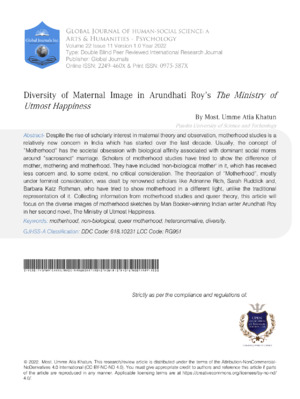
Diversity of Maternal Image in Arundhati Roy’s The Ministry of Utmost Happiness

α
Most. Umme Atia Khatun
α Pundra University of Science and Technology

Send Message

To: Author

Diversity of Maternal Image in Arundhati Roy’s The Ministry of  Utmost Happiness

Article Fingerprint

ReserarchID

1OA1P

Diversity of Maternal Image in Arundhati Roy’s The Ministry of  Utmost Happiness Banner

AI TAKEAWAY

Connecting with the Eternal Ground
  • English
  • Afrikaans
  • Albanian
  • Amharic
  • Arabic
  • Armenian
  • Azerbaijani
  • Basque
  • Belarusian
  • Bengali
  • Bosnian
  • Bulgarian
  • Catalan
  • Cebuano
  • Chichewa
  • Chinese (Simplified)
  • Chinese (Traditional)
  • Corsican
  • Croatian
  • Czech
  • Danish
  • Dutch
  • Esperanto
  • Estonian
  • Filipino
  • Finnish
  • French
  • Frisian
  • Galician
  • Georgian
  • German
  • Greek
  • Gujarati
  • Haitian Creole
  • Hausa
  • Hawaiian
  • Hebrew
  • Hindi
  • Hmong
  • Hungarian
  • Icelandic
  • Igbo
  • Indonesian
  • Irish
  • Italian
  • Japanese
  • Javanese
  • Kannada
  • Kazakh
  • Khmer
  • Korean
  • Kurdish (Kurmanji)
  • Kyrgyz
  • Lao
  • Latin
  • Latvian
  • Lithuanian
  • Luxembourgish
  • Macedonian
  • Malagasy
  • Malay
  • Malayalam
  • Maltese
  • Maori
  • Marathi
  • Mongolian
  • Myanmar (Burmese)
  • Nepali
  • Norwegian
  • Pashto
  • Persian
  • Polish
  • Portuguese
  • Punjabi
  • Romanian
  • Russian
  • Samoan
  • Scots Gaelic
  • Serbian
  • Sesotho
  • Shona
  • Sindhi
  • Sinhala
  • Slovak
  • Slovenian
  • Somali
  • Spanish
  • Sundanese
  • Swahili
  • Swedish
  • Tajik
  • Tamil
  • Telugu
  • Thai
  • Turkish
  • Ukrainian
  • Urdu
  • Uzbek
  • Vietnamese
  • Welsh
  • Xhosa
  • Yiddish
  • Yoruba
  • Zulu

Abstract

Despite the rise of scholarly interest in maternal theory and observation, motherhood studies is a relatively new concern in India which has started over the last decade. Usually, the concept of “Motherhood” has the societal obsession with biological affinity associated with dominant social mores around “sacrosanct” marriage. Scholars of motherhood studies have tried to show the difference of mother, mothering and motherhood. They have included ‘non-biological mother’ in it, which has received less concern and, to some extent, no critical consideration. The theorization of “Motherhood”, mostly under feminist consideration, was dealt by renowned scholars like Adrienne Rich, Sarah Ruddick and, Barbara Katz Rothman, who have tried to show motherhood in a different light, unlike the traditional representation of it. Collecting information from motherhood studies and queer theory, this article will focus on the diverse images of motherhood sketches by Man Booker-winning Indian writer Arundhati Roy in her second novel, The Ministry of Utmost Happiness.

References

19 Cites in Article
  1. (2012). A triumphant debut.
  2. Erma Bombeck (1983). Bombeck, Erma.
  3. John Bowlby (1974). Child Care and the Growth of Love, Second Edition.
  4. Dorothy Dinnerstein (1991). The Mermaid and the Minotaur: Sexual Arrangements and Human Malaise.
  5. Margaret Gibson (2014). Mothers, Mothering, and Motherhood across Cultural Differences.
  6. Sarah Hardy,Caroline Wiedmer (2005). Motherhood and Space.
  7. Laura Heston (2013). Utopian Kinship: The Possibilities of Queer Parenting.
  8. Rhoda Maxwell (1994). Images of Mothers in Literature for Young Adults.
  9. Shelley Park (2013). Mothering Queerly, Queering Motherhood: Resisting Monomaternalism in Adoptive, Lesbian, Blended, and Polygamous Families.
  10. Rebecca Plant,Jo (2010). Mom: The Transformation of Motherhood in Modern America.
  11. Irene Reti (1992). Childless by Choice: A Feminist Anthology.
  12. Adrienne Rich (1981). Of Woman Born: Motherhood as Experience and Institution.
  13. Martha Rose,Joy (2015). ABOUT MOTHER STUDIES AND THE THEORY OF MOTHERNESS.
  14. Barbara Rothman (2001). Book of Life.
  15. Barbara Rothman,Katz (1994). Beyond Mothers and Fathers.
  16. Arundhati Roy (2017). The Ministry of Utmost Happiness.
  17. Sarah Ruddick (1995). Maternal Thinking: Toward a Politics of Peace.
  18. (2010). Motherhood Penalty/Fatherhood Bonus.
  19. Valerie Heffernan,Gay Wilgus (2020). Imagining Motherhood in the Twenty-First Century.

Funding

No external funding was declared for this work.

Conflict of Interest

The authors declare no conflict of interest.

Ethical Approval

No ethics committee approval was required for this article type.

Data Availability

Not applicable for this article.

How to Cite This Article

Most. Umme Atia Khatun. 2026. \u201cDiversity of Maternal Image in Arundhati Roy’s The Ministry of Utmost Happiness\u201d. Global Journal of Human-Social Science - A: Arts & Humanities GJHSS-A Volume 22 (GJHSS Volume 22 Issue A11): .

Download Citation

Diverse maternal health images illustrating nutrition and well-being for academic research.
Issue Cover
GJHSS Volume 22 Issue A11
Pg. 31- 36
Journal Specifications

Crossref Journal DOI 10.17406/GJHSS

Print ISSN 0975-587X

e-ISSN 2249-460X

Keywords
Classification
GJHSS-A Classification: DDC Code: 618.10231 LCC Code: RG951
Version of record

v1.2

Issue date

December 19, 2022

Language
en
Experiance in AR

Explore published articles in an immersive Augmented Reality environment. Our platform converts research papers into interactive 3D books, allowing readers to view and interact with content using AR and VR compatible devices.

Read in 3D

Your published article is automatically converted into a realistic 3D book. Flip through pages and read research papers in a more engaging and interactive format.

Article Matrices
Total Views: 1699
Total Downloads: 63
2026 Trends
Related Research

Published Article

Despite the rise of scholarly interest in maternal theory and observation, motherhood studies is a relatively new concern in India which has started over the last decade. Usually, the concept of “Motherhood” has the societal obsession with biological affinity associated with dominant social mores around “sacrosanct” marriage. Scholars of motherhood studies have tried to show the difference of mother, mothering and motherhood. They have included ‘non-biological mother’ in it, which has received less concern and, to some extent, no critical consideration. The theorization of “Motherhood”, mostly under feminist consideration, was dealt by renowned scholars like Adrienne Rich, Sarah Ruddick and, Barbara Katz Rothman, who have tried to show motherhood in a different light, unlike the traditional representation of it. Collecting information from motherhood studies and queer theory, this article will focus on the diverse images of motherhood sketches by Man Booker-winning Indian writer Arundhati Roy in her second novel, The Ministry of Utmost Happiness.

Our website is actively being updated, and changes may occur frequently. Please clear your browser cache if needed. For feedback or error reporting, please email [email protected]

Request Access

Please fill out the form below to request access to this research paper. Your request will be reviewed by the editorial or author team.
X

Quote and Order Details

Contact Person

Invoice Address

Notes or Comments

This is the heading

Lorem ipsum dolor sit amet, consectetur adipiscing elit. Ut elit tellus, luctus nec ullamcorper mattis, pulvinar dapibus leo.

High-quality academic research articles on global topics and journals.

Diversity of Maternal Image in Arundhati Roy’s The Ministry of Utmost Happiness

Most. Umme Atia Khatun
Most. Umme Atia Khatun Pundra University of Science and Technology

Research Journals