
I. INTRODUCTION
The Health organizations of various classifications seek to upgrade the level of services they provide to reach the degree of excellence, which is an example that both service providers and beneficiaries alike aspire to (Abdul Qadir, 2020). The recent period has witnessed advanced developments relating to the quality of health services as this endeavour has become a necessary requirement for all health organizations, which has made the administrations of these organizations face very important responsibilities towards challenges that they must cope with in order to improve the quality of health services (Al-Mousawi, 2016). The presence of information systems in health organizations is an important aspect of improving services and increasing its quality in order to keep pace with scientific and technological changes in the health field (Al Gazali & Ali, 2022).
The remaining parts of the paper are laid out as follows: The review of the literature is presented in section 2. The method is explained in Section 3. Sections (4) and (5) contain explanations for the discussion and results of statistical analysis, while section (5) contains conclusions.
II. THEORETICAL FRAMEWORK AND LITERATURE REVIEW
a) Management Information Systems
i. Definition of management information systems
A management information system is defined as a set of interrelated components for collecting, retrieving, processing, storing and distributing information to support decision-making and control in an organization (Laudon & Laudon, 2014).
ii. Importance of management information systems
- Providing appropriate information at the appropriate time to support decision-making for all administrative levels.
- Allocating horizontal and vertical communication channels between the administrative units associated with the organization in order to establish easy procedures for their retrieval.
- Good relationship with customers and achieving competitive advantage, growth and development (Yasser et al., 2014).
iii. Components of management information systems
- Hardware: They are the input units, which are the keyboard, audio pickups and scanners that work on data entry, as well as the output units, which are responsible for outputting the results in the form of audio or visual information or texts printed on paper. In addition, units of storing information from laser hard and flexible disks (David, 2014).
- Software: it includes operating systems that manage devices and form interactions between devices and users. It also includes software applications that provide something useful to the user. In addition,
software can be classified into horizontal software that serves all organizations such as Microsoft Office and Adobe Acrobat, and vertical software that serves specific requirements in organizations, such as software used by stores to control inventory purchases and sales (Abdeldayem & Aldulaimi, 2019 & 2020; Artit, 2021).
- Personnel: Individuals in MIS can be classified into systems analyst, programmer, computer engineer, software engineer, network engineer, computer operator, and database administrator (Abdeldayem & Sadeek 2018; Elizabeth & Ventus, 2008).
- Data: They are the facts, principles, and instructions that come in a formal and appropriate form for communication, analysis, interpretation and operation by individuals and automatic machines. Data are considered raw facts and can come in the form of a number or phrase for producing information in management information system (Abdeldayem & Darwish, 2018; Dinesh, 2014).
iv. Advantages of information in a management information system
Information must be accurate, error free, relevant, timely, complete, clear, objective, measurable and easy obtainable (Mamary et al., 2014).
b) Quality of Health Services
i. Definition of quality of health services
The quality of the health services is the ability to achieve a health service that exceeds the expectation of the patients in the right place, at the right time, and at the right price (Mosadeghrad, 2014).
ii. The importance of the Quality of Health Service
- Quality in the health service is a prominent indicator in measuring the level of satisfaction achieved by patients with the health service provided to them by health organizations.
- Ensuring the physical and psychological health of the patients.
- Developing and improving communication tools between health service beneficiaries and providers.
- Enabling health organizations to perform their tasks efficiently and effectively.
- Improving the morale of employees in health organizations and enhancing their confidence in the effectiveness of their work, which leads to the best.
- Providing a distinguished health service that will achieve the patient's satisfaction and increase their loyalty to the health organization, which is an effective media means for that organization (Saad & Amsheeri, 2017).
iii. Dimensions of Health Service Quality
Tangible: it represents the physical facilities, equipment, people, and materials that can be perceived through human senses.
Responsiveness: it is the voluntary presence of the service provider to the serve of the patient in a good, accurate and timely manner.
Reliability: it is represented in transforming the capabilities of resources to perform the services in a safe, active, stable and compatible with what has been agreed upon.
Assurance: Represents the understanding of employees and their ability to achieve trust.
Empathy: it refers to caring for the patient, helping him in a unique way, and providing effort and feelings to know his needs (Mileide et al., 2013).
III. METHODOLOGY
a) Research Problem
- Based on various studies that confirmed that importance of the components of management information systems (software, personnel and data components) and its positive role in achieving the quality of health services at Salmaniya Medical Complex in Kingdom of Bahrain. The problem of research could therefore be expressed in the following key questions: "What is the role of the components of management information systems (hardware, software, personnel and data components) in achieving the quality of health services at Salmaniya Medical Complex in Kingdom of Bahrain?" b) Research Hypotheses
Main hypothesis 1
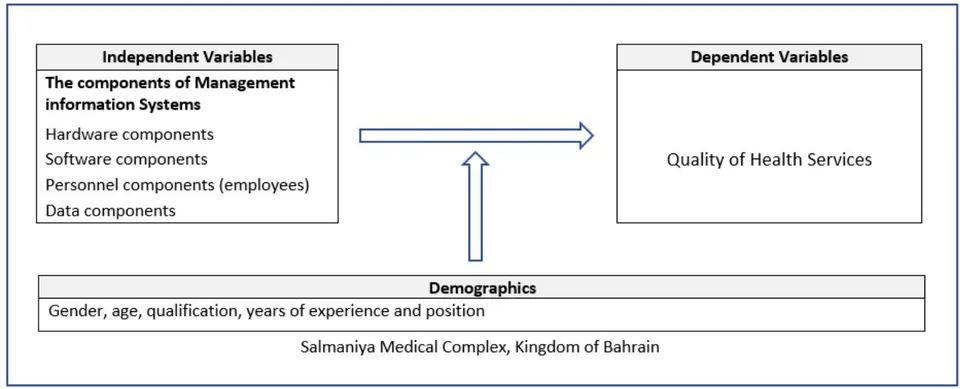
H1: There is a positive significant role for the components of management information system (Hardware, software, personnel and data components) in achieving the quality of health services at Salmaniya Medical Complex in the Kingdom of Bahrain.
Main hypothesis 2
H1: There are positive significant differences relating to the role of components of management information systems in achieving the quality of health services at Salmaniya Medical Complex inthe Kingdom of Bahrain due to the demographics (gender, age, qualification, years of experience and position).
c) Research Framework
IV. ANALYSIS AND EMPIRICAL FINDINGS
| Sr. | Statement | Mean | Standard Deviation | Ranking | Mean Interpretation |
| 1 | The hospital has modern and advanced hardware. | 2.28 | 0.751 | 5 | Neutral |
| 2 | The hardware is appropriate for the hospital work. | 3.32 | 0.778 | 3 | Neutral |
| 3 | The material requirements are characterized by flexibility speed in entering and processing data. | 3.31 | 0.784 | 4 | Neutral |
| 4 | Storage units have ability to store large amounts of data and information | 3.41 | 0.838 | 2 | Agree |
| 5 | The output units are distinguished by displaying the information clearly | 4.25 | 0.486 | 1 | Strongly agree |
| Average | 3.51 | 0.727 | Agree | ||
The general average of the variable (the components of the management information system, hardware dimension) reached (3.51), as shown in table
1, indicating that the research sample's opinions fell within this dimension
| Sr. | Statement | Mean | Standard Deviation | Ranking | Mean Interpretation |
| 1 | The software used can accomplish various hospital tasks accurately | 3.55 | 0.761 | 3 | Agree |
| 2 | The software is characterised by speed, accuracy and flexibility in analysing and processing data and converting it into information. | 3.51 | 0.975 | 4 | Agree |
| 3 | Software has the ability to flexibly exchange information between users. | 3.58 | 1.015 | 1 | Agree |
| 4 | The software is distinguished to keep pace with the change and development in the hospital's business | 3.56 | 0.763 | 2 | Agree |
| Average | 3.55 | 0.878 | Agree | ||
The general average of the variable (the components of management information systems, opinion of this dimension. software dimension) reached 3.55, as shown in table 2,
| Sr. | Statement | Mean | Standard Deviation | Ranking | Mean Interpretation |
| 1 | The workers have a high ability to deal with the available hardware and software | 3.35 | 0.746 | 4 | Neutral |
| 2 | The employees have administrative and technical expertise commensurate with the tasks assigned to them | 4.21 | 0.554 | 3 | Agree |
| 3 | The employees are characterised by adapting to the changes, developments, and work requirements | 4.23 | 0.5.9 | 2 | |
| 4 | Information system workers are specialist | 4.25 | 0.481 | 1 | |
| Average | 4.01 | 0.573 | Agree | ||
The general average of the variable (the components of management information systems, personnel dimension) reached 4.01, as shown in table
3, indicating that the research sample held high opinions regarding this dimension.
| Sr. | Statement | Mean | Standard Deviation | Ranking | Mean Interpretation |
| 1 | Data coordinates and speed up the hospital's administrations. | 4.21 | 0.536 | 4 | Strongly agree |
| 2 | Data helps to identify problem and find solutions to them. | 4.22 | 0.537 | 3 | Strongly Agree |
| 3 | The data is continuously updated | 4.24 | 0.503 | 1 | Strongly agree |
| 4 | Database presents duplication of stored data | 4.23 | 0.522 | 2 | Strongly agree |
| Average | 4.23 | 0.525 | Strongly agree | ||
The general average of the variable (the components of management information systems, data dimension) reached (4.23), indicating that the research sample's opinions on this dimension were high, as shown in Table 4.
| Sr. | Statement | Mean | Standard Deviation | Ranking | Mean Interpretation |
| 1 | The hospital has modern looking facilities. | 3.88 | 1.015 | 1 | Agree |
| 2 | The physical facilities look attractive. | 3.28 | 0.786 | 4 | Neutral |
| 3 | The staff has elegant appearance. | 3.83 | 0.450 | 2 | Agree |
| 4 | The articles related to the health service are attractive. | 3.42 | 0.529 | 3 | Agree |
| Average | 3.60 | 0.695 | Agree | ||
Table 5 showed that the general average of the variable (quality of health services, tangible dimension) reached (3.60) which demonstrated that the research sample held high opinions regarding this aspect.
| Sr. | Statement | Mean | Standard Deviation | Ranking | Mean Interpretation |
| 1 | Rapid response to provide service to patients and reviews when they need it. | 3.29 | 0.779 | 3 | Neutral |
| 2 | Staff give clear and understandable information to patients and reviewers. | 4.25 | 0.544 | 1 | Strongly Agree |
| 3 | The hospital management provides good communication and right service the first time | 3.23 | 0.922 | 4 | Neutral |
| 4 | Employees interested in responding to patients' and auditors' request continuously | 4.22 | 0.538 | 2 | Strongly agree |
| Average | 3.75 | 0.696 | Agree | ||
The general average of the variable (quality of health services, responsiveness dimensions) reached
(3.75), indicating that the research sample's opinions on this dimension were high, as shown in Table 6.
| Sr. | Statement | Mean | Standard Deviation | Ranking | Mean Interpretation |
| 1 | When the hospital promises to do something at a certain time, it will stick to it. | 3.13 | 0.810 | 2 | Neutral |
| 2 | The hospital provides timely services | 2.94 | 0.651 | 5 | Neutral |
| 3 | The hospital is providing service correctly from the first time. | 2.96 | 0.621 | 4 | Neutral |
| 4 | The Hospital maintains error-free records. | 3.03 | 0.646 | 3 | Neutral |
| 5 | The hospital seeks to solve problems of patients and auditors. | 3.38 | 0.759 | 1 | Neutral |
| Average | 3.09 | 0.097 | Neutral | ||
The general average of the variable (quality of health services, reliability dimension) reached 3.09 in
Table 7, indicating that the research sample's opinions were moderate in this regard.
| Sr. | Statement | Mean | Standard Deviation | Ranking | Mean Interpretation |
| 1 | Staff behaviour enhances confidence for patients and auditors. | 3.97 | 0.595 | 1 | Agree |
| 2 | Patients feel safe when dealing with employees. | 3.80 | 0.417 | 3 | Agree |
| 3 | The staff is always kind and patients. | 3.04 | 0.619 | 4 | Neutral |
| 4 | Staff has the knowledge to answer questions from patients and reviewers. | 3.91 | 0.629 | 2 | Agree |
| Average | 3.68 | 0.565 | Agree | ||
Table 8 indicated that the general average of the variable (assurance dimension, quality of health services) reached 3.68, indicating that the research sample's opinions were high on this dimension.
| Sr. | Statement | Mean | Standard Deviation | Ranking | Mean Interpretation |
| 1 | Staff provide personal attention to patients. | 4.13 | 0.639 | 5 | Agree |
| 2 | The patients' management pays attention to patients. | 4.16 | 0.619 | 3 | Agree |
| 3 | Staff understand the special needs of patients. | 4.18 | 0.608 | 1 | Agree |
| 4 | Staff working hours are decided according to the patients' needs. | 4.15 | 0.627 | 4 | Agree |
| 5 | The interests of the patients are important to the hospital | 4.17 | 0.605 | 2 | Agree |
| Average | 4.16 | 0.620 | Agree | ||
The general variable (empathy dimension, quality of health services) reached 4.14 in Table 9, indicating that the research sample's opinions were high on this dimension.
a) Testing Research Hypothesis
To make sure that the main hypothesis (1) is correct," there is a positive significant role for the components of the management information systems, hardware, software, personnel and data components in achieving the quality of health services at Salmaniya Medical complex in Kingdom of Bahrain, multiple linear regression analysis was used where the results showed the following:
| The components of management information systems | Correlation co-efficient with the quality of health services | Significance |
| Hardware | 0.856 | 0.00 |
| Software | 0.780 | 0.00 |
| Personnel | 0.533 | 0.00 |
| Data | 0.297 | 0.00 |
The results shown in table 10 indicate that the primary hypothesis (1) is true. Additionally, the findings of the second main hypothesis state that "due to the demographics (gender, age, qualification, years of experience, and position), there are positive significant differences relating to the role of the components of management information systems in achieving the quality of health services at Salmaniya Medical Complex in the kingdom of Bahrain." They showed that there were no significant differences in the demographics (gender, age, qualifications, number of years in the job, and position).
V. CONCLUDING COMMENTS
- There was a positive significant role for the components of management information systems (Hardware, software, personnel, and data components) in achieving the quality of health services at Salmaniya Medical Complex in the Kingdom of Bahrain.
- There were no significant differences relating to the role of the components of management information systems in question, in achieving the quality of health services at the complex in question due to demographics (gender, age, qualification, years of experience and position).
The following recommendations were made in light of the drawn conclusions:
- The necessity of providing adequately qualified human resources that have experience in their field of work because of their effective role in achieving the quality of health services in Salmaniya Medical Complex in the Kingdom of Bahrain.
- The necessity for the management of the medical complex in question to hold training courses for employees in the MIS units to develop their capabilities and skills to enable them to deal with the materials supplies and advanced software.
- The necessity of encouraging employees in the medical complex in question to use management information systems, identify their needs, and work to solve the problems they face when using them.
- The necessity of raising the level of commitment of the medical complex in question management to the standards of health service quality.
- The necessity of providing long-term plans in the medical complex in question to improve the quality of the health service provided.