I. INTRODUCTION
Since gaining its independence in 1966, Botswana has enjoyed four decades of economic growth and rapid development which came with both positive and negative impacts. As for positive impacts, the investment in the mineral sector has made the country rapidly self-supporting. But Botswana's development has brought corruption and economic crime due to an increase in government budget and the expansion of public service. As we know any country, organization, enterprises even developed can't prosper if it is badly managed. Conscious of this threat that can mess the country's reputation, many resolutions have been taken by Botswana's government consequence of an establishment of a dedicated anti-corruption agency, the Directorate on Corruption and Economic Crime (DCEC) to which was given special powers of investigation, arrest, search and seizure. This agency which has its headquarters in Gaborone and an office in Francistown with 100 officer's combats both corruption and economic crime. According to DCEC, by the end of 1999, the anti-corruption had received 5250 from which 1565 cases were investigated, 1018 of which have been completed and 197 persons have been prosecuted. Measures have also been taken by government to educate the population especially young people about the knowledge of right and wrong and the values of ethics. In this approach Botswana's first superhero, Rre Boammaruri (Mr. Honesty) with its character can be seen in public functions and at school has been introduced to the public. On the program anti-corruption, many seminars have been held in purpose of prevention and reduction of corruption opportunities. The establishment of the DCEC has enabled the country to be among the ranks of the least corrupt country in sub-Saharan Africa. According to the corruption watchdog, Transparency International. This reflects how control of corruption in Botswana is very good. Control of corruption is perceived to have a positive effect on economic development. Previous studies were mostly conducted on the impact of corruption on economic growth and came out with results that corruption has a negative relationship with economic which is true because the effects of corruption are visible in our daily life (poor infrastructure, slow growth, increase in poverty) even if some of the studies were not conclusive. The focus of this paper is to examine whether the control of corruption in Botswana can impact the economic growth. In addition to that, the aim of this paper is also to investigate if there is a positive and significant relationship between control of corruption and economic growth in Botswana. This article is organized as follows: following the introduction in section I, is section II, reviewing relevant literatures used. Objectives of study in section III. Rational of study, methodology in section IV and V. The empirical model, occupies section VI. Section VII discusses the results, while section VIII concludes the study.
II. REVIEW OF LITERATURE
In this section, we shall discuss some previous studies related to impact of control of corruption on economic growth as well on economic development in general. The research conducted by Beekman et. al (2014) by analyzing on how corruption affects investments and its contributions to public goods in Liberia based on experimental and survey data collected in November and December 2010, employing subsample of 20-30 household found that corrupt leaders reduce investment incentives. He also found that corruption undermines incentives to create goods or services. Finally, they argued that the impact of corruption is heterogeneous. Ju Huang (2015) by investigating on the impact of corruption on economic growth in 13 Asian countries covering the period of 1997-2013 by using panel granger causality approach found a positive and significant relationship running from corruption to economic growth, while and significant relationship between corruption and economic growth in China. He also found that there is not significant causality between corruption and economic in the rest of countries. He argued that he doesn't support the general opinion on the perception of corruption as bad factor for economic growth for this study sample. Finally, he said that an increase in economic growth in China will lead an increasing corruption level. Aidt et.al (2007) by investigating theoretically and empirically on the relation between regimes, corruption and growth in two governance regimes defined by the quality of political institutions found that corruption have a negation impact on growth in the regime with high quality of political institutions however in the regime with low quality institutions, corruption has no effect on economic growth. Blackburn (2005) by examining the incidence and persistence of corruption in economic development among bureaucrats predicted a negative relationship between corruption and development. Beekman et. al (2013) by investigating on how corruption impacts the economic activities in Liberia found that corrupt leadership cause reduction income source of generating activities. Saha and Gounder (2012) by investigating the relationship between corruption and economic development found a negative income corruption. He also found that good stage of development reduces corruption level substantially. Finally, he suggested the combination of economic and social policies can reduce or lower the impact of corruption on society, economic and development. Abdul Farooq et.al (2013) by examining the impact of corruption on economic growth in Pakistan covering the period of 1987-2009 by applying break unit root test and structural break co integration found that corruption impedes economy growth. He also found feedback effect between corruption and economic. Dzhumashev (2014)by examining how governance quality, the size of public spending and economic development impact the relationship bureaucratic corruption and economic growth found that the incidence of corruption decline with economic development. Lash (2004) by investigating on corruption consequences and causes found that corruption can affect negatively economy efficiency, capital formation as well the economic growth. Popova and Podolyakina (2013) by examining the impact of corruption on social system and economic growth found that there is statistical dependency between the corruption level and factors of social system. He also found that the countries with different social model present different dependence between corruption and other factors of social systems. Kunieda et. al (2014) by investigating both theoretically and empirically, how the negative effect of government corruption on economic growth found that government corruption has negative and significant impact on economic growth. Ulman (2013) by examining the impact of corruption on national competitiveness found a positive relation between these two variables. In another terms corruption influence, significantly the competitiveness of a country. Kennedy (1997) by investigating the impact of corruption on economy growth in transitions economy found the impact of corruption on growth depends on surrounding environment and corruption often hobbled entrepreneurship. However, corruption has ameliorated less-than-ideal circumstances. Seyf (2001) by examining the relationship between corruption and economic development found that corruption may boost efficiency. He also argues that high level of corruption may advantage powerful individuals with low efficiency and waste of resources at macro-economic level as consequences. Egiegba Agbiboa (2013) by examining the socio-economic aspects of corruption in Nigeria found that there is no solution to the problem of corruption and economic crime in Nigeria. He also argued that corruption can be significantly decreased if more radical policies such as: tax on an unaccountable wealth is adopted by developing countries. King et.al (2004) by investigating on the impacts of corruption on economic development on the Baltic littoral found that the country with poor level of economy is affected more by corruption. He argued also that it is important to fight against corruption in the Baltic States by improving policies against illegal use of individual or organizational power. Publicize cases of corruption and legal sanctions must be taken. Emm Halkos and Tzeremes (2010) by examining impact of corruption on economy efficiency in 79 countries using panel data covering the period of 2000 to 2006 found that corruption have negative impact on countries economic efficiency. Breslin and Samanta (2008) by examining the nature of relationship between level of corruption and investment decisions for developing countries found that corruption affected seriously the inflow of FDI as well the economic growth of developing countries.
III. OBJECTIVES
Following the corruption scandals during the 1990s which involves the country of misuse of public money or an abuse of power in several high-ranking government leaders, Botswana has made many efforts the management of corruption by keeping control and reducing its level. The objective of this study is to examine whether the control of corruption in Botswana can impact the economic growth. In addition to that, the aim of this paper is also to investigate if there is a positive and significant relationship between control of corruption and economic growth in Botswana.
IV. RATIONALE OF THE STUDY
The rationale behind of this study is contributed due to the fact previous studies were mostly conducted on corruption and economy development in general with a qualitative approach and several of the studies on corruption and economic growth. This study will be the first quantitative approach using control of corruption to examine its impact on economic growth.
V. METHODOLOGY, DATA SOURCE, AND SAMPLE FRAME
In this section, we present the methodology used in our study. The paper used secondary time series data covering the period 1996-2014 in Botswana. The data were collected from World Bank. Three variables are employed in our model such as: Control of corruption, government effectiveness and exports in goods and services. The variables control of corruption and government effectiveness, were collected from worldwide governance indicators available at: www.govindicators.org. The export of goods and services was collected from world development indicators database with the source from World Bank National Accounts data, and OECD National Accounts data files. This paper used vector auto regression model (VAR) to investigate the effect of control of corruption on economic growth of Botswana. Preliminary times series unit root test by using Augmented Dickey-Fuller(Dickey and Fuller, 1981), Phillips and Perron) were conducted to check if our variables are stationary or not. Cointegration approach was conducted to examine whether control of corruption, government effectiveness, exports have long relationship preceded by the running of unrestricted VAR following the selection of lag length. Granger causality was employed for testing causality between control of corruption and the rest of remaining variables in our model. In addition to that,the stability test was conducted to evaluate our model.
VI. EMPIRICAL MODEL
The specification of the model for our study is as follows:
The model employed includes:
Where:
GR= Gross Domestic Product (%) is measured by real GDP annual growth
CC= Control of corruption is measured by the index of corruption estimate rating from -2.5 to 2.5
GE= Government effectiveness is measured by the index of government effectiveness estimate rating from -2.5 to 2.5
EGS= Exports in goods and services (% of GDP)
Error term
coefficient
Economic growth can be defined as an increase in the capacity of an economy to produce goods and services over one year is very important in judgment by economists to see whether the country is growing or not. A lot of factors can impact the economic growth, but our study we used three variables such as: control of corruption, government effectiveness, and export of goods and services. Control of corruption is crucial for economic growth. As we know is one of the major obstacle to development, its effects on development are disastrous. Corruption leads to high investment cost and low profits of government as well foreign investors. In another term, corruption discourages investments which in turn negatively affect the economic growth. The control of corruption which leads to the better management of public budget with consequences such as: good services to the population, reduction of inequalities, encouragement investors and developing partners is very crucial for sustainable economic growth. Because Botswana has a good internationally reputation for control of corruption, we expected a positive and significant relationship between economic growth and control of corruption. Government effectiveness as well anti-corruption is important for economic growth. Two decades ago developing partners, donors do not hesitate to provide help to the governments despite the bad governance (case of Mobutu in Zaire, current Democratic of Congo), now everything have been changed. The priority now to an effective governance and low level of corruption determinant for aid effectiveness, an increase in foreign direct investment inflows which in turn will boost the economic growth of the country. We expected positive and significantly relationship between government effectiveness and economic growth. Export plays a crucial role in the economy. Export is a source of development, a source of improvement of a country reputation as well a business boost. In another term export stimulate economy and ensure the country business sustainability in the context of globalization with a great impact on economic growth. We expected a positive and significant relationship between exports and economic growth.
Cointegration Test
VII. RESULTS AND DISCUSSIONS
The table 1 and the table 2 present respectively the test results for ADF and PP which indicate that the variables which are non-stationary in level become stationary in first difference. The results of unit roots test are done to avoid spurious regression. The first difference in the case of ADF for the variables economic growth, control of corruption, government effectiveness and export in goods and services become stationary by the inclusion of time intercept.
| At Level | First Difference | Remarks | |||
| Variables | t. stat | Prob | t. stat | Prob.* | |
| GR | -4.772340 | 0.0016 | -7.099262 | 0.0000*** | Intercept |
| CC | -1.975335 | 0.2936 | -8.257354 | 0.0000** | Intercept |
| GE | 0.646706 | 0.8362 | -4.552374 | 0.0027* | Intercept |
| EGS | -2.367877 | 0.1637 | -5.426858 | 0.0005*** | Intercept |
| At Level | First Difference | Remarks | |||
| Variables | t. stat | Prob | t. stat | Prob.* | |
| GR | -4.829166 | 0.0014 | -15.37356 | 0.0000*** | Intercept |
| CC | -2.998796 | 0.0541 | -8.318518 | 0.0000** | Intercept |
| GE | 0.756443 | 0.8073 | -4.529402 | 0.0028* | Intercept |
| EGS | -2.320355 | 0.1765 | -5.426858 | 0.0005*** | Intercept |
According to Johansen (1991), the co integration is employing to check whether there exists a long run relationship between our variables. The result of co integration (trace and Maximum-Eigen value) is also reported in our analysis.
| Hypothesized No. of CE(s) | Eigenvalue | Trace Statistics | 0.05 Critical Value | Prob.** |
| None* | 0.693060 | 39.49326 | 47.85613 | 0.2411 |
| At most 1 | 0.540234 | 19.41453 | 29.79707 | 0.4634 |
| At most 2 | 0.251967 | 6.204907 | 15.49471 | 0.6713 |
| At most 3 | 0.071965 | 1.269667 | 3.841466 | 0.2598 |
hypothesis at the 0.05 level, Source: Prepared by the authors, based on Eview 8 Table 4: Johansen test for cointegration for unrestricted Cointegration Rank Test (Maximum Eigenvalue)
| Hypothesized No. of CE(s) | Eigenvalue | Max-Eigen Statistics | 0.05 Critical Value | Prob.** |
| None* | 0.693060 | 20.07873 | 27.58434 | 0.3357 |
| At most 1 | 0.540234 | 13.20962 | 21.13162 | 0.4332 |
| At most 2 | 0.251967 | 4.935241 | 14.26460 | 0.7500 |
| At most 3 | 0.071965 | 1.269667 | 3.841466 | 0.2598 |
The table 3 and 4 show the result of a co-integration test. The estimated Eigenvalue, trace statistics, the critical value and the probability. The results of Johansen test for co integration for unrestricted Co integration Rank Test (Trace) indicates no co-integration in our model. The trace statistics is (39.49326) less than the critical value (47.85613) at 5% level means that the GDP growth, control of corruption, exports and the government's effectiveness are not co-integrated. Therefore, VAR is used to estimate our results. Before running the vector auto-regression, the granger causality test was performed.
| Null Hypothesis | F-Statistics | P-value. |
| GE does not Granger Cause GR | 1.42467 | 0.2785 |
| GR does not Granger Cause GE | 0.25076 | 0.7822 |
| EGS does not Granger Cause GR | 0.31568 | 0.7352 |
| GR does not Granger Cause EGS | 0.81346 | 0.4663 |
| CC does not Granger Cause GR | 0.66605 | 0.5317 |
| GR does not Granger Cause CC | 0.99088 | 0.3997 |
Table 5 presented the results of Granger causality test. This test is conducted if there is short-run relationship between control of corruption and economic growth. Our results showed that the p-value is greater than 5% means that the control of corruption, the exports, government effectiveness does not granger economic growth. We concluded that there is no short-run causality running from these variables to gross to economic growth.
| Variable | Coefficient | Std. Error | t-Stat | Prob. |
| CC | 4.501561 | 4.368181 | 1.030534 | 0.3181 |
| GE | -21.74931 | 9.451376 | -2.301179 | 0.0352 |
| EGS | 0.246325 | 0.080233 | 3.070110 | 0.0073 |
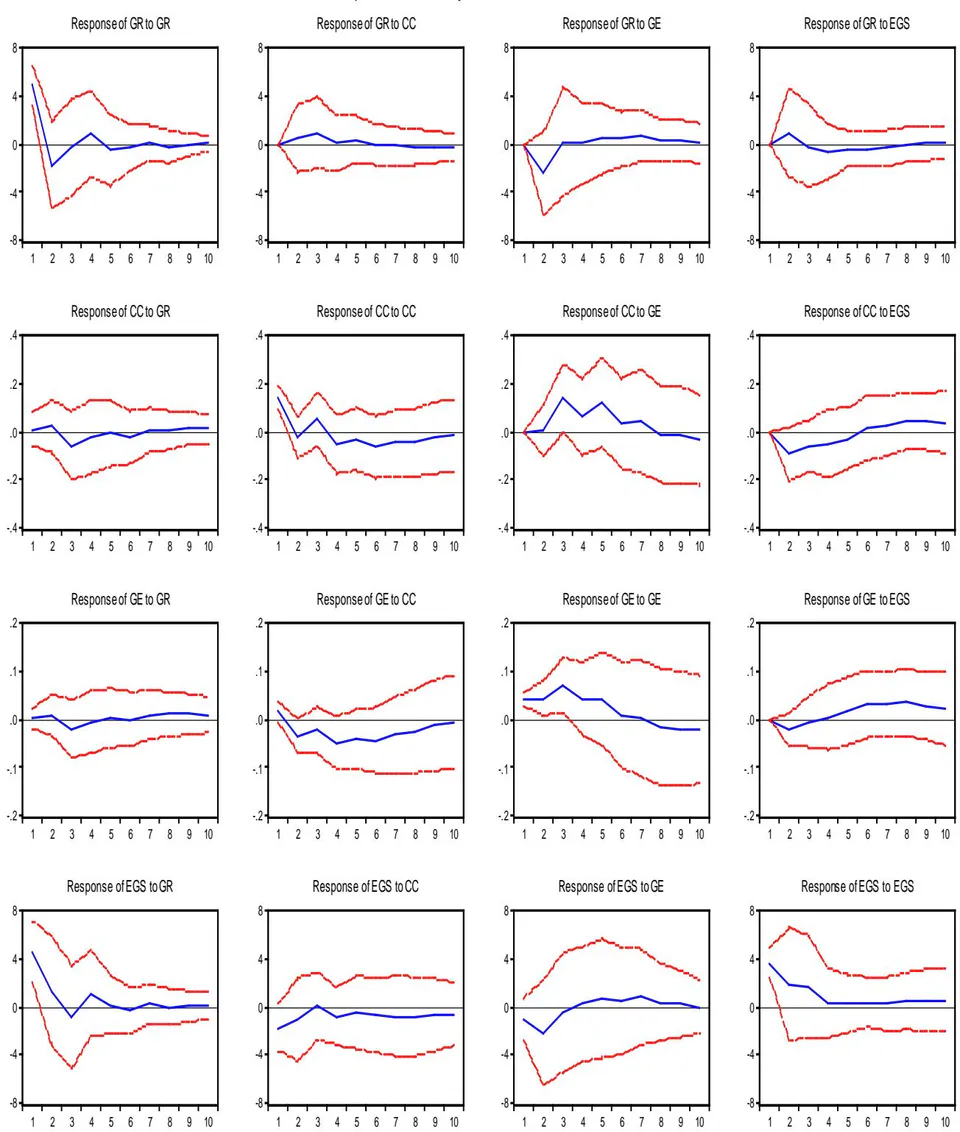
The co integration results allowed us to run our regression based on vector auto regression model (VAR). The results summarized in table 6 generating using OLS method showed that government effectiveness and export in goods and services are statically significant respectively at 5 and 10% level and have a positive relationship with economic growth. However, the control of corruption is not statically significant but has a positive relationship with the economic growth. This result confirmed the speech of Lot Moroka, regional Magistrate speech (Friday 18 March 2016, 16:26 pm, Mmegi news) said that: Botswana loses P1 billions to corruption every year due to the cases of corruption and economic crimes. A large amount of money which can be used create business, build schools and hospitals and improve public services. We conclude that the control of corruption in Botswana still not yet so effective to impact significantly the economic growth. The government must continue to keep fighting against corruption as a priority in its agenda. To strength, the direction relation between economic growth, control of corruption, export in goods and services, and the impulse response test was conducted. The figure 1 showed the results obtained from impulse responses from dependent variables to dependent variables over 10 years fora long run and 5 years for short -run. In the short -run, the impulse response of economic growth to control of corruption is positive before dying off in the long run. The impulse responses economic growth to government effectiveness is negative in short- run and started slightly to improve and become positive in the long run. The impulse response of economic growth to export in goods and services is positive and decline in short-run and continue to decline in long run before to die positively. The existence of co integration coming does not unavoidably denote that the estimated coefficients are stable. To ascertain the evaluation of our model, the stability test was conducted. The stability of the model control of control of corruption and economic growth indicates that our model is stable since no root lies outside the range of the conditions. The recursive residual test satisfies the stability test at 5% significance level.
VIII. CONCLUSION AND MANAGERIAL IMPLICATIONS AND FUTURE RESEARCH
To investigate the impact of control of corruption on economic growth of Botswana, the vector auto regression model (VAR) was employed. Government effectiveness, exports of goods and services were found to be positively significant and impact the economic growth of the country. However, control of corruption is not significant but affects positively the economic growth. For a sustainable economic growth, the fight against corruption must remain a priority in government agenda important for country attractiveness. A Lot of efforts must be conducted towards economy diversification as well its growth in purpose to help people to move out the poverty. We suggest further study to be conducted on political stability, control of corruption and economic development as well on how does control of corruption affect the economic growth and Human Development in the least Corrupt African Countries. Most African countries have a lot of mineral resources, but those resources have been factors of corruption which lead to violence, civil wars, Democratic Republic of Congo and Liberia). An investigation in this area can help African countries who are suffering for political instability such as: Sudan, Uganda and Central African Republic to use control of corruption asa toolto enjoy political stability and economic development.
APPENDICES
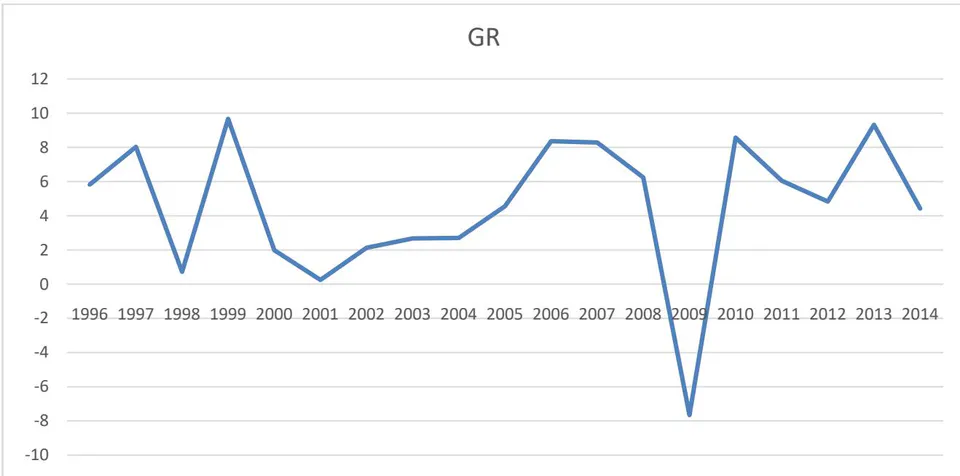
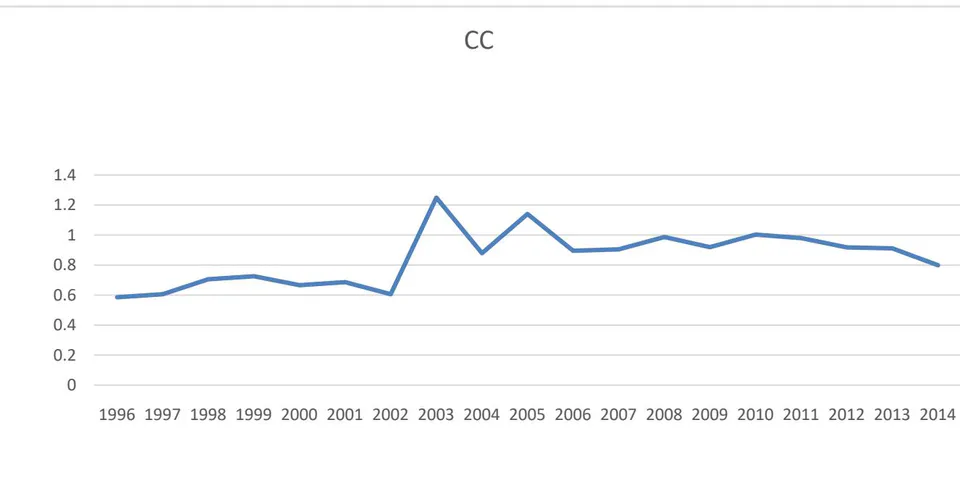
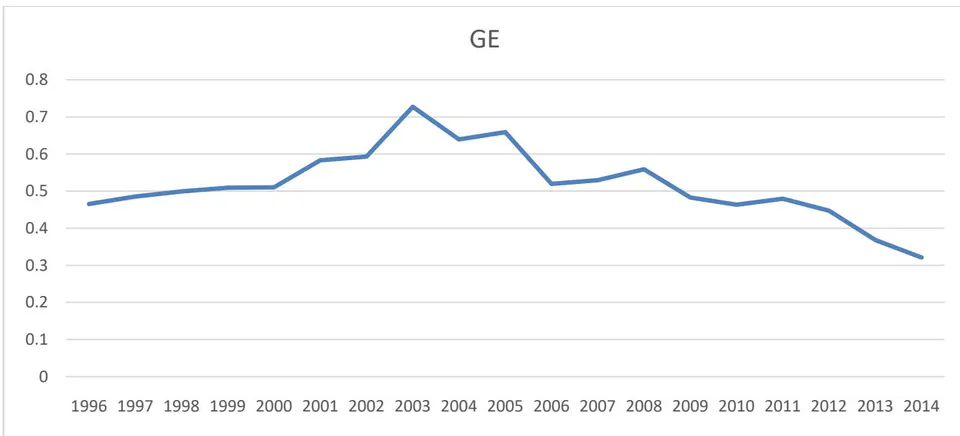
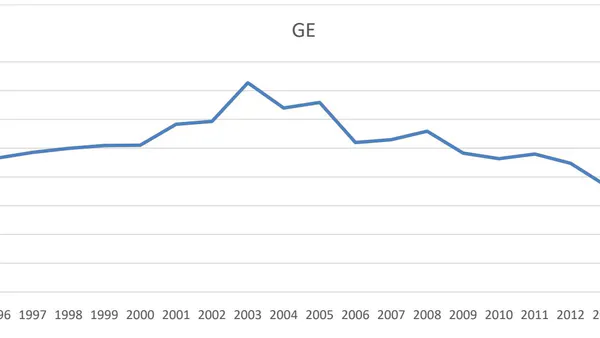
Figure 3: Evolution of Government Effectiveness in Botswana (rating from -2.5 to 2.5)
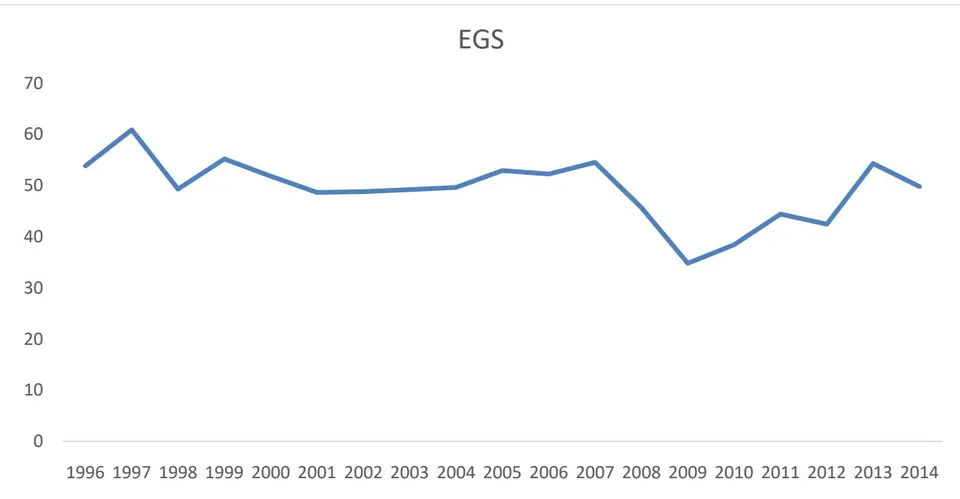
The figures 1, 2, 3 and 4 respectively represent the evolution of economic growth, control of corruption, government effectiveness, exports in goods and services based on the data collected in 1994-2014 from World Bank. According to the figure 1, The lowest value of economic growth was observed in 2009 with a value of -7.65 of GDP and the highest value was observed in 1999. The control of corruption increases progressively since 1990 to reach the highest value in 2003 and slightly decreases in 2004 before continuing to keep it steady movement till now (figure 2). The figure 3 present the tendency of government effectiveness, the highest value was observed in 2003. Figure 4 show the trend of export and goods and services which started with increase. the highest value was observed in 1997 and the lowest in 2009 before recover slightly in 2014.