

Neural Networks and Rules-based Systems used to Find Rational and Scientific Correlations between being Here and Now with Afterlife Conditions
Neural Networks and Rules-based Systems used to Find Rational and

To: Author
Article Fingerprint
ReserarchID
9277I
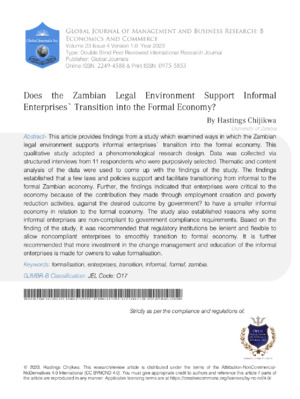
This article provides findings from a study which examined ways in which the Zambian legal environment supports informal enterprises` transition into the formal economy. This qualitative study adopted a phenomenological research design. Data was collected via structured interviews from 11 respondents who were purposively selected. Thematic and content analysis of the data were used to come up with the findings of the study. The findings established that a few laws and policies support and facilitate transitioning from informal to the formal Zambian economy. Further, the findings indicated that enterprises were critical to the economy because of the contribution they made through employment creation and poverty reduction activities, against the desired outcome by government? to have a smaller informal economy in relation to the formal economy. The study also established reasons why some informal enterprises are non-compliant to government compliance requirements. Based on the finding of the study, it was recommended that regulatory institutions be lenient and flexible to allow noncompliant enterprises to smoothly transition to formal economy. It is further recommended that more investment in the change management and education of the informal enterprises is made for owners to value formalisation.
Hastings Chijikwa. 2026. \u201cDoes the Zambian Legal Environment Support Informal Enterprises` Transition into the Formal Economy?\u201d. Global Journal of Management and Business Research - B: Economic & Commerce GJMBR-B Volume 23 (GJMBR Volume 23 Issue B4): .
Crossref Journal DOI 10.17406/GJMBR
Print ISSN 0975-5853
e-ISSN 2249-4588
The methods for personal identification and authentication are no exception.
Total Score: 101
Country: Zambia
Subject: Global Journal of Management and Business Research - B: Economic & Commerce
Authors: Hastings Chijikwa (PhD/Dr. count: 0)
View Count (all-time): 165
Total Views (Real + Logic): 1259
Total Downloads (simulated): 31
Publish Date: 2026 01, Fri
Monthly Totals (Real + Logic):
Neural Networks and Rules-based Systems used to Find Rational and
A Comparative Study of the Effeect of Promotion on Employee
The Problem Managing Bicycling Mobility in Latin American Cities: Ciclovias
Impact of Capillarity-Induced Rising Damp on the Energy Performance of
This article provides findings from a study which examined ways in which the Zambian legal environment supports informal enterprises` transition into the formal economy. This qualitative study adopted a phenomenological research design. Data was collected via structured interviews from 11 respondents who were purposively selected. Thematic and content analysis of the data were used to come up with the findings of the study. The findings established that a few laws and policies support and facilitate transitioning from informal to the formal Zambian economy. Further, the findings indicated that enterprises were critical to the economy because of the contribution they made through employment creation and poverty reduction activities, against the desired outcome by government? to have a smaller informal economy in relation to the formal economy. The study also established reasons why some informal enterprises are non-compliant to government compliance requirements. Based on the finding of the study, it was recommended that regulatory institutions be lenient and flexible to allow noncompliant enterprises to smoothly transition to formal economy. It is further recommended that more investment in the change management and education of the informal enterprises is made for owners to value formalisation.
We are currently updating this article page for a better experience.

Lorem ipsum dolor sit amet, consectetur adipiscing elit. Ut elit tellus, luctus nec ullamcorper mattis, pulvinar dapibus leo.






























































