Domestic or Foreign Debt? A Choice of no Wrong Selection

α
David Owuor
David Owuor

Send Message

To: Author

Domestic or Foreign Debt? A Choice of no Wrong Selection

Article Fingerprint

ReserarchID

NO6IT

Domestic or Foreign Debt? A Choice of no Wrong Selection Banner

AI TAKEAWAY

Connecting with the Eternal Ground
  • English
  • Afrikaans
  • Albanian
  • Amharic
  • Arabic
  • Armenian
  • Azerbaijani
  • Basque
  • Belarusian
  • Bengali
  • Bosnian
  • Bulgarian
  • Catalan
  • Cebuano
  • Chichewa
  • Chinese (Simplified)
  • Chinese (Traditional)
  • Corsican
  • Croatian
  • Czech
  • Danish
  • Dutch
  • Esperanto
  • Estonian
  • Filipino
  • Finnish
  • French
  • Frisian
  • Galician
  • Georgian
  • German
  • Greek
  • Gujarati
  • Haitian Creole
  • Hausa
  • Hawaiian
  • Hebrew
  • Hindi
  • Hmong
  • Hungarian
  • Icelandic
  • Igbo
  • Indonesian
  • Irish
  • Italian
  • Japanese
  • Javanese
  • Kannada
  • Kazakh
  • Khmer
  • Korean
  • Kurdish (Kurmanji)
  • Kyrgyz
  • Lao
  • Latin
  • Latvian
  • Lithuanian
  • Luxembourgish
  • Macedonian
  • Malagasy
  • Malay
  • Malayalam
  • Maltese
  • Maori
  • Marathi
  • Mongolian
  • Myanmar (Burmese)
  • Nepali
  • Norwegian
  • Pashto
  • Persian
  • Polish
  • Portuguese
  • Punjabi
  • Romanian
  • Russian
  • Samoan
  • Scots Gaelic
  • Serbian
  • Sesotho
  • Shona
  • Sindhi
  • Sinhala
  • Slovak
  • Slovenian
  • Somali
  • Spanish
  • Sundanese
  • Swahili
  • Swedish
  • Tajik
  • Tamil
  • Telugu
  • Thai
  • Turkish
  • Ukrainian
  • Urdu
  • Uzbek
  • Vietnamese
  • Welsh
  • Xhosa
  • Yiddish
  • Yoruba
  • Zulu

Abstract

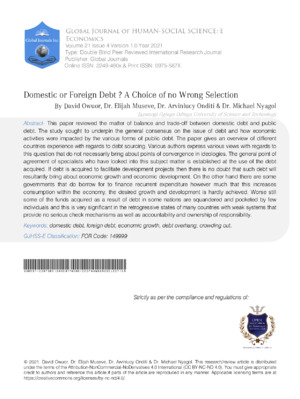
This paper reviewed the matter of balance and trade-off between domestic debt and public debt. The study sought to underpin the general consensus on the issue of debt and how economic activities were impacted by the various forms of public debt. The paper gives an overview of different countries experience with regards to debt sourcing. Various authors express various views with regards to this question that do not necessarily bring about points of convergence in ideologies. The general point of agreement of specialists who have looked into this subject matter is established at the use of the debt acquired. If debt is acquired to facilitate development projects then there is no doubt that such debt will resultantly bring about economic growth and economic development. On the other hand there are some governments that do borrow for to finance recurrent expenditure however much that this increases consumption within the economy, the desired growth and development is hardly achieved. Worse still some of the funds acquired as a result of debt in some nations are squandered and pocketed by few individuals and this is very significant in the retrogressive states of many countries with weak systems that provide no serious check mechanisms as well as accountability and ownership of responsibility.

References

42 Cites in Article
  1. M Abbas (2010). The Role of Domestic Debt Markets in Economic Growth: An empirical investigation for low-income countries and emerging markets.
  2. A Addison (1995). Economic Progress and Policy in Developing Countries.
  3. M Adofu & Abula (2010). 2. Adjusting to Slower Economic Growth: The Domestic Economy.
  4. P Aghion,S Durlauf (2007). Handbook of Economic Growth.
  5. Allen And Unwin,N Mankiw,D Elmendorf (1999). Government Debt. Handbook of Macroeconomics.
  6. W Ashraf,J Akhtar,H.-U Rehman,G Awan (2020). Impact of external Debt on Poverty in Pakistan.
  7. M Babatunde,R Adefabi (2005). Long run relationship between education and Economic Growth in Nigeria: Evidence from the Johansens Cointegration Approach.
  8. J Barro (1991). Economic Growth in a Cross Section of Countries.
  9. Sani Bawa,Ismaila S. Abdullahi,Danlami Tukur,Sani I. Barda,Yusuf J. Adams (2010). Asymmetric Impact of Oil Price on Inflation in Nigeria.
  10. M Benli (2020). External Debt Burden and Infrastructural Development Nexus In NIGERIA: An Ardl Approach(1981-2020).
  11. E Borensztein (1995). Debt overhang, debt reduction and investment: The case of Philippines.
  12. C Burnside,D Dollar (2000). Aid Policies and Growth.
  13. R Chandra,N Perera (2009). Foreign Debt, Trade Openness, Labor Force and Economic Growth: Evidence from Sri Lanka' Sydney Business School -Papers.
  14. P Chauhan,A Sabale,Y Yeole (2020). Impact of External Debt on the Economy of India.
  15. R Chowdhury (2001). Realigning the global debt architecture to work for developing countries.
  16. Stijn Claessens (1996). The debt laffer curve: Some estimates.
  17. E Clements (2003). External debt, public investment and growth in low-income countries.
  18. D Cohen (1993). Low investment and large debt in the 1980s.
  19. Paul Collier,Jan Gunning (1999). Explaining African Economic Performance.
  20. T Cunningham (1993). The effects of debt burden on economic growth in heavily indebted nations.
  21. J Eaton (1993). Sovereign Debt: A Primer.
  22. A Elbadawi (1996). Debt overhang and economic growth in Sub-Saharan Africa.
  23. J Ekpe (2020). Impact of external debt on economic growth in Nigeria.
  24. A Fosu (1999). External debt burden and economic growth in the 1980s: Evidence from SubSaharan Africa.
  25. G Goŕniewicz (2018). POLISH EXTERNAL DEBT.
  26. A Hadzǐahmetovic,J Huric-Bjelan (2020). External Debt in Bosnia and Herzegovina-An Empirical Analysis.
  27. R Harrod (1939). An Essay in Dynamic Theory.
  28. T Ibrahim,A Farah (2020). External Debt Stock and Economic Growth in Somalia (1990-2016.
  29. Erdal Karagol (2002). THE RELATIONSHIP BETWEEN EXTERNAL DEBT, DEFENCE EXPENDITURES AND GNP REVISITED: THE CASE OF TURKEY.
  30. T Karimanzira,T Maradze,T Nyoni,S Nyoni (2020). The Impact of external Debt on Poverty in Zimbabwe.
  31. Mohsin Khan,Manmohan Kumar (1997). Public and Private Investment and The Growth Process in Developing Countries.
  32. Thomas Klein (1994). External debt management.
  33. K Krumm (1985). The External Debt of Sub-Saharan Africa.
  34. H Lutkepohl (2005). New Introduction to Multiple Time Series Analysis.
  35. Tilak Mahara,Sabina Dhakal (2020). Macroeconomic determinants of external debt in Nepal: The ARDL Approach.
  36. F Modigliani,H Miller (1958). The Cost of Capital, Corporation Finance and the Theory of Investment.
  37. Carmen Reinhart,Kenneth Rogoff (2009). The Aftermath of Financial Crises.
  38. J Sachs (1989). External debt, structural adjustment and economic growth.
  39. A Schclarek (2004). Debt and Economic Growth in Developing Industrial Countries.
  40. Robert Solow (1956). A Contribution to the Theory of Economic Growth.
  41. J Soren (1995). Likelihood-Based Inference in Cointegrated Vector Autoregressive Models.
  42. P Krugman (1988). Financing versus forgiving debt overhang.

Funding

No external funding was declared for this work.

Conflict of Interest

The authors declare no conflict of interest.

Ethical Approval

No ethics committee approval was required for this article type.

Data Availability

Not applicable for this article.

How to Cite This Article

David Owuor. 2021. \u201cDomestic or Foreign Debt? A Choice of no Wrong Selection\u201d. Global Journal of Human-Social Science - E: Economics GJHSS-E Volume 21 (GJHSS Volume 21 Issue E4): .

Download Citation

Smart trade policies for economic growth.
Issue Cover
GJHSS Volume 21 Issue E4
Pg. 43- 49
Journal Specifications

Crossref Journal DOI 10.17406/GJHSS

Print ISSN 0975-587X

e-ISSN 2249-460X

Keywords
Classification
GJHSS-E Classification: FOR Code: 149999
Version of record

v1.2

Issue date

August 24, 2021

Language
en
Experiance in AR

Explore published articles in an immersive Augmented Reality environment. Our platform converts research papers into interactive 3D books, allowing readers to view and interact with content using AR and VR compatible devices.

Read in 3D

Your published article is automatically converted into a realistic 3D book. Flip through pages and read research papers in a more engaging and interactive format.

Article Matrices
Total Views: 1925
Total Downloads: 911
2026 Trends
Related Research

Published Article

This paper reviewed the matter of balance and trade-off between domestic debt and public debt. The study sought to underpin the general consensus on the issue of debt and how economic activities were impacted by the various forms of public debt. The paper gives an overview of different countries experience with regards to debt sourcing. Various authors express various views with regards to this question that do not necessarily bring about points of convergence in ideologies. The general point of agreement of specialists who have looked into this subject matter is established at the use of the debt acquired. If debt is acquired to facilitate development projects then there is no doubt that such debt will resultantly bring about economic growth and economic development. On the other hand there are some governments that do borrow for to finance recurrent expenditure however much that this increases consumption within the economy, the desired growth and development is hardly achieved. Worse still some of the funds acquired as a result of debt in some nations are squandered and pocketed by few individuals and this is very significant in the retrogressive states of many countries with weak systems that provide no serious check mechanisms as well as accountability and ownership of responsibility.


Our website is actively being updated, and changes may occur frequently. Please clear your browser cache if needed. For feedback or error reporting, please email [email protected]

Request Access

Please fill out the form below to request access to this research paper. Your request will be reviewed by the editorial or author team.
X

Quote and Order Details

Contact Person

Invoice Address

Notes or Comments

This is the heading

Lorem ipsum dolor sit amet, consectetur adipiscing elit. Ut elit tellus, luctus nec ullamcorper mattis, pulvinar dapibus leo.

High-quality academic research articles on global topics and journals.

Domestic or Foreign Debt? A Choice of no Wrong Selection

David Owuor
David Owuor

Research Journals