


Loading menu…

Drain Waste Water Cleaner

§ Theem college of engineering, Mumbai university.
‡ Professor, Theem college of engineering, Mumbai univ...

Send Message

To: Author

Drain Waste Water Cleaner

Article Fingerprint

ReserarchID

300PQ

Drain Waste Water Cleaner Banner

Key Research Insights

Synthesized scholarly intelligence & interactive research assistant
  • English
  • Afrikaans
  • Albanian
  • Amharic
  • Arabic
  • Armenian
  • Azerbaijani
  • Basque
  • Belarusian
  • Bengali
  • Bosnian
  • Bulgarian
  • Catalan
  • Cebuano
  • Chichewa
  • Chinese (Simplified)
  • Chinese (Traditional)
  • Corsican
  • Croatian
  • Czech
  • Danish
  • Dutch
  • Esperanto
  • Estonian
  • Filipino
  • Finnish
  • French
  • Frisian
  • Galician
  • Georgian
  • German
  • Greek
  • Gujarati
  • Haitian Creole
  • Hausa
  • Hawaiian
  • Hebrew
  • Hindi
  • Hmong
  • Hungarian
  • Icelandic
  • Igbo
  • Indonesian
  • Irish
  • Italian
  • Japanese
  • Javanese
  • Kannada
  • Kazakh
  • Khmer
  • Korean
  • Kurdish (Kurmanji)
  • Kyrgyz
  • Lao
  • Latin
  • Latvian
  • Lithuanian
  • Luxembourgish
  • Macedonian
  • Malagasy
  • Malay
  • Malayalam
  • Maltese
  • Maori
  • Marathi
  • Mongolian
  • Myanmar (Burmese)
  • Nepali
  • Norwegian
  • Pashto
  • Persian
  • Polish
  • Portuguese
  • Punjabi
  • Romanian
  • Russian
  • Samoan
  • Scots Gaelic
  • Serbian
  • Sesotho
  • Shona
  • Sindhi
  • Sinhala
  • Slovak
  • Slovenian
  • Somali
  • Spanish
  • Sundanese
  • Swahili
  • Swedish
  • Tajik
  • Tamil
  • Telugu
  • Thai
  • Turkish
  • Ukrainian
  • Urdu
  • Uzbek
  • Vietnamese
  • Welsh
  • Xhosa
  • Yiddish
  • Yoruba
  • Zulu
Reading Preferences
Font Size
Line Spacing
Background
This converted HTML version may contain rendering inconsistencies. Please refer to the PDF for the authoritative version, or click here to provide feedback.

Abstract

Wastewater is defined as the flow of used water from homes, businesses, industries, commercial activities and institutions which are subjected to the treatment plants by a carefully designed and engineered network of pipes. This type of wastewater is classified and defined according to its sources of origin. Typically 200 to 500 litres of wastewater are generated for each person connected to the system every day. The amount of flow handled by a treatment plant varies with the time of day and with the months of the year. The processes reviewed here include both those that remove pollutant dirts in wastewater and those that vanishes them. Using a wastewater treatment technology that removes, rather than destroys, a pollutant will give a treatment remains. At wastewater treatment plant, this flow is treated before it is allowed to be returned to the environment. There are no holidays for wastewater treatment, and most plants operate 24 hours every day of the week. Wastewater treatment plants works on critical point of the water cycle, helping nature protects water from the excessive pollution. Most treatment plants have primary treatment and secondary treatment. A short description about the primary treatment which includes screening whereas secondary treatment involves activated sludge, trickling filters etc. and also to measure removal of the carbon in the wastewater treatment processes can be done by TOC(Total organic carbon), BOD(Biochemical oxygen demand), and COD(Chemical oxygen demand) is also explaned here.

I. INTRODUCTION

The Maharashtra floods refers to the flooding of many parts of the Indian state of Maharashtra including large areas of Mumbai city located on the coast of the Arabian Sea, on the Western coast of India, in which almost 1,094 people died.

It occurred one month after the June 2005 Gujarat floods. Large numbers of people were stranded on the road, lost their homes, and many people walked very long distances back home from work that evening.

The floods were caused by the heaviest, ever recorded 24-hour rainfall of 944 mm (37.17 inches) which lashed the metropolis on 26 July 2005, and continued for the next day. 644mm (25.35 inches) was received within the 12-hour period between 8am and 8pm.

The rainfall continued for the next week. The highest 24-hour period in India was 1,168 mm (46.0 inches) in Aminidivi in Lakshadweep on 6 May 2004 although some reports suggest that it was a new Indian record.

Keeping in mind the natural calamities and Swachh Bharat Abhiyaan we have made this project. As this project is very compact as compared to other municipal machineries used to drain out the wastes. As the big machineries causes traffic jams on the roads and highways, but by using this we can easily remove waste easily and without causing any traffic jams.

II. THEORY AND CONCEPTS

a) Definition

Wastewater is defined as the flow of used water from homes, businesses, industries, commercial activities and institutions which are subjected to the treatment plants by a carefully designed and engineered network of pipes. There are large no. of machines used for removing out the wastes from drains.

b) Problem statement

Every dynamic spring is subject to these constraints where variation of forces and alignment takes place. To find a solution for the problem of water logging due to plastic, thermocol, metal, etc. To treat problems like malaria, typhoid, etc. caused due to water accumulation.

c) Past researches

By doing some research in the past we can say that it is seen that major factors that affect the strength of the machine are design parameters, material selection, raw material defect, and surface imperfection. It is seen that design parameters i.e. operating modes, operating temperature, and imperfections, as we seen as temperature increases the strength of material decreases.

III. DRAIN WASTE WATER CLEANER

a) Working of machine
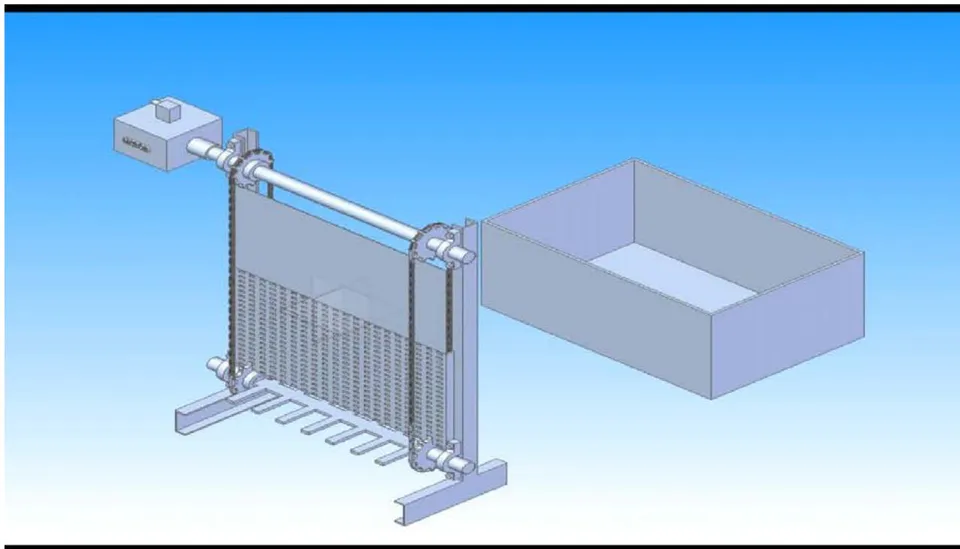
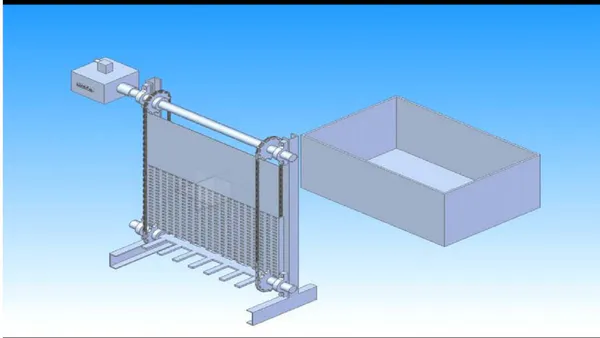
Figure 2: Cad model of drain waste water cleaner

b) Objectives

The main objective of this project to minimize or overcome the problem which can faced in manual machine. Also increased the dumping rate of waste. And help to operator do easily work.

The purpose of selecting a drain waste water cleaner machine is as follows:

  • Simplicity of Design and Control.

  • This type of machine are easy to operate and less time consuming.

  • Evaluate the effectiveness of alternative drainage design and operational practices, to reduce nitrate-N losses from drained agricultural lands.

  • Assess the impact of various soil and crop management practices on reducing nitrate-N loadings to subsurface drains.

  • Assess the need for further research in other aspects of water quality from drained agricultural lands, including the emerging issues of pathogens and phosphorus from manure applications.

  • Develop drainage guides and other extension materials, and work with state and federal action agencies, to assist in implementation of improved design and management practices for subsurface drainage systems

c) Advantages Of Machine

  • Low-cost drain-off solution if drains already exist.

  • Construction materials are often locally available - Creates employment (construction and maintenance)

  • It is Portable

d) Applications Of Machine

  • It can be used in BMC

  • It can be used to separate plastic, thermocol from sewage

  • It can be used in plastic industries

e) Machine specifications

AC supply gear motor speed of gear motor- 20 RPM

Voltage required – 230 volts

0.5 Horse Power

Torque of gear motor- 40 to 50 kg

Upper and bottom diameter of shaft -25mm

Adjustable plate as per required height

Back side waste bin Lifting mechanism attached on chain

f) Components And Material Selected

The components used in this Darin Waste Water Cleaner are AC geared motor, upper and lower shaft, ball bearings, backside waste bin, adjustable plates, chain drive. the material used for C.I for frame, for ball bearing the type of bering used is pillw block ball bearing made of C.I, galvanised steel is used for waste bin.

g) Modifications

Our project is simply a drain waste water cleaner machine, which is automatically operated. Following different modification can be done to improve the output and efficiency. we have use a geared motor, adjustable plates, backside waste bin, single plate clutch, springs,. This machine can be placed inside the drainage pipe to remove all the wastes like plastic, thermocol, etc.

Hence by having above modifications above machine can be made a multipurpose output machine, which can be may power driver and automatically operated.

IV. CONCLUSION

The drain waste water cleaner machine is designed and manufactured by using gear changing and shaft coupling principle. It consist mainly DC geared motor, shafts, waste removal plates, dust bin, bearings, sprocket and chains. Construction materials are easily available, creates employment (construction and maintenance), simple to construct.
1. INTERNATIONAL JOURNAL OF ENGINEERING RESEARCH AND APPLICATION (IJERA)

2. INTERNATIONAL JOURNAL OF ADVANCE ENGINEERING AND RESEARCH (IJAER)

3. https://en.wikipedia.org/wiki/Drainage_system

4. http://www.mdpi.com/2073-4441/6/4/976

References

4 Cites in Article
  1. 1. International Journal of Engineering Research and Applications. INTERNATIONAL JOURNAL OF ENGINEERING RESEARCH AND APPLICATION (IJERA
  2. 2. International Journal of Applied Engineering Research. INTERNATIONAL JOURNAL OF ADVANCE ENGINEERING AND RESEARCH (IJAER
  3. 3. 3.
  4. 4. (2073). 4.

Funding

No external funding was declared for this work.

Conflict of Interest

The authors declare no conflict of interest.

Ethical Approval

No ethics committee approval was required for this article type.

Data Availability

Not applicable for this article.

How to Cite This Article

Chougle Mohammed Zaid Sadique, Prof. Nitin Sall, Prathmesh Gawde, Shiraz Qureshi, Sunil Singh Bhadauriya. 2016. "Drain Waste Water Cleaner". Global Journal of Research in Engineering - J: General Engineering GJRE-J Volume 16 (GJRE Volume 16 Issue 6 (J1)).

More Citation Formats

Download Citation

Issue Cover
GJRE Volume 16 Issue 6 (J1)
Pg. 17-19
Journal Specifications

Crossref Journal DOI 10.17406/gjre

Print ISSN 0975-5861

e-ISSN 2249-4596

Keywords
Classification
GJRE-J Classification FOR Code: 091599
Version of record
v1.2

Issue date
March 14, 2016

Language
English
Order Article Reprint
Experience in AR

Explore published articles in an immersive Augmented Reality environment. Our platform converts research papers into interactive 3D books, allowing readers to view and interact with content using AR and VR compatible devices.

Read in 3D

Your published article is automatically converted into a realistic 3D book. Flip through pages and read research papers in a more engaging and interactive format.

Article Matrices
Total Views: 1.1K
Total Downloads: 50
All Trends

This is the heading

Lorem ipsum dolor sit amet, consectetur adipiscing elit. Ut elit tellus, luctus nec ullamcorper mattis, pulvinar dapibus leo.

High-quality academic research articles on global topics and journals.

Drain Waste Water Cleaner

Nitin Sall
Nitin Sall
Chougle Sadique
Chougle Sadique
Prathmesh Gawde
Prathmesh Gawde
Shiraz Qureshi
Shiraz Qureshi
Sunil Bhadauriya
Sunil Bhadauriya

Request Access

Please fill out the form below to request access to this research paper. Your request will be reviewed by the editorial or author team.
X

