

I. INTRODUCTION
The effectuality of business tends to be a phenomenon that managers, decision makers and practitioners are seriously fretful with in all companies globally but predominantly in the textile sector. This concern has been fuelled by the need for firms to dominate their market based on attaining and sustaining competitive advantage. As such, Besanko (2010) established that competitive advantage is imperative as it enhances the performances of the firm and ensures greater economic benefits for the nation. Similarly, Ardianus and Petrus (2016) asserted that competitive advantage is prominent as it ensures organization's sustainability in the industry which is feasible through continuous improved performance. In line with this, past scholars have posited that for a firm to achieve and sustain its competitive advantage, strategic entrepreneurship is a fundamental practice (Idowu, Irefin, & Akarakiri, 2018; Ogbari, Obigbemi, Atolagbe, & Ojo, 2016). Correspondingly, Durotoye, Adeyemi, Omole, and Onakunle (2018); Makinde and Agu (2018); Ukenna, Makinde, Akinlabi, and Asikhia (2019) also emphasized that strategic entrepreneurship results in superior firm performance in a highly turbulent environment for the sole goal of ensuring their competitive advantage.
In the same vein, researchers (Dogan, 2015; Renato & Naguib, 2016) speculated that strategic entrepreneurship is imperious for a firm as it encompasses the incorporation of entrepreneurial innovativeness, flexibility, adaptive and risk taking skills that create wealth and indicate sound performance. Takhtshahi and Maroofi (2017) also affirmed that strategic entrepreneurship enhances firm's performance, increase profit or/and market share when aligned with entrepreneurial activities which results into competitive advantage.
However, the increasing competition in the business world has stimulated the debate on how strategic entrepreneurship can rouse competitive advantage of textile firms. Based on this, scholars such as Mazzei, David, and Christopher (2017); Paek and Lee (2017); Sandeep and Jaiswal (2016) and Sarutaya (2015) had studied strategic entrepreneurship and competitive advantage in diverse sectors across Africa, Europe, USA, Asia and Middle East countries. Nevertheless, some of these studies found a significant positive relationship between strategic entrepreneurship and competitive advantage (Ali & Mohammad, 2012; Daryani & Tabrizinia, 2015; Mazzei et al., 2017; Paek & Lee, 2017; Rezaian & Naeiji, 2012), while the result of Kagathi (2013) showed a negative relationship. However, these studies did not examine strategic entrepreneurship dimensions and competitive advantage of textile manufacturing firms in Lagos State Nigeria.
Manufacturing Association of Nigeria [MAN] Report (2018), has showed that the Nigerian textile sector is no longer competitive anywhere in neighbouring African countries, Europe, the Far East and the United States of America. Moreover, Nigeria is no longer among the six African countries that contributed 91% of exports by value to the U.S. under the African Growth and Opportunity Act [AGOA] in
African Cotton and Textile Industries Federation [ACTIF](Aminu, 2016; MAN, 2018). Similarly, the stiff competition between the local and foreign textile manufacturers has generated much problems in the Nigerian textile sector, and this has led to the local firms being subjected to low product demand due to high price and low quality of their products when compared with foreign made fabrics (National Bureau of Statistics [NBS], 2015). This situation has hindered local manufacturers from being competitive not only in the country but also across the globe.
In the same vein, Murtala, Ramatu, Yusuf, and Gold (2018) attributed the problem to low inputs supply, demand, and price competitiveness of the Nigerian textile sector, high cost of production, trade liberalization and low packaging quality are among the challenges that have crippled its ability to achieve competitive advantage of textile firms in Nigeria. Paek and Lee (2017) posited that strategic entrepreneurship plays a critical role in competitive advantage of firms. Daryani and Tabrizinia (2015) previously asserted that strategic entrepreneurship leads to competitive advantage. In addition, Ali and Mohammad (2012), Rezaian and Naeiji (2012) earlier discovered that strategic entrepreneurship has a significant and positive effect on competitive advantages and organisational performance. However, the study of Kagathi (2013) on some dimensions of strategic entrepreneurship like strategic leadership and innovation found negative effect on competitive advantage. Based on the mixed results of strategic entrepreneurship on competitive advantage, this study seeks to ascertain how strategic entrepreneurship would affect the competitive advantage of textile manufacturing firms in Lagos State. The work is organized in sections of the introduction, literature review, methodology, the results presentation, conclusion, and recommendation.
II. LITERATURE REVIEW
The aspect of literature review comprised of synthesis of concepts, empirical discourse and theoretical exploration in relation to the thesis of the work so as to scientifically deepen understanding on the constructs and interplay between constructs. Competitive advantage within context is firm's capability to produce products or offer services dissimilar to what rivals do, by exploiting unique assets that organisations warehouse in order to add value in a way that rivals find problematic to replicate and outstrip (Sarpong & Tandoh, 2015). Wirda, Herri, Elfindri, and Rivai (2019) agreed with Sarprong and Tandoh (2015) and added that the benefit achieved by firms with competitive advantage was feasible as a result of executing a strategy that utilizes various resources owned by the company. According to Malkawi, Omari, and Halasa (2018), competitive advantage describes the features that enable an organisation to out-perform its competitors. Similarly, Hosseini, Soltani, and Mehdizadeh (2018) see competitive advantage from the financial perspective especially when a firm's profit rate is more advanced than the average rate of the related industry due to its inimitable capabilities. Competitive advantage has been measured by studies along market share, efficiency, product or services cost (Kortelainen & Karkkainen, 2011), gross margin, returns on assets, net income, unit cost ratio (Farole, Reis, & Wagle, 2010), and total factor productivity by Toit, Ortmann, and Ramroop (2010). This paper sees competitive advantage as organization's superiority over its competitors in producing goods and services that are distinctive due to its peerless resources.
III. STRATEGIC ENTREPRENEURSHIP
Strategic entrepreneurship denotes the association between entrepreneurship and strategic management (Kuratko & Audretsch, 2009). Kyrgidou and Hughes (2010) and Ukenna et al. (2019) defines strategic entrepreneurship as a practice that entails organisational efforts to recognize opportunities with the maximum potential to lead, create value via the entrepreneurial element, utilize them through tactical activities based on the organisational resources. In the view of Djordjevic (2013), strategic entrepreneurship is captivating entrepreneurial act using strategic perspective and it engages in concurrent opportunity seeking and competitive advantage actions designed and executed in order to generate wealth. Dogan (2015), Hanne, Daniel, and Jon-Arild (2016), Lackéus (2016), and Makinde and Agu (2018) defined strategic entrepreneurship as the fusion of entrepreneurial (opportunity-seeking actions) with strategic (advantage-seeking actions) to create wealth. According to Paek and Lee (2017) strategic entrepreneurship is an organization's strategic intent to unceasingly and carefully leverage entrepreneurial opportunities for organisational development and benefit. Hence, this paper measured strategic entrepreneurship as strategic flexibility, adaptability, innovation, leadership, risk taking and dynamic capabilities.
Innovation can be defined as all activities involved in the refinement/invention of a product/service. According to Bor (2018), innovation is the firm's predisposition to engross in and sustain a new idea, novelty investigation and creative processes. The route of deciphering an idea or invention into a good or service that generates value or for which consumers will pay is also referred to as innovation (Bor, 2018). In business, innovation habitually results when ideas are transformed by the company in order to further satisfy the needs and expectations of the customers (Duan, Cao, & Edwards, 2020). In line with this, Schumpeter opines that an entrepreneur is a leader, who strategically controls the means of production into new straits (Schumpeter, 1911). Entrepreneurs set profit estimates as a prerequisite for innovation choices.
Alberto (2016) described strategic leadership as the leadership ability that incorporates a core of significant managerial practice such as long term goal fortitude, exploring and exploiting a firm's core competences. In the same vein, Yilmaz and Flouris (2017) identified the main aim of strategic leadership as strategic productivity while inventiveness, perception, and planning to assist an individual in realizing his/her objectives and goals. Moreover, Golensky and Hager (2020) added that strategic leadership enables both leaders and managers to be smart, responsible and effective in fulfilling their obligation to the organisation which enable a firm to have an edge in the industry.
Kitigin (2017) defines risk-taking as a firm's propensity to be involved in risky projects and managerial preferences for bold versus cautious actions in order to achieve firm's aims. Llanos-Contreras, Arias, and Maquieira (2020) maintained Kitigin (2017) definition but added that risk-taking is an opportunity that enhances business long-term position in financial and socioemotional wealth creation. The inability of firms to take valiant risk has not only affected the progress of the firm but also hindered them from taking advantage of opportunities in the environment. Wahl and Kirchler (2020) positioned that firms should adopt optimistic attitudes towards risk-taking as it yields positive returns for the firm.
Dynamic capability is a firm's outline of combined activity through which a firm systematically spawns and revises its functional routines in quest of upgraded effectiveness (Piening, 2013). Similarly, Singh and Rao (2016) postulated dynamic capability as firm's competency to manage alliances, acquire, incorporate and reconfigure resources base to address the varying business situations. Moreover, firm's ability to refurbish competences so as to achieve corresponding business environment is referred to as dynamic capability (Kumar & Kumar, 2020). As such, Supeno, Sudharma, Aisjah, and Laksmana (2015) defined strategic flexibility as a way of amassed control in an extremely stormy environment. A firm's capacity to retort meritoriously to alterations can offer a strong base for strategic flexibility. In addition, Brinckmann, Villanueva, Grichnik, and Singh (2019) postulated that firms need strategic flexibility in order to proactively or reactively adjust to the market and internal demands as they aim to establish themselves. Adaptability is defined by Buch (2009) as an organization's aptitude to clasp change or be changed to fit a reformed environment. In addition, Choi (2020) argued that adaptability illustrates the capability to learn from experience, and improve the aptness of the learner as a competitor. From the numerous views on strategic entrepreneurship proxies the paper define strategic entrepreneurship as the process through which employees with entrepreneurial personalities having risky, innovative ideas are able to find opportunities, seek advantage in a dynamic manner and get it implemented for the benefit of the organization.
a) Strategic entrepreneurship and competitive advantage
Several scholars established that strategic entrepreneurship positively influences firm's competitive advantage (Gelard & Ghazi, 2014; Hitt, Ireland, & Hoskisson, 2012; Mazzei et al., 2017). Amongst such scholars is the study of Paek and Lee (2017) which revealed that strategic entrepreneurship plays a crucial role in the competitive advantage of firms. In the same vein, Ali and Mohammad (2012); Rezaian and Naeiji (2012) earlier discovered that strategic entrepreneurship has a considerable positive effect on competitive advantage and organisational performance. The work of Ireland, Hitt, and Sirmon (2003) also established that strategic entrepreneurship helps in achieving competitive advantage and value creation in an organisation. Daryani and Tabrizinia (2015) results also concurred with Ireland et al. (2003) that strategic entrepreneurship has a positive effect on competitive advantage and wealth-creation while a prior study by Ireland and Webb (2007) demonstrated that strategic entrepreneurship facilitate firms to have advantage in the market.
Moreover, Sarutaya (2015) indicated that dynamic capability as a dimension of strategic entrepreneurship has a significant positive impact on competitive advantage. Similary, Breznik and Lahovni (2016) position supported Sarutaya (2015) that firms which has and deploy relevant competences as dynamic capabilities hold the prospective for a sustained competitive advantage. In the same vein, Kaur and Mehta (2017) affirm past findings through a comparative analysis and indicated that dynamic capability have significant effect on competitive advantage in both foreign and local firms. In line with the empirical conclusions by preceding scholars, the survival-based theory otherwise called "survival of the fittest theory" initially created by Herbert Spencer (Miesing & Preble, 1985) was considered best-fit for theoretical underpinning. The theory's philosophy assert that the best and the fittest of contenders will win at last which would prompt the improvement of the social community overall. The survival-based theory examines the tactics a company uses to avert being eradicated by contenders (Miesing & Preble, 1985) and achieve a major edge in the industry. Brain (1996) supported the theory that a firm needs to ceaselessly adjust to aggressive competition in the environment in order to endure.
The survival-based view accentuated with respect to the suppositions that in order to endure, firms needs to convey techniques that ought to be centred around running exceptionally proficient tasks and can react quickly to the changing of aggressive competitive environment (Khairuddin, 2005). However, Lynch (2000) critiqued the theory and posited that choosing a specific arrangement of technique would not be ideal. Lynch (2000) and Abdullah (2010) further explained that it is smarter to explore different avenues regarding a few procedures without a moment's delay and let the procedure of the most suitable method be picked based on the best system that adjusts better to the environment. This theory is essential in understanding entrepreneurial techniques that can possibility help a company to reinforce its position. This is with the expectation that it would improve business performance and accomplish a definitive objective of ensuring their competitive advantage is achieved.
b) Methodology
This study is basically quantitative in nature. A cross-sectional survey research design was adopted in this study. The adoption of cross-sectional survey research design is in line with the study of Daryani and Tabrizinia (2015) and Paek and Lee (2017). The respondent organisations were three surviving textile manufacturing firms in Lagos State out of the 15 textile firms in existence. The three textile manufacturing companies consist of Wollen and Synthetic Textile Ltd, Nichemtex Textile Ltd and Sunflag Textile Ltd with a target population of two hundred and fifty-three (253) senior management staff of the selected textile-manufacturing firms. The sample technique adopted was census. Primary data were collected through an adapted questionnaire on strategic entrepreneurship and competitive advantage over a period of three months.
The questionnaire was a Likert-scale type. It was pretested for validity and reliability. The content and construct validity were conducted by administering twenty-five (25) copies of the questionnaire to senior management of Gbemi Aladire Clothes and Fabric manufacturer in Ita-bada, Itoku, Abeokuta South, and Baba Show Kampala at Ake, Abeokuta South, Abeokuta Ogun State. The content validity informed the decision to refine some question items and others were removed. The construct validity was done with Kaiser-Meyer-Olkin indicating good-fit. The reliability results revealed that the instrument was above the minimum threshold of 70% according to (Hair, Black, Babin, & Anderson, 2010).
Two hundred and fifty-three (253) copies of the questionnaire were administered with the help of trained research assistants to the senior management staff of the three textile-manufacturing firms. The senior management staff were considered capable of answering the questions intelligently and accurately due to their accumulated experiences and insight about their firms and the industry. 237 of the administered copies were retrieved and considered usable giving a response rate of 93.7%. Sixteen copies of questionnaire were dropped due to missing information needed for the analysis. The data were treated (Construct and Convergent validity, Discriminate validity, and Normality test) before the analysis. Data were analysed in two phases: descriptive was used and for covariance Smart PLS a technique of structural equation modelling (SEM) application was used for confirmatory analysis.
c) Analysis and findings
Majority (73.8%) of the respondents were male while 24.9% were female and 38.0% were of the age bracket 31-35 years, 24.5% were in the age bracket 36-40 years, 18.1% of the respondents were of the age bracket 25-30 years, 10.5% were of the age bracket 41-45 years, 3.8% were of the age bracket 46-50 and 51-55 years and 1.3% were of the age bracket 56-60 years. 68.4% of the respondents are married, 25.3% single, 4.6% divorced/separated and 0.8% are widowed. In terms of work experience, 39.2% had worked for a period between 5 to 10 years, 36.3% between 0 to 4 years, 13.9% for the period 11-15 years, 5.5% for a period 16 to 20 years, and 4.2% between 21 to 25 years. The respondents are educated with 30.0% holders of a bachelor's degree, 17.3% had SSCE certificate, 19.8% held higher national diploma, 25.3% had Masters (MBA/MSc) degree, 5.5% holders of DBA and 0.4% had doctorate degree.
d) Measurement Model
The outer or measurement model assessed the relationship between the observable variables and the theoretical constructs they represent. A reliability test was conducted to determine the internal consistency of the measures used. The Cronbach alpha ( ) for adaptability, dynamic capability, innovation, risk taking, strategic flexibility, and strategic leadership were 0.70, 0.735, 0.750, 0.773, 0.741, and 0.838 respectively while competitive advantage had a value 0.714 which are higher than the recommended threshold of 0.70 demonstrating adequate reliability (Hair et al., 2010). The constructs were initially purified using Exploratory Factor Analysis (EFA). EFA was performed on the items composing the constructs to identify the variables that cluster together into the most effective number of factors (Bordens & Abbot, 2014) and identify the structure of the measurement model (Hair et al., 2010). Prior to performing EFA, the suitability of the data was assessed through two tests, that is, Kaiser-Meyer-Olkin measure of sampling adequacy (KMO) and Bartlett's Test of Sphericity. Kaiser-Meyer-Olkin measure of sampling adequacy (KMO) is a measure to quantify the degree of correlations among the variables which indicates the proportion of variance in the studied variables that might be caused by the underlying factors. The KMO index ranges from 0 to 1, the closer the value to 1, the more significant the correlation among the variables (Kaiser, 1974). On the other hand, Bartlett's test of Sphericity provides the statistical probability that the correlation matrix has significant correlations among at least some of the variables with small values (p<0.5) indicating that the data is useful in factor analysis. The results of KMO and Bartlett's test of Sphericity are presented in Table 1.
| Variables | KMO | Bartlett (Chi Square) |
| Innovation | 0.709 | 0.000; (158.624) |
| Strategic Leadership | 0.679 | 0.000; (156.234) |
| Risk Taking | 0.633 | 0.000; (174.872) |
| Dynamic Capabilities | 0.615 | 0.000; (151.811) |
| Strategic Flexibility | 0.801 | 0.000; (94.512) |
| Adaptability | 0.663 | 0.000; (132.586) |
| Competitive Advantage | 0.683 | 0.000; (97.086) |
Table 1 indicated that all variables had achieved KMO index values of 0.600 above the threshold of 0.500 and p-values of Bartlett's Test of Sphericity below 0.05 which indicated that the data were useful for factor analysis (Kaiser, 1974). The variability of each observed variable that could be explained by the extracted factors. Confirmatory factor analysis (CFA) was estimated using Smart PLS version 3.2.8 software in order to establish the extent to which the observed data validate and fit the pre-specified theoretically based model (Chao & Spillan, 2010). CFA was estimated on multiple criteria such as construct reliability, convergent validity and discriminant validity. Construct validity for the variables was assessed by computing composite reliability and internal consistency of the items. Composite reliability was evaluated using Smart PLS which generated values above 0.6 which was found to be accepted. Internal consistency was estimated using Cronbach's alpha ( ) and the values were 0.600 above which is higher than the recommended threshold of 0.700 demonstrating adequate reliability (Hair et al., 2010). In this paper, convergent validity was assessed using Average Variance Extracted (AVE). The Average Variance extracted (AVE) for adaptability was 0.568, dynamic capability was 0.585, innovation was 0.599, risk taking was 0.526, strategic flexibility was 0.695, and strategic leadership was 0.605 and competitive advantage was 0.648 which exceeded the cut-off value of 0.5, thus confirming convergent validity (Bryman, 2012). To satisfy the requirement of discriminant validity of the measurement model, the criterion suggested by Fornell and Larcker (1981) was followed. The discriminant validity was confirmed as the square root of a construct's AVE was greater than the correlation between the construct and other constructs in the model (Madhoushi, Sadati, & Delavari, 2011).
| Variables | rho_A | Composite Reliability | (AVE) |
| Adaptability | 0.774 | 0.804 | 0.568 |
| Competitive Advantage | 0.809 | 0.811 | 0.684 |
| Dynamic Capability | 0.754 | 0.823 | 0.585 |
| Innovation | 0.778 | 0.831 | 0.599 |
| Risk Taking | 0.807 | 0.844 | 0.526 |
| Strategic Flexibility | 0.769 | 0.827 | 0.695 |
| Strategic Leadership | 0.864 | 0.884 | 0.605 |
| Adaptability | Competitive Advantage | Dynamic Capability | Innovation | Risk Taking | Strategic Flexibility | Strategic Leadership | |
| Adaptability | 0.781 | ||||||
| Competitive Advantage | 0.444 | 0.796 | |||||
| Dynamic Capability | 0.475 | 0.522 | 0.794 | ||||
| Innovation | 0.434 | 0.465 | 0.535 | 0.796 | |||
| Risk Taking | 0.466 | 0.390 | 0.602 | 0.573 | 0.725 | ||
| Strategic Flexibility | 0.416 | 0.366 | 0.587 | 0.472 | 0.390 | 0.702 | |
| Strategic Leadership | 0.427 | 0.479 | 0.593 | 0.639 | 0.729 | 0.449 | 0.778 |
The normality of data was assessed by examining its skewness and kurtosis. The result showed that skewness was within the range of -0.748 and +2.433 and kurtosis was within the range of -0.406 and +0.868 which complied with the normality threshold of -3 to +3 (Cooper & Schindler, 2011). Multicollinearity was tested using Tolerance and Variance Inflation Factor. The variance inflation factor (VIF) obtained is between 1 to 10 while the tolerance value is greater than 0.10 showing that there was no multicollinearity associated with strategic entrepreneurship and competitive advantage variables.
e) Structural Model and Assumption Testing
Partial Least Squares Structural Equation Modelling (PLS-SEM) was used to analyse the model and testing the assumption. PLS-SEM was used since it provides more flexibility in modelling second order constructs and formative constructs (Chin, 1998). The structural model evaluated by examining the value and the size of the structural path coefficient. The values range between 1 and 0 where 1 means a perfect prediction of the structural model (Hair et al. 2010). According to Hair et al. (2010), in development and testing of structural model, bootstrap method was used in order to find t-statistics and standard deviation estimations in path-coefficient. The path-coefficient estimates were used to determine the significance of the relationship. The resultant T-tests statistics from the bootstrapping procedure provided the basis for determining the statistical significance of the path-coefficient estimates (Hensler, Ringle, & Sinkovics, 2009). Hair et al. (2010) and Azar and Shafigi (2013) noted that coefficient results are significant to accept hypothesis if t-statistics is larger than 1.96.
Table 4 sets out the path coefficient and the t-values observed with the level of significance achieved from bootstrapping.
| Path | SER | TStatistics | PValues | Results | |
| Adaptability -> Competitive Advantage | 0.213 | 0.131 | 1.624 | 0.105 | Not Supported |
| Dynamic Capability -> Competitive Advantage | 0.304 | 0.103 | 2.957 | 0.003 | Supported |
| Innovation -> Competitive Advantage | 0.161 | 0.079 | 2.05 | 0.041 | Supported |
| Risk Taking -> Competitive Advantage | -0.099 | 0.106 | 0.941 | 0.347 | Not Supported |
| Strategic Flexibility -> Competitive Advantage | -0.002 | 0.102 | 0.021 | 0.983 | Not Supported |
| Strategic Leadership -> Competitive Advantage | 0.184 | 0.09 | 2.031 | 0.043 | Supported |
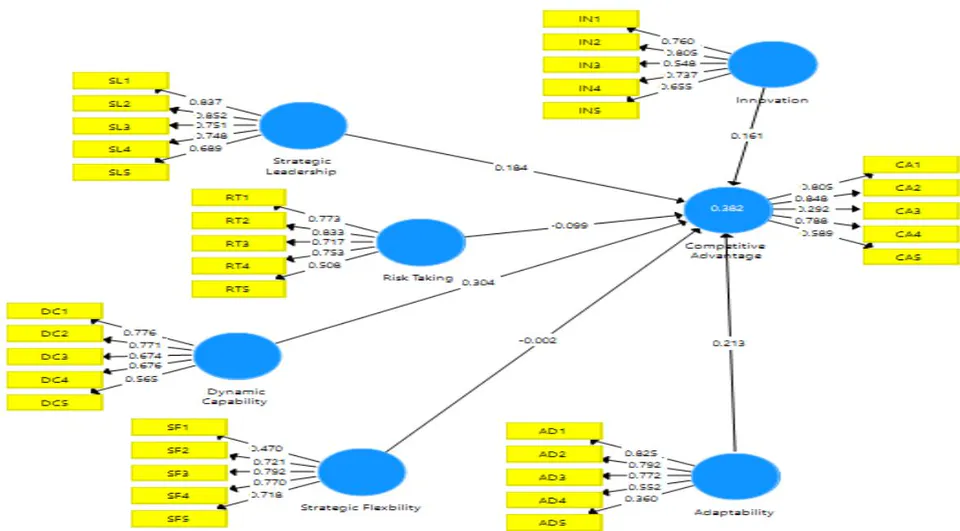
As indicated in Table 4 and Figure 1, the path coefficient between adaptability and competitive advantage was positive but insignificant with a path coefficient of 0.213 and a significance level of 0.105 ( , p>0.05). Results show positive and insignificant relationship between adaptability and competitive advantage. The path coefficient implied that for every 1 unit increase in adaptability, competitive advantage was increased by 0.213 units. Thus, results show positive and insignificant relationship of adaptability with competitive advantage. The path coefficient between dynamic capability and competitive advantage was positive and significant with a path coefficient of 0.304 and a significance level of 0.003 ( , p<0.05). The path coefficient implied that for every 1 unit increase in dynamic capability, competitive advantage was increased by 0.304 units. Thus, results confirm positive and significant relationship of dynamic capability with competitive advantage.
The path coefficient between innovation and competitive advantage was positive and significant with a path coefficient of 0.161 and a significance level of 0.041 ( ). The path coefficient implied that for every 1 unit increase in innovation, competitive advantage was increased by 0.161 units. The result confirms positive and significant association between the two variables. With regards to risk taking, the path coefficient between risk taking and competitive advantage was negative and insignificant with a path coefficient of -0.099 and a significance level of 0.347 ( ). The path coefficient implied that for every 1 unit increase in risk taking, competitive advantage was reduced by 0.099 units. The result reveals negative and insignificant association between risk taking and competitive advantage.
The path coefficient between strategic flexibility and competitive advantage was also negative and insignificant with a path coefficient of -0.002 and a significance level of 0.983 ( ). The path coefficient implied that for every 1 unit increase in strategic flexibility, competitive advantage was reduced by 0.002 units. The result reveals a negative and insignificant relationship between strategic flexibility and competitive advantage. Finally, the path coefficient between strategic leadership and competitive advantage was positive and significant with a path coefficient of 0.184 and a significance level of 0.043 ( ). The path coefficient implied that for every 1 unit increase in strategic leadership, competitive advantage was increased by 0.184 units. The result reveals positive and significant relationship between strategic leadership and competitive advantage.
The quality of the structural model was assessed using the determination of coefficients . From the analysis, the value of coefficient was 0.382 which indicated that 38.2% of the variation in competitive advantage can be accounted for by strategic entrepreneurship dimensions (adaptability, dynamic capability, innovation, risk taking, strategic flexibility, and strategic leadership) with . Based on the assessment criterion suggested by Cohen (1988) and Chin (1998), the outer model that contains strategic entrepreneurship dimensions was found to reflect a moderate predictive relevance. It implied that strategic entrepreneurship dimensions have moderate effect on competitive advantage.
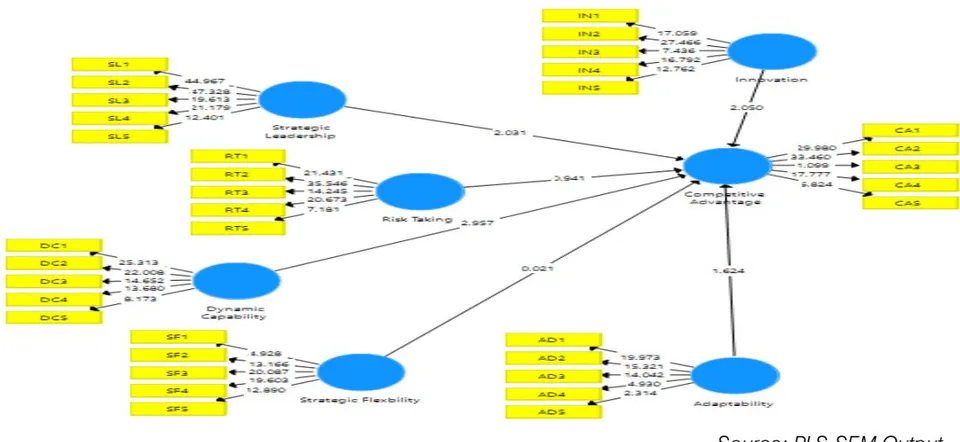
T-statistics was used to test the significance to the relationship between strategic entrepreneurship dimensions and competitive advantage where critical values for t-statistics should be greater than 1.96 at 0.001 level of significance. The resultant T-tests statistics are illustrated in Figure 2 and showed that dynamic capability (t=2.957, p<0.05), innovation (t=2.05, p<0.05) and strategic leadership (t=2.031, p<0.05) had significant t-statistic values which are above the 1.96 standard, while adaptability (t=1.624, p>0.05), risk taking (t=0.941, p>0.05), and strategic flexibility (t=0.021, p>0.05) t-statistics are not statistically significant at 0.05 significance level. The results showed that dynamic capability, innovation, and strategic leadership have positive and statistically significant effect on competitive advantage. Hence, dynamic capability, innovation, and strategic leadership are significant predictors of competitive advantage of textile manufacturing firms in Lagos State, Nigeria. And, in order to increase competitive advantage in the industry, textile manufacturing firms in Lagos State must focused on their dynamic capability, innovation, and strategic leadership.
f) Discussion of Findings
The findings indicated that strategic entrepreneurship had affects competitive advantage of textile manufacturing firms in Lagos State. The result affirms the result of Bosire and Nzaramba (2015) that the adoption of strategic entrepreneurship components do lead to better business practices, increased revenues and profits of firms. Similarly, Daryani and Tabrizinia (2015) also confirmed that strategic entrepreneurship positively impact on competitive advantage and wealth-creation. This finding is consistent with the submission of other scholars that strategic entrepreneurship enhances firm's competitive advantage (Barchue & Aikaeli, 2013; Ireland & Webb, 2007; Ukenna et al., 2019). In the same vein, past studies have substantiated strategic entrepreneurship as the bedrock for achieving and improving on the competitive advantage of firms (Hoogendoorn, Zwan, & Thurik, 2017; Liyanage & Weerasinghe, 2018; Tur-Porcar, Roig-Tierno, & Mestre, 2018; Youssef, Boubaker, & Omri, 2017; Yusuf, 2017). Thus, it is affirmed that strategic entrepreneurship impulses firm to immediately act to sudden changes in the external business environment that might pose as threat to the attainment of the firms' objectives.
On the other hand, the individual coefficient results revealed that risk taking and strategic flexibility have negative and insignificant effect on competitive advantage could infer adverse consequences on competitive advantage. Consistent with these findings, Kitigin (2017) argued that the low inclination of firms to undertake risky ventures has not only led to negative outcome but has also hindered their performance. Moreover, this could lead to poor creativity and low competency of employees in the organization. Additionally, Brinckmann, Villanueva, Grichnik, and Singh (2019) opined that the static strategies and tactics utilized by firms could result in their inability to adjust to the market and internal demands which they aim to establish themselves.
In addition, the individual coefficient results also indicated that dynamic capabilities have a positive and significant effect on competitive advantage. Szymanski, Fitzsimmons, and Danis (2019) supported this finding that successful organizations have dynamic capabilities that are aligned with their competitive environments and they continuously improve on it. As the competition intensifies globally across sectors, managers are charged with the responsibility to improve their dynamic capabilities as this enables them to record an unremitting competitive advantage. Further corroborating the individual regression results of dynamic capabilities, Fainshmidt, Wenger, Pezeshkan, and Mallon (2019) posited that dynamic capabilities positively affects the competitive advantage of an organization.
Moreover, the adoption of flexible and effective strategies facilitate firms to identify and exploit opportunities in the changing trend of the external business environment so as to achieve competitive advantage (Dogan, 2015; Haddawee, 2018; Ibrahim, Rizal, & Mahadi, 2016; Makinde & Agu, 2018; Paek & Lee, 2017). However, the adoption of strategies will not promote competitive advantage if the staffs are not strategic leaders with improved proactive and reactive skills to utilize the firm's dynamic capabilities (Singh & Rao, 2016). It is affirmed that strategic entrepreneurship can help competitive advantage and value creation in an organization through establishing a balance between exploration and exploitation of opportunities which is in line with Ukenna et al. (2019).
Theoretically, the study findings are validated by survival-based theory which stress on firm's ability to quickly learn, coordinate and reconfigure their capabilities to achieve competitive advantage (Ukenna et al., 2019). The capability of firms to offer services disparate to competitors by exploiting organisational assets would ensure their survival and achieve competitive advantage (Sarpong & Tandoh, 2015). The survival based theory is more concerned about short term advantage that can be used to build longer term competitive advantage by simply being the best and the fittest of contenders. It is a response to the question of how and why some firms espouse strategies to avert being eradicated by contenders and in order to create and sustain competitive advantage compared with others in the dynamic markets (Singh & Rao, 2016). It could be said that a firm with exceptional proficient tasks can react quickly to the changes in the aggressive competitive environment (Khairuddin, 2005). An organization that is very mindful of its survival in the midst of the turbulent business environment will have an advantage over its competitors because such a firm would ensure that it adapts to the environment, flexible in its resources and adjust existing competencies or developing new ones in order to achieve overall firm performance.
IV. CONCLUSION AND RECOMMENDATIONS
Based on the findings, it can be concluded that, dynamic capabilities, innovation, and strategic leadership are the major predictors of competitive advantage of textile manufacturing firms in Lagos State, Nigeria. Specifically, dynamic capabilities had the most significant relative positive effect on competitive advantage, followed by strategic leadership, and innovation. The study affirmed that strategic entrepreneurship has a significant effect on competitive advantage and the assumption that survival-based theory has universal applicability is sustained. However, the individual coefficient results revealed that dynamic capabilities, innovativeness, and strategic leadership had positive and significant effect on competitive advantage while risk taking and strategic flexibility had positive and insignificant effect on competitive advantage. Based on finding, this paper concludes that strategic entrepreneurship enhances competitive advantage. Thus, recommended that firms should focus on dynamic capabilities and refinement of bundle of self-reconfiguration to drive competitive advantage. In addition, strategic adaptability to remain fit and alignment to turbulent business environment is imperative for longevity. As such, researchers could consider incorporating factors such as government policies and knowledge management, as moderating variables between strategic entrepreneurship components and competitive advantage so as to gain further insight.
ACKNOWLEDGEMENT
The author's first appreciation is to God Almighty for life, health, renewed mercies, wisdom and providence.