I. INTRODUCTION
Concrete was once thought to be an extremely long lasting that required no maintenance. The assumption is largely true, except when it is subjected to highly aggressive environments [1]. Concrete is a multipurpose and generally used in the construction material in the world. There are different limits for the design of concrete. One of the important parameters in the design of concrete is durability. To increase the service life of structure, not only strength is required but durability parameter is also important [1]. Durability of the concrete is defined as ability of the concrete to repel the weathering action, chemical attack, abrasion or any other process of deterioration. Durability is either through the concrete system like binder type, mixing, transportation, aggregates, admixtures, curing, and temperature at the time of curing, or through the assertiveness of the environment like abrasion, leaching, expansion, erosion, cavitation etc. [1]. Most commonly durability of concrete is affected by sulphate attack, chloride attack, carbonation, ASR reaction, freezing and thawing damage. Durability of concrete is fundamentally related to permeability [1].
In real environment concrete structures are exposed to numerous environmental factors acting in a shared and certainly synergistically physical and chemical manner to quicken the destruction procedure, so it is significant to study the chloride resistance of concrete to acquire satisfactory information on concrete durability [1]. The concentration of the hydroxyl ion inside the concrete is largely measured by the concentration of sodium and potassium. The mechanism of expansion of alkali silica reaction can be explained by absorption theory or osmotic pressure theory. In absorption theory, the reticence of pore water and bulge of the alkali silica gel causes expansion, whereas in osmatic pressure theory, there is an inward diffusion of , , and from the pores to aggregate surface. The ratio of the to the alkali present controls the expansive nature of the concrete [2]. The concrete can be protected against the alkali silica reaction by the use of stumpy alkali content (less than ), use of chemical admixtures, use of mineral admixtures such as silica fumes, or by applying coatings or water proofing agents. The use of high reactivity metakaolin has the prospective to improve the durability [2]. If the concrete remains frozen, then there will not much problem occurs, but if the cycles of the freezing and thawing repeat again and again, then there will be the existence of deterioration. The internal stress is produced in the concrete, due to the pore solution inside concrete freezes into ice through freezing-thawing process. When the stress is more than that of the strength of concrete, there will be the incidence of the micro-cracks, which will result in interconnecting the flow channels, owing to which there will be more chloride penetration, which result in decrease of durability [2].
Due to antagonistic marine acquaintance environment and wide use de-icing salts, corrosion in the reinforced concrete structure due to the chloride persuaded is most common cause of degradation [3]. In concrete, chlorides can chemically bound with kind and period of curing, the point of hydration, the entrained air content are roughly the issues on which the water absorption of the concrete rest on. The freezing-thawing can cause failures like paste failure, aggregate failure (D cracking, pop out) etc. To quicken the chloride ions through the concrete as the diffusion coefficients experiments were time overwhelming, the test set up of the migration test was useful [10]. Also for determine the diffusion coefficients values; the steady state migration test is effective way, as chloride binding just primes to an increase in time lag [10].
II. EXPERIMENTAL PROGRAM
a) Materials
All the chemicals and reagents used in the present study were of analytical grade. The cement used was Ordinary Portland Cement (OPC 43) conforming to IS: 8112 - 1989 (ACC Limited, India). A Super Plasticizer "High Range Water Reducing Agent" of Fosrec were procured which is used for the preparation of concrete and testing of concrete.
b) Methodology
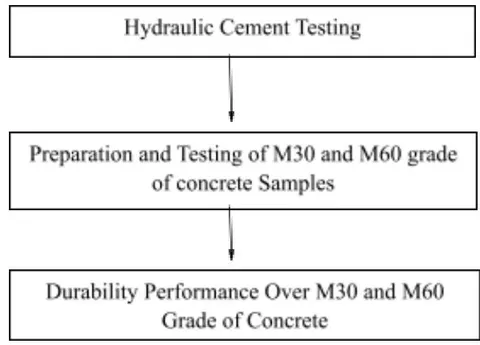
The following flow chart represents the different stages:
i. Physical Properties of Cement
Hydraulic Cement required to satisfy its physical properties up to its permissible limit. Hydraulic cement tests were performed to obtain the Physical characteristics of Cement used in the present study. To get the consistency and initial & final setting time of cement Vicat's apparatus used, the plunger penetration gave consistency and initial setting time for cement while the needle impression gave the final setting time of cement. The consistency helps us to find the water requirement for complete hydration of cement. Initial and Final setting time used to elaborate the setting times of cement when it starts to set till its hardening. LeChatelier apparatus used to obtained the soundness of the cement which is affected by the presence of free lime. The cement must be fine enough to pass the 90-micron sieve. The specific gravity of cement and all cementitious materials were find out by using LeChatelier's bottle. The specific gravity of fine aggregate obtained by using fineness modulus of sand was also done to determine the zone of sand while density bucket used for measure the specific gravity of coarse aggregates. The specific gravity of fine and coarse aggregates along with the cement specific gravity helps us to design the concrete mix. The proportion of mix design for M30 and M60 grade of concrete is shown in Table 1 and Table 2.
| Sr. No. | Material | Quantity (kg/m3) |
| 1. | Cement | 413 |
| 2. | Water | 186 |
| 3. | Coarse Aggregate | 1186.688 |
| 4. | Fine Aggregate | 674.804 |
| Sr. No. | Material | Quantity (kg/m3) |
| 1. | Cement | 500 |
| 2. | Water | 165.8 |
| 3. | Coarse Aggregate | 1072.3 |
| 4. | Fine Aggregate | 660.21 |
| 5. | Micro Silica | 35 |
| 6. | HRWR | 0.0096 |
ii. Sulfate Attack
The 3 set of concrete cubes of mm were casted by manual mixing in the laboratory for M30 and M60 grade of concrete. The cubes were in solution for curing at room temperature. Cubes were tested for compressive strength after 7, 14, & 28 days of curing in solution and tested in compression testing machine.
iii. Chloride Attack
The set of 3 concrete cubes of mm and mm were casted by the manual mixing in the laboratory for M30 and M60 grade of concrete. The cubes were kept in NaCl solution for curing at room temperature. The cubes were tested for the compressive strength after 7, 14, & 28 days of curing in chloride solution and testing in compression testing machine at respective days. And for the electrical conductivity, the test specimen of size mm for M30 and M60 grade of concrete; were also placed in NaCl solution and reading were recorded with electric conductivity meter. For the Rapid Chloride Penetration Test, the test specimen was of size mm for M30 and M60 grade of concrete and negative cell was filled with NaCl solution and positive side of the cell was filled with NaOH (Sodium Hydroxide) solution and power was set at and Power was applied for 6 hours and recordings were recorded at an interval of 30 minutes from which total charge was calculated.
where:
iv. Acid Attack Test
The 3 set of concrete cubes of mm were casted by manual mixing in the laboratory for M30 and M60 grade of concrete. The cubes were kept in respective solutions of , HCL & in solution of for curing, at room temperature. Cubes were tested for compressive strength after 28 days of curing, tested in compressive testing machine.
v. Sorptivity Test
It is the test method used to govern the rate of absorption of water by hydraulic cement concretes. It is measured as increase in mass of specimen resulting from the absorption of water, when alternate side is exposed to water. The test for determining the absorption rate follows ASTM C 1585 - 13. The test specimen was diameter and with a length of 50 mm. The test specimen should be placed in a sealable container and store the container at . for at least 15 days. Then remove the specimen from the container after 15 days and record the initial mass of the specimen. Epoxy paint was used for sealing the specimen. And then record the mass of sealed specimen. Then, place the support on the pan and fill with water till it rises up to , above the top of support device. Then place the test specimen on the supported material and immediately start the timing device. The mass of the specimen was recorded at interval of 60 secs, 5 min, 10 min, 20 min, 30 min, 60 min and every hour up to 6 hr. The absorption rate is calculated by the formula:
Where;
vi. Water Absorption Test
A cylinder were oven dried at for 24 hours. And weighed as W1; after 24 hours oven drying the samples were placed in warm water of about for 3.5 hours. The samples were then weigh after surface drying as W2. The calculation of water absorption was made by following equation;
Where;
III. RESULTS AND DISCUSSION
a) Sulfate Attack
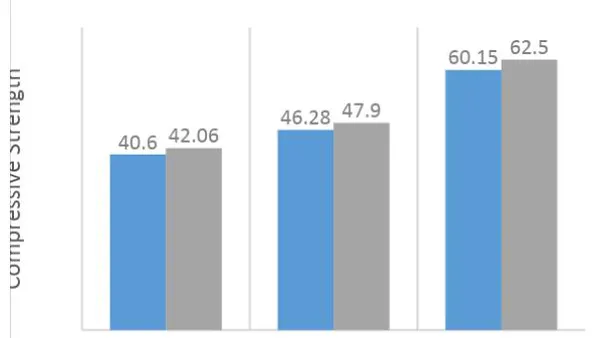
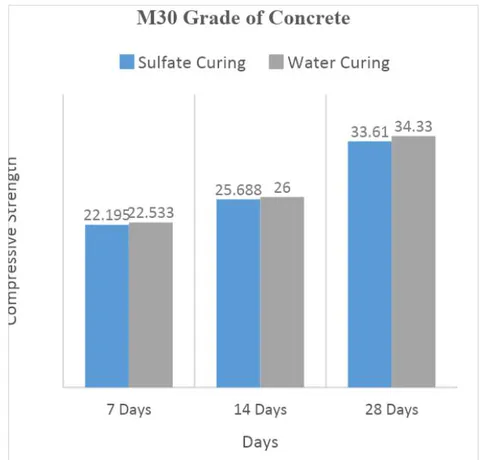
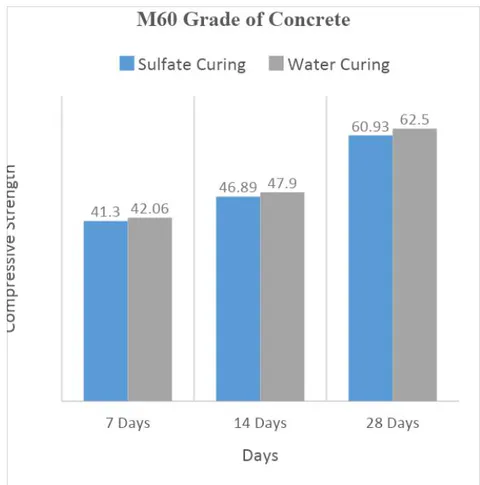
The loss in compressive strength for M30 is and for M60 is . The comparative graphical representation between sulfate curing and tap water curing of M30 grade of concrete is shown in Figure 2 and similarly of M60 grade of concrete is shown in Figure 3.
b) Chloride Attack
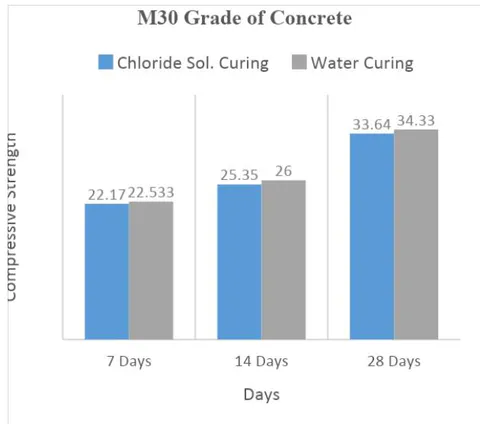
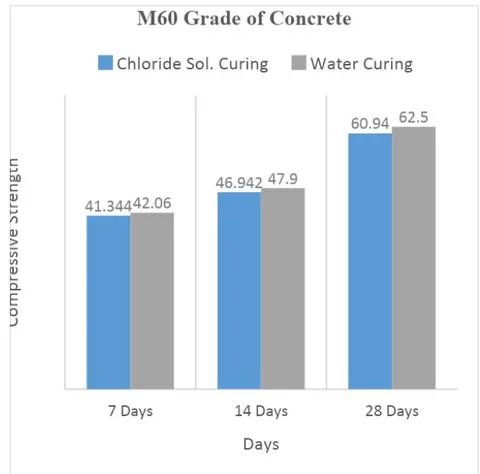
The change in compressive strength was compared to the standard samples were for M30 and for M60. The comparative graphical representation between chloride solution curing and tap water curing of M30 grade of concrete is shown in
Figure 4, And similarly of M60 grade of concrete is shown in Figure 5.
Electric Conductivity: The electric conductivity of concrete samples of M30 and M60 shown in the Table.1. It was observed that the electric conductivity of M30 and M60 concrete core was 24.2 Mhos/cm and 21.0 Mhos/cm for 60 minutes respectively.
| Electric Conductivity(Mhos/cm) | ||||
| Sample↓/ Time→ | 0 Min | 15 Mins | 10 Mins | 60 Mins |
| Distilled Water | 0.04 | 0.04 | 0.05 | 0.05 |
| 3%NaCl Solution | 21.2 | 21.1 | 21.2 | 21.2 |
| M30 in 3%NaCL | 21.3 | 21.3 | 23.0 | 24.2 |
| M60 in 3%NaCL | 20.1 | 20.8 | 21.0 | 21.0 |
Rapid Chloride Penetration Test: It was observed that the M30 grade of concrete has moderate Chloride ion penetration as the electric charge passed through the concrete sample were in between 2000 to 4000 which is moderate penetration and for M60 grade of concrete the Chloride ion penetration recorded was low penetration as the charge pass through the sample was in between 1000 to 2000. The Rapid chloride penetration test results are shown in Table.2.
| Specimen | Electrical Charge in coulomb | Chloride ion Penetration |
| M30 | 2250 | Moderate |
| 2560 | Moderate | |
| 3200 | Moderate | |
| M60 | 1905 | Low |
| 1890 | Low | |
| 1950 | Low |
c) Acid Attack
The effect of acid attack measured by the reduction in compressive strength w.r.t., controlled samples is shown in the graph for M30 and M60 respectively. The comparative graphical representation between HCl solution curing and tap water curing of M30 grade of concrete is shown in Figure 6, And M60 grade of concrete is shown in Figure 7. Similarly, the comparative graphical representation between solution curing and tap water curing of M30 grade of concrete is shown in Figure 8, And M60 grade of concrete is shown in Figure 9.
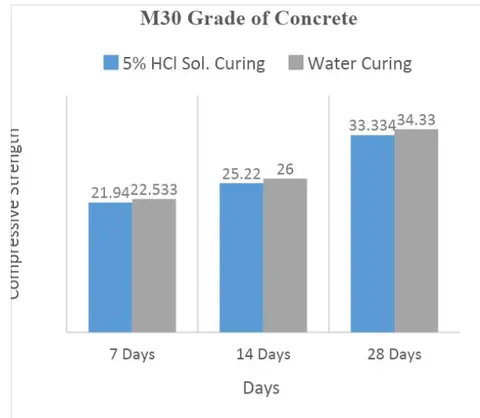
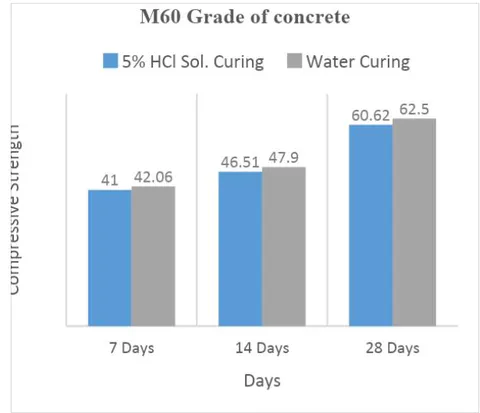
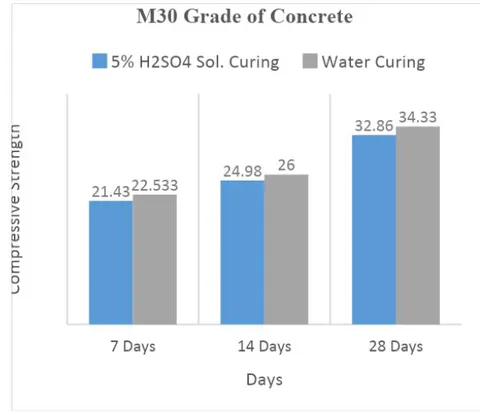
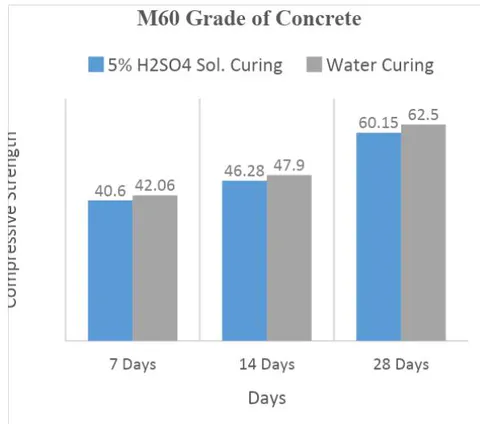
Therefore, it was observed that there was drop in the compressive strength when the samples were cured in the HCl solution and solution after 7, 14, and 28 days both for M30 and M60 Grade of concrete.
d) Sorptivity Test
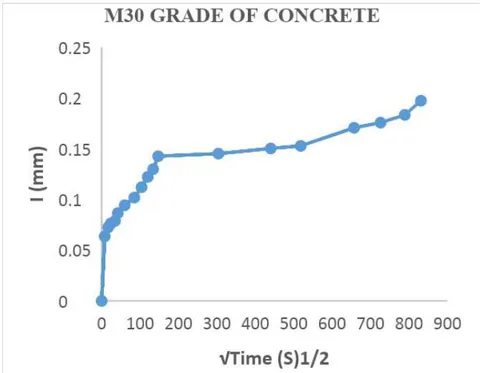
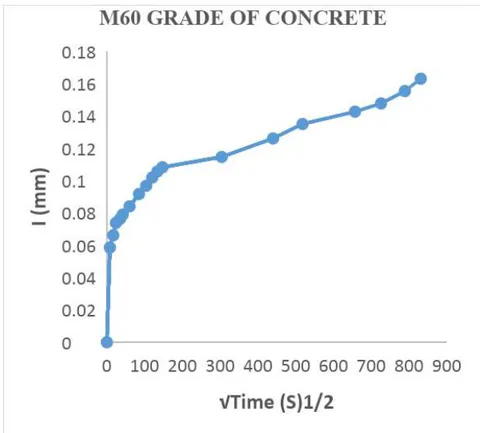
The maximum absorption in M30 grade of concrete found 0.197352 mm after 8 days' immersion of 100X50 mm core in water. While the maximum absorption in M60 grade of concrete found 0.162974 mm after 8 days of immersion of M60 grade concrete sample. The data for different time duration is shown in the graphical representation as shown in figure.10 And figure.11 respectively for M30 and M60 Grade of concrete.
e) Water Absorption Test
The test performed and the results are shown in Table.3. It was found that the average percentage water absorption for M30 grade of Concrete is while for M60 grade is of average percentage of water absorption recorded.
| Specimen | Oven Dried Weight (W1) Kg | Saturated Weight (W2) Kg | Difference in Weight (W2-W1) Kg | Water Absorption%age |
| M30 | 0.727 | 0.907 | .18 | 1.8 |
| 0.735 | 0.925 | .19 | 1.9 | |
| 0.736 | 0.916 | .18 | 1.8 | |
| M60 | 0.614 | 0.744 | .13 | 1.3 |
| 0.630 | 0.770 | .14 | 1.4 | |
| 0.652 | 0.772 | .12 | 1.2 |
IV. CONCLUSIONS
The sulfate attack, the chloride attack, the acid attack, and the water absorption of M30 and M60 grade of concrete was investigated in this study. The following conclusions can be drawn on the basis of experimental results:
Concrete exposed to the sulfate solution shows the loss in compressive strength for M30 is and for M60 is .
Concrete exposed to chloride solution shows the loss in compressive strength for M30 is and for M60 is . The electric conductivity of M30 and M60 concrete core was 24.2 Mhos/cm and 21 Mhos/cm for 60 minutes respectively. the M30 grade of concrete has moderate Chloride ion penetration as the electric charge passed through the concrete sample were in between 2000 to 4000 which is moderate penetration and for M60 grade of
- concrete the Chloride ion penetration recorded was low penetration as the charge pass through the sample was in between 1000 to 2000.
Concrete exposed to acid solution, it was observed that the strength reduction in HCl solution for M30 Grade of concrete is and for M60 grade of concrete is . While the reduction in compressive strength for immersed samples of M30 and M60 grade of concrete were found and respectively.
The maximum absorption in M30 grade of concrete found 0.197352 mm after 8 days' immersion core in water. While the maximum absorption in M60 grade of concrete found 0.162974 mm after 8 days of immersion concrete sample.
It was found that the average percentage water absorption for M30 grade of concrete was while for M60 grade of concrete was of average percentage of water absorption recorded.
ACKNOWLEDGEMENT
Authors would like to acknowledge Jaypee University of Information Technology, Waknaghat, Solan, for providing funds, essential facilities, and environment for research.