
I. INTRODUCTION
Malaria is one of the world's most deadly diseases, and it is perilous for pregnant women and children under 5 years of age. In 2018, of all the mortality due to malaria was attributed to pregnant mothers and children years (WHO, 2020). Africa is greatly affected by malaria more than the other continents that more than of morbidity and of mortality were from Africa (WHO, 2020). Apart from the consequences in mortality and the subsequent reduction in life expectancy, malaria affects people's physical conditions, making them more vulnerable to other diseases (Blanco, 2018). Anemia, malnutrition, and other health problems can significantly increase one's vulnerability to malaria. This option emphasizes that these factors directly contribute to being more susceptible to malaria.
Malaria-endemic countries are heavily impacted by the economic burden of the disease, primarily due to: -1- Reduced productivity: Malaria affects the workforce by causing absenteeism and decreased work performance due to illness. -2-). Reduces students' attendance at school, affecting their education and productivity in the long run: -3-) Large of money spent for its prevention and treatment that could otherwise be used for investment in productive activities (Blanco, 2018).
Investment in malaria control has greatly reduced transmission. An estimated 663 million cases have been averted worldwide between 2000 and 2015, with of them attributed to insecticide-treated nets (Bhatt, et al., 2015). Long-lasting insecticidal nets (LLINs) protect against malaria by acting as a physical barrier between mosquitoes and humans, and by the insecticide repelling or killing susceptible mosquitoes (Darriet et al., 1984; Lengeler, 2004 and Davies et al., 2007). Insecticide enhances public health by reducing mosquito density and helping maintain the net's effectiveness after holes develop (Derriet et al., 1984)).
In Eritrea, found in Sub-Saharan Africa (SSA), malaria is still endemic in four of the six zones (regions) despite the rate of endemicity is different among these regions. However, malaria is greatly reduced in Eritrea over the past two decades (Mihreteab et al, 2020).
During the last years, prevention in Eritrea has been based on two main methods of intervention: LLINs mass distribution and indoor residual spraying (IRS) in selective epidemic-prone areas with other supporting strategies like larval source management (LSM) and larviciding using temephos.
According to WHO Global Malaria Program (a system to improve value for money in LLIN procurement through market competition based on cons per year of adequate coverage), the annual cost of LLINs for malaria control is more than 500 million US dollars; it is the largest commodity category in the malaria control budget, so do in Eritrea mainly in Anseba Zone uses only LLINs with other supporting activity in malaria prevention nowadays every individual is provided with the net with high cost.
The same study was conducted in Benin, West Africa, to assess the physical integrity and survivorship of LLINs distributed to households in a community with similar socio-cultural characteristics. The study found that only of the LLINs exhibited visible integrity loss after six months (Gnanguenon et al. 2014). After a year, the damaged nets were increased by . This study revealed that the survival rate of the nets in households was lower than expected. However, the nets surprisingly met the WHO standard for physical integrity for a period of one year (Ahogni et al. 2020). Different studies from the same country found almost the same result in 12 months of utilization, that more than of the nets survived (Azondekon et al., 2014 and Gnanguenon et al., 2014).
Ahogni's study found that, out of 1,134 bed nets, only needed replacement, while required repairs. In contrast, another study from Uganda reported a significantly higher rate of net damage, with over of the nets having one or more holes (Kilian et al, 2011).
LLINs are expected to remain effective for at least three years under typical use conditions (WHO, 2011; Kilian et al. 2011). This recommendation from the WHO informs the practice of mass distribution campaigns every three years. However, numerous studies (Ahogni et al. 2020; Massue et al. 2016; Tan et al. 2016; Randriamaherijaona, 2017) have shown that various factors can compromise net lifespan, preventing them from reaching the expected three years.
Universal coverage campaigns often lack strategies to address net survivorship (resistance to damage and loss), attrition (nets falling out of use), and physical integrity (tears and holes). While the WHO emphasizes the importance of monitoring national coverage and durability (WHO, 2017), a more comprehensive approach is needed. Studies evaluating LLIN durability typically assess survivorship and attrition, physical integrity, and bio-efficacy (insecticide effectiveness).
In Eritrea, LLINs combined with IRS and larviciding remain the primary tools for vector control (Mihreteab et al., 2020). However, despite increased coverage of IRS and LLINs in recent years, malaria cases and deaths haven't shown a consistent decline (Mihreteab et al., 2020). Notably, LLINs have been the mainstay of malaria prevention for many years, distributed freely throughout the country. While the Eritrean government's commitment to tackling communicable diseases and providing free bed nets is commendable, a critical gap exists - a lack of recent studies on net survivorship, fabric integrity, and insecticidal activity (bio-efficacy).
II. METHODOLOGY
a) Study design
This study employed a community-based, prospective longitudinal design in the Asmat, Habero, Hagaz, and Elabered sub-zones (January 2021 - December 2020) – a period with an error. During net distribution, researchers identified participants and followed them for six months. The study focused on the durability of Yorkool-type LLINs, distributed one year prior, where each household member received a net (100% coverage). A total of 101 households were selected, enrolling 405 Yorkool nets (263 reported as used and 142 stored). The nets marked for use were assessed for durability every six months over three consecutive years.
Separately, 40 Yorkool LLINs were tested for bio-efficacy at baseline (day zero) and distributed to families in four sentinel sites. After one year, the tagged nets were collected and transported to the Elabered malaria entomology laboratory for further biological testing. Importantly, these families did not receive new nets during the study, as they were considered additional to the standard one-to-one distribution.
b) Study area
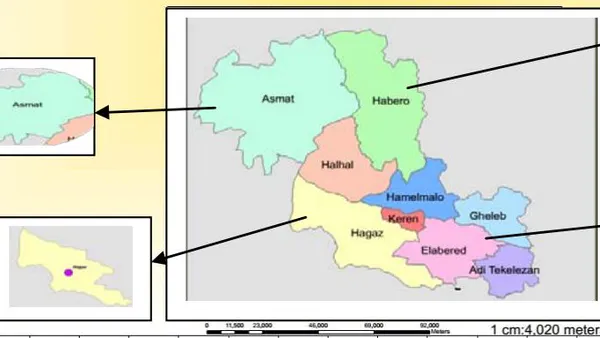
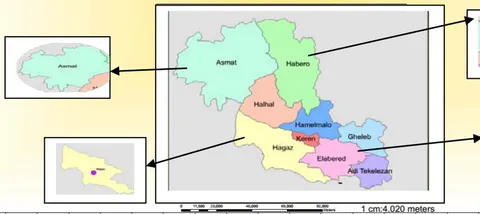
The study was conducted at 4-sentinel sites of Anseba region: Asneda (Asmat Sub-zone), Filfle (Habero Sub-zone), Adi Berbere (Elabered Sub-zone) and Hagaz town (Hagaz-Sub zone).
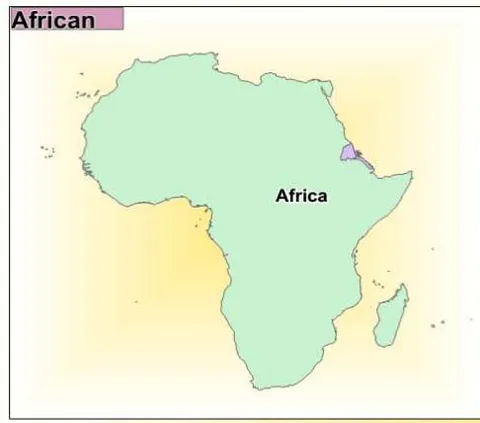
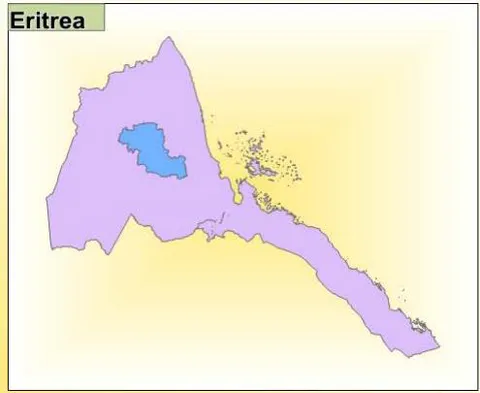
Geographical Location Africa, Eritrea&Anseba Zone
c) Study Population
The study population consisted of Yorkool type long-lasting insecticidal nets (LLINs). These nets had been tested for insecticidal activity at day zero and were impregnated with deltamethrin. Nets that were given away for others to use, stolen, destroyed, used for other purposes, or were torn (with a proportionate hole index between 65-642 mm) were excluded from the study. Furthermore marked nets in which the study HH was moved from the village for different purposes.
d) Sampling size determination
According to different studies, a sample size of 250 nets per product was used to detect a -point difference in LLIN attrition rate if the best-performing product has an attrition rate of . An buffer was added to the required sample size to prevent any negative impact of the mid-course withdrawal of some study participants. So, a sample size of 270 LLIN (yorkool) were retained for the study.
e) Sampling Techniques
In this community-based study, villages were selected using convenience sampling, while households (HHs) were chosen through simple random sampling. Villages within each sentinel site were chosen based on malaria incidence and the presence of active breeding sites. Household selection, however, employed simple random sampling. First, a complete census of all HHs in the chosen village was conducted prior to the distribution of nets. Then, from this list, ten households were randomly selected based solely on the head of household's name and provided with marked LLINs, each tested for bio-efficacy at day zero. The remaining 60 HHs per village were selected using the same method, yielding a total of 70 HHs per village to monitor attrition and fabric integrity of the nets.
f) Data Collection
Data was collected at the end of the malaria transmission season, just one year after mass distribution in November 2021. A standard questionnaire was used to collect data from an adult member of each household (HH) at the follow-up. Data collectors, who included public health officers, an entomologist, and insect collectors, were trained before conducting the survey to ensure understanding of the questionnaire. A pilot study was conducted by randomly selecting of the sample size from a non-selected administrative area. Information collected included the status, patterns of use, and handling of each study LLIN distributed to the HH. Additionally, data on fabric integrity and the overall condition of the LLINs were collected.
g) Data Management and Analysis
Data were analyzed using SPSS version 23, and separately it was analyzed on the three factors attributed to durability: The number of nets in the sample, the proportion of the indicator and confidence interval was reported.
h) Measurement of variables
Measurement of survivorship and attrition
The analysis included data on all nets recorded during the exercise at each time interval.
Survivorship:
- Numerator: Total number of LLIN product present in surveyed HHs (and available for sleeping under) x 100
- Denominator: Total number of LLIN product distributed to surveyed HHs
A. Attrition rate-1: for nets that have been destroyed or disposed of:
- Numerator: Total number of LLIN product reported as lost due to wear and tear (poor condition) in surveyed HHs x 100
- Denominator: Total number of LLIN product distributed to surveyed HHs
B. Attrition rate-2 for nets not available for sleeping under:
- Numerator: Total number of LLIN product reported as lost for reasons other than poor fabric integrity (given away, stolen, sold or used in another location) in surveyed households x 100
- Denominator: Total number of LLIN product distributed to surveyed HHs C. Attrition rate-3 for nets used for other purposes:
- Numerator: Total number of LLIN product reported as being used for another purpose in surveyed HHs x 100
- Denominator: Total number of LLIN product distributed to surveyed HHs For each LLIN product, the survivorship rate plus attrition rate-1, attrition rate-2 and attrition rate-3 will add up to .
Abbott's formula:
Measurement of Fabric integrity
Fabric integrity was analyzed for all the LLINs found in the HHs (and used for sleeping under), and all the LLINs assessed for holes at each monitoring round. Two indicators were calculated at each survey time: the proportion of LLINs with holes and a hole index.
Proportion of LLINs with any holes (with confidence interval):
- Numerator: Total number of LLINs product with at least one hole of size 1–4
- Denominator: Total number of LLINs product found and assessed in surveyed HHs
The hole index was calculated by weighting each hole by size and summing for each net. If the weight of hole sizes 1, 2, 3 and 4 was A, B, C and D, respectively, the hole index was calculated as:
Hole index = (A x no. of size-1 holes) + (B x no. of size-2 holes) + (C x no. of size-3 holes) + (D x no. size-4 holes).
Measurement WHO cone bioassay:
Standard WHO bioassays use standard susceptible 3-5 day old, non-blood fed Anopheles females exposed to netting under WHO cones for 5 minutes. Cones will be gently fitted on the net. Five female mosquitoes were introduced in each cone with 5 replicates per net sample (i.e. 25 mosquitoes per net).
After a 5-minute exposure time in each cone, the mosquitoes were held for 24 hours with access to a sugar solution. Knockdown was measured 60 minutes after exposure, and mortality was measured after 24 hours. A negative control, using an untreated net, was included in each round of cone bioassay testing.
If the mortality in the control was between and , the data was adjusted with Abbott's formula. If the mortality in the control is , all the tests were discarded for that day. Bioassays were carried out at and relative humidity.

i) Ethical Clearance
First and foremost, clearance to conduct the study was obtained from the Ethical Approval Committee at the Ministry of Health, Eritrea. Upon entering a selected community, the assistance of opinion leaders was sought to obtain permission to use their communities as study sites and to inform the communities about the study objectives and methods. Informed consent was then obtained from all participants in the study who received the nets. Confidentiality was ensured by not sharing any respondent information with anyone.
III. RESULT
a) Characteristics of Respondents and Housing Condition
Table 3.1 shows that the majority of respondents who completed the questionnaire were heads of households and parents/guardians. Among the interviewees, had no formal education or only a primary level education. The housing conditions where the nets were placed revealed that of the homes had concrete walls, while the rest were constructed with mud bricks or a combination of mud and wood framing.
Additionally, of the floors were made of soil or sand.
b) LLINs Utilization and Maintenance
Table 3.2 shows that of participants reported using their long-lasting insecticidal nets (LLINs) the night before the survey. Reasons for not using the nets included no reported malaria or mosquito presence. Over of the LLINs found in households were reportedly used every night for sleeping, with being used year-round. However, of the nets were used outside the main house, such as in gardens or on farmland (Figure 3.2).
Washing frequency, materials, and drying location can impact insecticidal activity. As shown in Table 3.4, only of the nets were washed one year after distribution. The primary cleaning material was local bar soap, though over reported using soap or detergent powder for washing. In more than half of the cases, washed LLINs were dried in sunlight.
| Characteristics | Hagaz | Elabered | Asmat | Haboro | Total | |
| Interviewee | Head Of HH | 48 | 50 | 40 | 19 | 39 |
| Guardian/Parent | 35 | 3 | 4 | 78 | 39 | |
| Other Adult | 17 | 12 | 56 | 4 | 22 | |
| Educational Level | No Former Education | 9 | 15 | 4 | 33 | 15 |
| Primary School | 52 | 3 | 32 | 44 | 42 | |
| Junior School | 17 | 19 | 12 | 19 | 17 | |
| High School | 17 | 23 | 36 | 4 | 20 | |
| Higher Level | 4 | 4 | 16 | 0 | 6 | |
| Roof of the wall(Where the nets are found) | Mud Brick | 45 | 0 | 0 | 7 | 13 |
| Mud With Wood Frame | 0 | 4 | 4 | 70 | 20 | |
| Concrete | 55 | 9 | 76 | 19 | 61 | |
| Wood | 0 | 0 | 4 | 0 | 1 | |
| Straw | 0 | 0 | 0 | 0 | 0 | |
| No Wall | 0 | 0 | 0 | 0 | 0 | |
| Other | 0 | 0 | 0 | 0 | 0 | |
| Type of flooring in the Room | Soil Or Sand | 69 | 63 | 95 | 67 | 74 |
| Wood | 0 | 0 | 0 | 15 | 4 | |
| Cement | 31 | 37 | 5 | 18 | 23 | |
| Carpet | 0 | 0 | 0 | 0 | 0 | |
| How often the being used is the net being used in the last week | Every night | 100 | 92 | 96 | 96 | 96 |
| Most nights | 0 | 0 | 0 | 4 | 1 | |
| Some nights | 0 | 8 | 0 | 0 | 2 | |
| Not used at all | 0 | 0 | 4 | 0 | 1 | |
| During which period is the net used | All year round | 59 | 85 | 96 | 89 | 82.3 |
| During transmission season | 41 | 15 | 0 | 11 | 16.7 | |
| During dry season | 0 | 0 | 0 | 0 | 0 | |
| Displacement of the net from the main house | Taken to farm land | 23 | 0 | 0 | 26 | 12.3 |
| Taken to garden | 0 | 4 | 0 | 4 | 1 | |
| Other | 0 | 4 | 8 | 7 | 4.8 | |
| Not used away | 77 | 92 | 92 | 63 | 81.9 | |
| LLINs maintenance | ||||||
| Ever washed Nets | Yes | 50 | 36 | 47 | 61 | 48 |
| No | 50 | 64 | 53 | 39 | 52 | |
| Washing method | washed with cold water | 57 | 8 | 18 | 0 | 20 |
| washed with a bleach/ soap | 43 | 92 | 82 | 100 | 80 | |
| Those Nets Washed With Bleach/Soap | local bar soap | 17 | 0 | 22 | 6 | 9 |
| detergent powder | 50 | 92 | 78 | 94 | 84 | |
| mix of bar and detergent | 33 | 8 | 0 | 0 | 7 | |
| Drying Method | exposed to sun light | 29 | 46 | 73 | 59 | 51 |
| dried in shaded place | 36 | 54 | 27 | 41 | 40 | |
| dried in indoor | 36 | 0 | 0 | 0 | 9 | |
c)Survivorship and attrition
During follow-up visits at 12 months, a total of 250 LLINs marked as used and 139 marked as stored were found to be available at the households (HHs). While the text mentions a survival rate of for used LLINs and for stored LLINs, these percentages seem to be incorrect based on the provided data.
d) Physical Integrity
At 12 months of use, the percentage of nets with hole was found to be . As depicted in table 4.7, it was , , and in Hagaz, Elabered, Asmat, and Haboro respectively. The average proportional hole index (pHI) of Yorkool®LN mosquito nets after 12 month of distribution was 14.31, 10.75, 3.36, 1.59 in Hagaz, Elabered, Asmat and Haboro respectively. The average of LLINs with a hole but in a good condition was . However, the present study found that all damaged e nets could be repaired and be used further; besides, none of the nets was categorized under "to be replaced".
Table 3.2:Survivorship
| Nets in the master list under use | yes use | Survivorship of nets in use | Nets in the master list under store | yes store | Survivorship of nets in store | |
| Hagaz | 70 | 64 | 91.43% | 23.00 | 22 | 95.65% |
| Elabered | 66 | 62 | 93.94% | 39.00 | 37 | 94.87% |
| Asmat | 64 | 64 | 100.00% | 31.00 | 31 | 100.00% |
| Haboro | 63 | 60 | 95.24% | 49.00 | 49 | 100.00% |
| Total | 263 | 250 | 95.05% | 142.00 | 139 | 97.88% |
Table 3.4: Attrition
| Nets in the master list under use | Attrition rate 1 | Attrition rate 2 | Attrition rate 3 | |
| Hagaz | 70 | (0/70)*100=0% | (6/70)*100=8.57% | (0/70)*100=0 |
| Elabered | 66 | (1/66)*100=1.52% | (3/66)*100=4.55% | (0/66)*100=0% |
| Asmat | 64 | (0/64)*100=0% | (0/64)*100=0% | (0/64)*100=0% |
| Haboro | 63 | (0/63)*100=0% | (3/63)*100=4.76% | (0/63)*100=0% |
| Total | 263 | (1/263)*100=0.38% | (12/263)*100=4.56% | (0/263)*100=0% |
Table 3.5: Physical integrity Table 3.6: PHI Value
| Sub zone | Nets in the master list under use | Nets with holes | Proportion of the net with holes |
| Hagaz | 70 | 13.00 | 0.19 |
| Elabered | 66 | 13.00 | 0.20 |
| Asmat | 64 | 18.00 | 0.28 |
| Haboro | 63 | 9.00 | 0.14 |
| Total | 263 | 53.00 | 0.20 |
| Total nets assessed | Nets with no Holes | Nets with at least one hole | |||
| Good condition (PHI< 64) | To be repaired (65<= PHI <= 642) | To be replaced (PHI > 624) | |||
| Hagaz | 70 | 57(81.43%) | 10(14.28%) | 3(4.28%) | 0(0%) |
| Elabered | 66 | 53(80.30%) | 10(15.15%) | 3(4.54%) | 0(0%) |
| Asmat | 64 | 46(71.88%) | 17(26.56%) | 1(1.56%) | 0(0%) |
| Haboro | 63 | 54(85.71%) | 9(14.28%) | 0(0%) | 0(0%) |
| Total | 263 | 217(82.51%) | 46(17.49%) | 7(2.66%) | 0(0%) |
e) Bio-Efficacy
Table 4.7 shows that 40 nets (10 nets from each sub zone) were enrolled for WHO bio-assay test. So the mean knockdown down rate was 80. and the mean mortality rate after 24 h was with CI of – 81.5
Table 3.8: Mean KD and Mean mortality rate of the LLINs after 12 month with WHO Cone Test
| Sub-Zone | ||||
| Hagaz | Elabered | Haboro | Asmat | |
| Total Yorkool LLINs | 10 | 10 | 10 | 10 |
| Total Mosquito Inserted (tested) | 500 | 500 | 500 | 500 |
| Mean Knockdown Rate | 89% | 85% | 77% | 71% |
| Mean Mortality Rate After 24 Hrs. | 72% | 79% | 68% | 65% |
| 95% CI of percent's | 56 - 82 | 60 - 86 | 51 – 79 | 42- 75 |
IV. DISCUSSION
This study revealed that the washing frequency in the past year was less than half of what was expected for the total number of distributed nets. While washing frequency didn't seem to impact the overall survival rate of the nets, it did affect their physical integrity. This finding aligns with a study from Benin by Gnanguenon et al. (2014), which also observed a negative impact of frequent washing on the physical condition of LLINs. However, another study from Benin by Ahogni et al. (2020) found that even with holes, LLINs generally maintained a mortality rate above . This highlights a crucial point: even if physically damaged, LLINs can still offer significant protection against mosquito bites, making their continued use essential.
The study results showed that, of the total observed LLINs, more than was in serviceable condition after an average use of 12 months. The result also showed that almost none of the nets badly torn and removed from utilization. A study from Chad revealed, among the observed LLINs less than were found to be serviceable after 14 months of utilization and nearly of the total were badly torn and considered unserviceable (Allan et al., 2012). As the study revealed sleeping without mattress was one of the reasons which reduced the serviceable life of the LLINs (Allan et al., 2012). On the contrary a study from Benin on similar type of bed net revealed after eighteen months of use, more than two-third were found functionally survived (Ahogni et al., 2020).
Our study observed a low attrition rate of only after 12 months of monitoring, significantly lower than findings from Benin and Mozambique (Ahogni et al., 2020; Juliette et al., 2015). This lower rate can be attributed to the nets being primarily given away to others, unlike the other studies where misuse was reported. Interestingly, a study from Nepal (mention reference) found LLIN loss due to displacement for seasonal fieldwork, alongside instances of misuse (Ahogni et al., 2020).
Nearly of the study LLINs remained in good physical condition, without holes, after 12 months of use. Similar results were observed in Benin and
Madagascar (Ahogni et al., 2020; Tan et al., 2016), while a higher proportion of torn nets was reported in Zambia (Kilian et al., 2011). Furthermore, the present study found that of the Yorkool LLINs were in good working condition after 12 months of distribution. This finding is slightly lower than that reported by Ahogni et al. Additionally, the present study did not observe as high a proportion of torn nets as was observed in the study from Zambia (Craig et al., 2015). A high proportion of holes compromises the physical protection offered by LLINs. This allows mosquitoes to feed on humans, thereby perpetuating human-vector contact and malaria transmission (Ochomo et al., 2013; Haji et al., 2013). Supporting this, another study demonstrated a direct link between the physical integrity of LLINs and human-vector contact. They found that damaged nets increased the average number of mosquito bites per person per night from zero to five (Gnanguenon et al., 2014).
The study measured a knock-down (KD) rate of at 60 minutes and a mortality rate after 24 hours of exposure. These findings fall short of the World Health Organization (WHO) standards. According to the WHO Pesticide Evaluation Scheme (WHOPES), an effective LLIN should retain biological efficacy for at least 3 years. This is defined as at least of nets achieving either knock-down or mortality (WHO, 2012). Ideally, LLINs should maintain their insecticidal activity for this timeframe (Albert, 2012).
A study conducted in Madagascar on Yorkool LLINs reported similar results to the present study, with over of the nets failing to meet the WHO threshold (Tan et al., 2016; Gnanguenon et al., 2014). However, Ahogni et al. (20XX) found that of their study nets met the WHO quality standard for both knock-down at 60 minutes and mortality after 24 hours.
The durability and lifetime of LLINs are critical factors for program planners to determine the most cost-effective timing and distribution strategies for net replacements. However, the most crucial aspect remains the biological efficacy of LLINs. They must meet the WHO's minimum requirements for knock-down (KD) and mortality rates after 60 minutes and 24 hours, respectively.
V. CONCLUSION
The newly distributed Yorkool LLINs are expected to have a lifespan of approximately 3 years, maintaining their physical integrity, survivorship, attrition resistance, and bio-efficacy. However, the present study identified holes in nearly of the nets after only 12 months of use. Fortunately, none required immediate replacement.
Encouragingly, over of the nets in the study remained intact despite the insecticide not meeting WHO's bio-efficacy criteria for knock-down or mortality rates. Further evaluation of net durability is recommended to determine the ongoing protective effect these nets provide to the community.