Dynamic Interplay: Unveiling the Biosphere-Geosphere Nexus in Carbon Cycling

1
A.A. Ivlev
A.A. Ivlev

Send Message

To: Author

GJHSS Volume 24 Issue B1

Article Fingerprint

ReserarchID

Y5N3Z

Dynamic Interplay: Unveiling the Biosphere-Geosphere Nexus in  Carbon Cycling Banner
  • English
  • Afrikaans
  • Albanian
  • Amharic
  • Arabic
  • Armenian
  • Azerbaijani
  • Basque
  • Belarusian
  • Bengali
  • Bosnian
  • Bulgarian
  • Catalan
  • Cebuano
  • Chichewa
  • Chinese (Simplified)
  • Chinese (Traditional)
  • Corsican
  • Croatian
  • Czech
  • Danish
  • Dutch
  • Esperanto
  • Estonian
  • Filipino
  • Finnish
  • French
  • Frisian
  • Galician
  • Georgian
  • German
  • Greek
  • Gujarati
  • Haitian Creole
  • Hausa
  • Hawaiian
  • Hebrew
  • Hindi
  • Hmong
  • Hungarian
  • Icelandic
  • Igbo
  • Indonesian
  • Irish
  • Italian
  • Japanese
  • Javanese
  • Kannada
  • Kazakh
  • Khmer
  • Korean
  • Kurdish (Kurmanji)
  • Kyrgyz
  • Lao
  • Latin
  • Latvian
  • Lithuanian
  • Luxembourgish
  • Macedonian
  • Malagasy
  • Malay
  • Malayalam
  • Maltese
  • Maori
  • Marathi
  • Mongolian
  • Myanmar (Burmese)
  • Nepali
  • Norwegian
  • Pashto
  • Persian
  • Polish
  • Portuguese
  • Punjabi
  • Romanian
  • Russian
  • Samoan
  • Scots Gaelic
  • Serbian
  • Sesotho
  • Shona
  • Sindhi
  • Sinhala
  • Slovak
  • Slovenian
  • Somali
  • Spanish
  • Sundanese
  • Swahili
  • Swedish
  • Tajik
  • Tamil
  • Telugu
  • Thai
  • Turkish
  • Ukrainian
  • Urdu
  • Uzbek
  • Vietnamese
  • Welsh
  • Xhosa
  • Yiddish
  • Yoruba
  • Zulu

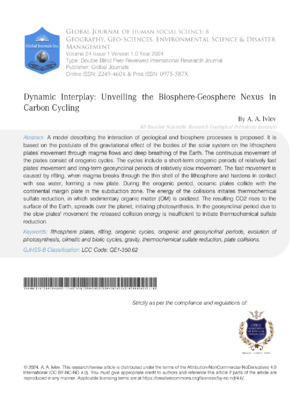
A model describing the interaction of geological and biosphere processes is proposed. It is based on the postulate of the gravitational effect of the bodies of the solar system on the lithosphere plates’ movement through magma flows and deep breathing of the Earth. The continuous movement of the plates consist of orogenic cycles. The cycles include a short-term orogenic periods of relatively fast plates’ movement and long-term geosynclinal periods of relatively slow movement. The fast movement is caused by rifting, when magma breaks through the thin shell of the lithosphere and hardens in contact with sea water, forming a new plate. During the orogenic period, oceanic plates collide with the continental margin plate in the subduction zone. The energy of the collisions initiates thermochemical sulfate reduction, in which sedimentary organic matter (OM) is oxidized. The resulting CO2 rises to the surface of the Earth, spreads over the planet, initiating photosynthesis. In the geosynclinal period due to the slow plates’ movement the released collision energy is insufficient to initiate thermochemical sulfate reduction.

Funding

No external funding was declared for this work.

Conflict of Interest

The authors declare no conflict of interest.

Ethical Approval

No ethics committee approval was required for this article type.

Data Availability

Not applicable for this article.

A.A. Ivlev. 2026. \u201cDynamic Interplay: Unveiling the Biosphere-Geosphere Nexus in Carbon Cycling\u201d. Global Journal of Human-Social Science - B: Geography, Environmental Science & Disaster Management GJHSS-B Volume 24 (GJHSS Volume 24 Issue B1): .

Download Citation

High-res visual of biosphere-geosphere interactions in carbon cycling.
Issue Cover
GJHSS Volume 24 Issue B1
Pg. 23- 37
Journal Specifications

Crossref Journal DOI 10.17406/GJHSS

Print ISSN 0975-587X

e-ISSN 2249-460X

Keywords
Classification
Not Found
Version of record

v1.2

Issue date

February 29, 2024

Language

English

Experiance in AR

The methods for personal identification and authentication are no exception.

Read in 3D

The methods for personal identification and authentication are no exception.

Article Matrices
Total Views: 1223
Total Downloads: 28
2026 Trends
Research Identity (RIN)
Related Research

Published Article

A model describing the interaction of geological and biosphere processes is proposed. It is based on the postulate of the gravitational effect of the bodies of the solar system on the lithosphere plates’ movement through magma flows and deep breathing of the Earth. The continuous movement of the plates consist of orogenic cycles. The cycles include a short-term orogenic periods of relatively fast plates’ movement and long-term geosynclinal periods of relatively slow movement. The fast movement is caused by rifting, when magma breaks through the thin shell of the lithosphere and hardens in contact with sea water, forming a new plate. During the orogenic period, oceanic plates collide with the continental margin plate in the subduction zone. The energy of the collisions initiates thermochemical sulfate reduction, in which sedimentary organic matter (OM) is oxidized. The resulting CO2 rises to the surface of the Earth, spreads over the planet, initiating photosynthesis. In the geosynclinal period due to the slow plates’ movement the released collision energy is insufficient to initiate thermochemical sulfate reduction.

Our website is actively being updated, and changes may occur frequently. Please clear your browser cache if needed. For feedback or error reporting, please email [email protected]
×

This Page is Under Development

We are currently updating this article page for a better experience.

Request Access

Please fill out the form below to request access to this research paper. Your request will be reviewed by the editorial or author team.
X

Quote and Order Details

Contact Person

Invoice Address

Notes or Comments

This is the heading

Lorem ipsum dolor sit amet, consectetur adipiscing elit. Ut elit tellus, luctus nec ullamcorper mattis, pulvinar dapibus leo.


High-quality academic research articles on global topics and journals.

Dynamic Interplay: Unveiling the Biosphere-Geosphere Nexus in Carbon Cycling

A.A. Ivlev
A.A. Ivlev

Research Journals