Similarity is crucial in mathematics and other fields. It relates to different curricular mathematics content, for instance, proportionality, measures, and shapes. This article discusses the interactions of prospective teachers when performing similarity tasks in a multiuser, online, virtual, and synchronous environment with Geo Gebra, the VMTwG. The analyzed task focused on the similarity ratio from a slider. The focus here is to illustrate how the subjects interact when dragging free points of two triangles created with dependence on each other and using a checkered mesh. Data production came from registers written and Geo Gebra screen construction by participants and VMT replayer. The use of the slider may represent a more potent form of thought process, which implies both the global observation of geometric properties, the validation of conjectures and checking detailed results.
## I. INTRODUCTION
This study was motivated by the need for new paths in the teaching and learning geometry, precisely triangle similarity, to understand what contributions and synchronous interactions in a Virtual Math Teams (VMT) environment can be observed in the learning of (prospective) teachers. VMT allows for the creation of workspaces using Desmos or GeoGebra, and the latter is called Virtual Math teams with GeoGebra (VMTwG)[^1] $^{1}$.
VMT platform adds the Dynamic Geometry Environment (DGE) GeoGebra. It makes possible to drag points, free or linked to a figure, allowing to produce hypotheses on the observed properties (Arzarello, Olivero, Paola & Robutti, 2002), as well as for the verification of relations among objects and the dynamics of relations (Alqahtani & Powell, 2016). As it is a multiuser environment, the VMT constitutes collaborating groups that explore, question, and learn together (Stahl, Koschmann & Suthers, 2008), involving the interaction between the individual and the device, and among the subjects. We consider not only the importance of an individual's learning, one's mind with itself, but also the possibility of collective learning and group cognition (Stahl, 2015).
We understand that tasks in a DGE open the way to producing mathematical meanings (conceptual, procedurals, etc.), although not automatically (Bussi & Mariotti, 2008). It becomes necessary, therefore, to have a didactic project that supports the students in these environments. In this way, we seek to understand the role of the checkered grid, the task script, and the chat in a task of geometry, virtual and synchronous, in the configuration of thinking among teachers and prospective teachers. We would like to stress that a checkered grid/mesh is a resource available at the graphic zone of VMTwG, the chat is one of the spaces of VMTwG designed to exchange posting, and the script for the task was made by the authors (Brito, 2022).
In our research group[^2] we are designing, implementing, and analyzing tasks in the VMTcG concerning similarity (Brito & Bairral, 2023) and isometry (Bairral & Silvano, 2023). This article[^3] illustrates and analyzes synchronous interactions of (prospective) teachers[^4] in online tasks on triangle similarities and establish the role of the checkered mesh and sliding control in the configuration of geometric thinking among the participants. It summarizes results from Brito & Bairral (2023) concerning reasoning and geometric processes involved in using sliding control in the provided task. Since in Brazil similarity instruction is mainly focused on static geometric shapes, on numerical procedures and applying the rule of three, the study's contribution is reflecting about another possibility of teaching and learning similarity with online DGE.
## II. TEACHING AND LEARNING SIMILARITY
The similarity of plane figures is usually related to the notion of measure, amplification, and reduction, keeping the proportion of the corresponding sides and angles. The similarity of figures is related to homothety, the right triangle metric ratios, the invariance of trigonometric ratios (Jaconiano, Barbosa, Concordido & Costa, 2019; González et al., 1990), the demonstration of mathematic theorems, as the fundamental theorem of proportionality and the Thales theorem (Pereira, 2017).
Similarity is applied in different fields of knowledge such as engineering, architecture, the study of optical phenomena, videogame programming and digital image processing. Such fields of study have the professional aim to control the dimensions and proportions of the shapes involved (Maciel & Almouloud, 2004; Powell & Alqahtani, 2021). One example of the application of similarity of plane figures is when you slide your fingers over the screen of a smartphone, tablet, or any other touch screen devices, to visualize an image without deforming it. It is also usual in computer programs when you alter the length and height of figures, keeping the proportion of their corresponding sides when you drag the image diagonally (Bairral, 2020; Brito & Bairral, 2023).
The concept of similitude, mainly of triangles, is exceptionally prominent (Lima, 2011). Books usually define similar triangles as those that have equal angles and proportional homologous sides, and this definition is extended to polygons. Triangles are the only group of non-deformable polygons, and the two conditions that guarantee similitude always occur together [...]: if the sides are proportional, the corresponding angles will automatically be equal, and vice-versa (Machado, 2000). The triangles show specific characteristics of similitude, which constitute the basis for understanding the similitude of other polygons.
The criteria that establish the similitude of triangles are not well established for the learning subjects (González et al. 1990). According to authors, there is some language interference of mathematical language into everyday language, because the word similar has different meanings depending on the context of the language being used as pointed out by Bairral (1998) and Machado (2000). We have specified the way mathematics defines similar figures. Nevertheless, in everyday language, similar objects can be either equal or only resembling each other. We observe that from a mathematics point of view, we are dealing with something clearly more defined: figures that have the same shape, with equal or different sizes (Pereira, 2017).
González et al. (1990) stress two criteria - equal corresponding angles and proportional homologous sides - to identify similarity. The first one is probably the easiest to identify. Still, the second criterion, the similarity ratio between the figures, is a concept that is closely related to the proportionality between quantities. It needs to be worked upon with plenty of activities significant enough to ensure their acquisition, including tasks using floor plans and the scale concept (Bairral, 1998).
Galvão, Souza and Miashiro (2016) developed work on trigonometric functions among undergraduate students of mathematics. They observed that the students' lack of mastery of trigonometry when dealing with right triangles, Pythagoras theorem, measuring angles (in degrees and radians), and in the definition of the sine function was all a result of the little understanding they had about triangle similitude.
Other studies involving mathematics teachers stress the abusive use of the rule of three in solving geometry problems without considering concepts of proportionality and similarity (Costa & Allevato, 2015; Tinoco, 1996). Along these lines, it is argued that the teaching of similarity should not be restricted to how to solve something, but rather stress on the reason why one method is used, to avoid prejudice when learning (Jaconiano et al., 2019; Menduni-Bortoloti & Barbosa, 2018).
We understand that this scenario demands new practices in the teaching of triangle similarity to enable the development of geometric and proportional thinking among learners. The concept of proportionality is essential to make connections, as it integrates content of different branches of mathematics (Tinoco, 1996). And, more than the content to be taught, proportionality works in building cognitive structures that are necessary for the comprehension of other mathematics concepts, whether in the numeric or the geometric field (Costa & Allevato, 2015).
González et al. (1990) propose working the concept of similitude from figure enlarging or reduction and observing variant and invariant characteristics. Since similarity is a relevant concept in mathematics, exploring geometrically – and not only numerically or applying the rule of three – these processes of enlarging, reducing, and verifying congruence sounds powerful in mathematical thinking and using DGE to enhance learning.
### a) Learning similarity using DGE and VMTwG
Mathematic activity takes place in the dialog of a mind with itself over observations of objects, relations among objects, and relations among relations or dynamics (Gattegno, 1987). We consider that mathematic activity of (prospective) teachers regarding triangle similitude takes place from dialogs with themselves over observations of objects (angles, sides, and their measurements), relations among objects (corresponding angles, sides, and points), and relations among relations or dynamics (congruence of corresponding angles, ratio, proportion, and proportionality of homologous sides, as well as similitude among triangles).
We consider essential to establish a new approach on the similitude of triangles from the use of DGE with the audience of prospective mathematics teachers. The logic involved in DGE emphasizes the development of mathematic activity through moving or deformable figures as a resource to promote exploration, discovery, and research of mathematic objects, whether through software or not (Arceo, 2009 apud Bairral & Barreira, 2017). It is crucial to highlight that those processes do not occur automatically. They require the teacher's mediation while the actions are taking place in the DGE (Arzarello et al., 2002).
Among the particularities of a DGE through software, we are stressing the possibility to drag free points and transforming figures, keeping, or not keeping Euclidian properties (Bairral & Barreira, 2017). The dragging action helps the individual to produce conjectures through the observation and exploration of the movements of a figure and through the discovery of invariant properties (Azarello et al, 2002).
Those features can be enhanced by making groups of interaction in virtual environments, working on the resolution of mathematic tasks in a collaborative way (Powell, 2014). It was with this aim that VTM was developed, so that participants could interact with one another through a chat, build figures and drag points in the graphic area of GeoGebra.
In this way, with GeoGebra added to VMT, besides the interaction among individuals and DGE, other elements are related, like the interaction among the participants in the group that has come into play. We use the term interaction, from discourse analysis studies, as a synonym for interlocution and meaning exchange, reflection, and negotiation of meanings, with the possibility to take place among two or more interlocutors subjected to shared norms, orally or in writing, with or without the use of technology (Maingueneau, 2004; Oliveira & Bairral, 2020).
Interaction related to the use of VMT focuses on the collaboration among individuals, so it is a collaborative interaction in which the group works for on joint task and learning (Oliveira & Bairral, 2020), where the students learn through their questions, pursuing joint lines of reasoning, teaching one another, and watching how others are learning (Stahl et al., 2008). Collaborative interaction implies that the task is carried out jointly - even the discourse that issues from it does not belong to one individual but to the collective that has issued from the joint work.
DGE and its functions comprise a microworld in which the logic of Euclidean geometry is embedded (Mariotti, 2000), and it is possible to produce graphic strokes where the properties of the object are preserved thanks to the working of the tools that operate in this micro world. We shall call this micro world an artifact (Bussi & Mariotti, 2008), and the functions of dragging are classified as direct or indirect dragging. In direct dragging it is possible to drag a point without interfering with another. In contrast, in whereas in indirect dragging there is some interference in the movement of other points and elements built from the original point. It is worth noting that the meaning of artifact is not restricted to the DGE, but is a broader notion, including every type of human creation that has a practical nature, everything to which an individual attributes a use and which, at the same time, moves from the sphere of intellect to the sphere of practical doings and vice-versa (Bussi & Mariotti, 2008).
In the next section we shall discuss about the importance of dragging, artifacts, signs in each task and in mathematical learning in DGE.
## III. THEORETICAL FRAMEWORK
Online and synchronous virtual environments can provide a favorable space for learning both individually and collectively. Collaborative interactions and the role of VMT can be analyzed through discursive aspects, through interactions among individuals with DGE, through the dragging action, and through the meanings that individuals apply to each form of dragging. For instance, Alqahtani & Powell (2016, 2017b) organized a training course for teachers of mathematics, online and synchronously on VMTwG, and they noticed that the dragging $^5$ resource was used more knowingly, to the extent that teachers didn't only check the features contained in the construction, but they also checked the validity of the construction.
The tasks proposed by Alqahtani & Powell (2016, 2017b) involved triangles that were dependent on one another, where indirect dragging was necessary for the resolution of the problem that was proposed. The teachers participating in the research used the dragging resource together with the algebra window, aiming to understand the dependence of measures of the angles and the sides. Besides, the teachers also "dragged a triangle on top of another, or whatever they called overlapping triangles... so that in almost every task after this one, they discussed some form of congruence and similitude of objects" (Alqahtani & Powell, 2017b, p.32).
The authors stress the importance of educators' understanding how their students take over virtual collaborating environments, and how this appropriation brings a new configuration to the geometric thinking of the learners. These authors highlight two aspects of tasks with DGE: the manipulation of geometric objects by dragging and the discourse based on the relations and dependencies observed when dragging the objects. The resource of dragging is related to the external context of the student, that is, to the DGE itself and to the icons that allow the manipulation of objects. The dragging action is interlinked with the students' discourse, as it opens the way to actions that can become part of the mathematic discourse, thinking, and communication of geometric ideas (Alqahtani & Powell, 2017b).
It is in this sense that Bussi & Mariotti (2008) discuss the role of artifacts and signs in a given mathematic task, comprising the external context (the artifact) and the internal one (the signs). Artifacts act externally and are related to their practical perspective in the task, that is, how individuals attribute them a use. For instance, there are situations that come into play in the use of hammer. Depending on what it is aimed for, it can be used to hammer nail into the wall or to take it out. It will be necessary to consider the amount of strength, the position etc. Situations like the ones regarding the use of the hammer make it an artifact. We shall now move on to deal with the internal context.
Besides the physical device, an artifact such as the VMT, through its dragging function, can internally guide the behavior of an individual and it can affect their cognitive activity. Despite differences, the sign and the artifact have in common the function of mediation in the resolution of a task. Still, they differ in the way they orient human behavior. Vigotski calls "internalization" the process "in which individuals transform external activities linked to artifacts into internal activities which are linked to signs" (Alqahtani & Powell (2017b, p.3), involving "the inner reconstruction of an external operation" (Bussi & Mariotti, 2008, p. 751).
Internalization is led by semiotic processes. In other words, this means that the process involves a semiotic mediation that consists not only in encouraging the relation of mathematic knowledge with the student, but also comprises the links between signs and the content being studied. According to Bussi & Mariotti (2008), there is a system of signs of the artifact that relate the artifact to the specific task that is aimed. These signs have a solid link to the procedures that are carried out, and the semiotic means through which these signs are produced go from gestures, words, figures, etc.
The second system of signs - called mathematic signs - is parallel to the one mentioned above, and it consists of the relation between an artifact and mathematic knowledge. This relationship is expressed through signs that reveal properties embedded in the artifact. These two systems do not relate spontaneously, and so it is vital for the teacher to understand the evolution of signs, from artifact to mathematics. Usually, the teacher can explore the signs elaborated socially, aiming to guide the evolution of signs towards what is known as mathematics, relating personal meanings generated using the artifact to mathematic meanings (Bussi & Mariotti, 2008).
The teacher who masters both personal and mathematic meanings can orient the evolution of the signs in the context of the artifact, relating to the artifact and to experience for its use, for mathematic signs, as definitions, conjectures to be proven or mathematic proof. There is a category of signs called pivot signs (Bussi & Mariotti (2008). They work as pivots or hinges, and they allow for the signs of the context of the artifact to evolve towards the mathematical realm. These signs belong to the mathematic field as much as to the artifact. As what is at play are signs, the teacher can use the pivot signs to relate the personal meanings of their students, leading them to mathematic meanings. This double relation is called semiotic potential and does more than relate mathematic knowledge to students. It demands a system of transformations of signs into other signs. It is therefore not just a mediation process; it is semiotic mediation.
The artifact also plays a role in semiotic mediation, although not in an automatic way. The teacher's guiding is necessary for the evolution of signs with a stress on the use into signs in the mathematic context. It is worth noting that any artifact will be referred to as a tool for semiotic mediation, if it is used (or meant to be used) intentionally by the teacher to mediate a mathematic content through a planned didactic intervention (Bussi & Mariotti, 2008).
## IV. METHODOLOGY
The pedagogical intervention occurred in 2020 with prospective mathematics teachers and MA students. Both groups were following online courses in Subject Teaching and Learning Mathematics in Virtual Environments. This was their first experience with VMTwG and the proposed tasks.
The VMT allows the user to create independent rooms or courses organized in groups of rooms. The working space can be created for the use of Desmos or GeoGebra. The tasks were planned to take place in an average time of two hours and with the participation of three to four users per room. We chose this organization mode to favor understanding among participants during a high flow of data generated in the chat. We looked for ways to understand in which ways learners construct their knowledge both individually and collectively, paying particular attention to dragging and group interaction.
The VMTwG interface comprises: GeoGebra area of tools which we shall refer to as icons, GeoGebra graphic zone, algebraic zone, chat area, button to ask for the control, button to refer previous postings in the chat and area for the presentation of instructions to the task. Figure 1 presents the interface of a VMTwG room and the subareas that belong in it.
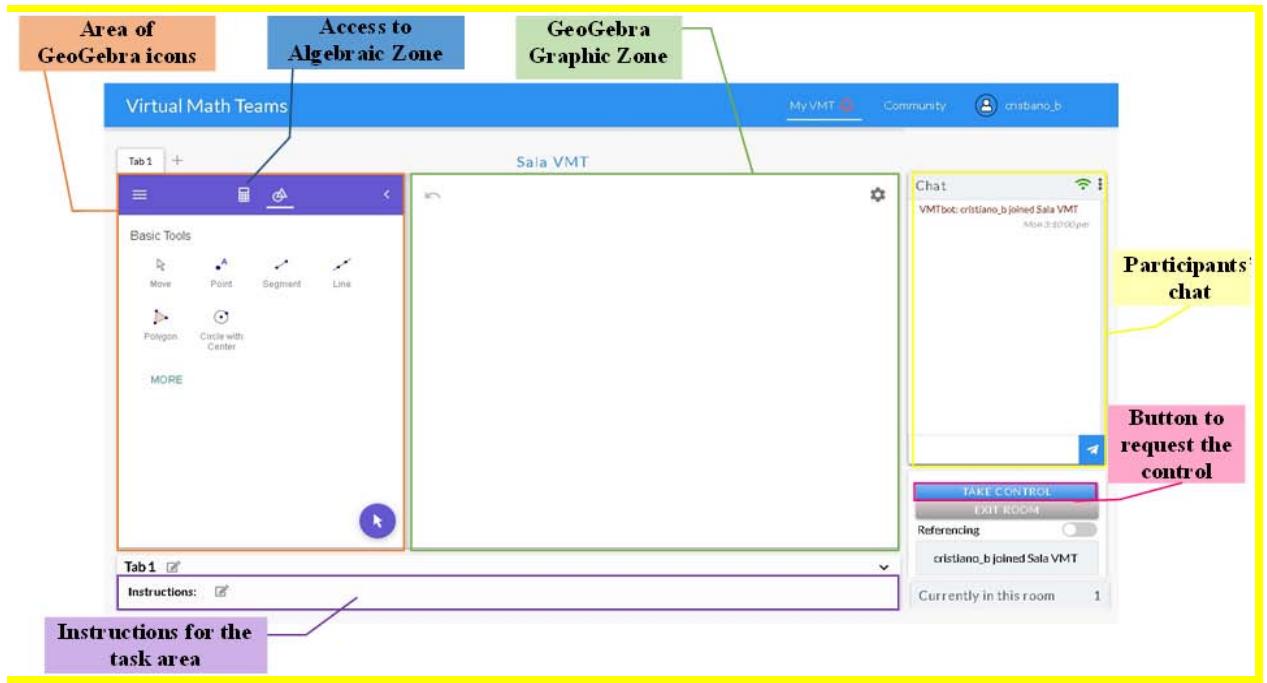
Source: Our own elaboration from VMT environment Figure 1: Subareas in VMTwG Interface
The button to request the control allows one user at a time to use the GeoGebra icons to make constructions on the graphic area, drag points and manipulate an embedded sliding control. While this occurs, the other participants can observe and share their ideas on the chat. If another participant has already selected the button 'take control' the posting 'Can I take control' is generated automatically on the chat. The candidates must wait for the control to get free.
All the data generated by the functions of a VMT room are saved in a sort of cloud on the site, which can be accessed later, and the data can be reviewed in chronological order. This resource - called Replayer-allowed for the analysis of the data of the implementations carried out in the research done by Brito (2022), even with data in charts, graphs, and filters generated by the platform itself. The editing functions of the room are available only to the teacher/monitor of the room, and they can insert the statement of a problem in the area meant for the instructions for the task.
The three tasks and it is learning aims (Appendix):
- Task 1- research the concept of congruence of triangles by the overlapping of two triangles and identifying the corresponding angles and sides.
- Task 2- make out variation and covariation factors of two similar triangles, by comparing the ratio of their corresponding sides.
- Task 3 - check necessary and sufficient conditions for two triangles to be similar, from the exploration of the case of similitude of triangles Angle-Angle (AA).
The tasks are focused on the procedures of construction, the involved properties in the construction, and the concepts that are already known by the participants (Barreira & Bairral, 2017). In the tasks, triangles were created dependent
(Task 2 and 3) on each other, but there are free points in the original triangle that can have changed position. We summarize here the analysis based on the second task, on the ratio of triangle similitude to understand the subjects' aims when dragging values on a slider that linked two triangles. The first triangle had free points and the second one reacted to the dragging of the values of the slider and the points of the original triangle. As task 2 was designed with the use of the slider, there is a dependence of one triangle on the other. Although the participants used the checkerboard mesh to verify their conjectures the triangles continued to depend on each other.
Data production came from registers written and GeoGebra screen construction by participants and VMT replayer. From these registers which were taken out of interaction in the chat, we recovered the moments of the use of the resource, and we associated that to the registers in the chat. We looked at the postings before and after the dragging action and, finally, we crossed the discursive data and graphs to interpret that action.
## V. RESULTS
In the episode illustrated below - focused on Task 2 - we analyze the role of sliding control of semiotic mediation to identify the pivot sign and the relation between signs of the artifact and mathematic signs. To do this, we sought the interpretation of the aim of the participant's dragging through the crossing of the written registers on the chat, both before and after the dragging movement of the sliding control.
### a) Episode: sliding control and the ratio of similitude
In this episode, three (prospective) teachers used the sliding control to explore the ratio of similitude between two triangles. The second task aimed to build any triangle, a sliding control, and a second triangle dependent on the first, through the function of "homothety" of GeoGebra. The script proposal was to direct the participants to explore the angular properties and the ratio between the length of the sides of the similar triangles.
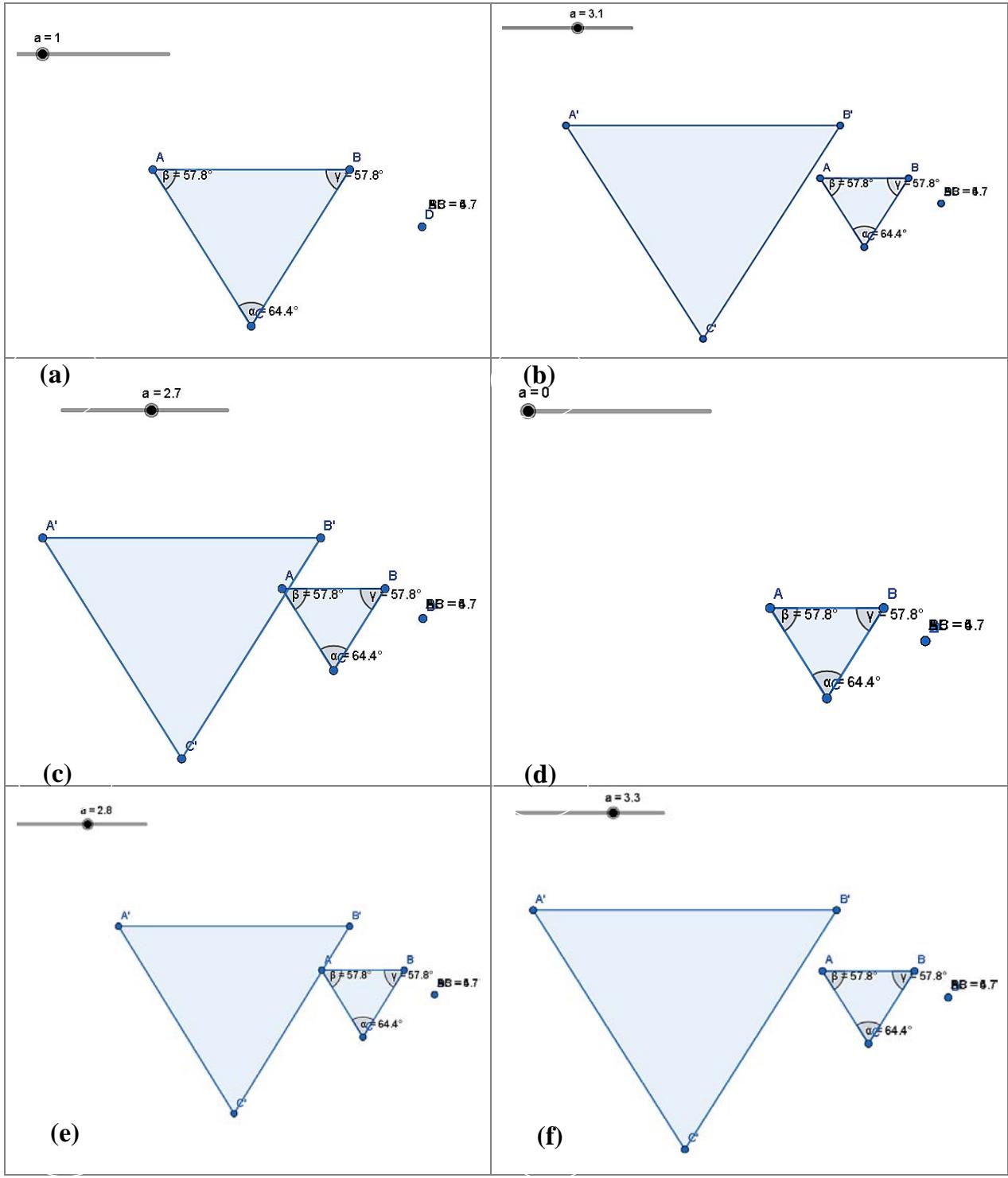
Nicole and Maria, who participated in the previous task, were also involved in the task with sliding control. The team consisted only of undergraduate students, and their fictional names are: Julio, Suzi, Nicole, and Maria. Julio came in one hour earlier than planned and wrote down his initial remarks in the chat. Some of them were considered by the group during the proposed task. After the construction of the sliding control and depending on triangles, the group members started to alter the value of the sliding control and, later, shared their remarks in the chat. Chart 2 presents the data from Replayer during the exploration of sliding control by Nicole.
Chart 2: Process of alteration of values of the sliding control by Nicole (19:44:05 - 19:44:45)
Source: Our own elaboration, based on data from the Replayer(Brito & Bairral, 2023)
The values explored by Nicole belong to the interval between zero and five (Chart 2, figures a to d) and then concentrate on values higher than one (Chart 2, figures e to f). The same pattern in the variation of values repeated itself at the later moment when Maria dragged first between intervals from one to five and then altered to the value of zero and values over five. Both students explored on a broader way the sliding control between the initial value and the last. Therefore, the remarks in the chat relate to more general aspects. Maria observed the existence of the relation of the movement of the sliding control with the enlarging and reduction of triangle A'B'C'. Nicole conjectured about the distancing or approaching of the triangle to D, the point where the homothety function from GeoGebra was applied to the extent that it altered the values of the sliding control.
Maria and Nicole generated different signs, although they were using the same artifact, as they were sharing their meanings with the group, resulting from their own experience with the sliding control. Later the participants explored more specific values of the sliding control. They noted cases as $a = 1$ and $a = 0$, and they observed that the triangles are congruent and that in the second case, the distance from the points in the triangle to point D is zero. Concerning the first moment, there was an advancement of the most generic aspects to the more specific ones to the extent that the personal meanings began to converge.
The participants still had not interacted about the interval between one and zero, neither had they measured the length of the sides, only the internal angles. They used the random dragging to discover the regularities of the figure, and by the reaction of the environment, they identified the corresponding angles and observed that they were equal. The group members measured the length of the sides of the triangles.
When we reached step 8 in the task script, we asked the participants: "Compare the length of the sides of triangle A'B'C' with the corresponding sides of triangle ABC. To do so, select the entrance field with the icon $a = \square$. In this field, calculate the ratio of segment AB by A'B". The participants tried to insert the length ratio of the sides in the entrance box of the commands. They were not successful because of a limitation of VMT which didn't make the insertion of formulas available.
The participants questioned the mediating teacher (second author) about a problem with the entrance box for the GeoGebra commands and were oriented to use the calculator in their computers to obtain the ratio between the corresponding sides. The final configuration in the Graphic zone at that instant in the task is shown in Figure 1.
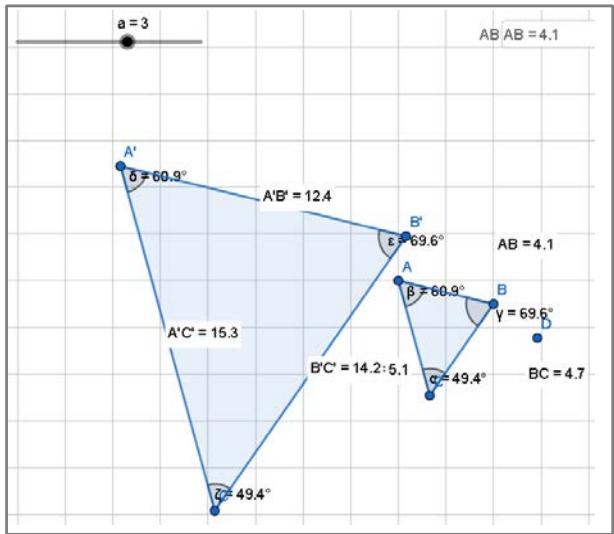
Source:Replayer Data Figure 1: Configuration of Graphic zone, the data of which were extracted to use with the calculator (146-167)
Chart 3: Presents the interaction segment among participants and second author when they were using their computer or smart phone calculators and sharing the results in the chat. Artifact signs and mathematic signs were identified. We are representing those signs by the symbols $<<$ and $>>$. The pivot sign, the sliding control $<a>$, is represented between the columns of Chart 3 in the text boxes.
Chart 3: Synthesis of the evolution from artifact to mathematic signs
<table><tr><td>Index</td><td>Participant</td><td>Posting in chat</td><td>Artifact sign</td><td>Mathematic sign</td></tr><tr><td>148</td><td>Author</td><td>The other groups also had a problem with this tool. You can use your computer calculator in case you cannot use this tool.</td><td></td><td></td></tr><tr><td>149</td><td>Nicole</td><td>Because the ratio would be A'B=a*AB</td><td><A'B>, <a></td><td><A'B=a*AB></td></tr><tr><td>150</td><td>Nicole</td><td>And so on, for each side</td><td><side></td><td></td></tr><tr><td>151</td><td>Maria</td><td>OK</td><td></td><td></td></tr><tr><td>152</td><td>Maria</td><td>8) ratio AB/A'B=0,3307</td><td rowspan="4"><a=3></td><td><ratio></td></tr><tr><td>153</td><td>Maria</td><td>Approximately that value</td><td><A'B'/AB, is 3></td></tr><tr><td>154</td><td>Nicole</td><td>8) the ratio for a=3, A'B'/AB, is 3</td><td><AB/A'B'=0,3307></td></tr><tr><td>155</td><td>Suzi</td><td>It's AB/A'B'</td><td><AB/A'B' also was 0, 3306></td></tr><tr><td>156</td><td>Maria</td><td>I did the ratio for a=3, but for AB/A'B'=0,3307 approximately</td><td rowspan="2"><a=3></td><td><AB/A'B' also was 0, 3306></td></tr><tr><td>157</td><td>Nicole</td><td>Doing AB/A'B' it also was 0,3306</td><td><BC/B'C'=0,3309></td></tr><tr><td>158</td><td>Maria</td><td>9) a=3, ratio BC/B'C'=0,3309</td><td rowspan="5"><a=3></td><td><AC/A'C'=0,33333></td></tr><tr><td>159</td><td>Nicole</td><td>BC/B'C'=0,3309</td><td><a></td></tr><tr><td>160</td><td>Maria</td><td>9) a=3, ratio AC/A'C'=0,33333</td><td><1/3></td></tr><tr><td>161</td><td>Nicole</td><td>AC/A'C'=0,333...</td><td></td></tr><tr><td>162</td><td>Nicole</td><td>For me, the ratio of AC and A'C' is the most precise, because it would be 1/3 which is exactly 0,333...</td><td></td></tr><tr><td>163</td><td>Author</td><td>does this result have anything to do with the value of "a"?</td><td><a></td><td></td></tr><tr><td>164</td><td>Nicole</td><td>I think that a is the ratio</td><td><a></td><td><ratio></td></tr><tr><td>165</td><td>Maria</td><td>Yes, altering the value of a, the triangle A'B'C' changes its size, therefore the ratio changes</td><td rowspan="2">triangle A'B'C'></td><td rowspan="2"><ratio from ABC to AB'C' é 1/3></td></tr><tr><td>166</td><td>Nicole</td><td>That's why it says that the ratio from ABC to A'B'C' is 1/3</td></tr><tr><td>167</td><td>Nicole</td><td>Now you can see from the side AC=6, as a=4, then A'C'=24</td><td><a></td><td></td></tr></table>
Various artifact signs were generated by the participants, regarding the constructions manipulated in the graphic zone. In the same way, mathematic signs were generated regarding the value obtained by the ratio of corresponding sides, represented by the number in decimal modality. The sign $< \mathbf{a} >$ of the sliding control was often referred to and played the role of connecting the two contexts to promote the passage from personal meanings to mathematic meanings represented by the respective ratios of the triangle sides.
Nicole realized that, performing the ratio of side AB to A'B', the values were close to de decimal representation 0,333 or $1/3$ in fractional form (Chart 3, index 162). As she noticed that the sliding control was set at a value of three, Nicole conjectured that the value of the inverted ratio of $1/3$ was represented by the value of the sliding control $<\mathrm{a}=3>$ (Chart 3, index 154). So, she proposed to her mates they calculate the ratio of A'B' for AB.
We also registered that Nicole manipulated the sliding control again and, more intentionally this time, she modified the sliding control to the whole value $< \mathrm{a} = 4 >$ and she obtained the length $\mathrm{AC} = 6$ e $\mathrm{A}'\mathrm{C} = 24$, as shown in Figure 4.
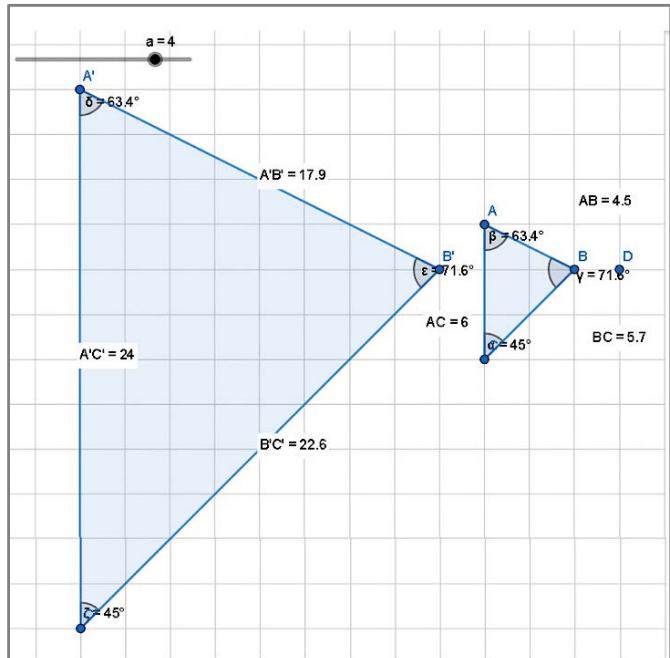
Source:Replayer data Figure 1: Configuration of the Graphic zone that comprises the descending process
Figure 4 and Chart 3 (indexes 149, 167) illustrate how Nicole concluded that A'C is equal to the product of $< \mathrm{a} >$ by the length of segment AC. Therefore, Nicole used a process with a descending flow - from the theory to the construction - thus checking the validity of the property and that it was kept for other measures of the sides of the triangles. In this process, the calculator was used to construct a conjecture about the ratio of the length of the sides of A'B'C' by ABC, and the process of altering the values of the sliding control played the role to help in the production of conjectures and the validation of an observed property.
The use of grid was restricted to the exploration of more global geometric properties while those related to the use of the slider may represent a more robust form of thought process. Remarkably, regarding the use of sliding control:
- It was often referred to and played the role of connecting the two contexts to promote the passage from personal meanings to mathematic meanings represented by the respective ratios of the triangle sides.
- It played the role to help in the production of conjectures and the validation (or refutation) of an observed property and checking result.
## VI. CONCLUSIONS
In this article, we illustrated (prospective) teachers interacting in VMTwG in activities concerning triangle similitude. In the illustrated episode – from the measures of the sides and the calculus of the ratios with the calculator – the participants constructed the conjecture of the proportion of the corresponding sides. Using of the sliding control enabled us to explore approaches, inferences on measures and the notion of ratio as fraction, the analysis of global and cases ( $a = 1$ and $a = 0$ ). The processes involved in the use of sliding control can assume a more potent form, as they allow not only global observation, but also the checking. The types of flow of thought identified were ascending and descending and encouraged exploration, building conjectures, and intentionally checking their suppositions. Further research needs to be done using sliding control with different numerical intervals.
This intertwined movement of observation, exploration and checking were provided by the design of the task integrating slider control and the interactions within the dynamic environment. For instance, when subjects perform congruence tasks using different triangles cut out of paper they only compare - the angles and the sides - the shape by superposition. When dealing with the task using slider control the subject can explore a variety of shapes and mathematic objects. This process makes it possible for a different geometric property that emerges to be analyzed and verified whether it is true or false.
We are not saying the use of shapes cut out of paper is not essential. Still, the development of mathematical thinking with deep understanding and improving different forms of justification (writing, construction, and motion on screen, graphical, etc.) about some property or mathematical routine is more potent than merely checking measurements of angles or sides as we often observe in static resources. The semiotic mediation provided by VMTwG and other DGE can orient the evolution of the different signs enriched by interaction.
In the analytical episode summarized here it was possible to have a notion of the semiotic mediation process of thought involved in dragging, either by free points or sliding control. We hope that this article can contribute to other mathematics teachers' exploration of the semiotic potential of geometric tasks with DGE and that they can help their students learn triangle similitude and other geometry subjects paying less attention on calculus or applying mechanically the rule of three. We would like to stress the importance of VMTwG as an environment of interrelated spaces that enables a constant interactive process, where the students themselves explore, share, interpret, and check their thoughts and discovers.
We must warn that, as it is a robust system involving various functions, a good connection is required, so that all tasks may be carried out without obstacles. The VMT environment is in constant construction and relies on a technical support team who listens to suggestions to the problems reported by the users. Some suggestions were made through our research, including the availability of the box to the access of VMTwG commands, following the problem that took place in episode 2. This was duly solved, and it is already possible to insert commands for the side ratios directly in the environment.
This research had its educational outcome $^{6}$ - Sequence of activities on triangle similitude in Virtual Math Teams environment - where we present, besides the tasks mentioned above, other tasks, discussing the semiotic process involved in each task, and give suggestions to the teachers (Brito, 2022). We welcome the reader to learn, develop, and adapt the tasks with VMT among their students. As a closing remark, let us highlight that VMTwG is one of the scenarios that can occur in mathematic instruction, and we would not boast about it being the only one. On the contrary, let's rejoice in the fact that it is there as one more field for the exploration of mathematics concepts and to awaken students' interest and pleasure in learning mathematics online and/or face-to-face.
### APPENDIX
#### Task 1: Congruence of triangles
#### Estimated time: 2 hours.
Objective: To investigate the concept of congruence of triangles by overlapping two triangles and identifying the corresponding angles and sides.
1. Enable the GeoGebra mesh using the icon $\triangleright$. Select the "Display Mesh" option and then "Main Mesh". Construct any triangle ABC using the icon $\triangleright$.
2. Measure the internal angles of the triangle ABC by selecting
3. Select to find the measure of each side of the triangle.
a) With the tool selected, move the points on the vertices of the triangle freely and comment on what you see.
4. Construct any triangle DEF by repeating the previous steps.
b) What did you notice when you compared the lengths of the sides and angles of triangles ABC and DEF?
c) With the help of the grid, move the vertices of triangle ABC with $\nmid \aleph \rangle$, so that triangle ABC coincides exactly with triangle DEF.
5. Tap the center of the triangle and drag it to the side.
d) Comparing the measure of angles and sides: what can you say about the characteristics of overlapping triangles?
e) Observe and comment in the chat, what are the corresponding angles of triangles ABC and DEF?
f) What are the corresponding sides of triangles ABC and DEF?
g) Based on the construction you have made, comment on whether (or not) triangles ABC and DEF are congruent and explain the reasons that led you to this conclusion.
#### Task 2: Similarity ratio
#### Estimated time: 2 hours.
Objective: Distinguish components of variation and covariation of two similar triangles by comparing the ratios of their corresponding sides.
1. Let's create a numerical parameter. Select the tool and click in the top corner of the GeoGebra screen. When a new tab opens, put the value 0 (zero) in the "min" box and then press "OK".
2. Construct a triangle ABC with $\triangleleft$ and measure its internal angles and the lengths of its sides.
3. Create a point D outside triangle ABC using $\boxed{\bullet^A}$.
4. Selecting $\boxed{\mathbf{k}}$, press on the center of triangle ABC and then tap on point D, which is outside triangle ABC. When the Homothety box appears under "factor", type in "a". Then press "ok".
5. Select $\bowtie$ and then increase and decrease the values of "a" and observe.
a) What happened to triangle A'B'C' when you changed the values of "a"?
6. After constructing triangle A'B'C', measure its interior angles.
7. With the option $\downharpoonright$, move the vertices of triangle ABC freely and observe.
b) Compare the corresponding angles of the two triangles, what do you see?
8. Compare the lengths of the sides of triangle A'B'C' with the corresponding sides of triangle ABC. What do you notice?
9. Calculate the ratio of the other corresponding sides. To do this, enter the ratio of the segment A'B' to AB in the input box.
c) What is the relationship between the calculated ratios?
d) If you change the value of "a", what do you notice when you compare it to the ratios you calculated earlier?
e) What is the relationship between the lengths of the sides of triangles A'B'C' and ABC?
10. Finally, change the value of "a" to 1 and move the vertices of the triangle by changing their angles and side lengths.
f) How does this activity differ from or enrich the activity you experienced in the previous section?
#### Task 3: Cases of similarity of triangles
Estimated time: 1 hour.
Objective: Check the necessary and sufficient situations for two triangles to be similar by exploring the case of triangle similarity Angle-Angle (AA).
1. Enable the GeoGebra mesh using the icon Select the "Display Mesh" option and then the "Isometric" option.
2. Construct a triangle ABC with $\triangleright$. Left click inside the triangle and choose a color by selecting $\diamondsuit$.
3. Measure just two internal angles of triangle ABC.
4. Next, construct any triangle DEF and measure just two internal angles.
5. Position points D, E and F so that triangle DEF is similar to ABC.
a) Look at the construction of triangles ABC and DEF and explain why you think they are similar.
6. Measure the angles and sides that have not yet been measured in the two triangles.
b) Now that you know the measures of the internal angles and sides, what can you say about all the triangles that have two equal internal angles?
c) How does this activity differ from or enrich the activities you experienced in the previous sections?
[^2]: $^{2}$ www.gepeticem.ufrrj.br _(p.2)_
[^3]: It comes from a research project granted by CNPq and Faperj, Brazil. _(p.2)_
[^4]: We use the expression (prospective) teachers to indicate the inclusion of graduate and undergraduate teachers in our working team. _(p.2)_
[^1]: This environment is designed by Drexel University (Philadelphia, USA). We would acknowledge Drexel University and Dr. Arthur Powell (Rutgers University, Newark, USA) for join us in this research project. _(p.1)_
[^5]: In Brito & Bairral (2023) we detail the seven modalities of dragging according Arzarello et al. (2002). _(p.5)_
Generating HTML Viewer...
References
30 Cites in Article
Muteb Alqahtani,Arthur Powell (2016). Instrumental Appropriation of a Collaborative, Dynamic-Geometry Environment and Geometrical Understanding.
Muteb Alqahtani,Arthur Powell (2017). Mediational activities in a dynamic geometry environment and teachers’ specialized content knowledge.
Muteb Alqahtani,Arthur Powell (2017). Teachers’ Instrumental Genesis and Their Geometrical Understanding in a Dynamic Geometry Environment.
E Arceo (2009). Geometríadinámica con Cabri-Géomètre.
F Arzarello,F Olivero,D Paola,O Robutti (2002). A cognitive analysis of dragging practises in Cabri environments.
M Bairral (2020). Not Only What is Written Counts! Touch screen Enhancing Our Cognition and Language.
M Bairral (1998). Semelhança na 7 a série: algumas dificuldades.
Marcelo Bairral,Thuane Silvano (2023). Licenciandos em matemática interagindo no VMTcG em uma tarefa sobre translação.
C Brito (2022). Licenciandos e professores de matemática interagindo no VMTcG em atividades de semelhança de triângulos.
Cristiano Brito,Marcelo Bairral (2023). Triangle similarity: interactions in meshes and slider.
M Bairral,J Barreira (2017). Algumas particularidades de ambientes de geometria dinâmica na educação geométrica.
M Bussi,M Mariotti (2008). Semiotic mediation in the mathematics classroom: Artifacts and signs after a Vygotskian perspective.
M Costa,N Allevato (2011). O conceito de proporcionalidade através da resolução de problemas de geometria: perspectivas didáticas de (futuros) professores de Matemática em formação inicial.
Maria Galvão,Vera Souza,Paulo Miashiro (2016). A Transição das Razões para as Funções Trigonométricas.
C Gattegno (1987). The science of education: Part 1: Theoretical considerations.
R González,L Nieto,M García,C Pesquero,L Zurita,L García (1990). Proporcionalidad geométrica y semejanza.
E Jaconiano,A Barbosa,M Costa,C Concordido (2019). Resolução de problemas de proporcionalidade por meio da redução à unidade.
E Lima (2011). Medida e forma em geometria: comprimento, área, volume e semelhança.
N Machado (2000). Semelhança não é mera coincidência.
A Maciel,S Almouloud (2004). Semelhança de figuras planas: uma proposta de ensino In: Anais do 8ºEncontro Nacional de Ensino de Matemática.
D Maingueneau (2000). Termos-chave da análise do discurso.
Maria Mariotti (2000). Introduction to Proof: The Mediation of a Dynamic Software Environment.
R Menduni-Bortoloti,J Barbosa (2018). Matemática para o ensino do conceito de proporcionalidade a partir de um estudo do conceito.
R Oliveira,M Bairral (2020). Interações em um ambiente de aprendizagem online e síncrono: que tarefa propor com o GeoGebra?.
M Pereira (2017). Uma sequência didática para ensino de semelhança de figuras.
A Powell (2014). Construção colaborativa do conhecimento tecnológico, pedagógico e do conteúdo de professores de matemática.
A Powell,M &alqahtani (2021). Estudantes usando geometria dinâmica e construindo critérios necessários para semelhança e congruência de triângulos.
Explore published articles in an immersive Augmented Reality environment. Our platform converts research papers into interactive 3D books, allowing readers to view and interact with content using AR and VR compatible devices.
Your published article is automatically converted into a realistic 3D book. Flip through pages and read research papers in a more engaging and interactive format.
Similarity is crucial in mathematics and other fields. It relates to different curricular mathematics content, for instance, proportionality, measures, and shapes. This article discusses the interactions of prospective teachers when performing similarity tasks in a multiuser, online, virtual, and synchronous environment with Geo Gebra, the VMTwG. The analyzed task focused on the similarity ratio from a slider. The focus here is to illustrate how the subjects interact when dragging free points of two triangles created with dependence on each other and using a checkered mesh. Data production came from registers written and Geo Gebra screen construction by participants and VMT replayer. The use of the slider may represent a more potent form of thought process, which implies both the global observation of geometric properties, the validation of conjectures and checking detailed results.
Our website is actively being updated, and changes may occur frequently. Please clear your browser cache if needed. For feedback or error reporting, please email [email protected]
Thank you for connecting with us. We will respond to you shortly.