## I. INTRODUCTION
According to Aude (2021), in Africa, early childhood education records much greater inequalities in access than other levels of education. Indeed, disparities linked to income and place of life persist within national territories, but vary in magnitude from one country to another. In Ivory Coast, early childhood education is a hot topic given the impact of these centers on the development of children. The role of early childhood education in the development of children and the development of society is widely discussed and recognized by numerous theories. Indeed, early childhood education also helps to reduce the rate of repetition and dropout in primary school. Early childhood education is one of the best investments a country can make to prepare children to learn and give them the chance to thrive. In a world of globalization where education systems in Africa are still lagging behind, it would be important to carry out an in-depth analysis of the early childhood education system in Côte d'lvoire with a view to making an improvement. practices applied there. As part of the study, the specific research objectives were as follows:
(1) To Analyze the situation of early childhood education in Côte d'lvoire (2) To determine the importance of early childhood education in the economic context of Cote d'Ivoire (3) To find the challenges of early childhood education in Côte d'lvoire (4) To propose solutions in order to overcome those challenges
# a) The Concept of Early Childhood Education
Early childhood education focuses on the critical developmental milestones, skills and concepts that children learn during this period of their lives, from social-emotional skills to the beginnings of numeracy, literacy and critical thinking. Early childhood education is also a way to prepare children for future academic success. This is a very important stage for the child's life because it allows them to have good skills. Early childhood education plays a crucial role in the future of children. During this time, children develop skills, knowledge and attitudes that form the foundation of their lifelong learning journey. According to UNESCO (2024), "Early childhood care and education (ECCE) is more than preparation for primary school. It aims at the holistic development of a child's social, emotional, cognitive and physical needs in order to build a solid and broad foundation for lifelong learning and wellbeing. ECCE has the possibility to nurture caring, capable and responsible future citizens." Early childhood education helps develop the skills necessary for children's school preparation outside the family context. The power of early childhood education is immense and has a multitude of benefits such as better social skills, increased confidence levels, greater coordination, greater creativity and increased confidence levels. Indeed, every child is precious and children are assets to our society. They are the nation's most valuable resource. The development of a nation and its people begin with early childhood education.
### b) Situation of Early Childhood Education in Cote d'Ivoire
Preschool education is a field rich in its importance and the added value that it can add to the development of young children in particular and people in general. Elsewhere, it benefits from particular attention and the conditions are brought together so that young children have the necessary foundation for their harmonious development. More and more, professionals and individuals are looking into the issue and initiatives are being taken in the sub-region and particularly in Côte d'Ivoire to create the conditions for successful preschool education. What is the reality of preschool education in Cote d'Ivoire?
Preschool education in Côte d'lvoire is shared between three (3) different Ministries:
- The Ministry of National Education with Nursery Schools; – The Ministry of Social Affairs with the Learning Rooms in the Social Centers; – The Ministry of Women, Families and Children with the CPPE (Early Childhood Protection Centers) and the CACE (Community Action Center for Children) for the public sector. In the private sector, certain procedures must be satisfied in order to benefit from approval from one or other of the aforementioned Ministries. Despite the efforts made by the Ivorian government to provide quality early childhood education, numerous obstacles hamper popularization in the Ivorian territory.
## II. THEORETICAL FRAMEWORK
According to Orazio.et.al, (2022) children's experiences during early childhood are essential to their cognitive and socio-emotional development, two key dimensions of human capital. So to have productive human capital for a country, it would be important to focus on the development of these two aspects in people's lives from early childhood. To fully understand the merits of early childhood education, the analysis of certain theories would be essential. This section highlights some theories and rationale that justifies the importance of early childhood education.
According to behaviorists, environmental stimuli and consequences shape learner behavior. In the context of early childhood, this law applies perfectly. Indeed, in the context of study in early childhood centers, children learn according to the environmental factors they face throughout their education. In education generally, behavioral learning theory is a popular concept that focuses on how students learn. Behaviorism focuses on the idea that all behaviors are learned through interaction with the environment. This learning theory states that behaviors are learned from the environment and that innate or inherited factors have very little influence on behavior. Skinner, B. F. (1976), one of the precursors of the theory, states in his theory of behavior that for a group of children, the environment and the way of being educated have a major impact on their behavior. From this observation we can clearly see the impact of early childhood education on children.
Jean Piaget's Theory of Cognitive Development also emphasizes the importance of early childhood education. It is a very significant theory in child development which is used as the foundation and basis of early childhood education until now. This theory focuses on the child's cognitive development or thought processes. It examines the impact of these thought processes on the way we interact and understand the world around us. According to Piaget's theory, children think differently from adults. Cognitive theory aims to explain and describe how mental processes and states arise. It also examines how various ways of thinking affect the way we perceive and interact with the outside world. Several other theorists have done remarkable work regarding early childhood and education at this stage. With this in mind, Montessori (1952) stated that early childhood learning required a two-pronged approach: first educating the child's senses, then educating the child's intellect. His approach was to view children as sources of knowledge, with the teacher or educator acting as a social engineer. His hands-on approach to teaching, with the learning environment considered as vital as the knowledge itself, transformed the academic success of many children who did not respond well to traditional classroom methods. The Montessori system is applied in the best early childhood establishments and shines with these conclusive results.
## III. CONCEPTUAL FRAMEWORK
Early childhood education is very important for a child's development and preparation for working life. Early childhood education is now a daily reality for many children before they enter school. It therefore becomes necessary to consider the educational quality of these important living environments for young children.
Several studies have demonstrated that a high level of educational quality in educational daycare services would have a positive impact on the development of children. More specifically, it would be the dimension of the quality of interactions between the adult and the child which would be determining. Educators also have an efficient and leading role to play in the quality of early childhood education.
The framework below represents the process in order to have an efficient early childhood education. This diagram is a summary of how a quality childhood education should work. Actors, theories and objectives are listed there with the aim of having a clear vision of what the early childhood education system should be.
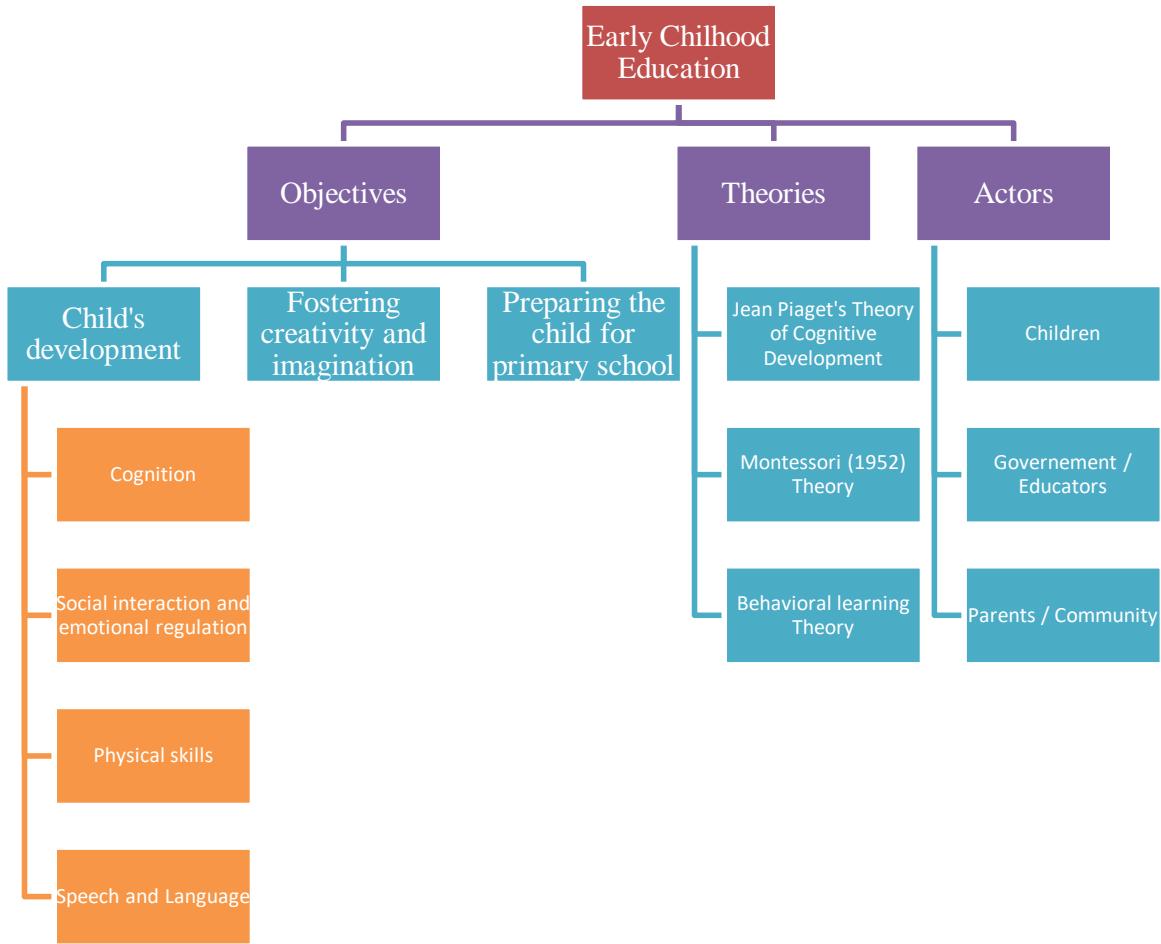 Source:Developed by Researcher Conceptual Framework of an efficient Early Childhood Education System
## Benefits of Early Childhood Education By Fung Lan Yong
In his opening address of the 2009 Malaysian International ECEC Conference, Prime Minister YAB Dato' Sri Mohd Najib Tun Abdul Razak said, "Every child is precious and children are assets to our society. They are the most valuable resource of the nation. I believe that developing a nation and its people begins with early childhood education. While it is the duty of parents to ensure a child has the opportunities to develop, it is also the government's responsibility to help parents bring the potential to fruition. In developing a child's potential, we are in reality developing the human capital of the child and of the nation. In carrying out this task, we are enabling the child to grow holistically so that the child is equipped with the abilities, knowledge and skills to become a productive member of the nation." Snapping synapses in early childhood Early childhood education plays an important role in the neurological development of young children. Researchers believe that neurological development greatly depends on learning that occurs during the earliest years of life and that a young child's brain needs certain types of stimulation to develop normally. Such stimulation makes certain types of learning possible when the child begins school. It also augments the child's neural pathways that are responsible for social, emotional and intellectual development. Early childhood education therefore capitalizes on a vast array of kinaesthetic, tactile, auditory and olfactory activities that stimulate a child's brain to develop to its full potential.
### Growing need for Quality Child Care
According to this conceptual framework, many aspects must be taken into account in order to have an efficient early childhood education system.
## IV. METHODOLOGY
A qualitative research approach was applied in carrying out this research. The study included an analysis of documents and publications relating to early childhood education in general and in Cote d'Ivoire in particular. The documentary review made it possible to quickly arrive at the research results. Particular attention was paid to the analysis of the challenges facing early childhood education in Cote d'Ivoire in order to finding adequate solutions. The data were analyzed thematically, with results presented in accordance with the research questions.
## V. FINDINGS
The results of the study are presented according to the main research questions. This study answers four key questions. The first question related to the current situation of early childhood education in Côte d'lvoire which was discussed in the introduction to the study. The second question related to the relevance and usefulness of early childhood education in the Ivorian economic context. The third question sought to determine the challenges of early childhood education in Ivory Coast. The final question sought answers regarding key scalable strategies that could be adopted to improve access and equity in early childhood education.
### a) Growing need for Quality Early Childhood Education in Cote d'Ivoire
According to a Statista report (2024) on the unemployment rate among women in Côte d'lvoire from 2012 to 2019. Around $3\%$ of women in Côte d'lvoire are inactive. This clearly shows that women are very involved in the economic development of the country and more and more women aspire to managerial positions. Women's interest in their autonomy and development is a very remarkable contribution to Ivorian society. However, the involvement of women in the economy causes a lack in the family unit. Indeed, in traditionalist societies like Ivorian society, the role of the woman was rather limited to keeping the house and being responsible for the education of the children. But these days more women aspire to things other than this role assigned to them. Raising children becomes more and more difficult for them because they are busy with other tasks. Many women, in Africa and Ivory Coast in particular, prefer to have an income, their children will have to spend their critical early years in daycare. Early childhood education therefore comes at the right time in a context where children need careful monitoring with a view to being good citizens for the future and also participating in the development of the country. It also provides relief to working mothers by providing an appropriate learning environment for young children to enjoy a quality child care experience that meets their developmental and social-emotional needs. In rural settings in Côte d'lvoire many children tend to live in poor environments characterized by poverty, inadequate health care, poor infrastructure and illiteracy. Early childhood education in this context is an essential contribution because it gives children from disadvantaged backgrounds a head starts by offering them a learning environment adapted to their development which stimulates their cognitive development, verbal and social. Most parents in rural communities are uneducated and have not learned simple childcare practices or ways to stimulate learning. As poverty is all they have known, their aspirations for themselves and their children are low. This is a relief for the parents, who are not educated. In rural areas, children have few opportunities to learn at home. Preschool education gives children opportunities to learn, understand, become familiar with the school environment, believe in their abilities and develop skills to facilitate their transition to grade 1. Children arrive at school with their own baggage, a reflection of their personal and family history as well as their socio-cultural environment.
### b) Challenges of Early Childhood Education in Cote d'Ivoire
According to Moussa (2023) Education is a crucial issue for the economic and social development of Africa. Despite the progress made in recent years, many challenges persist in education on the continent. The challenges of education in Africa are numerous and complex, ranging from limited access to quality education. In Ivory Coast, access to quality education, especially in rural areas, is a major challenge. In the North of the country in this case, certain establishments do not have basic infrastructure to accommodate and protect learners. According to UNESCO statistics (2022) on access to education in Africa, more than 30 million children in sub-Saharan Africa are out of school, which represents around one in five children in the region. Children in rural areas are often the most affected by this problem, because schools there are rare and the distances, they have to travel to reach them are often long.
The quality of education in Cote d'Ivoire remains very unequal and poses another important challenge for the development of the continent. Public and private institutions often differ significantly in terms of the quality of education and available infrastructure. In the field of early childhood education, teacher training is needed because they are the first in contact with children after their parents. Teachers are often poorly trained and poorly paid, which affects the quality of teaching and discourages many qualified teachers from working in the early childhood sector in Côte d'Ivoire. The excessive cost for the standard of living of Montessori training in Ivory Coast. Indeed, registration fees in Montessori style establishments in Ivory Coast amount to 2,520,000 FCFA ($4,500) per year for a child in a country where the minimum wage amounts to 75,000 FCFA ($125/month). These are costs that are inaccessible to the Ivorian population.
Given the various challenges, quality early childhood education remains inaccessible to the Ivorian population.
### c) Propose Solutions for Early Childhood Education in Cote d'Ivoire
To improve the quality of early childhood education, it is necessary to invest in teacher training and remuneration, implement teaching programs adapted to local contexts, develop evaluation systems and quality assurance. Indeed, early childhood education is a very important stage and to have well-formed children, emphasis should be placed on the training and monitoring of teachers.
Reducing training costs in early childhood education centers should be required. Indeed, to make this training accessible, it would have to be much cheaper; a cost study should be carried out with a view to finding a happy medium. To solve this infrastructure problem in rural areas it is necessary to invest in educational infrastructure, develop scholarship programs for poor families, provide books and school materials, and reduce schooling costs. It is also important to put in place policies to encourage the schooling of girls, as well as awareness campaigns to promote education as a fundamental human right.
The Ivorian state should raise awareness among the Ivorian populations of the importance of early childhood education with a view to motivating reluctant parents to enroll their child with a view to preparing them for a future and making them a efficient human capital for the development of the country.
## VI. CONCLUSION
Education in Cote d'lvoire is experiencing much greater interest from the point of view of performance and pedagogy. The quality of teaching is the key word of the government in matters of education. Early childhood education in Ivory Coast is not left out and the objective is to provide quality education for all children, particularly those in rural areas or adequate conditions for their development. However, gaps in accessibility and participation are still perceived depending on the socio-economic environment and regions. This study attempted to highlight the challenges faced by stakeholders in early childhood education with a view to finding adequate solutions to the Ivorian education system. Cote d'lvoire can draw on the experience of countries like Canada with which it has several partnerships and cooperation in the field of early childhood education to improve the performance of its system. Financial support and support for early childhood centers is crucial in order to make them accessible to many children, particularly those in rural areas. Teacher training must be essential with a view to having good quality education. The Ivorian government must redouble its efforts to mobilize domestic and external resources, such as remittances from the diaspora, to finance more early childhood centers.
The study showed the importance of training from early childhood, which is a means of forming much more productive human capital.
Generating HTML Viewer...
References
5 Cites in Article
Abdeljalil Akkari (2022). Early childhood education in Africa: Between overambitious global objectives, the need to reflect local interests, and educational choices.
Lynn Cohen,Sandra Waite-Stupiansky (2017). Theories of Early Childhood Education.
Olivia Saracho (2023). Theories of Child Development and Their Impact on Early Childhood Education and Care.
Todd Schoellman (2016). Early Childhood Human Capital and Development.
Orazio Attanasio,Sarah Cattan,Costas Meghir (2022). Early Childhood Development, Human Capital, and Poverty.
Explore published articles in an immersive Augmented Reality environment. Our platform converts research papers into interactive 3D books, allowing readers to view and interact with content using AR and VR compatible devices.
Your published article is automatically converted into a realistic 3D book. Flip through pages and read research papers in a more engaging and interactive format.
Our website is actively being updated, and changes may occur frequently. Please clear your browser cache if needed. For feedback or error reporting, please email [email protected]
Thank you for connecting with us. We will respond to you shortly.