Warehouse inventory and layout optimization are critical to inventory and logistics management in organizations. In many instances, limited warehouse space is a constraint and a barrier to expanding operations and increasing demand. In this paper, I explore various econometric optimization models to improve inventory management and space utilization. I present various case studies to illustrate the applicability and use benefits. Additionally, I’ve applied one such econometric model to a sample inventory dataset from Saudi Aramco demonstrating its effectiveness in identifying opportunities for improving inventory management and space optimization.
## I. INTRODUCTION
E conometrics is a branch of economics that applies statistical and mathematical models to test hypotheses and forecast future trends based on real-world data. In the context of inventory management and warehousing, econometrics enables data-driven decision-making, optimizing operations, reducing costs, and enhancing customer satisfaction through predictive analytics and demand forecasting. Among key applications of econometrics are Demand Forecasting, Inventory Optimization, Supply Chain Risk Management and Warehouse Space Optimization. Empirical studies show that organizations utilizing econometrics approaches in supply chain gain $10 - 30\%$ reduction in inventory cost, improved demand prediction accuracy by $50\%$ and faster response time to market changes. [1, 2, 3, 4].
Optimizing warehouse layout is also, crucial for enhancing operational efficiency, reducing costs, and improving order fulfillment rates. Lack of data driven warehousing layout strategies results in a lot of inefficiencies and unoptimized resources. There are several mathematical models developed to design and optimize warehouse layouts. In the literature we explore several warehouse inventory and layout optimization models. Among key econometric models for warehouse layout optimization include.
- Mixed Integer Linear Programming
- Systematic Layout Planning
- Simulation-Based Optimization
- Reinforcement Learning
And the Inventory Optimization Models:
- Autoregressive Integrated Moving Average (ARIMA).
- Vector Autoregression (VAR).
- Cointegration and Error Correction Models (ECM).
- Panel Data Models (Fixed-effects and Random-effects models).
- Generalized Autoregressive Conditional Heteroskedasticity (GARCH).
This paper aims to explore the practical application of econometric modeling to an oil and gas warehouse layout optimization.
## II. LITERATURE REVIEW
### a) Warehouse Layout based Models
An orthogonal warehouse layout is characterized by its simple, straight-line or parallel aisle design. This layout is commonly used due to its straightforward nature and ease of implementation. However, it can sometimes lead to longer travel distances for pickers or material handling equipment. Among warehouses layouts simulated is the CPU-Based Layout methodology which is based on Intel based CPU structure. The layout segments warehouse space into 3 specialized zones.
- Performance Zone: Ground storage nearest outbound area for high-frequency SKUs, minimizing retrieval time.
- Efficiency Zone: High-density vertical storage racks for low frequency SKUs maximizing spatial efficiency.
- Shared Zones: Flexible buffer storage for overflow and mid-frequency SKUs.
The study conducted by Timo Looms and Lin Xiein 2025 resulted in clear advantage of CPU-based layouts compared to other Orthogonal and Flying-V layouts. [5].
Sanjaya Mayadunne, Hari Rajagoalan and Elizabeth Sharer utilized a two-step mixed integer programming approach to optimize layout of a warehouse for Mitsubishi Electric Trane. They found that linear programming approach to maximizing storage can be tailored to yield multiple optimal solutions. The case study undertook provided insights into organizations' needs during the process of determining a warehouse layout. Mitsubishi increased the total available storage space by $7\%$ with no additional investment and reduced the average picking distance by $3.8\%$. [6]
### b) Inventory-based Models
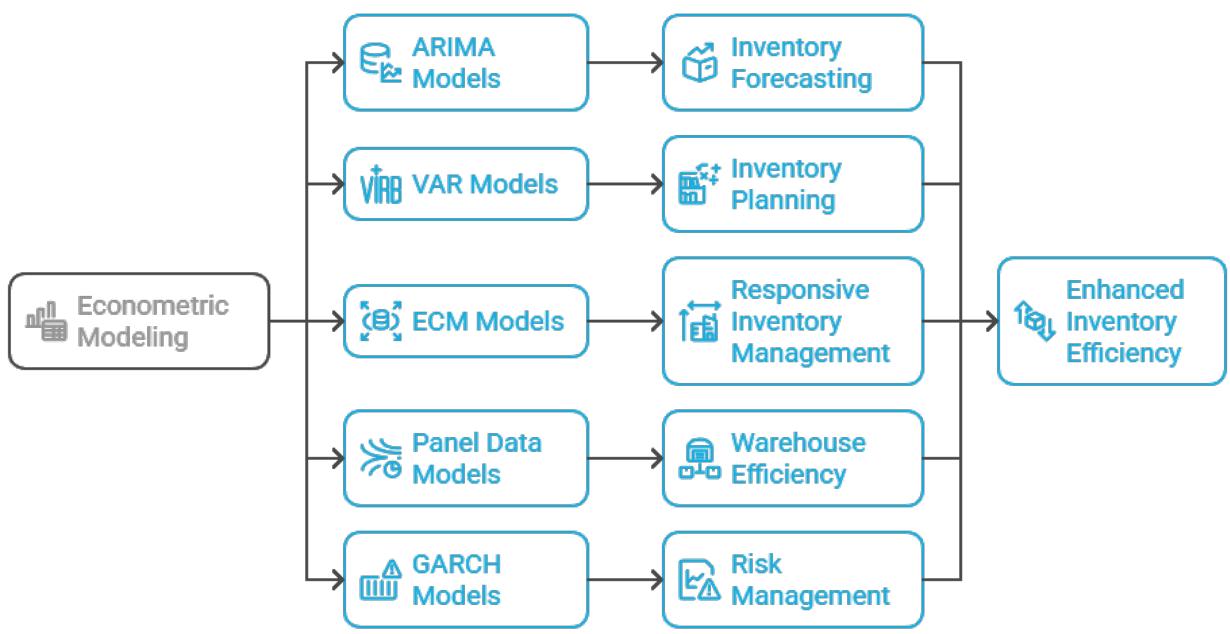
Econometric modeling is integral to optimizing inventory management and warehouse operations by enabling data-driven decision-making processes. Various econometric models have gained prominence due to their effectiveness and versatility in handling inventory forecasting and warehouse optimization challenges.
- Autoregressive Integrated Moving Average (ARIMA) ARIMA models are among the most extensively applied econometric techniques for inventory forecasting. ARIMA models are extensively employed for univariate time-series forecasting. They effectively capture historical trends, autocorrelation, and seasonality in data by using past observations and errors to predict future values. Such a model was implemented by Walmart to optimize seasonal inventory management. [7] Walmart utilized ARIMA to forecast the demand for seasonal products like holiday decorations, adjusting inventory levels proactively. Walmart achieved significant reductions in overstocks and stockouts, lowering carrying costs and enhancing customer satisfaction through improved availability (Mentzer & Moon, 2005). [7] ARIMA is ideal for straightforward, univariate forecasting scenarios with clear seasonal patterns.
- Vector Autoregression (VAR): Models extend ARIMA principles to multivariate contexts. VAR is a multivariate time-series model capturing the dynamic interdependencies between several time-series variables simultaneously, crucial for comprehensive inventory management involving multiple products or related factors. Tesco (Grocery Retail) implemented the model with the objective of optimizing inventory and warehouse space by modeling relationships among multiple product categories. The model improved warehouse stocking strategies, optimized storage space allocations, and significantly reduced excess inventory, enhancing overall operational efficiency (Coelho & Laporte, 2014). [8] VAR suits situations requiring simultaneous modeling of multiple interdependent inventory series where the model strength lies in its capability to manage dynamic interrelationships in inventory data effectively.
- Cointegration and Error Correction Models (ECM): Are particularly valuable in examining long-term relationships between inventory variables and external economic indicators, such as demand, prices, and supply chain disruptions. ECM models identify both short-term adjustments and long-term equilibrium relationships among variables such as inventory levels, prices, and market demand,
making them invaluable during economic shifts or supply chain disruptions. Toyota (Automotive Parts Manufacturing) applied ECM models to manage inventory levels dynamically by considering long-term relationships between parts inventory, production rates, and market demand and achieved a reduction in inventory holding costs, optimizing warehouse space through strategic inventory alignment (Johansen, 1995). [9] ECM is beneficial for managing inventories influenced by long-term economic relationships or external market factors.
- Panel Data Models (Fixed-effects and Random-Effects Models): Are extensively utilized for analyzing inventory data collected across multiple warehouses or locations. Panel Data Models leverage both cross-sectional and time-series data, allowing for nuanced analysis across multiple warehouse locations or regions, capturing both location-specific and time-based effects. Amazon (Multinational Electronics Distributor) utilized this model to analyze the performance of inventories across different warehouses, factoring in regional market characteristics and warehouse-specific attributes. Amazon, improved inventory distribution efficiency, allocation of products based on localized demand forecasts, and significantly optimized warehouse space utilization across diverse geographic regions (Baltagi, 2021). [10]
- Generalized Autoregressive Conditional Heteroskedasticity (GARCH): Models have found utility in managing inventory risks and uncertainty. Warehouses adopting GARCH models benefit from refined estimates of inventory volatility, aiding decisions regarding safety stock levels, storage requirements, and contingency planning.
Collectively, these econometric models equip warehouse managers with precise, actionable insights, significantly enhancing inventory efficiency, reducing costs, and optimizing warehouse operations.
## Econometric Models in Inventory Management
## III. BUSINESS CASE
I applied a panel data model to a sample Saudi Aramco inventory dataset to evaluate the effectiveness of inventory distribution in response to regional demand across multiple warehouses and products over time. Both fixed-effects and random-effects specifications
Hausman Test:
were tested, and the Hausman test was conducted to determine the most appropriate model. The objective was to assess the degree to which inventory inflows align with demand variations by product, warehouse, and time period. The analysis was performed using R version 4.5.1.
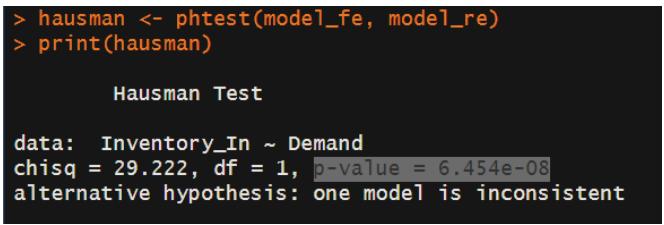
As p value is less than 0.05, I utilized fixed effects model as shown on next screenshot.
Model Estimation (Two-Way Fixed Effects):
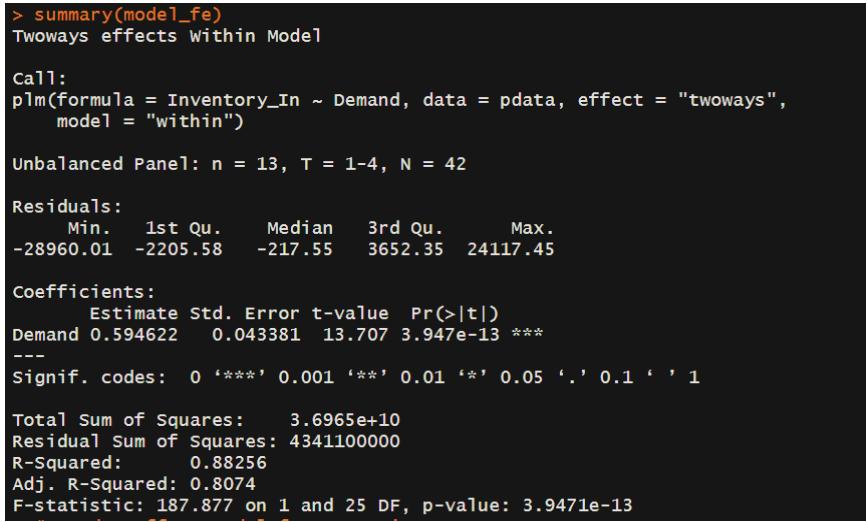
With an R squared of 0.88256, this shows that $88\%$ of the variation in the inventory inflow is explained by the model. The F-statistic of 187.877 and p-value less than 0.05 indicates a statistical significance model overall. So, each unit increase in demand leads to approximately 0.6 unit increase in inventory inflow. The model suggests a strong and statistically significant relationship between demand and inventory received with consistency across panels.
## IV. CONCLUSION
The application of a two-way fixed effects panel data model revealed a statistically significant and robust relationship between regional customer demand and inventory inflows across multiple warehouses and products. With demand explaining over $88\%$ of the variance in inventory receipts and a highly significant coefficient estimate, the results indicate a strong alignment between supply actions and customer needs. However, while this responsiveness suggests a sound demand-driven approach, it does not in isolation confirm optimal inventory management or distribution efficiency. As supported by literature, panel data models are effective for analyzing cross-sectional and temporal variations in inventory behavior, particularly in multi-warehouse, multi-product contexts. Their integration with other econometric approaches- such as ARIMA for forecasting, VAR for product interdependencies, and ECM for long-term equilibrium adjustments- can provide a more comprehensive framework for warehousing optimization. To fully evaluate inventory performance, future analyses should incorporate additional KPIs such as inventory turnover, service levels, and responsiveness to demand volatility, ensuring a holistic assessment of operational efficiency.
Generating HTML Viewer...
References
10 Cites in Article
Fernando Rojas,Peter Wanke,Víctor Leiva,Mauricio Huerta,Carlos Martin-Barreiro (2022). Modeling Inventory Cost Savings and Supply Chain Success Factors: A Hybrid Robust Compromise Multi-Criteria Approach.
Maurício Silva,Ernée Kozyreff Filho,Elias Rodríguez,Fernando Marins (2024). An inventory allocation model for cost reduction in the supply chain of a payment means company.
Mahdi Abolghasemi,Eric Beh,Garth Tarr,Richard Gerlach (2020). Demand forecasting in supply chain: The impact of demand volatility in the presence of promotion.
K Nishinari,T Ezaki,G Cui,N Imura (2024). The effect of local forecasting improvements on supply chain performance.
Shruthi Sajid,Jeewanie Arachchige,Faiza Bukhsh,Abhishta Abhishta,Faizan Ahmed (2025). Building Trust in Predictive Analytics: A Review of ML Explainability and Interpretability.
Sanjaya Mayadunne,Hari Rajagopalan,Elizabeth Sharer (2024). A multi-step mixed integer programming heuristic for warehouse layout optimization.
No ethics committee approval was required for this article type.
Data Availability
Not applicable for this article.
How to Cite This Article
Ali K. Al Fardan. 2026. \u201cEconometrics Modeling for Strategic Warehouse Optimization\u201d. Global Journal of Computer Science and Technology - G: Interdisciplinary GJMBR-G Volume 25 (GJMBR Volume 25 Issue G1): .
Explore published articles in an immersive Augmented Reality environment. Our platform converts research papers into interactive 3D books, allowing readers to view and interact with content using AR and VR compatible devices.
Your published article is automatically converted into a realistic 3D book. Flip through pages and read research papers in a more engaging and interactive format.
Warehouse inventory and layout optimization are critical to inventory and logistics management in organizations. In many instances, limited warehouse space is a constraint and a barrier to expanding operations and increasing demand. In this paper, I explore various econometric optimization models to improve inventory management and space utilization. I present various case studies to illustrate the applicability and use benefits. Additionally, I’ve applied one such econometric model to a sample inventory dataset from Saudi Aramco demonstrating its effectiveness in identifying opportunities for improving inventory management and space optimization.
Our website is actively being updated, and changes may occur frequently. Please clear your browser cache if needed. For feedback or error reporting, please email [email protected]
Thank you for connecting with us. We will respond to you shortly.