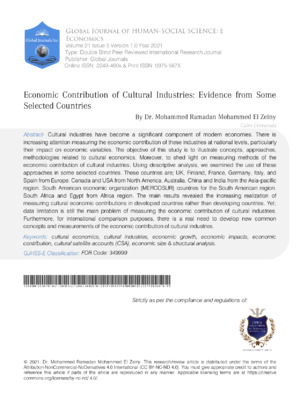
Economic Contribution of Cultural Industries: Evidence from some Selected Countries

Dr. Mohammed Ramadan Mohammed El Zeiny
Cairo University Cairo University

Send Message

To: Author

Economic Contribution of Cultural Industries: Evidence from some Selected Countries

Article Fingerprint

ReserarchID

Q6G8X

Economic Contribution of Cultural Industries: Evidence from some Selected Countries Banner

AI TAKEAWAY

Connecting with the Eternal Ground
  • English
  • Afrikaans
  • Albanian
  • Amharic
  • Arabic
  • Armenian
  • Azerbaijani
  • Basque
  • Belarusian
  • Bengali
  • Bosnian
  • Bulgarian
  • Catalan
  • Cebuano
  • Chichewa
  • Chinese (Simplified)
  • Chinese (Traditional)
  • Corsican
  • Croatian
  • Czech
  • Danish
  • Dutch
  • Esperanto
  • Estonian
  • Filipino
  • Finnish
  • French
  • Frisian
  • Galician
  • Georgian
  • German
  • Greek
  • Gujarati
  • Haitian Creole
  • Hausa
  • Hawaiian
  • Hebrew
  • Hindi
  • Hmong
  • Hungarian
  • Icelandic
  • Igbo
  • Indonesian
  • Irish
  • Italian
  • Japanese
  • Javanese
  • Kannada
  • Kazakh
  • Khmer
  • Korean
  • Kurdish (Kurmanji)
  • Kyrgyz
  • Lao
  • Latin
  • Latvian
  • Lithuanian
  • Luxembourgish
  • Macedonian
  • Malagasy
  • Malay
  • Malayalam
  • Maltese
  • Maori
  • Marathi
  • Mongolian
  • Myanmar (Burmese)
  • Nepali
  • Norwegian
  • Pashto
  • Persian
  • Polish
  • Portuguese
  • Punjabi
  • Romanian
  • Russian
  • Samoan
  • Scots Gaelic
  • Serbian
  • Sesotho
  • Shona
  • Sindhi
  • Sinhala
  • Slovak
  • Slovenian
  • Somali
  • Spanish
  • Sundanese
  • Swahili
  • Swedish
  • Tajik
  • Tamil
  • Telugu
  • Thai
  • Turkish
  • Ukrainian
  • Urdu
  • Uzbek
  • Vietnamese
  • Welsh
  • Xhosa
  • Yiddish
  • Yoruba
  • Zulu
Font Type
Font Size
Font Size
Bedground

Abstract

Cultural industries have become a significant component of modern economies. There is increasing attention measuring the economic contribution of these industries at national levels, particularly their impact on economic variables. The objective of this study is to illustrate concepts, approaches, methodologies related to cultural economics. Moreover, to shed light on measuring methods of the economic contribution of cultural industries. Using descriptive analysis, we examined the use of these approaches in some selected countries. These countries are; UK, Finland, France, Germany, Italy, and Spain from Europe. Canada and USA from North America. Australia, China and India from the Asia-pacific region. South American economic organization (MERCOSUR) countries for the South American region. South Africa and Egypt from Africa region. The main results revealed the increasing realization of measuring cultural economic contributions in developed countries rather than developing countries. Yet; data limitation is still the main problem of measuring the economic contribution of cultural industries. Furthermore, for international comparison purposes, there is a real need to develop new common concepts and measurements of the economic contribution of cultural industries.

References

64 Cites in Article
  1. Gretel Adorno,Rolf Tiedemann (1998). Editors’ Afterword.
  2. S Alikhan (2001). The Cultural Industries and Their Contribution To Economic Growth.
  3. (2001). Measuring wellbeing: Frameworks for Australian Social Statistics.
  4. Hasan Bakhshi,Eric Mcvittie (2008). Creative supply-chain linkages and innovation: Do the creative industries stimulate business innovation in the wider economy?.
  5. E Banfield (1958). The Moral Basis of a Backward Society.
  6. Trine Bille,Günther Schulze (2006). Chapter 30 Culture in Urban and Regional Development.
  7. R Boix,L Prols,F Capone,D Sanchez-Serra (2010). The geography of creative industries in Europe: comparing France, Great Britain, Italy and Spain.
  8. Benjamin Green (2008). UNDERSTANDING COLLABORATIVE DOCUMENTARY FILMMAKING PRACTICE AS A METHODOLOGY FOR EXPLORING PARTICIPANT PERSPECTIVES OF PLACE IN AREAS OF LOW SOCIAL MOBILITY.
  9. (2013). Creative Economy.
  10. P Drouin,M Mathieu,L Bedlington (2008). Brittle Fracture in Ships.
  11. C. (1998). Concise Handbook of the Council of Europe. Strasbourg, Directorate of Information of the Council of Europe.
  12. Howard Cox,Simon Mowatt,Stuart Young (2005). Innovation and organisation in the UK magazine print publishing industry: a survey.
  13. P Dasgupta (2003). Social Capital and Economic Performance: Analytics.
  14. Madeleine Daepp,Marcus Hamilton,Geoffrey West,Luís Bettencourt (2015). The mortality of companies.
  15. (1998). Young, Andrea, (born 30 July 1964), Director, Broadcasting, Media and Creative Industries, Department for Digital, Culture, Media and Sport (formerly Department for Culture, Media and Sport), since 2017.
  16. Elizabeth Jacka,Meredith Quinn (1994). Review & Booknote: Commonwealth Department of Communications and the Arts.
  17. A Ellmeier (2003). Cultural Entrepreneurialism: On the Changing Relationship Between the Arts, Culture and Employment.
  18. Roberta Comunian (2007). Complexity and Creative Economies, NESTA, London, 17 June 2011.
  19. Terry Flew (2012). The Creative Industries: Culture and Policy.
  20. R Florida (2004). The Flight of the Creative Class: The New Global Competition for Talent.
  21. R Florida (2002). The Rise of Creative Class.
  22. Francis Fukuyama (1995). Trust. The Social Virtues and the Creation of Prosperity.
  23. Ahmed Ghoneim (2005). The audio-visual sector in Egypt.
  24. A Ghoneim (2002). CHAPTER 5 Stabilization and Structural Adjustment in Egypt, Jordan, Morocco, and Tunisia.
  25. Serge Hadisi,Jen Snowball (2017). Assessing the potential of the craft sector’s contribution to employment and gross domestic product in South Africa.
  26. Christian Handke,Erwin Dekker (2013). From Austria to Australia: Mark Blaug and cultural economics.
  27. James Heilbrun,Charles Gray (2004). The Economics of Art and Culture.
  28. J Hervas-Olivier (2011). The Importance of Creative Industries Agglomerations in Explaining the Wealth of European Regions.
  29. David Hesmondhalgh (2002). Cultural and Creative Industries.
  30. P Higgs,S Cunningham,H Bakhshi (2008). Beyond the Creative Industries: Mapping the Creative Economy in the United Kingdom.
  31. J Howkins (2001). Money.
  32. R Ingelhart (2000). Culture Matters: How Values Shape Human Progress.
  33. R Inghleart (1997). CHAPTER 3 Modernization and Postmodernization in 43 Societies.
  34. R Inghleart (1990). Culture Shift in Advanced Industrial Society.
  35. R Jensen (1999). IEE Colloquium on How Your Employees Can Transform Your Business (Ref. No. 199/028).
  36. Andrea Juan,Linda Zuze,Sylvia Hannan,Ashika Govender,Vijay Reddy (2014). Bullies, victims and bully-victims in South African schools: Examining the risk factors.
  37. Christoph Meinel,Maxim Asjoma (2006). HTTP, HTML, CSS – Aufbauhelfer im Web.
  38. K King,M Blaug (1973). Does the Arts Council Know What It Is Doing?.
  39. A Klamer (1996). The Value of Culture : On the Relationship between Economics and Arts.
  40. J Knell,K Oakley (2007). Till, Barry Dorn, (1 June 1923–12 June 2013), Principal of Morley College, London, 1965–86; Adviser, 1973–86, Director, 1986–92, Baring Foundation.
  41. J Knell,T Fleming (2008). Heterogeneity in Economic Thought: Foundations and Modern Methods.
  42. Scott Lash,John Urry (1994). Economies of Signs and Space.
  43. Christopher Madden (2001). Using ‘Economic’ Impact Studies in Arts and Cultural Advocacy: A Cautionary Note.
  44. A Marini (2016). Cultural Beliefs, Values and Economics: A Survey.
  45. Matteo Marini (2013). The traditions of modernity.
  46. K Marx (1859). A Contribution to the Critique of Political Economy.
  47. François Matarasso (1997). Smoke and mirrors: a response to paola merli's “evaluating the social impact of participation in arts activities”, IJCP, 2002, vol. 8(1).
  48. Thomas Glick (2009). "Catalonia, Factory of Spain," an Exhibition in Barcelona.
  49. Thomas Glick (2007). "Catalonia, Factory of Spain," an Exhibition in Barcelona.
  50. Luigi Ferraris (2009). Contacts Between People, Diffusion of Information, Co-Operation in the Field of Culture and Education in the Helsinki Final Recommendations.
  51. Lebogang Nawa,Mzo Sirayi (2014). Digital Technology and Cultural Heritage Sites in the City of Tshwane.
  52. Kate Oakley (2009). The disappearing arts: creativity and innovation after the creative industries.
  53. K Oakley,B Sperry,B,A Pratt (2008). The art of innovation: How fine arts graduates contribute to innovation.
  54. Dave O’brien,Daniel Laurison,Andrew Miles,Sam Friedman (2016). Are the creative industries meritocratic? An analysis of the 2014 British Labour Force Survey.
  55. Oluwayemisi Oyekunle,Mziwoxolo Sirayi (2018). The role of design in sustainable development of handicraft industries.
  56. Oluwayemisi Oyekunle (2017). The contribution of creative industries to sustainable urban development in South Africa.
  57. O Oyekunle,I Fillis (2016). The role of handicraft micro-enterprises as a catalyst for youth employment.
  58. B Pine,J Gilmore (1999). The Experience Economy.
  59. E Porter (2000). Attitudes, Values, Beliefs, and the Microeconomics of Prosperity.
  60. E Porter (1990). Competitive Advantage of Nations.
  61. Jason Potts (2007). Creative Industries Over an Innovation Trajectory.
  62. Jason Potts,Stuart Cunningham (2008). Four models of the creative industries.
  63. A Pratt (2005). Cultural industries and public policy: An oxymoron.
  64. R Putnam,R Leonardi,R Nanetti (1993). Making Democracy Work: Civic Traditions in Modern Italy.

Funding

No external funding was declared for this work.

Conflict of Interest

The authors declare no conflict of interest.

Ethical Approval

No ethics committee approval was required for this article type.

Data Availability

Not applicable for this article.

How to Cite This Article

Dr. Mohammed Ramadan Mohammed El Zeiny. 2021. \u201cEconomic Contribution of Cultural Industries: Evidence from some Selected Countries\u201d. Global Journal of Human-Social Science - E: Economics GJHSS-E Volume 21 (GJHSS Volume 21 Issue E5).

Download Citation

Economic cultural industries.
Journal Specifications

Crossref Journal DOI 10.17406/GJHSS

Print ISSN 0975-587X

e-ISSN 2249-460X

Keywords
Classification
GJHSS-E Classification FOR Code: 349999
Version of record

v1.2

Issue date
October 30, 2021

Language
en
Experiance in AR

Explore published articles in an immersive Augmented Reality environment. Our platform converts research papers into interactive 3D books, allowing readers to view and interact with content using AR and VR compatible devices.

Read in 3D

Your published article is automatically converted into a realistic 3D book. Flip through pages and read research papers in a more engaging and interactive format.

Article Matrices
Total Views: 1832
Total Downloads: 872
2026 Trends
Related Research
Our website is actively being updated, and changes may occur frequently. Please clear your browser cache if needed. For feedback or error reporting, please email [email protected]

Request Access

Please fill out the form below to request access to this research paper. Your request will be reviewed by the editorial or author team.
X

Quote and Order Details

Contact Person

Invoice Address

Notes or Comments

This is the heading

Lorem ipsum dolor sit amet, consectetur adipiscing elit. Ut elit tellus, luctus nec ullamcorper mattis, pulvinar dapibus leo.

High-quality academic research articles on global topics and journals.

Economic Contribution of Cultural Industries: Evidence from some Selected Countries

Dr. Mohammed Ramadan Mohammed El Zeiny
Dr. Mohammed Ramadan Mohammed El Zeiny <p>Cairo University</p>

Research Journals