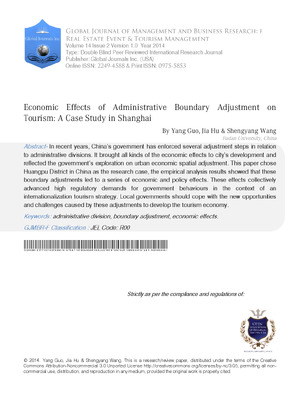
Economic Effects of Administrative Boundary Adjustment on Tourism: A Case Study in Shanghai

§ Fudan University Fudan University

Send Message

To: Author

Economic Effects of Administrative Boundary Adjustment on Tourism: A Case Study in Shanghai

Article Fingerprint

ReserarchID

MBRXLF18

Economic Effects of Administrative Boundary Adjustment on Tourism: A Case Study in Shanghai Banner

Key Research Insights

Synthesized scholarly intelligence & interactive research assistant
  • English
  • Afrikaans
  • Albanian
  • Amharic
  • Arabic
  • Armenian
  • Azerbaijani
  • Basque
  • Belarusian
  • Bengali
  • Bosnian
  • Bulgarian
  • Catalan
  • Cebuano
  • Chichewa
  • Chinese (Simplified)
  • Chinese (Traditional)
  • Corsican
  • Croatian
  • Czech
  • Danish
  • Dutch
  • Esperanto
  • Estonian
  • Filipino
  • Finnish
  • French
  • Frisian
  • Galician
  • Georgian
  • German
  • Greek
  • Gujarati
  • Haitian Creole
  • Hausa
  • Hawaiian
  • Hebrew
  • Hindi
  • Hmong
  • Hungarian
  • Icelandic
  • Igbo
  • Indonesian
  • Irish
  • Italian
  • Japanese
  • Javanese
  • Kannada
  • Kazakh
  • Khmer
  • Korean
  • Kurdish (Kurmanji)
  • Kyrgyz
  • Lao
  • Latin
  • Latvian
  • Lithuanian
  • Luxembourgish
  • Macedonian
  • Malagasy
  • Malay
  • Malayalam
  • Maltese
  • Maori
  • Marathi
  • Mongolian
  • Myanmar (Burmese)
  • Nepali
  • Norwegian
  • Pashto
  • Persian
  • Polish
  • Portuguese
  • Punjabi
  • Romanian
  • Russian
  • Samoan
  • Scots Gaelic
  • Serbian
  • Sesotho
  • Shona
  • Sindhi
  • Sinhala
  • Slovak
  • Slovenian
  • Somali
  • Spanish
  • Sundanese
  • Swahili
  • Swedish
  • Tajik
  • Tamil
  • Telugu
  • Thai
  • Turkish
  • Ukrainian
  • Urdu
  • Uzbek
  • Vietnamese
  • Welsh
  • Xhosa
  • Yiddish
  • Yoruba
  • Zulu
Reading Preferences
Font Size
Line Spacing
Background
This converted HTML version may contain rendering inconsistencies. Please refer to the PDF for the authoritative version, or click here to provide feedback.

Abstract

In recent years, China’s government has enforced several adjustment steps in relation to administrative divisions. It brought all kinds of the economic effects to city’s development and reflected the government’s exploration on urban economic spatial adjustment. This paper chose Huangpu District in China as the research case, the empirical analysis results showed that these boundary adjustments led to a series of economic and policy effects. These effects collectively advanced high regulatory demands for government behaviours in the context of an internationalization tourism strategy. Local governments should cope with the new opportunities and challenges caused by these adjustments to develop the tourism economy.

References

19 Cites in Article
  1. 1. Sue Berry,Adele Ladkin (1997). Sustainable tourism: a regional perspective. Tourism Management, 18(7), 433-440.
  2. 2. Z Deng (2000). East Asian Model and the Government-leading Tourism Development Strategy. Academic Forum, 47-50.
  3. 3. X Gao,Y Wang,S Mai (2010). A Research on Economic Division in Regional Economic Development: Based on Thoughts of the Conflict between Economic divisions and Administrative divisions. Guizhou Social Sciences, 11, 72-76.
  4. 4. C Hall (1994). Tourism and politics: policy, power, and place. Tourism and politics: policy, power, and place, 230-235.
  5. 5. S Hao (2001). A Study on the Market Development of China's Tourism Industry and Government Behavior. Tourism Tribune, 19-22.
  6. 6. Iuoto (1974). The role of the state in tourism. Annals of Tourism Research, 66-72.
  7. 7. A Jose,Puppim De,Oliveira (2003). Governmental responses to tourism development: three Brazilian case studies. Tourism Management, 97-110.
  8. 8. J Li,X Lin (2000). A Discussion on the Government-leading Tourism Development Strategy in China. Social Scientist, 45-47.
  9. 9. X Liang,D Ding (2002). A Study on Administrative Behavior in Developing Regional Tourism. Productivity Research, 99-101.
  10. 10. J Liu (1996). Theory and Practice of Chinese Administrative Division. Theory and Practice of Chinese Administrative Division
  11. 11. L Meng (2006). Cause, Harm and Countermeasure of China's Administrative District Economy. Administrative Tribune, 80-82.
  12. 12. R Mill,A Morrison (1997). The Tourism System: An Introductory Text. The Tourism System: An Introductory Text, 143-146.
  13. 13. Q Shu,K Zhou (2003). From Closed to Open: An Insight into China's Administrative District Economy. From Closed to Open: An Insight into China's Administrative District Economy
  14. 14. X Wang,L Zhao (2007). The City Rename Method in the Service of Urban Tourism. Urban Problems, 52-55.
  15. 15. Y Wang (2009). Tourism Cooperation and Regional Innovation. Tourism Cooperation and Regional Innovation
  16. 16. X Xiong,D Wu,J Cao (2007). A Thought about China's Administrative District Economy. Journal of Chongqing Technology and Business University, 18-20.
  17. 17. F Yin (2009). Writing up the dissertation. Planning Research in Hospitality & Tourism, 237-250.
  18. 18. F Yu,L Lu,W Cao,T Zhu (2006). A Study on the Effect of Administrative Division Adjustment: A Comparison between Jingangshan, Jiangxi and Huangshan. Anhui. Geosciences, 2, 20-25.
  19. 19. Bo-Shuai Yang,Ling-Xiao Liu,Min Yuan,Yi-Bin Hou,Qing-Tao Li,Su Zhou,Yu-Xin Shi,Bu-Lang Gao (1999). Multiple imaging modality-guided radiofrequency ablation combined with transarterial chemoembolization for hepatocellular carcinoma in special locations. Diagnostic and Interventional Radiology, 26(2), 131-139.

Funding

No external funding was declared for this work.

Conflict of Interest

The authors declare no conflict of interest.

Ethical Approval

No ethics committee approval was required for this article type.

Data Availability

Not applicable for this article.

How to Cite This Article

gy. 2014. "Economic Effects of Administrative Boundary Adjustment on Tourism: A Case Study in Shanghai". Global Journal of Management and Business Research - F: Real estate, Event, Tourism Management & Transporting GJMBR-F Volume 14 (GJMBR Volume 14 Issue F2).
Download Citation

Journal Specifications

Crossref Journal DOI 10.17406/GJMBR

Print ISSN 0975-5853

e-ISSN 2249-4588

Keywords
Classification
GJMBR-F Classification JEL Code: R00
Version of record

v1.2

Issue date
November 26, 2014

Language
English
Order Article Reprint
Experiance in AR

Explore published articles in an immersive Augmented Reality environment. Our platform converts research papers into interactive 3D books, allowing readers to view and interact with content using AR and VR compatible devices.

Read in 3D

Your published article is automatically converted into a realistic 3D book. Flip through pages and read research papers in a more engaging and interactive format.

Article Matrices
Total Views: 1K
Total Downloads: 72
All Trends

Request Access

Please fill out the form below to request access to this research paper. Your request will be reviewed by the editorial or author team.
X

This is the heading

Lorem ipsum dolor sit amet, consectetur adipiscing elit. Ut elit tellus, luctus nec ullamcorper mattis, pulvinar dapibus leo.


High-quality academic research articles on global topics and journals.

Economic Effects of Administrative Boundary Adjustment on Tourism: A Case Study in Shanghai

gy
gy Fudan University