Economicheat Exchanger Is?
I. USES AND APPLICATIONS OF HEAT EXCHANGER
Heat exchangers are used to transfer heat from one media to another. It is most commonly used in space heating such as in the home, refrigeration, power plants and even in air conditioning. It is also used in the radiator in a car using an antifreeze engine cooling fluid. Heat exchangers are classified according to their flow arrangements where there are the parallel flow, and the counter flow. Aside from this, heat exchangers also have different types depending on their purpose and how that heat is exchanged.
But the fact is that there are heat exchangers even in the circulation system of fishes and whales. The veins of these animals are intertwined such that one side is carrying cold blood and the other has cold blood. As a result, these species can prevent heat loss especially when they are swimming in cold water. In some whales, the heat exchanger can be found in their tongues. When it comes to the manufacturing industry, heat exchangers are used both for cooling and heating. Heat exchangers in large scale industrial processes are usually custom made to suit the process, depending on the typeof fluid used, the phase, temperature, pressure, chemical composition and other thermodynamic properties. Heat exchangers mostly can be found in industries which produce a heat stream. In this case, heat exchangers usually circulate the output heat to put it as input by heating a different stream in the process. The fact that it really saves a lot of money because when the output heat no longer needed then it can be recycled rather than to come from an external source as heat is basically recycled. When used in industries and in the home, it can serve to lower energy costs as it helps recover wasted heat and recycle it for heating in another process. Typically, most heat exchangers use fluid to store heat and heat transfer can take the form of either absorption or dissipation. For instance, heat exchangers are used as oil coolers, transmission and engine coolers, boiler coolers, waste water heat recovery, condensers and evaporators in refrigeration systems. In residential homes, heat exchangers are used for floor heating, pool heating, snow and ice melting, domestic water heater, central, solar and geothermal heating. Of course, heat exchangers have different designs which depend on the purpose it is intended for. Brazed heat exchangers, a collection of plates which are brazed together, are used for hydronic systems like swimming pools, floor heating, snow and dice melting. The shell and coil heat exchanger design is best for areas with limited spaces as it can be installed vertically. Of course, for the highly industrial process, the shell and tube heat exchanger is the perfect solution.
II. TYPES OF HEAT EXCHANGERS
In industries, there are lots of heat exchangers that can be seen. The types of heat exchanger can be classified in three major constructions which are tubular type, plate type and extended surface type.
a) Tubular Heat Exchangers
The tubular types are consists of circular tubes. One fluid flows inside the tubes and the other flows on the outside of the tubes. The parameters of the heat exchanger can be changed like the tube diameter, the number of pitch, tube arrangement, number of tubes and length of the tube can be manipulate. The common types of heat exchangers lie under these categories are double-pipe type, shell-and-tube type and spiral tube type. The tubular heat exchangers can be designed for high pressure relative to the environment and high pressure difference between the fluids. These exchangers are used for liquid-to-liquid and liquid-to-vapor phase. But when the operating temperature or pressure is very high or fouling on one fluid side, it will used gas-to-liquid and gas-to-gas heat transfer applications.
i. Double-Pipe Heat Exchanger
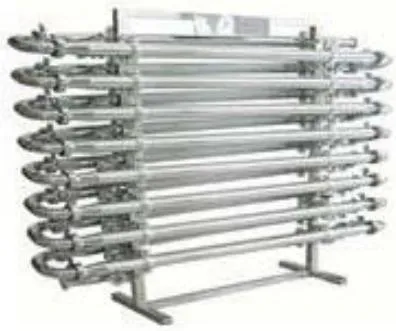
A double-pipe heat exchanger consists of smaller and larger diameter pipe where the smaller pipe fitted concentrically into the larger one in purpose to give direction to the flow from one section to another shown in Figure 1. One set of these tubes includes the fluid that has to be cooled or heated. The second fluid runs over the tubes being cooled or heated in order to provide heat or absorb the heat. A set of tubes is the tube bundle and it can be made up of several types of tubes such as longitudinally plain, longitudinally finned, and more. If the application requires an almost constant wall temperature, the fluids may flow in a parallel direction. It's easy to clean and convenient to disassemble and assemble. The double-pipe heat exchanger is one of the simplest. Usually, it is used for small capacity applications because it is so expensive on a cost per unit area basis.
ii. Shell-and-Tube Heat Exchanger
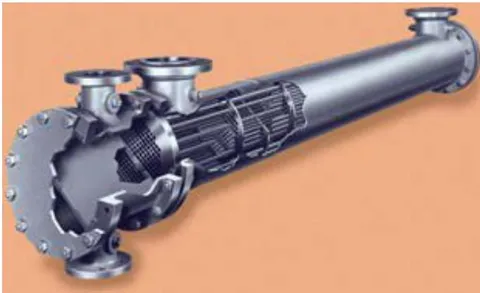
This exchanger is built of a bundle of round tubes mounted in a large cylindrical shell with the tube axis parallel to the shell to transfer the heat between the two fluids shown in Figure 2. The fluid flows inside the tubes and other fluid flows across and along the tubes. But for baffled shell-and-tube heat exchanger the shell side stream flows across between pairs of baffles and then flows parallel to the tubes as it flows from one baffle compartment to the next. This kind of exchanger consists of tubes, shells, and front-end head, rear-end head, baffles and tube sheets. The different type of Shell-and-tube heat exchangers depend on different application. Usually in chemical industry and process application, it is used as oil-coolers, power condensers, preheaters in power plants and also steam generators in nuclear power plants. The most common types of shell-and-tube heat exchanger are fixed tube sheet design, U-tube design and floating-head type. Cleaning this heat exchanger is easy. Instead of easily cleaning, it is also low in cost. But among all tube bundle types, the U-tube is the least expensive because it only needs one tube sheet. Technically, because of its construction in U shape, the cleaning is hardly done in the sharp bend. An even number of tube passes only can be achieved.
iii. Spiral-Tube Heat Exchanger
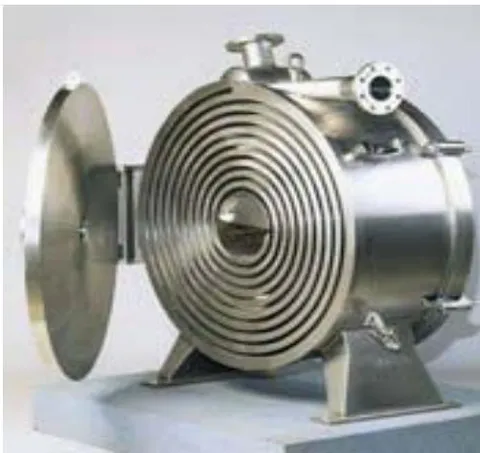
A spiral heat exchanger is a helical or coiled tube configuration shown in Figure 3. It consists of spirally wound coils placed in a shell or designed as co-axial condensers and co-axial evaporators that are used in refrigeration systems. The heat transfer coefficient is higher in a spiral tube than in a straight tube. Since the cleaning is impossible, the spiral tubes are suitable for thermal expansion and clean fluids. The biggest advantage of the spiral heat exchanger is its efficient use of space. A compact spiral heat exchanger can lower costs, while an oversized one can have less pressure drop, higher thermal efficiency, less pumping energy, and lower energy costs. Spiral heat exchangers are frequently used when heating fluids that have solids and therefore often foul the inside of the heat exchanger. Spiral heat exchangers have three types of flow arrangements.
Firstly, the spiral flow and cross flow has one fluid in each. The spiral flow passages are welded at each side and this type of flow is good for handling low density gases which pass-through the cross flow. This can be used for liquid-to-liquid applications if one fluid has a much greater flow rate than the other. A second type is the distributed vapor and spiral flow. The coolant moves in a spiral and exits through the top. The hot gases that enter will leave as condensate out of the bottom outlet. The third type is the counter current flow where both of the fluids will flow in opposite directions and are used for liquid-to-liquid applications. The spiral heat exchanger is good for pasteurization, heat recovery, digester heating, effluent cooling, and pre-heating.
b) Plate Heat Exchangers
A second type of heat exchanger is a plate heat exchanger. It has many thin plates that are slightly apart and have very large surface areas and fluid flow passages that are good for heat transfer. This can be a more effective heat exchanger than the tube or shell heat exchanger due to advances in brazing and gasket technology that have made this plate exchanger more practical. Large heat exchangers are called plate and frame heat exchangers and there allow for periodic disassembly, cleaning, and inspection. There are several types of permanently bonded plate heat exchangers like dip brazed and vacuum brazed plate varieties, and they are often used in refrigeration. These heat exchangers can further be classified as gasketed plate, spiral plate and lamella.
i. Gasketed Plate Heat Exchangers
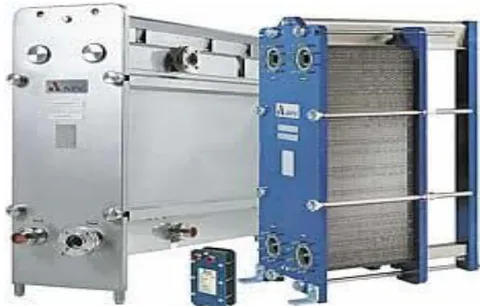
A gasketed plate heat exchanger consists of a series of thin plates that have wavy surface which function as separating the fluids shown in Figure 4. The plates come with corner parts arranged so that the two media between which heat is to be exchanged flow through interchange exclaim spaces. Appropriate design and gas keting permit a stack of plates to be held together by compression bolts joining the end plates. Gaskets prevent leakage to the outside and direct the fluids in the plates as desired. The flow pattern is generally chosen so that the media flow countercurrent to each other. Since the flow passages are quite small, strong eddying gives high heat transfer coefficients, high pressure drops, and high local shear which minimizes fouling. These exchangers provide a relatively compact and lightweight heat transfer surface. Gas keted plate is typically used for heat exchange between two liquid streams. This type can be found in food processing industries because of the compatibility to be cleaned easily and sterilized as it completely disassembled.
ii. Spiral Plate Heat Exchanger
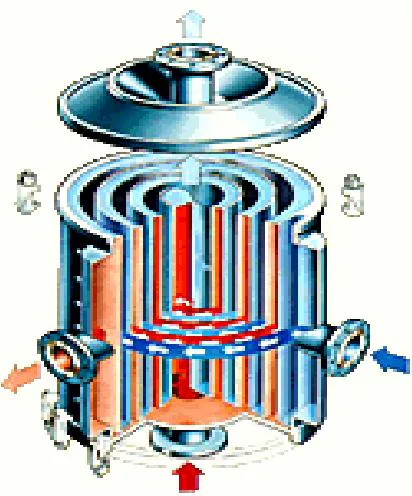
Spiral heat exchangers are formed by rolling two long, parallel plates into a spiral using a mandrel and welding the edges of adjacent plates to form channels shown in Figure 5. The distance between the metal surfaces in both channels is maintained by means of distance pins welded to the metal sheet. The two spiral paths introduce a secondary flow, increasing the heat transfer and reducing fouling deposits. These heat exchangers are quite compact but are relatively expensive due to the specialized fabrication. The spiral heat exchanger is particularly effective in handling sludge's, viscous liquids, and liquids with solids in suspension including slurries. The spiral heat exchanger is made in three main types which differ in the connections and flow arrangements. Type has flat covers over the spiral channels. The media flow countercurrent through the channels via the connections in the center and at the periphery. This type is used to exchange heat between media without phase changes such as liquid-liquid, gas-liquid, or gas-gas. One stream enters at the center of the unit and flows from inside outward. The other stream enters at the periphery and flows towards the center. Thus the counter flow is achieved. Type is designed for cross flow operation. One channel is completely seal-welded, while the other is open along both sheet metal edges. The passage with the medium in spiral flow is welded shut on each side, and the medium in cross flow passes through the open spiral annulus. This type is mainly used as a surface condenser in evaporating plants. It is also highly effective as a vaporizer. Two spiral bodies are often built into the same jacket and are mounted below each other. Type, the third standard type is in principle similar to type with alternately welded up channels, but type is provided with a specially designed to cover. This type of heat exchanger is mainly intended for condensing vapors with sub-cooling of condensate and no condensable gases. The top cover, therefore, has a special distribution cone where the vapor is distributed to the uncovered spiral turns in order to maintain a constant vapor velocity along the channel opening.
iii. Lamella Heat Exchangers
The lamella type of heat exchanger consists of a set of parallel, welded, thin plates channels are lamellae placed longitudinally in a shell. It is a modification of the floating-type shell-and-tube heat exchanger. These flattened tubes, called lamellae are made up of two strips of plates, profiled and spot-or seam-welded together in a continuous operation. The forming of the strips creates space inside the lamella and bosses acting as spacers for the flow sections outside the lamellae on the shell side. The lamellae are welded together at both ends by joining the ends with steel bars in between, depending on the space required between lamellae. Both ends of the lamella bundle are joined by peripheral welds to the channel cover which at the outer ends is welded to the inlet and outlet nozzle. The lamella side thus completely sealed in by welds. At the fixed end, the channel cover is equipped with an outside flange ring which is bolted to the shell flange.
III. DESIGN CONSIDERATIONS
For most economic small and simple units operating at moderate pressure and temperatures. Standard heat exchanger designs may be used for industrial applications, individually designed units may be required for a large variety of applications, the criteria for optimization depends on the minimum weight, minimum volume of heat transfer surface, minimum initial cost, minimum operating cost, maximum heat transfer rate, minimum pressure drop for a specified heat transfer rate, minimum mean temperature difference, and so on. The initial step in the optimization process is the solution of the rating and the sizing problems.
The rating problem is concerned with the determination of the heat transfer rate, the outlet temperature and the pressure drop on each side. The following quantities are generally specified in the rating problems: type of heat exchanger, surface geometries, flow arrangement flow rates, inlet temperatures and the overall dimensions of the matrix.
The sizing problems is concerned with the determination of the matrix dimensions to meet the specified heat transfer and pressure drop requirements. The designer's task is to select the type of construction, flow arrangements and surface geometries on both sides. The following quantities are generally specified fluid inlet and outlet temperatures, fluid pressure drops, and heat transfer rate.
Apart from the heat transfer requirements an important consideration in the heat exchanger design, as cited earlier, is the pressure drop or pumping power. The size of the heat exchanger can be reduced by forcing the fluids through it at higher velocities there by increasing the overall heat transfer coefficient. But higher velocities will result in large pressure drops ( ) and so large pumping costs. For a given flow rate, the smaller diameter pipe may involve less initial cost but higher operating or pumping cost. For an incompressible fluid, and pumping power , where mis the pumping cost increases considerably with higher velocity a compromise between the large overall heat transfer coefficient and the corresponding velocities will have been made. The cost of the materials and the floor space occupied by the heat exchanger may impose limitation on the physical size of the heat exchanger.
IV. SELECTION OF HEAT EXCHANGER
The proper selection depends on several factors as explain below.
Heat Transfer Rate: This is most important quantity. A heat exchanger should be capable of transferring heat at the specified rate in order to achieve the desired temperature change of the fluid at the specified mass flow rate.
Cost: Budgetary limitation often restricts the selection of the heat exchanger. An off-the-self heat exchanger has a definite cost advantage over those made to order. However, in many cases, the standard available heat exchanger is not satisfactory. It is then needed to undertake the expensive and time-consuming task of designing and manufacturing a heat exchanger from scratch to suit the needs. The operation and maintenance cost of the heat exchanger are also required to consider for assessing the overall cost.
Pumping Power: In a heat exchanger, both fluids are usually forced to flow by pumps or fans that consume electrical power. The annual cost of electricity associated with the operation of the pumps and fans can be determined from
Operating cost = {Pumping power, kW X Hours of operation, h X Price of electricity, Rs. /kWh] Where the pumping power is the total electricity consumed by the motors of the pumps and fans. Minimizing the pressure drop and the mass flow rate of the fluids will minimize the operating cost of the heat exchanger, but it will maximize the size of the heat exchanger and thus the initial cost.
Size and weight: Normally, the smaller and lighter the heat exchanger, the better. Important consideration factors are space availability.
Type: The type of heat exchanger to be selected depends primarily on the type of the fluids involved, the size and weight limitations, and the presence of phase-change process. A heat exchanger is suitable to cool a liquid by a gas. On the other hand, a plate or shell-and-tube heat exchanger is very suitable for cooling a liquid by another liquid.
Materials: The materials used in the construction of the heat exchanger have an important effect on the selection. The thermal and structural stress effects
c) Copper & Copper Alloy Tubes
Condition: Half hard/Annealed/Hard. Coil form straight in length)
Standard: BS: 2871, C101 copper,
CZ 111 Admirable Brass IS: 1545
Theoreticalwt.:[0.785 X (OD - ID )X ρ XLX Qty]/1000
(OD & ID in mm, , L in mm)
Visual check: Surface marks/ pitting, cracks, Dent, Ovality.
Dimensional: OD, thickness range, length range, Qty.,
Weight (Weight = Actual/Theoretical)
Spectro Analysis
d) MS plate
Make: Bhilai /Bokaro/Rourkela/Jindal
Quality: Prime/Test/Boiler Quality
Theoretical wt.: [LXBX thickness X ρ]
(L & B in m, , thickness in mm)
Standard: IS: 2062, SA: 285 Gr C, SA: 515 Gr 60/70, SA: 516 Cr 60/70 or any other.
Visual check: a) Edge should be perpendicular each other.
b) Corner Rounded: Not Accepted
Rectangular: Accepted
c) Pitting/Lamination: Not Accepted
d) Fatness of plate ± 1: Accepted
e) Plate should be radish and not bluish in color. (Indicated proper heat treatment)
Dimensional: Thickness range, length range, Width, Qty., Weight (Weight = Actual/Theoretical)
e) Expanding Tool
Make, Model No., Tube OD, Thickness, Hole size, Expanding length.
Make, Model No., Min & Max dia. of the cage when in and out respectively.
Spare Mandrel – Model No.
Spare Roller set – Model No.
need not be considered at pressure below 15 atmosphere or temperature below C. Differential thermal expansion problems need be considered by it a temperature difference of C or more exists the tubes and the shell.
- Other Considerations: Heat exchanger should be leak-tight particularly for toxic or expensive fluids. There should be ease of servicing, low maintenance cost, safety, reliability and silence in operation.
V. OBSERVATION
a) Material appearance
Copper: Red in appearance
Brass: Yellow in appearance
SS: White in appearance
MS: Black in appearance
b) Dimensions conversion
1" 25.4 mm
1cm 10 mm
1ft 304mm
f) Electric Motor Make: H.P., Phase, RPM, voltage, frequency, and insulation Type: squirrel cage. Visual check: a) Dent on fan cover.
b) Crack on motor pedestal.
c) Smoothness of rotation of shaft.
Name plate marking: Motor S. No., Installation, H.P., frequency, volts, RPM. Test certificate enclosed or not. Verify: RPM, No load current - a) R b) Y c) B No load voltage - a) RY b) RB c) YB
g) MS, ERW Pipes NB/OD, Thickness: mm/class/light/medium/heavy Length & Qty.: Make:Jaindal& Tata Inspection: a) Pitting below black painting b) Dents c) Cracks d) Ovality Dimension: OD, thickness, L, Qty. Marking: up to 6" NB Hot stamping and beyond paint marking.
h) Dished End Shape: Tori Spherical/Elliptical/Hemispherical. (NB /OD), thickness, straight face, Knuckle radius, crown radius, wt. / piece, Quantity Standard: Plate confirming to MS (IS: 2062) / Boiler Quality (IS: 2002) Visual check: a) No pitting, hammer mark also: Not Accepted b) Crinkle: Not Accepted c) Cracks: Not Accepted Tolerances:- a) On crown radius a) 1.2% of ID Over dishingshown in Figure 6.
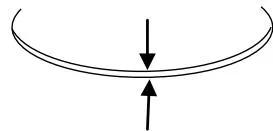
Gap between require and actual = 1.25% of ID
Figure 6: Over dishing
b) of
b) ID under dishing shown in Figure 7.
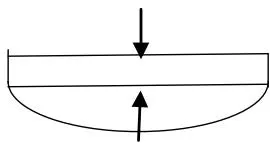
Under dishing
Knuckle radius = Nil
Weight: Actual/Theoretical
c) HP sheet
Make:
Dimension: Length, Width, thickness, Qty.
Visual check: a) Edge should be perpendicular: Not Accepted
b) Pitting/Lamination: Not Accepted
c) Waviness on the sheet: Not Accepted
d) Integral Finned Tube
Dimension: OD, thickness, Length, Qty., Material, Plain end (L) on each side,
No. of fins/inch
Condition: Hard/Half Hard/Annealed
Standard: BS: 2871 Pt. -3,
Theoretical wt.:[0.785 X (OD - ID )X ρ XLX Qty]/1000
Fin depth - 19/26
Visual check: a) Fins have to be formed and the material is not to be remove from the surface.
b) Size of OD is not exceed tube any case.
c) Groove depth
d) Dent
e) Surface cracks, pitting
f) Ovality
g) S.S. Plates Circles
Dimension: OD, thickness, Qty.
Theoretical wt.:[0.785 X (OD )X ρ XLX Qty]/1000
Visual check: a) Surface flat width in 1mm
b) Gas cut edges should be perpendicular with in 2mm.
c) Manufactures test certificate required along with supply.
d) Weight
Spectro analysis
e) Working fluid with compatible materials
| Working Fluid | Temperature | Compatible Materials |
| Water | 50°C – 200°C | Copper |
| Freon | Up to 50°C | Aluminum |
| Diphenyle oxide | Up to 300°C | Steel |
| Organic fluid | Up to 300°C | Steel |
| Liquid metals like sodium | Up to 600°C | Stainless steel |
| Liquid oxygen | -200°C | Cryogenic |
| Liquid nitrogen | -200°C | Cryogenic |
| Niobium | Up to 1500°C | Inconel or refractory |
| Tantalum | Up to 1500°C | Inconel or refractory |
An alternate to refractory metals is ceramic tubing. Ceramic such as silicon carbide and alumina have excellent corrosion and erosion resistance. Working fluid can be nontoxic, non-corrosive, less viscous, high surface tension of high latent heat and chemically compatible with the heat exchanger.