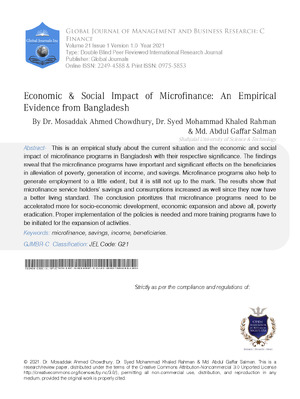
Economic & Social Impact of Microfinance: An Empirical Evidence from Bangladesh

Β§ Shahjalal University of Science and Technology

Send Message

To: Author

Economic & Social Impact of Microfinance: An Empirical Evidence from Bangladesh

Article Fingerprint

ReserarchID

C: FINANCE6Y345

Economic & Social Impact of Microfinance: An Empirical Evidence from Bangladesh Banner

AI TAKEAWAY

Connecting with the Eternal Ground
  • English
  • Afrikaans
  • Albanian
  • Amharic
  • Arabic
  • Armenian
  • Azerbaijani
  • Basque
  • Belarusian
  • Bengali
  • Bosnian
  • Bulgarian
  • Catalan
  • Cebuano
  • Chichewa
  • Chinese (Simplified)
  • Chinese (Traditional)
  • Corsican
  • Croatian
  • Czech
  • Danish
  • Dutch
  • Esperanto
  • Estonian
  • Filipino
  • Finnish
  • French
  • Frisian
  • Galician
  • Georgian
  • German
  • Greek
  • Gujarati
  • Haitian Creole
  • Hausa
  • Hawaiian
  • Hebrew
  • Hindi
  • Hmong
  • Hungarian
  • Icelandic
  • Igbo
  • Indonesian
  • Irish
  • Italian
  • Japanese
  • Javanese
  • Kannada
  • Kazakh
  • Khmer
  • Korean
  • Kurdish (Kurmanji)
  • Kyrgyz
  • Lao
  • Latin
  • Latvian
  • Lithuanian
  • Luxembourgish
  • Macedonian
  • Malagasy
  • Malay
  • Malayalam
  • Maltese
  • Maori
  • Marathi
  • Mongolian
  • Myanmar (Burmese)
  • Nepali
  • Norwegian
  • Pashto
  • Persian
  • Polish
  • Portuguese
  • Punjabi
  • Romanian
  • Russian
  • Samoan
  • Scots Gaelic
  • Serbian
  • Sesotho
  • Shona
  • Sindhi
  • Sinhala
  • Slovak
  • Slovenian
  • Somali
  • Spanish
  • Sundanese
  • Swahili
  • Swedish
  • Tajik
  • Tamil
  • Telugu
  • Thai
  • Turkish
  • Ukrainian
  • Urdu
  • Uzbek
  • Vietnamese
  • Welsh
  • Xhosa
  • Yiddish
  • Yoruba
  • Zulu
Font Type
Font Size
Font Size
Bedground

Abstract

This is an empirical study about the current situation and the economic and social impact of microfinance programs in Bangladesh with their respective significance. The findings reveal that the microfinance programs have important and significant effects on the beneficiaries in alleviation of poverty, generation of income, and savings. Microfinance programs also help to generate employment to a little extent, but it is still not up to the mark. The results show that microfinance service holders’ savings and consumptions increased as well since they now have a better living standard. The conclusion prioritizes that microfinance programs need to be accelerated more for socio-economic development, economic expansion and above all, poverty eradication. Proper implementation of the policies is needed and more training programs have to be initiated for the expansion of activities.

References

25 Cites in Article
  1. Salehuddin Ahmed (2009). Microfinance institutions in Bangladesh: achievements and challenges.
  2. C Al Mamun,M Hasan,A Rana (2013). Micro-credit and poverty alleviation: The Case of Bangladesh.
  3. Z Ali,M Ahmed (2014). Public Sector Microfinance and Rural Wellbeing: Evidence from BRDB.
  4. M Bhuiya,R Khanam,M Rahman (2016). Microfinance operations in Bangladesh-an overview.
  5. A Chowdhury (2009). Microfinance as a Poverty Reduction Tool.
  6. S Churchill,J Danso,S Appau (2016). Microcredit and poverty reduction in Bangladesh: average effects beyond publication bias.
  7. A Dutta,S Banerjee (2018). Does microfinance impede sustainable entrepreneurial initiatives among women borrowers? Evidence from rural Bangladesh.
  8. Marie Godquin (2004). Microfinance Repayment Performance in Bangladesh: How to Improve the Allocation of Loans by MFIs.
  9. Mohammad Hasan,Mohammad Malek (2017). Microfinance Market in Bangladesh.
  10. A Hassan,S Saleem (2017). An Islamic microfinance business model in Bangladesh.
  11. M Huque (2017). Effectiveness of Micro-Credit on Urban Poor Women in Dhaka City: An Empirical Study.
  12. Katsushi Imai,Md. Azam (2012). Does Microfinance Reduce Poverty in Bangladesh? New Evidence from Household Panel Data.
  13. A Islam,C Nguyen,R Smyth (2015). Does microfinance change informal lending in village economies? Evidence from Bangladesh.
  14. K Islam (2016). Impact of Micro-Financing on Women Empowerment in Bangladesh.
  15. M Khalily (2004). Quantitative approach to impact analysis of microfinance programmes in Bangladesh-what have we learned.
  16. M Khatun,M Islam,S Majumder (2012). Why some poor women in Bangladesh do not opt for micro-credit?.
  17. Rubana Mahjabeen (2008). Microfinancing in Bangladesh: Impact on households, consumption and welfare.
  18. Mohummed Mazumder (2015). Role of Microfinance in Sustainable Development in Rural Bangladesh.
  19. M Mia (2017). An Overview of the Microfinance Sector in Bangladesh.
  20. R Mizanur,M Ahmad,F (2010). Impact of microfinance of IBBL on the rural poor's livelihood in Bangladesh: an empirical study.
  21. Golzare Nabi,Aminul Islam,Rosni Bakar (2015). Islamic Microfinance as a Tool of Financial Inclusion in Bangladesh.
  22. Faraha Nawaz (2017). Bargaining with Poverty: An Empirical Review on Some Rural Women in Bangladesh.
  23. Mohammad Rahman,Rasheda Khanam,Son Nghiem (2017). The effects of microfinance on women’s empowerment: new evidence from Bangladesh.
  24. Rafiqur Rahman,Qiang Nie (2012). The Synthesis of Grameen Bank Microfinance Approaches in Bangladesh.
  25. Rashadur Rahman,Nishad Nasrin,Sal Islam (2015). Microcredit in rural Bangladesh: evaluation of consumption change and poverty gap.

Funding

No external funding was declared for this work.

Conflict of Interest

The authors declare no conflict of interest.

Ethical Approval

No ethics committee approval was required for this article type.

Data Availability

Not applicable for this article.

How to Cite This Article

Md. Abdul. 1970. "Economic & Social Impact of Microfinance: An Empirical Evidence from Bangladesh". Global Journal of Management and Business Research - C: Finance GJMBR-C Volume 21 (GJMBR Volume 21 Issue C1).

Download Citation

Journal Specifications

Crossref Journal DOI 10.17406/GJMBR

Print ISSN 0975-5853

e-ISSN 2249-4588

Keywords
Classification
GJMBR-C Classification JEL Code: G21
Version of record

v1.2

Issue date
January 16, 2021

Language
English
Experiance in AR

Explore published articles in an immersive Augmented Reality environment. Our platform converts research papers into interactive 3D books, allowing readers to view and interact with content using AR and VR compatible devices.

Read in 3D

Your published article is automatically converted into a realistic 3D book. Flip through pages and read research papers in a more engaging and interactive format.

Article Matrices
Total Views: 157K
Total Downloads: 5
All Trends

Request Access

Please fill out the form below to request access to this research paper. Your request will be reviewed by the editorial or author team.
X

This is the heading

Lorem ipsum dolor sit amet, consectetur adipiscing elit. Ut elit tellus, luctus nec ullamcorper mattis, pulvinar dapibus leo.


High-quality academic research articles on global topics and journals.

Economic & Social Impact of Microfinance: An Empirical Evidence from Bangladesh

Md. Abdul
Md. Abdul Shahjalal University of Science and Technology