I. INTRODUCTION
Over the years, the road building industry has developed asphalt mixtures that have high level of performance. These asphalt mixtures used as paved materials are generally made up aggregates, bituminous binder, air voids and different additives. Due to research purposes in road works sector, it is necessary to separate asphalt mixes into their components. Extraction is an important operation that consists of separating the bituminous binder from the aggregates in reclaimed asphalt or asphalt mixture using a chlorinated solvent. It is mainly used as test to determine the binder properties and content and also to check the grading curve of aggregates after washing and sieving. The extraction process differs in their use of heat method of agitating the mixture and allowable solvents. Different methods have been used for extracting bituminous binders from reclaimed asphalt. They were grouped based on solvent temperature during the process and are categorized into so called hot methods, cold methods, a standardized non-solvent method (EN 12697-39, 2012) and finally automatic method (Montepara and Guiliani, 1999). The hot methods are mostly reflux extraction in which bituminous sample is heated to dissociate the coated aggregates and soxhlet extraction method which is commonly used in organic chemistry. In his paper Collins-Garcia et al.,
2000 has mentioned to a less extended hot method for bitumen extraction. Several methods for cold extraction exist and do not use a heat source. Among them, there are agitation method (Ongel and Hugener, 2014; Sugar et al., 2002; Zhao et al., 2015), centrifuge method (Schultz, 1988; Sengoz and Oylumluoglu, 2013; Stroup-Gardiner and Nelson, 2000) and vacuum method (Jones et al., 1969; State of California – Business, transportation and housing agency/California test 310, 2000; Texas DOT Tex-210-F, 2008). Automatic methods (Montepara and Giuliani, 1999) which use different machine models that are available on the market. They have several advantages due to the fast testing and satisfactory experimental working conditions in terms of safety.
Due to the reasons of asphalt content of HMA calculation for quality control and quality acceptance (QC/QA) testing, solvents are still desirable. A number of solvents have been used through the years (Burr et al., 1990). Carbon disulphide (CS2) was initially used since the early 1900s (Bateman & Delp, 1927) followed by benzene (C6H6). Chlorinated solvents like trichloroethene (TCE, C2HCl3), 1-1-1-trichloroethane (C2H3Cl3) and dichloromethane (CH2Cl2) became very popular in the 1950s and 1960s (Cipione, Davison, Burr, Glover, & Bullin, 1991) after benzene has been proven to be carcinogenic and its use, bee phase out. TCE was later then found as effective as Benzene based on Abson and Buton (1960) research and thus it became the main replacement of Benzene. Traxler (1967) found that more binder is removed from aggregate when 10-15% of ethanol or methanol added to TCE is used. Cipione et al., 1991 has mentioned that the use of this combination become popular among many researchers at least in US. Several companies have introduced in the market various normal propyl bromide (nPB) solvents as direct substitutes for both TCE and TCA (M. Stroup-Gardiner & J.W. Nelson, 2000).
A number of researchers have shown in the past that asphalt is never completely removed from aggregate, regardless the solvent used. This incomplete extraction results in underestimating the asphalt content between 0.1 to 0.5% (Peterson et al., 1999). This retained asphalt result in significant changes in the recovered asphalt properties (M. Stroup-Gardiner et al., 1994). After extraction, recovery is important since the goal is to evaluate the final properties of the binder. There are two different state-of-the-art methods for binder recovery from solvent mixtures used in the European Union: EN 12697-3: Bitumen recovery: Rotary evaporator (2013) and EN 12697-4: Bitumen recovery: Fractionating column (2015). In the US, ASTM D1856: Standard test method for recovery of asphalt from solution by Abson method (ASTM, 2015), introduced in 1933 and ASTM D5404: Standard practice for recovery of asphalt from solution using the rotary evaporator (ASTM, 2012) are the two different methods used for binder recovery. Rotary evaporator is the most method used in EU and US. In his paper tilted recovery and testing of RAP binders from recycled asphalt pavements, Peterson et al., (2000) showed that the rotary evaporator method has to be preferred when it comes to binder tests. It is the method of choice and has been increasingly used since the 1970 because of fewer problems with residual solvent and lower heat need for recovery (Peterson et al., 1999). Rotary evaporator is more prefer to the Abson recovery method since subsequent research showed that the latter left enough residual solvent in the binder which leads to a significant reduction in binder stiffness (Peterson et al., 1999, Abson and Buton, 1960).
Ma Tao et al., 2008 conducted a study with the aim to verify the influence of trichloroethylene, mineral filler and temperature on the reclaimed SBS modified asphalt during the process of extraction and recovery experiments. Different test were then designed and carried out and the corresponding solutions for different influencing factors were presented so that the performance of SBS modified asphalt can be evaluated accurately. They found that the adoption of the upper part of extracting solution from the extraction equipment from Abson recovery experiment after natural sediment for more than 24 hours decrease the adverse effects from residual mineral filler while when there are no equipments for high speed centrifugal separation and pressure filtration. They also indicated after test results that the adverse effects from residual trichloroethylene can be decreased if the temperature of Abson recovery experiment can be reduced to less than 140°C, and the protection gas can be removed, when no condensing liquid trichloroethylene coming out from the end of the orifice of the condenser tube. Physical properties, including softening point, penetration, 15°C ductility and the 60°C dynamic viscosity have been carried out by (Liu Zhihui, 2012; Hu Xudong, 2003) on virgin and recovered blank pitch binders using trichloroethylene under well-defined operating conditions. The results obtained from the experiments showed that the penetration degree increased while the softening point and the 60°C viscosity decrease as well as the asphalt density when the asphalt is recovered. They concluded that the reduction of the physical properties of recovered binder is due to the non-completely removal of the solvent. To investigate the factors that affect the recovery of asphalt, the effect of the trichloroethylene and powder mineral residue at four different percentages (0.5%, 1%, 1.5%, and 2%) on the asphalt properties has been analyzed. In this study, 70# grade asphalt and SBS modified asphalt were used to analyze the effect of residue on the properties of asphalt. A large number of experiments have shown that the possible residual residues for the recovery of asphalt from rotary evaporators include mineral filler and trichloroethylene, which are mainly aimed at the effects of residuals on the properties of asphalt. To investigate the factors that affect the recovery of asphalt, the effect of the trichloroethylene and powder mineral residue at four different percentages (0.5%, 1%, 1.5%, and 2%) on the asphalt properties has been analyzed. In this study, 70# grade asphalt and SBS modified asphalt were used to analyze the effect of residue on the properties of asphalt.
II. EXPERIMENTAL PROGRAM
Prior to the test, 150g of each type of asphalt is heated under constant temperature: 70# grade asphalt to about 150°C and SBS modified asphalt to about 160°C. Then, the desired content of trichloroethylene and mineral filler is added to the asphalt, and a glass rod is used to stir the asphalt. When the trichloroethylene is added, the quantity of trichloroethylene is needed to be quickly dispersed into the asphalt because of the rapid evaporation of trichloroethylene.
In this study, the ductility test is performed at C for unaged 70# grade asphalt while it is at C for unaged SBS modified asphalt. The dynamic shear rheometer test DSR is performed at C for unaged 70# grade asphalt while it is C for SBS bitumen. The penetration test temperature is at C. The 70# grade asphalt and SBS modified asphalt were aged by the pressure aging vessel process (PAV), then the effect of extraction residue on the properties of aged asphalt was studied. After the PAV process, the ductility test temperature for both ageing asphalt is C.
III. RESULTS AND DISCUSSION
a) Analysis of the Effect of Extraction Residue on the Properties of 70# grade asphalt and SBS Modified Asphalt
i. Effect of the extraction residue on softening point
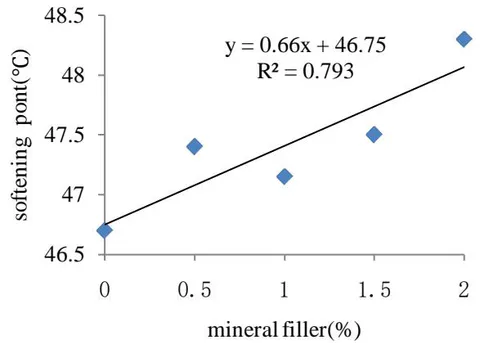
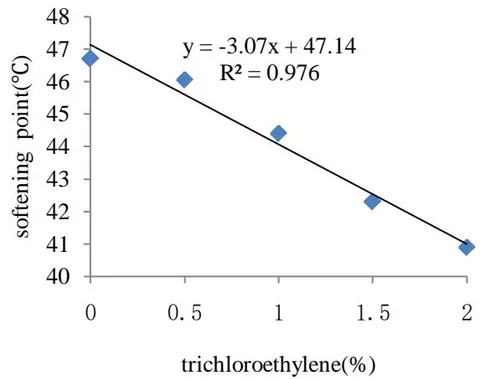
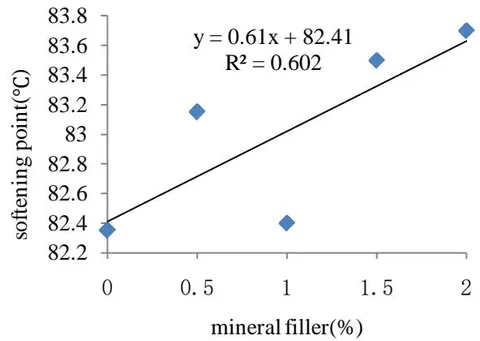
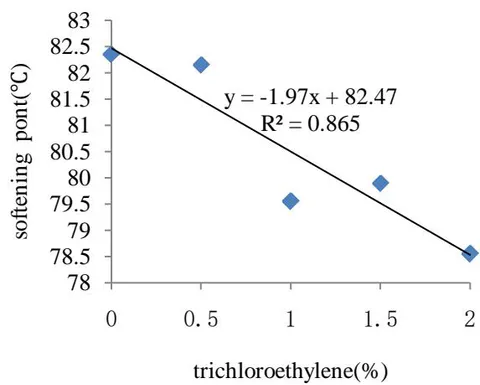
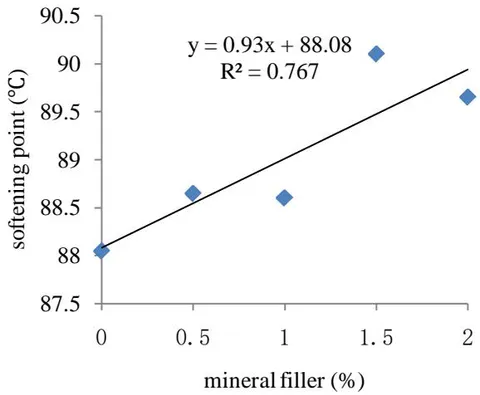
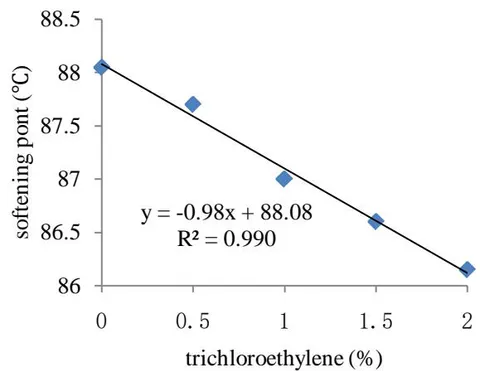
The effect of the extraction residue on the softening point of asphalt is shown from Fig. 1 to Fig. 4. It can be clearly seen that the softening point of both asphalt binders increases with the increase of mineral filler residue while it gradually decreases with increase in the amount of trichloroethylene. From the development of the trend line, it can be seen that the effect of the extraction residue on the softening point of the 70# grade asphalt is higher than that of SBS modified asphalt. From the numerical point of view for each 0.1% increase in mineral filler residue, the softening point of
70# grade asphalt increased by about C while that of SBS modified asphalt increased by about C. An increase of 0.1% in trichloroethylene results to a decreased of C and C on the softening point of 70# grade asphalt and SBS modified asphalt respectively. It can be shown that the effect of mineral filler residue on the softening point of 70# grade asphalt
ii. Effect of extraction residue on penetration
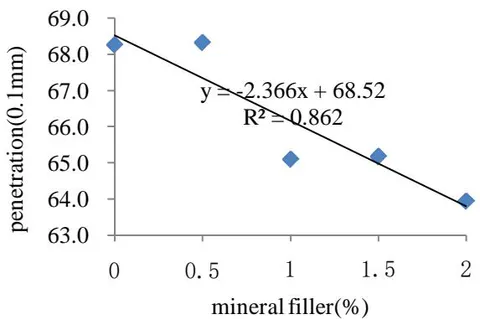
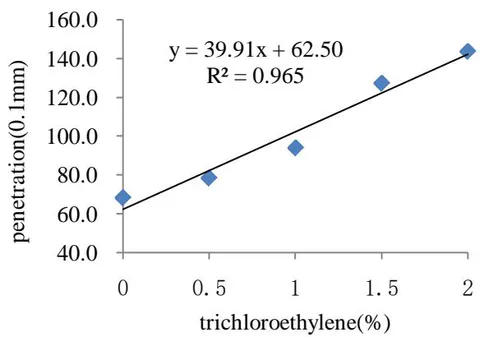
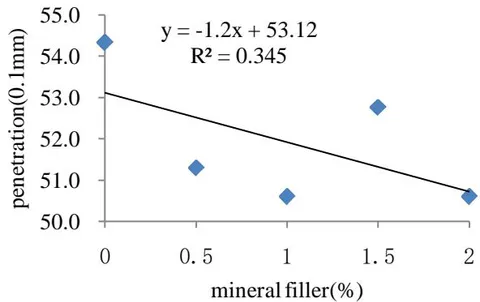
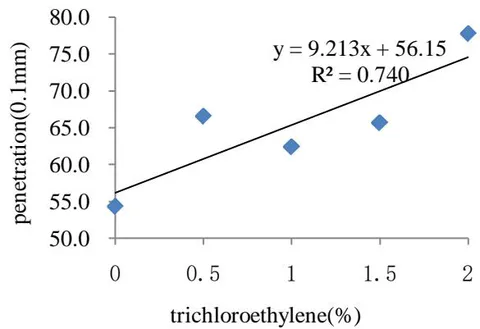
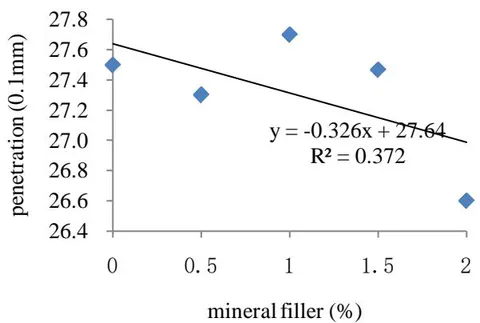
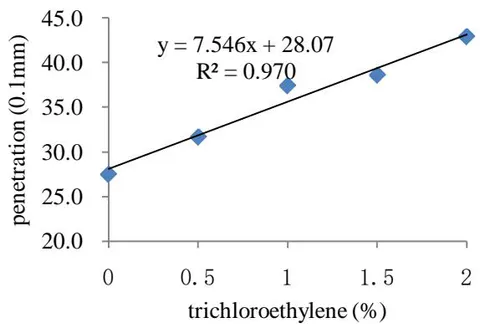
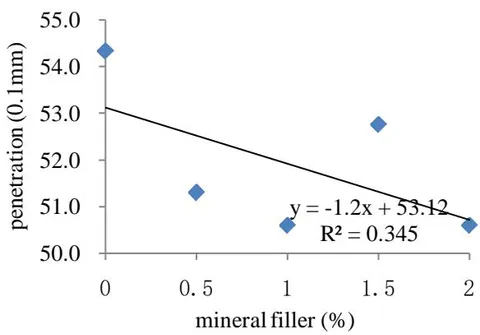
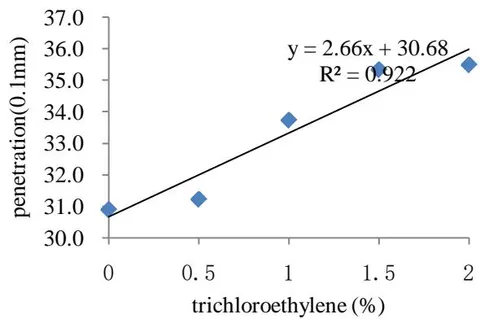
The effect of the extraction residue on the penetration of the asphalt is shown from Figures 5 to 8. It can be clearly seen that the penetration of both asphalt is gradually reduced with the increase of mineral filler residue content while it is the opposite trend with the increase in the amount of trichloroethylene. From the development of the trend line, the effect of extraction residue on the penetration of 70# grade asphalt is stronger than that of SBS modified asphalt. From the numerical point of view, the penetration rate of 70# grade asphalt decreased by about 0.237 (0.1mm)that of SBS modified asphalt decreased by about 0.120 (0.1mm) when the residue of mineral filler increased by is close to that of SBS modified asphalt, but the effect of trichloroethylene on softening point of 70# grade asphalt is much greater than that of SBS modified asphalt. It can be concluded that the trichloroethylene has a greater effect on the softening point of the asphalt than the mineral filler.
0.1%. With the increase of trichloroethylene by 0.1%, the penetration of 70# grade asphalt increased by about 3.991 (0.1mm) and that of SBS modified asphalt increased by about 0.921 (0.1mm). It can be explained that the influence of mineral filler residue on the penetration of 70# grade asphalt is much greater than that of SBS modified asphalt and the trichloroethylene effect is higher than that of mineral filler for both asphalt binders.
iii. Effect of extraction residue on ductility
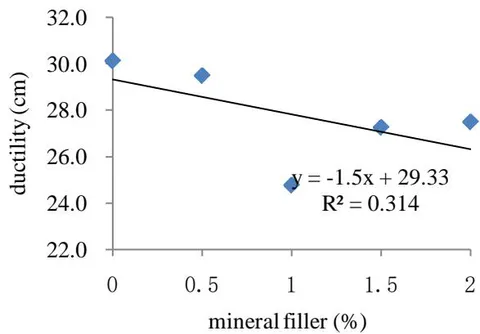
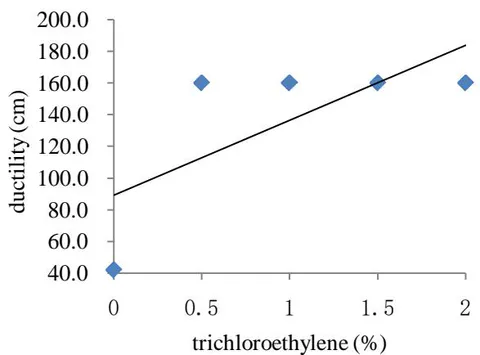
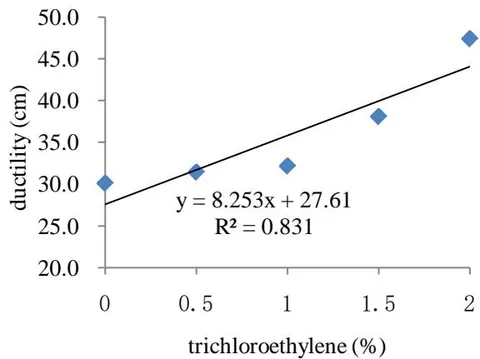
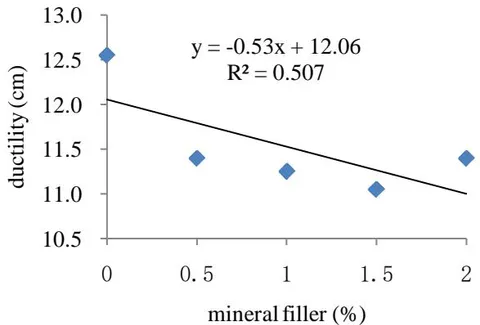
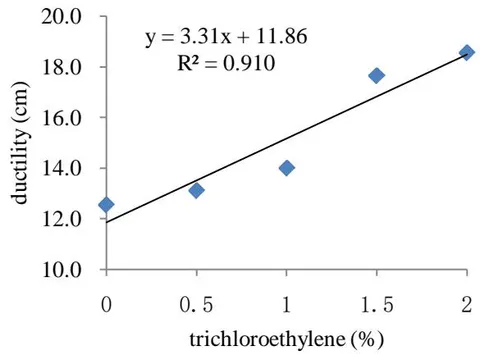
The effect of the extraction residue on the ductility of the asphalt is shown from Figures 9 to 12. It can be clearly seen that the ductility of 70# grade asphalt and SBS modified asphalt is gradually reduced with the increase of mineral filler while it is the opposite trend with the increase in the content of trichloroethylene. From the numerical point of view, each 0.1% increase in the mineral filler residue results in the decreased of 1.039cm and 0.15cm in the ductility of 70# grade asphalt and SBS modified asphalt respectively.
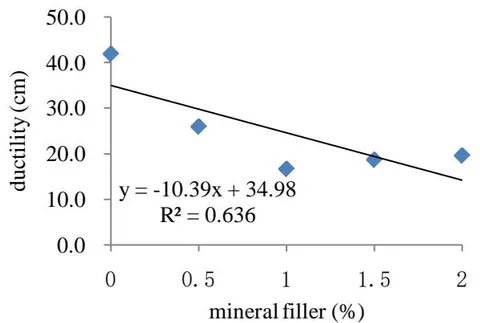
As long as the trichloroethylene residual increase by 0.5%, the 10 °C ductility of 70# grade asphalt increased from 41.9cm to a value greater than 160cm, while the 5 °C ductility increased from 30.1cm to 31.5cm for SBS modified asphalt Relatively speaking, the influence of trichloroethylene on the ductility of 70#grade asphalt is very obvious while it has a little effect on the SBS modified asphalt, and the mineral filler residue has the same influence rule.
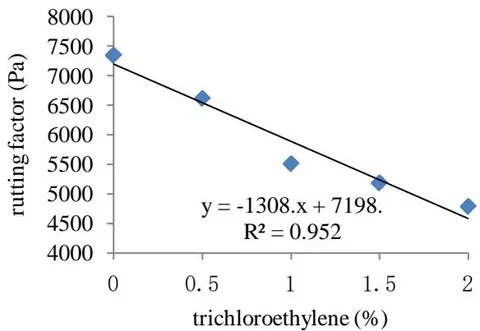
iv. Effect of extraction residue on rutting factor (DSR)
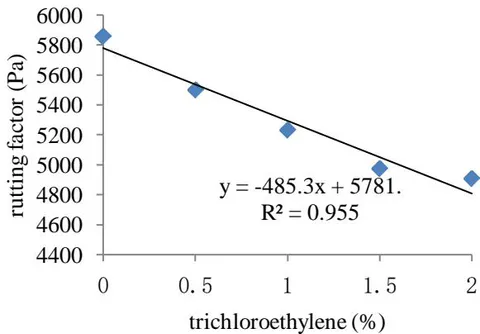
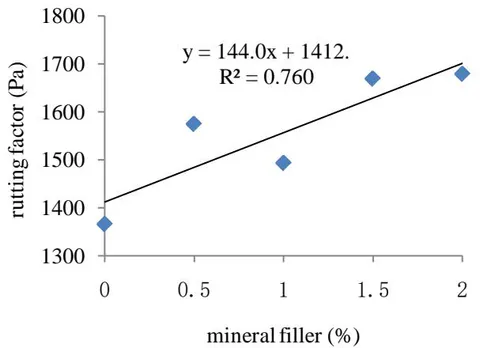
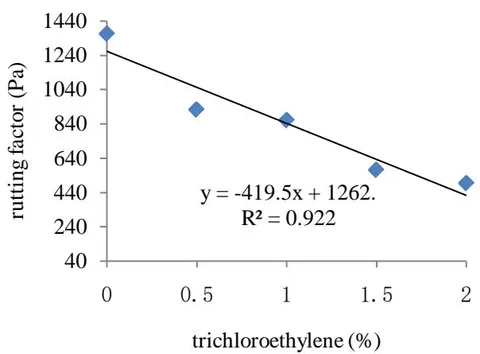
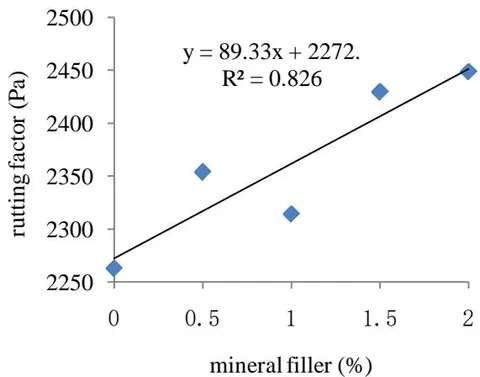
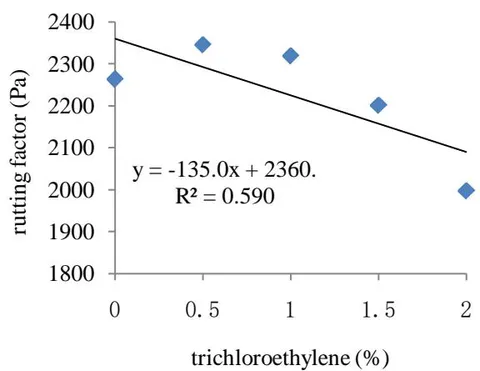
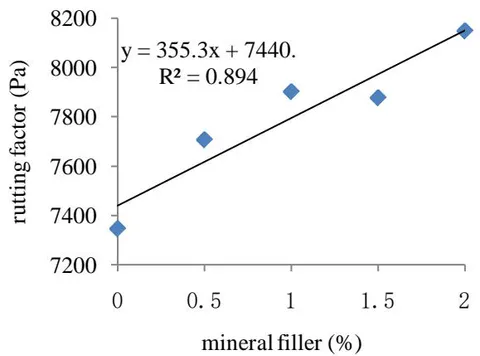
The effect of the extraction residue on the asphalt rutting factor is shown from Figures 13 to 16. It can be seen that the rutting factor of asphalt increases with the increase of mineral filler, and the rutting factor of 70# grade asphalt increases by about 14.4Pa for each 0.1% increase in mineral filler content while that of SBS modified asphalt increases by about 8.9Pa. The rutting factor of asphalt has a significant downward trend with the increase in the amount of trichloroethylene. The rutting factor of 70# grade asphalt is reduced by about 42 Pa for each 0.1% increase in the amount of trichloroethylene and that of SBS modified asphalt is reduced by about 13.5 Pa.
b) Analysis of the effect of extraction residue on the properties of 70# grade asphalt and SBS modified asphalt after ageing (PAV)
i. Effect of extraction residue on softening point
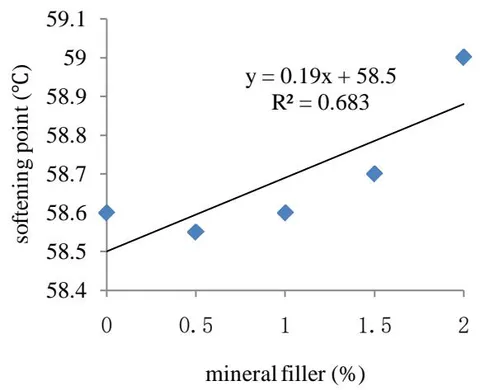
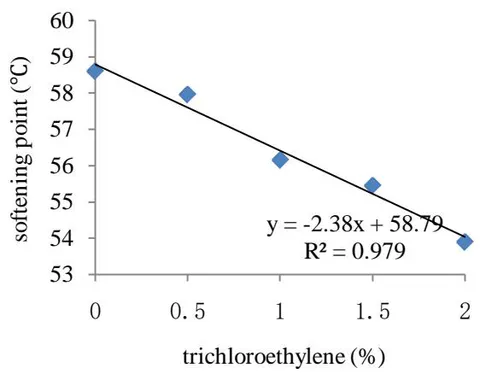
The effect of the extracted residue on the softening point of asphalt after PAV aging is shown from Fig. 17 to Fig 20. It can be clearly seen that the softening point of the asphalt gradually increased with the increase of the content of the mineral filler. With the increase of the content of trichloroethylene, the softening point of the aged asphalt gradually decreases. From the numerical point of view, the softening point of 70# gradeaging asphalt increased by about 0.019 °C, 0.3 times less than the temperature sensitivity of the unaged asphalt while that of the SBS aging asphalt increased by about 0.093 °C, 1.41 times more than the temperature sensitivity of the unaged asphalt for an increase of 0.1% of mineral filler. For an increase of
ii. Effect of extraction residue on penetration
The effect of the extraction residue on the penetration of PAV aged asphalt is shown from Fig. 21
0.1% of trichloroethylene, the softening point of 70# gradeaged asphalt decreased by about 0.238 °C, 0.78 times less than the temperature sensitivity of the unaged asphalt, the softening point of SBS modified asphalt decreased by about 0.098 °C, 0.5 times less than the temperature sensitivity of the unaged asphalt. It can be explained that the softening point of aged asphalt is different from that of unaged asphalt to the sensitivity of mineral residue and trichloroethylene. SBS aging asphalt is more sensitive, while the sensitivity of 70# grade aging asphalt is weaker. In addition, we can see that the softening point of the aging asphalt is more sensitive to trichloroethylene than the mineral filler. The experimental data on the effect of slag on the softening point of aging asphalt is more discrete than that of trichloroethylene. It is shown that if the extraction of asphalt contains mineral filler, it will affect the parallelism of the results of asphalt softening point test.
to Fig 24. It can be clearly seen that the penetration of aged asphalt decreases with the increase of the content of mineral filler. With the increase of the content of trichloroethylene, the penetration of aged asphalt increases gradually. From the point of view, the increase in mineral filler content by 0.1%, the penetration of the 70# grade aging asphalt reduce by about 0.033 (0.1mm), is less 0.14 times than the temperature sensitivity of the original asphalt; the penetration SBS modified asphalt reduction of about 0.120 (0.1 mm), which is twice less sensitive as the original asphalt. For every 0.1% increase in the residual amount of trichloroethylene, the penetration of 70# grade ageing
iii. Effect of extraction residue on ductility
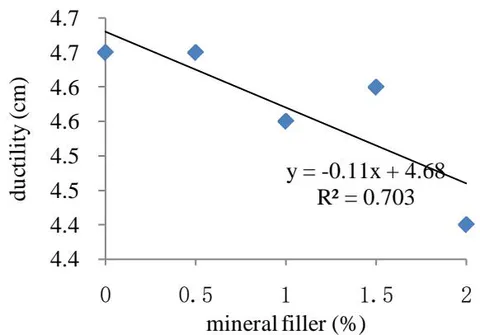
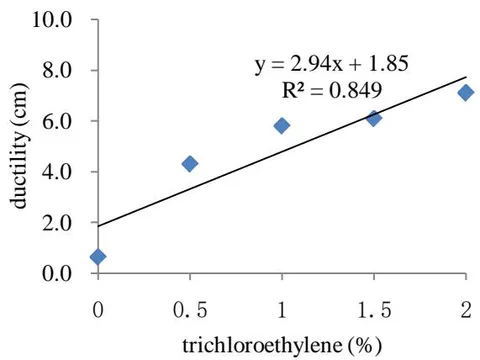
The effects of extraction residues on the ductility of aging asphalt are shown from Fig.25 to Fig.28. It can be clearly seen that the ductility of aging asphalt is gradually reduced with the increase of the mineral filler. With the increase of the residual amount of trichloroethylene, it increased. From the numerical point of view, the increase of 0.1% in mineral filler results in decreased by about 0.011cm on the 15°C ductility of 70# grade aging asphalt, 0.0106 times less than the temperature sensitivity of the unaged 70# grade asphalt; and the 10°C ductility of SBS modified is about 0.053cm, 0.35 times less sensitive than that of the original asphalt. The 10°C ductility of 70# grade aging asphalt increased asphalt increased by about 0.75 (0.1mm), 0.19 times the sensitivity of the original bitumen. The penetration of SBS modified asphalt increases by about 0.27 (0.1mm), which is 0.289 times of the original asphalt sensitivity. It can be explained that the needle penetration index of aging asphalt is less sensitive than that of the original bitumen to the amount of trichloroethylene and mineral filler. The effect of mineral filler on the penetration of aging asphalt is also discretized, as well as the parallelism of the softening point of the aging asphalt.
by 0.294cm with the increased by 0.1% of amount of trichloroethylene, while the 10°C ductility of the original asphalt can increase from 41.9cm to a value greater than 160cm as long as the 0.5% of trichloroethylene is added. When the content of trichloroethylene is 0.5%, 10°C ductility of SBS aging asphalt increases from 12.7cm to 13.2cm, while that of original asphalt increases from 30.1cm to 31.5cm. Relatively speaking, asphalt aging reduces the sensitivity to trichloroethylene and mineral content. The effect of mineral filler on the stiffness of the asphalt is still discrete relative to the effect of trichloroethylene, which will also affect the parallelism of the results of the ductility test.
iv. Effects of extraction residue on rutting factors (DSR)
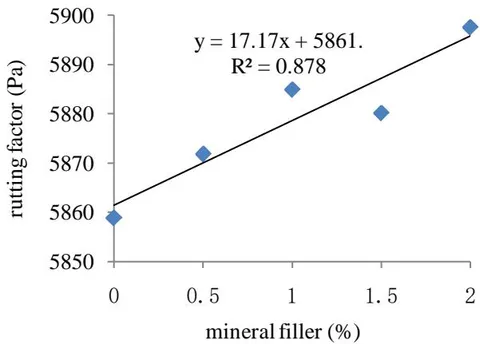
The influence of the extraction residue on the rutting factor of aged asphalt is shown from Fig.29 to Fig 32. It can be seen that the rutting factor of asphalt aging gradually increased with 0.1% increase of the mineral filler content, the rutting factor of the 70# grade aging asphalt increased about 35.53 Pa, is 2.5 times that of the original asphalt sensitivity; the rut factor of SBS aging asphalt increased about 1.72 Pa, 0.2 times that of the same original asphalt sensitivity. Rutting factor of aging asphalt has significant decline along with the increasing trichloroethylene every 0.1% increase in trichloroethylene results in 130.9 Pa of the 70# grade asphalt, which is 3.12 times the sensitivity rut factor of the original asphalt; the ruts factor of the ageing SBS modified asphalt is 48.5 Pa, 3.59 times that of the sensitivity rut factor of the original asphalt.
IV. CONCLUSIONS
In this study, the effect of the trichloroethylene and powder mineral residue at four different percentages (0.5%, 1%, 1.5%, and 2%) on the 70# grade asphalt and SBS modified asphalt properties has been analyzed. The following conclusions have be drawn:
Trichloroethylene reduces the softening point and rutting factors of the asphalt, increasing the penetration and ductility of the asphalt; the mineral filler residual reduces the asphalt ductility and penetration, and improves the softening point and rutting factor.
Under the same amount of extraction residue, the trichloroethylene has more influence on the penetration, softening point, ductility and rutting factor of asphalt than mineral filler.
The influence of trichloroethylene on the properties of 70# grade asphalt is greater than that of SBS modified asphalt. The influence of mineral filler on the properties of two kinds of asphalt is quite equivalent
The effect of extraction residue on the properties of 70# grade asphalt is better, and its effect on SBS modified asphalt is poor.
Most of the indicators indexes of ageing asphalt are less sensitive to extraction residue than original asphalt.
When the content of the mineral filler is small, it cannot uniformly influence the asphalt when it is dispersed. The mineral filler will affect the parallelism of the asphalt index test results, and the test results will be relatively discrete. It has then a little effect on the test result.
V. ACKNOWLEDGEMENTS
Special thanks to the Sichuan provincial Transport Department Highway Planning Survey, Design, And Research Institute by providing the required materials and devices needed to ensure that this work is successfully accomplished.