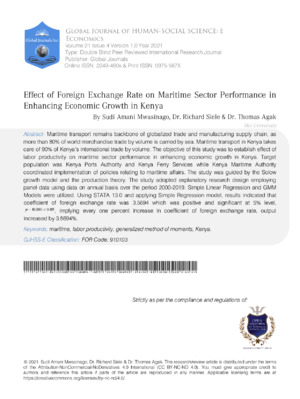
Effect of Foreign Exchange Rate on Maritime Sector Performance in Enhancing Economic Growth in Kenya

1
Sudi Amani Mwasinago
2
Richard Siele
Richard Siele
3
Thomas Agak

Thomas Agak

Send Message

To: Author

GJHSS Volume 21 Issue E4

Article Fingerprint

ReserarchID

5491V

Effect of Foreign Exchange Rate on Maritime Sector Performance in Enhancing Economic Growth in Kenya Banner
  • English
  • Afrikaans
  • Albanian
  • Amharic
  • Arabic
  • Armenian
  • Azerbaijani
  • Basque
  • Belarusian
  • Bengali
  • Bosnian
  • Bulgarian
  • Catalan
  • Cebuano
  • Chichewa
  • Chinese (Simplified)
  • Chinese (Traditional)
  • Corsican
  • Croatian
  • Czech
  • Danish
  • Dutch
  • Esperanto
  • Estonian
  • Filipino
  • Finnish
  • French
  • Frisian
  • Galician
  • Georgian
  • German
  • Greek
  • Gujarati
  • Haitian Creole
  • Hausa
  • Hawaiian
  • Hebrew
  • Hindi
  • Hmong
  • Hungarian
  • Icelandic
  • Igbo
  • Indonesian
  • Irish
  • Italian
  • Japanese
  • Javanese
  • Kannada
  • Kazakh
  • Khmer
  • Korean
  • Kurdish (Kurmanji)
  • Kyrgyz
  • Lao
  • Latin
  • Latvian
  • Lithuanian
  • Luxembourgish
  • Macedonian
  • Malagasy
  • Malay
  • Malayalam
  • Maltese
  • Maori
  • Marathi
  • Mongolian
  • Myanmar (Burmese)
  • Nepali
  • Norwegian
  • Pashto
  • Persian
  • Polish
  • Portuguese
  • Punjabi
  • Romanian
  • Russian
  • Samoan
  • Scots Gaelic
  • Serbian
  • Sesotho
  • Shona
  • Sindhi
  • Sinhala
  • Slovak
  • Slovenian
  • Somali
  • Spanish
  • Sundanese
  • Swahili
  • Swedish
  • Tajik
  • Tamil
  • Telugu
  • Thai
  • Turkish
  • Ukrainian
  • Urdu
  • Uzbek
  • Vietnamese
  • Welsh
  • Xhosa
  • Yiddish
  • Yoruba
  • Zulu

Maritime transport remains backbone of globalized trade and manufacturing supply chain, as more than 80% of world merchandise trade by volume is carried by sea. Maritime transport in Kenya takes care of 90% of Kenya’s international trade by volume. The objective of this study was to establish effect of labor productivity on maritime sector performance in enhancing economic growth in Kenya. Target population was Kenya Ports Authority and Kenya Ferry Services while Kenya Maritime Authority coordinated implementation of policies relating to maritime affairs. The study was guided by the Solow growth model and the production theory. The study adopted explanatory research design employing panel data using data on annual basis over the period 2000-2019. Simple Linear Regression and GMM Models were utilized. Using STATA 13.0 and applying Simple Regression model, results indicated that coefficient of foreign exchange rate was 3.5694 which was positive and significant at 5% level, , implying every one percent increase in coefficient of foreign exchange rate, output increased by 3.5694%.

Funding

No external funding was declared for this work.

Conflict of Interest

The authors declare no conflict of interest.

Ethical Approval

No ethics committee approval was required for this article type.

Data Availability

Not applicable for this article.

Sudi Amani Mwasinago. 2021. \u201cEffect of Foreign Exchange Rate on Maritime Sector Performance in Enhancing Economic Growth in Kenya\u201d. Global Journal of Human-Social Science - E: Economics GJHSS-E Volume 21 (GJHSS Volume 21 Issue E4): .

Download Citation

Sea trade's influence on Kenya's economy and foreign exchange rates analyzed.
Issue Cover
GJHSS Volume 21 Issue E4
Pg. 25- 29
Journal Specifications

Crossref Journal DOI 10.17406/GJHSS

Print ISSN 0975-587X

e-ISSN 2249-460X

Keywords
Classification
GJHSS-E Classification: FOR Code: 910103
Version of record

v1.2

Issue date

August 24, 2021

Language

English

Experiance in AR

The methods for personal identification and authentication are no exception.

Read in 3D

The methods for personal identification and authentication are no exception.

Article Matrices
Total Views: 1988
Total Downloads: 907
2026 Trends
Research Identity (RIN)
Related Research

Published Article

Maritime transport remains backbone of globalized trade and manufacturing supply chain, as more than 80% of world merchandise trade by volume is carried by sea. Maritime transport in Kenya takes care of 90% of Kenya’s international trade by volume. The objective of this study was to establish effect of labor productivity on maritime sector performance in enhancing economic growth in Kenya. Target population was Kenya Ports Authority and Kenya Ferry Services while Kenya Maritime Authority coordinated implementation of policies relating to maritime affairs. The study was guided by the Solow growth model and the production theory. The study adopted explanatory research design employing panel data using data on annual basis over the period 2000-2019. Simple Linear Regression and GMM Models were utilized. Using STATA 13.0 and applying Simple Regression model, results indicated that coefficient of foreign exchange rate was 3.5694 which was positive and significant at 5% level, , implying every one percent increase in coefficient of foreign exchange rate, output increased by 3.5694%.

Our website is actively being updated, and changes may occur frequently. Please clear your browser cache if needed. For feedback or error reporting, please email [email protected]
×

This Page is Under Development

We are currently updating this article page for a better experience.

Request Access

Please fill out the form below to request access to this research paper. Your request will be reviewed by the editorial or author team.
X

Quote and Order Details

Contact Person

Invoice Address

Notes or Comments

This is the heading

Lorem ipsum dolor sit amet, consectetur adipiscing elit. Ut elit tellus, luctus nec ullamcorper mattis, pulvinar dapibus leo.

High-quality academic research articles on global topics and journals.

Effect of Foreign Exchange Rate on Maritime Sector Performance in Enhancing Economic Growth in Kenya

Sudi Amani Mwasinago
Richard Siele
Richard Siele
Thomas Agak
Thomas Agak

Research Journals