
I. INTRODUCTION
Yam is the second most important tuber crop in Africa next to cassava. Nigeria is the main producer of yam globally with 71% of world production (FAO, 2009). Yams are annual or perennial tuber-bearing and climbing plants with over 600 species in which only few are cultivated for food and medicine (IITA, 2006). The most cultivated species in Nigeria are the white yam (Dioscorea. rotundata), yellow yam (Dioscoreacayenensis), water yam (Dioscorea. alata) and trifoliate yam (Dioscorea. dumetorum) (Amusa et al., 2003). The crop is of major importance in the diet and economic life of people in West Africa (Giranidin, et al., 1998). Yam is an elite crop, preferred over other root and tuber crops of West Africa and a choice during ceremonies and festivities. Dioscorea. alatais also referred to as greater yam. It is more important as food in West Africa and the Caribbean than in Asia and the Americas where it originated, and has been competing with the most important native species, Dioscorearotundata. Dioscoreaalata is also known for its high nutritional content (Osagie, 1992). Dioscoreaalata tubers have variable shapes, the majority being cylindrical. The flesh of the tuber ranges in colour from white to purplish (FAO, 2009). The texture of its flesh is usually not as firm as that of white yam and less suitable compared to other species for the preparation of the most popular food products from yam (fufu and pounded yam especially) in the West Africa region.
The production of the yam is seasonal, so storage is necessary before subsequent planting or for use as food. Fresh yam tubers are often difficult to store and are subject to deterioration by sprouting and microbial rot during storage. Post-harvest losses usually range from 25 to 60% (Afoakwa and Sefa-dede, 2001).
Loss of yam in storage is very high. Several inhibitory chemical growth regulators such as maleic hydrazide, Tetrachloronitro benzene, acetic acid, naphthalene have been used to retard sprouting in stored yam tubers. Apart from unavailability of the right type of chemicals and their toxicity nature, widespread adulteration of the available ones especially in Nigeria is a serious problem (David, 2009). Processing of yams into various products including flour is a viable alternative for checking postharvest losses and promotes year round availability. Radiation technology can complement existing technologies to ensure food security and safety (ICGFI, 1999).
Radiation processing could be used for anti-infestation and spoilage of food grains, flours and pulses; inhibition of sprouting in onions, potatoes, garlic, yam and ginger, preventing microbial contamination of spices; extending shelf-life under recommended conditions of storage of flours; and overcoming quarantine barriers in international trade. Ionizing radiations have the potentials of reducing considerable storage losses through inhibition of sprouting, inactivation of food spoilage micro-organism, control of insects and sterilization of food crops. Irradiation technology is easy to apply, clean, and environment friendly. It is a direct, simple and efficient on-line process (Bansa and Appiah, 1999).
Unlike most previous studies which have focused on other species or cultivars of root and tuber crops, this study investigated the potential of applying gamma irradiation for improving the quality of two yam tuber varieties in Makurdi, Benue State. It was carried out to determine the effect of gamma irradiation on the physico-chemical and microbial properties of flours from Dioscorearotundata and Dioscoreaalata
II. MATERIALS AND METHODS
a) Procurement of Materials
White yam (Dioscorearotundata), and Water yam (Dioscoreaalata), were purchased from Modern market in Makurdi, Benue State, Nigeria.
b) Sample Preparation
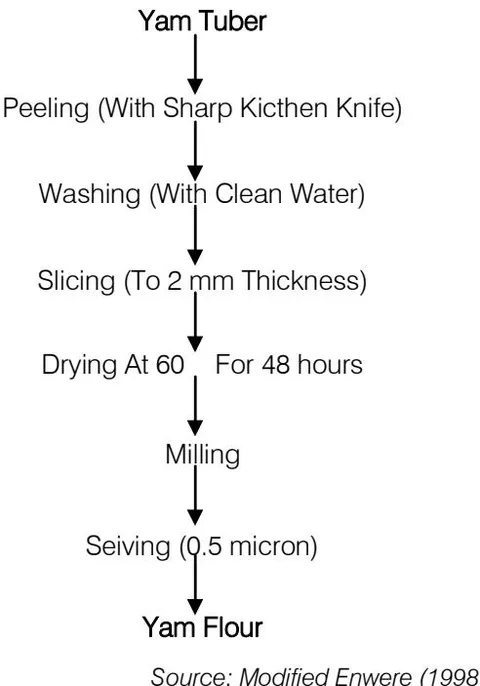
Fresh White yam (Dioscorearotundata), and water yam (Dioscoreaalata) were properly cleaned and sorted to remove dirt, and other extraneous matters, before they were processed into flour. The method used was a modification of the method described by En were, (1998). The yam tuber was washed, peeled, sliced, heated and dried, which was then milled into flour. The flow diagram for the production of yam flours is shown in Figure 1.
The yam tubers were processed into flour and then subjected to gamma irradiation doses, with one unirradiated batch to serve as control. Irradiation of samples were done using CO source. Target doses were 150 kGy and 2 kGy
III. ANALYTICAL METHODS
Pasting properties, functional properties and microbiological properties were done using standard methods as described by AOAC, 2012.
a) Statistical Analysis
Statistical Package for Social Sciences (SPSS) V23 computer software was used to analyze the data. Means and Standard deviation were calculated where appropriate. One way Analysis of variance (ANOVA) was used to determine the treatment that was different from others in the various parameters tested; differences were considered significant at 95% (p<0.05) significant level and 99% (p<0.01) significant level where mentioned.
IV. RESULT AND DISCUSSION
a) Effect of Gamma Irradiation on the Pasting Properties of White Yam Flour and Water Yam Flour
Peak viscosity and trough viscosity of the two varieties of yam flours were relatively low. The values of the peak viscosity were 162.44 RVU for the white yam (D. rotundata) flour at irradiation dose of 2 KGy and 198.88 RVU for the control sample. Peak viscosity is the maximum viscosity attained by the paste during the heating cycle (i.e from 50 to 95°C) due to starch granules swelling and leaching out of the soluble components into the solution. It reflects the ability of starch granules to swell freely before their physical breakdown (Sing et al., 2003) and often correlates with product quality. Peak viscosity had values of 198.33 and 225.56 RVU for white yam flour and 162.44 and 198.88 RVU for water yam flour. The relatively longer time taken for most (D. alata) flour to paste further indicates stronger bonding forces in their starch granules. Yam flours generally have some level of resistance to swelling which in this case is more pronounced in (D. alata). Richard et al. (1991) reported that cassava starch has a high peak viscosity because it exhibits a high degree of swelling. The low value of the peak viscosity in water yam (D. alata) and white yam (D. rotundata) flour indicates strong internal forces between their starch granules which resulted in lower swelling power pasting viscosity. High amylose content has been linked to low swelling power due to greater reinforcement of the internal network by amylose molecules (Hoover, 2001). Highly associated starch granules with an extensive and strongly bonded structure also exhibit resistance towards swelling. According to Richard et al., (1991) pasting viscosity and swelling are positively related. The higher the swelling power of a flour sample, the higher the pasting viscosity.
Kulkanir (1996), observed that flour has relatively low viscosity but high gel strength when compared with D. rotundata which was in agreement with the present study under irradiation. Therefore, D.
alata flour may be more suitable for products which require high gel strength and a low viscosity or they could be parboiled and processed to products such as amala. Flour with a higher peak viscosity is also required for making food products such as jelly or binder while dose with lower viscosity are desirable for preparing weaning foods and lighter gruels (Kulkani et al., 1996).
Trough is considered as a measure of the breakdown of hot paste. The ability of a paste to withstand the heating and shear stress is an important factor for most food processing operations and is also a factor in describing the quality of starch gels(Madens and Christensen, 1996). High paste stability is a requirement for industrial users of starch(Bainbridge et al., 1996). This is because drastic changes in paste during and after processing could lead to textural changes that may be undesirable. Trough values obtained were 96.38 RVU and 140.40 RVU for white yam (D. rotundata) flour, and 90.68 RVU and 146.21 RVU for water yam (D. alata) flour. The D. alata flour had the highest trough and lowest breakdown values, which indicates greater ability to withstand shear at high temperatures and higher cooked paste stability(Farhat et al., 1999). Flour with low trough values would have a greater need for cross-linking than one with high value; D. alata flour could therefore be targeted for industrial uses because of its hot paste stability.
The breakdown viscosity increased with the increasing radiation dose in the white yam flour (D. rotundata) and water yam (D. alata) flour. The values ranged from to RVU for the white yam flour, while the water yam flour ranged from to RVU. Mohd et al, (2009) observed significant changes in breakdown viscosity by the radiation dose indicates considerable disruption or weakening of the bonding forces (hydrogen bonds) in the starch granules by the radiation. The lower breakdown of viscosity indicates good stability of the starch granules, Celik et al. (2004) observed a reduction in the cooking period of irradiated legumes.
The viscosity after cooling cooked paste to 50 °C is the final viscosity. Anonymous (1990) reported that starch paste increases in viscosity when cooled. The increase in viscosity is not only caused by simple kinetic effect of cooling but also by re-association of molecules (particularly amylose). Final viscosity is the most commonly used parameter to determine the quality of starch-based samples because it indicates starch/flour ability to form a gel after cooking.
Yam flour is thixotropic and, as observed in this study, has a higher cooled paste viscosity than hot paste viscosity. The observation supports the general fact that yam pastes form firm gels rather than viscous gels after cooking and cooling. This has implications for the kind of products yam flour could be used for, such as weaning diets or crackers. Yam flour is noted for high retro gradation during cooling and this might have accounted for the increase in final viscosities during cooling. This is brought about by the high degree of association between the starch-water systems and their high ability to re-crystallize, resulting in progressively higher viscosities during cooling of yam starches (Anonymous, 1990). Ayernor (2012) reported that the rate at which the development of rigidity occurs in yam flour is dependent on the degree of starch-water binding which can be affected through processes that influence the interaction between the flour particles and water.
Setback shows the cold paste viscosity's tendency to retro-grade. Therefore, the decreased viscosity of the irradiated samples reveals the lack of ability of amylopectin to hold the granule during the imbibition of water (Mohd et al., 2009). Therefore, from the values obtained for the white and water yam flour decreasing as the irradiation dose increase show lack of ability of amylopectin to hold granules during imbibition of water.
Setback viscosity is an important factor for starch used as a food ingredient in processing and preservation, because the quality of the food's texture and physical properties deteriorate due to retrogradation as time passes (Nunoo, 2009). A decrease in setback viscosity was observed with increase in the irradiation dose. The lower setback viscosity of the paste indicated that the reassociation of the starch polymers is not as great as in the control. Pomeranz (1991) established that high setback (retrogradation) will cause undesirable gel texture or high freeze-thaw stability. This means the protein and starch in the flour obtained from the two irradiated yam flour would be unable to form strong gel matrices or networks, perhaps, due to poor ionic interactions between the individual molecules. Gamma irradiation is capable of hydrolyzing chemical bonds, there by cleaving large molecules of starch into smaller fragments of dextrin that maybe either electrically charged or uncharged as free radicals (Wu et al., 2002). These changes may affect the physical and rheological properties of irradiated starches, resulting in changes in properties of starch paste (Mohdetal., 2009). Decreases in pasting properties, such as breakdown and setback values, may result primarily from irradiation-induced starch degradation and may present opportunities such as ease of cooking and reduced starch retrogradation, respectively (Sabularse et al., 1991).
There was a reduction in the peak temperature among the two varieties of yam flour, although the reduction was not dose dependent as there were little variation in the values.
The peak temperature for the white yam (D. rotundata) flour with irradiation doses of 0.15 kGy and 2 kGy had a reduced value whereas in the water yam (D. alata) flour, the minimum peak temperature was observed in the 2 kGy irradiated samples. It can be deduced that irradiation caused the reduction. The reduction will result in low temperature and time of cooking of the flours from irradiated yam flour and temperature may be prepared when all other properties are equal.
Decreases in pasting properties, such as breakdown and setback values, may result primarily from irradiation-induced starch degradation and may present opportunities such as ease of cooking and reduced starch retro-gradation, respectively (Sabularse et al., 1991).
b) Effect of Gamma Irradiation on the Functional Properties of White Yam flour and Water Yam Flour
In this study, it was observed that water absorption capacity (WAC) and oil absorption capacity (OAC) of the two varieties of yam flours were significantly influenced by the irradiation.
Significant increase in water absorption capacity in the irradiated white yam (D.alata) and water yam (D.rotumdata) was observed, the control of white yam flour had the lowest value for the oil absorption capacity and the irradiated water yam flour at 2 kGy had the highest value of water absorption capacity 1.93ml/g. Abu et al., (2006a,b) observed similar trends. This suggests that the irradiation increases water affinity of resulting flours. The increase in the WAC may in part be due to irradiation-induced damage or degradation of cowpea starch to simpler molecules such as dextrins and sugar that have higher affinity for water than starch (Abu et al., 2006a,b). High WAC of flour is advantageous in the preparation of food items like bread and sausages to maintain freshness and for easy handling. Oshodi and Adeladun (1993) reported that high WAC of seed flour is useful in the preparation of soups and gravies. The phenomenon could be attributed to a degree of cross-linking, which may have occurred simultaneously with chain scission at the doses (1.0 and 1.5 K Gy) hence the observed results. Similar results were reported by Abu et al., (2006b).
OAC is an important functional trait in food industries for retention of flavor and improvement of shelf-life and palatability (Bhat et al., 2008). The OAC of the flour obtained from the irradiated samples of yam flours of the white yam (D. rotundata) and water yam (D. alata) were higher than the control samples. This was in agreement as reported by Abu et al. (2006a,b) that OAC of cowpea irradiated increased as doses increased. The increase in the OAC may be related to the radiation. The mechanism of the increase in the OAC upon irradiation involves the increased ability of degraded and/or cross-linked starch to physically entrap more oil and the high affinity of non-polar protein side chains for lipids (Salbe et al., 1982). As reported by Urbein, (1986) increase in OAC of seed flour has been attributed to the unmasking of non-polar protein residues as a result of irradiation-induced denaturation. White yam (D. rotundata) and water yam (D. alata) flour had relatively significant lowest OAC at 0.15 kGy with ml/g.
Water solubility index of the irradiated samples was significantly lower than the control across the two varieties of yam flour. This is an indication that the flours obtained from irradiated yam flour samples were less soluble in water to an extent. The irradiation may have cused the soluble substances in the flour to idolize making their binding sites for water inaccessible. Medoua et al., (2005) reported that the decrease in water solubility could be due to the mobilization of soluble substances. The water solubility of the yam flours for both white yam (D. rotundata) and water yam (D. alata) decreased significantly with the radiation doses but was not dose dependent. The values for control for both yam flours ranged from ml/g and ml/g as compared to the irradiated samples with values of ml/g for white yam flour and ml/g for water yam flour. This result was similar to those observed by Azimet al. (2009). Abu et al. (2006a,b), however, observed reduction in WSI with increasing radiation dose.
Bulk density of the white yam (D. rotundata) and water yam (D. alata) flour of irradiated or non-irradiated were not significantly different (p<0.05) from each other, even at 2 kGy the bulk density was not significantly different, which may not be attributed to the irradiation. This means that the bulk density of the yam flour was not significantly (p<0.05) affected by the irradiation. Abu et al., 2006 a, b. Azim et al. (2009) reported that the bulk density of groundnut flour was not affected significantly by gamma irradiation.
Reconstitution index of the yam flour samples were not significantly different from the irradiated and non-irradiated from each other. The control values for the white yam (D. alata) and water yam (D. rotundata) flour ranged between ml/g and ml/g as compared with the irradiated samples with values of ml/g and ml/g. though statistical differences were observed in the values obtained for reconstitution index in the white yam flour, their functionality in sample may not differ.
c) Effect of Gamma Irradiation on the Microbial Content of White Yam Flour and Water YamFlour
The microbial analysis for the white yam sample for aerobic plate count for the control was cfu/ml and that for water yam sample was . The bacteria present in the samples before irradiation would have been picked up during processing (Jay et al., 2005), but the low moisture content (due to the flour nature) might have prevented the growth of some bacteria even before irradiation and when there is low moisture in stored products, Bacillus species are usually the one ones that grow (Jay et al.
2005); this might have accounted for the low presence of Bacillus species in the flour samples after irradiation. Most of the bacteria isolated from the flour samples (white yam and water yam) before irradiation have been obtained by previous workers (Ojokoh and Gabriel, 2010). Report of occurrence of many Lactobacillus and Bacillus species were found to be dominant during the production of a fermented cassava product (Achi and Akomas, 2006). The same situation was obtained for the fungi whereby the samples contained less fungi qualitative after irradiation than before irradiation. Aspergillus niger which was the most predominant fungus in the samples before irradiation. This should be desirable because A. niger is one of the aflatoxin-producing moulds (Frazier and Westhoff, 2004) whose presence in foods will constitute health hazard to consumers. A. flavus and A. niger which are sporadic (Adegoke, 2004). Toxigenic strains of A. flavus have been known to produce aflatoxin, a potent hepatotoxic and carcinogenic agent (Uraih and Ogbadu, 2019).
V. CONCLUSION
The pasting temperature was not significantly affected by gamma irradiation which indicates the ability to withstand shear stress and high temperature. Gamma irradiation n reduced significantly bacteria and fungi count in the two varieties of yam flour, thereby lowering the activity of micro-organism. The use of gamma irradiation in the treatment of water yam flour and white yam flour showed that irradiation can preserve and maintain the quality of yam flour