Effect of Land Grabbing on Growth in Nigeria’s Agricultural Sector (1980 -2015)

§ Michael Okpara University of Agriculture

Send Message

To: Author

Effect of Land Grabbing on Growth in Nigeria’s Agricultural Sector (1980 -2015)

Article Fingerprint

ReserarchID

1O9Q3

Effect of Land Grabbing on Growth in Nigeria’s Agricultural Sector (1980 -2015) Banner

Key Research Insights

Synthesized scholarly intelligence & interactive research assistant
  • English
  • Afrikaans
  • Albanian
  • Amharic
  • Arabic
  • Armenian
  • Azerbaijani
  • Basque
  • Belarusian
  • Bengali
  • Bosnian
  • Bulgarian
  • Catalan
  • Cebuano
  • Chichewa
  • Chinese (Simplified)
  • Chinese (Traditional)
  • Corsican
  • Croatian
  • Czech
  • Danish
  • Dutch
  • Esperanto
  • Estonian
  • Filipino
  • Finnish
  • French
  • Frisian
  • Galician
  • Georgian
  • German
  • Greek
  • Gujarati
  • Haitian Creole
  • Hausa
  • Hawaiian
  • Hebrew
  • Hindi
  • Hmong
  • Hungarian
  • Icelandic
  • Igbo
  • Indonesian
  • Irish
  • Italian
  • Japanese
  • Javanese
  • Kannada
  • Kazakh
  • Khmer
  • Korean
  • Kurdish (Kurmanji)
  • Kyrgyz
  • Lao
  • Latin
  • Latvian
  • Lithuanian
  • Luxembourgish
  • Macedonian
  • Malagasy
  • Malay
  • Malayalam
  • Maltese
  • Maori
  • Marathi
  • Mongolian
  • Myanmar (Burmese)
  • Nepali
  • Norwegian
  • Pashto
  • Persian
  • Polish
  • Portuguese
  • Punjabi
  • Romanian
  • Russian
  • Samoan
  • Scots Gaelic
  • Serbian
  • Sesotho
  • Shona
  • Sindhi
  • Sinhala
  • Slovak
  • Slovenian
  • Somali
  • Spanish
  • Sundanese
  • Swahili
  • Swedish
  • Tajik
  • Tamil
  • Telugu
  • Thai
  • Turkish
  • Ukrainian
  • Urdu
  • Uzbek
  • Vietnamese
  • Welsh
  • Xhosa
  • Yiddish
  • Yoruba
  • Zulu
Reading Preferences
Font Size
Line Spacing
Background
This converted HTML version may contain rendering inconsistencies. Please refer to the PDF for the authoritative version, or click here to provide feedback.

Abstract

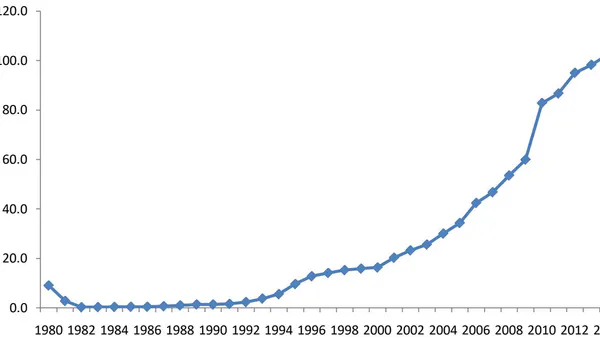
The issue of large scale land acquisitions for agricultural production by transnational corporations and foreign investors especially in sub-Sahara Africa has caused great concern in these Countries. This has given rise to the term land grabbing. This study investigated the effect of land grabbing on the per capita agriculture gross domestic product of the Country. Time series data were used for the study and the period span from 1980 to 2015. The per capita model and the trend model were used to estimate the per capita agriculture gross domestic product and its trend within the period. Also, the Augmented Dickey-Filler test for stationarity and the Johansen test for co-integration were performed to ensure that the variables were stationarity and that there is long run relationship between them. The vector error correction model was used to show the long run and short run relationships between the variables. The results show that the Country had an average per capita agriculture gross domestic product of N25 million for the period.

References

30 Cites in Article
  1. 1. S Anyanwu,U Ibekwe,O Adesope (2010). Figure 1.3. Africa’s output as a share of global gross domestic product, 2000-26. Report and Opinion, 2(8), 26-31.
  2. 2. O Ayinde,M Muchie,G Olatunji (2011). Effect of Climate Change on Agricultural Productivity in Nigeria: A Co-integration Model Approach. Journal of Human Ecology, 35(3), 189-194.
  3. 3. Nani Suhartini (2013). Analisis Faktor-Faktor Yang Mempengaruhi Indeks Saham OIC COMCEC 50 Shariah Dengan Inflasi Sebagai Variabel Intervening. Syi`ar Iqtishadi : Journal of Islamic Economics, Finance and Banking, 8(1)
  4. 4. A Constantino (2013). The Dark Side of the Boom: Land Grabbing inDependent Countries in the Twenty-First Century. Trends and Impacts of Foreign Investment in Developing Country Agriculture: Evidence from Case Studies. Food and Agriculture Organization of the United Nations Rome, 6, 79-100.
  5. 5. Lorenzo Cotula,Sonja Vermeulen (2009). Deal or no deal: the outlook for agricultural land investment in Africa. International Affairs, 85(6), 1233-1247.
  6. 6. Justice Djokoto (2012). Does Causal Relationships Exist between External Trade and Foreign Direct Investment Flow to Agriculture in Ghana?. International Journal of Business and Management, 7(2), 179.
  7. 7. (2013). Food and Agriculture Organization of the United Nations (FAO). Trends and Impacts of Foreign Investment in Developing Country Agriculture Evidence from Case Studies
  8. 8. C Friis,A Reenberg (2010). Land Grab in Africa: Emerging Land System Drivers in a Teleconnected World. Land Grab in Africa: Emerging Land System Drivers in a Teleconnected World
  9. 9. Reenberg Friis (2010). Unknown Title. IPO
  10. 10. A Gerlach,P; Liu (2010). Migration Policy and its Interactions with Aid, Trade, and Foreign Direct Investment Policies. FAO Commodity and Trade Policy Research Working Paper, 31
  11. 11. A Graham,S Aubry,R Künnemannand,S Suárez (2011). ): The Impact of Europe's Policies and Practices on African Agriculture and Food Security. International Conference on Global Land Grabbing organised by the Land Deals Politics Initiative (LDPI) in collaboration with the Journal of Peasant Studies and hosted by the Future Agricultures Consortium at the Institute of Development Studies
  12. 12. Grain (2008). Seized: The 2008 land grabs for food and financial. Security
  13. 13. David Hallam (2011). International investment in developing country agriculture—issues and challenges. Food Security, 3(S1), 91-98.
  14. 14. D Hallam (2009). Foreign Government-Controlled Investors and Recipient Country Investment Policies. Foreign Government-Controlled Investors and Recipient Country Investment Policies
  15. 15. S Hanson (2009). Corruption in Sub-Saharan Africa. Corruption in Sub-Saharan Africa
  16. 16. T Kachika (2010). Land Grabbing in Africa: A Review of the Impacts and the Possible Policy Responses. Land Grabbing in Africa: A Review of the Impacts and the Possible Policy Responses
  17. 17. T Karlsson,Gymnasium (2012). Land Grabbing in Sub-Saharan Africa Kungsholmens Gymnasium Stockholm. Land Grabbing in Sub-Saharan Africa Kungsholmens Gymnasium Stockholm
  18. 18. J Lafrancesca (2013). Land Grabs" and Implications on Food Sovereignty and Social Justice in Senegal. Land Grabs" and Implications on Food Sovereignty and Social Justice in Senegal
  19. 19. D Lee,B Neves (2009). Rural Poverty and Natural Resources: Improving Access and Sustainable Management. Background Paper for IFAD 2009 Rural Poverty Report
  20. 20. D Lee,B Neves (2009). Rural Poverty and Natural Resources: Improving Access and Sustainable Management. Background Paper for IFAD 2009 Rural Poverty Report
  21. 21. (2010). Principles for Responsible Agricultural Investment that Respects Rights, Livelihoods, and Resources.
  22. 22. James Mackinnon (1996). Numerical distribution functions for unit root and cointegration tests. Journal of Applied Econometrics, 11(6), 601-618.
  23. 23. T Odetola,C Etunmu (2013). Contribution of Agriculture to Economic Growth in Nigeria. 18th Annual Conference of the African Econometric Society (AES) Accra
  24. 24. Uau Onyebinama (2004). Land reform, security of tenure and environmental conservation in Nigeria. International Journal of Agriculture and Rural Development, 5(1), 86-90.
  25. 25. A Shiro (2009). The Impact of Foreign Direct Investments on the Nigerian Economy. The Impact of Foreign Direct Investments on the Nigerian Economy
  26. 26. (2009). Epilogue. United Nations Conference on Trade and Development (UNCTAD) World Investment Report (WIR), 195-196.
  27. 27. (2014). World investment report 2014. World Investment Report 2014: Investing in the SDGs: An Action Plan. United Nations Conference on Trade and Development
  28. 28. S Uremadu,O Umezurike,Odili (2016). Sensitivity of Foreign Direct Investment to Monetary Policy Dynamics in Nigeria. Research Journal of Finance and Accounting, 7(11), 31-43.
  29. 29. M Vicol (2015). Land Grabbing, Conflict and Agrarian-Environmental Transformations: Perspectives from East and Southeast Asia.
  30. 30. E Zoomers (2010). Globalisation and the foreignisation of space: seven processes driving the current global land grab. The Journal of Peasant Studies, 37(2), 429-447.

Funding

No external funding was declared for this work.

Conflict of Interest

The authors declare no conflict of interest.

Ethical Approval

No ethics committee approval was required for this article type.

Data Availability

Not applicable for this article.

How to Cite This Article

Simonyan J.B., Onyenweaku C.E., Ibeagwa, O.B.. 2019. "Effect of Land Grabbing on Growth in Nigeria’s Agricultural Sector (1980 -2015)". Global Journal of Science Frontier Research - D: Agriculture & Veterinary GJSFR-D Volume 19 (GJSFR Volume 19 Issue D4).

More Citation Formats

Download Citation

Journal Specifications

Crossref Journal DOI 10.17406/GJSFR

Print ISSN 0975-5896

e-ISSN 2249-4626

Keywords
Classification
GJSFR-D Classification FOR Code: 079999
Version of record

v1.2

Issue date
November 12, 2019

Language
English
Order Article Reprint
Experience in AR

Explore published articles in an immersive Augmented Reality environment. Our platform converts research papers into interactive 3D books, allowing readers to view and interact with content using AR and VR compatible devices.

Read in 3D

Your published article is automatically converted into a realistic 3D book. Flip through pages and read research papers in a more engaging and interactive format.

Article Matrices
Total Views: 1.1K
Total Downloads: 87
All Trends

Request Access

Please fill out the form below to request access to this research paper. Your request will be reviewed by the editorial or author team.
X

This is the heading

Lorem ipsum dolor sit amet, consectetur adipiscing elit. Ut elit tellus, luctus nec ullamcorper mattis, pulvinar dapibus leo.

High-quality academic research articles on global topics and journals.

Effect of Land Grabbing on Growth in Nigeria’s Agricultural Sector (1980 -2015)

Simonyan J.B.
Simonyan J.B. Michael Okpara University of Agriculture
Onyenweaku C.E.
Onyenweaku C.E.
Ibeagwa, O.B.
Ibeagwa, O.B.