
I. INTRODUCTION
With the start of the year 2020, the SARS-CoV-2 gripped the world and became one of the deadliest pandemics the world had ever seen. The severe acute respiratory syndrome novel coronavirus 2 (SARS-nCoV-2), according to the studies by Lai C et al., is transmitted from one human to the other through a direct contact, or through droplets, with an average incubation period standing at 6.4 days.
The aerosol transmission has been not focused on, but there are various essential reasons to doubt that it might play a role in the high transmission rate of the virus. Booth et al[^2] performed air sampling, which was used to establish that a patient, who had been hospitalized due to an infection of SARS during the 2003 pandemic, released the virus into the air in an aerosolised form. It is important to mention that SARS-CoV-1 is the next of kin to the current pandemic of SARS-nCoV-2.
Currently, with evidence to support this, many infected individuals have been transmitting the virus without showing any symptoms. Suchasymptomatic individuals, in general, do not cough or sneeze, which leaves direct/ indirect contact modes and aerosol transmission as the leading likely modes of transmission.3 Chan et al4, Zou et al5, Hu et al6, in China, have reported the positive test results of various individuals despite of them showing no symptoms at all. The transmission of the virus from these asymptomatic carriers was confirmed by Rothe et al7. Studies led by Li et al8 also calculated that of the infections in China, before the travel restrictions were implemented, were through individuals who have not been documented and showed no or mild symptoms and thus, had not been tested.
The wearing of masks by the community can possibly help in preventing the spread of COVID-19 by decreasing the emission of infected saliva and the respiratory droplets (described above as probable modes of transmission) from individuals with a subclinical or a mild case of the disease. The use of facemasks by the medical and paramedical workers has decreased the rate of transmission of droplets while working on patient with respiratory infections. Studies by Jefferson et al calculated the reduction in the spread of infection by if the health care workers wore masks while caring for patients.
With the increase in the usage of the masks came the question of the effect of the long-term use of the masks on the respiratory physiology of the user, and the effects seen on the respiratory gases, volumes and capacities as well.
20 young and healthy healthcare workers were subjected to exercise on a treadmill, at a low- moderate work rate, while wearing four different models of N95 fitting facepiece respirators, for one hour each. Two of the respirators were equipped with exhalation valves. Kim et al concluded that the pulmonary and heart rate responses were relatively small and they should be, on a general basis, tolerated by healthy persons.
To face the short supply and to extend the life of a N95 respirator during the pandemic influenza outbreak, the Institute of Medicine had advocated the use of surgical mask over N95 filtering face piece respirator. 30 National Institute for Occupational Safety and Health (NIOSH) - approved N95 models were taken, accompanied or unaccompanied by a surgical mask, and they were evaluated using automated breathing and metabolic simulator through six incremental work rates. As a result, the concentrations of average inhaled carbon dioxide and the average inhaled oxygen were increased with increasing oxygen consumption for both the subject groups. For a majority of the work rates, the peak inhalation and exhalation pressures were found to be statistically higher in N95 mask with a surgical mask as compared to the N95 mask only. In conclusion by Edward et al , the difference in the concentration of inhaled gases, in both the subject groups, was notable, particularly at lower levels of energy expenditure.
A study was also conducted to find the relation between the use of N95 respirator with the nasal physiology. A total of 77 volunteers (healthcare workers) were a part of the study by Zhu et al. After resting at room temperature for thirty minutes, the initial measurement of the nasal geometry was done using acoustic rhinometry. After the initial assessment, the subjects were exhorted to wear the above two respirators for three hours.
This was immediately followed by rhinomanometry and acoustic rhinometry measurements. Repeated measurements were also done at 30-minute intervals for a continuous period of 1.5 hours. The results of the study showed that the N95 respirator was found to cause a higher post-wearing nasal resistance.
Hua et al[^15] concluded that the N95 respirator trapped the respired air within the respirator which increased the volume of fraction of respired air during inspiration, which could feasibly be one of the vital promoters for an increased level of carbon dioxide. During expiration, the volume of fraction (VOF) of respired air was above . The study was done by using a "three-dimensional model of normal human nasal cavity to simulate the volume of fraction of both fresh air and respired air within the nasal cavity".
Studies conducted by Davis et al showed that at 2 metabolic equivalents (example, walking slowly during rounds), N95 mask use conspicuously increased inhaled carbon dioxide, reduced inspired oxygen, and increased the work of breathing. The resulting inhaled carbon dioxide of 2 to (normal ) produced transient acidosis and compensatory increases in minute ventilation, work of breathing and cardiac output. Maintaining 4 metabolic equivalents of activity for 10 to 30 minutes, 3 to 5 days per week for four weeks improves respiratory muscle endurance. Such conditioning of respiratory muscle strength and respiratory muscle endurance improves ventilation efficiency (example, ventilation perfusion and alveolar ability exchange), oxygen delivery/lactate removal at locomotor muscle, and overall exercise performance.
With the increase in constant use of N95 respirators and three-PLY surgical masks by the personnel on duty for about six hours or more, it has become important to determine the long-term effect that these respirators may have on the respiratory gases, volumes and capacities of the individual.
II. METHOD
a) Subject population
In this case-control trial, the long-term effect of using a N95 mask alone versus using only a three-ply surgical mask was assessed on the biochemical and pulmonary parameters of the healthcare workers. The junior resident doctors of Government Medical College and Hospital, Chandigarh were taken as the subjects.
The resident doctors, aged between 20-35 years, working in ICU, Emergency or OPD, able to pass the quantitative fit test, non-smokers (defined as someone who has either never smoked, or not smoked in the last year) with minimum six hours of duty a day and active mask-usage of either N95 or surgical mask for the past minimum six months were considered in the inclusion criteria. The junior residents were excluded on the conditions which could conceivably cause any risk due to the prolonged wearing of either N95 mask or the surgical mask. These conditions included the usage of mask for less than six hours, a pregnant and/or lactating woman, arrhythmia and/or hypertension, history of any recent major surgery (within the past three months), history of any active medications (allergy medicines, etc.), febrile condition during the course of the research, history of diagnosis of any restrictive/obstructive pulmonary disease, history of smoking and symptoms of any active upper respiratory tract infection (URTI) or lower respiratory tract infection (LRTI) and positive covid test in the past 6 months.
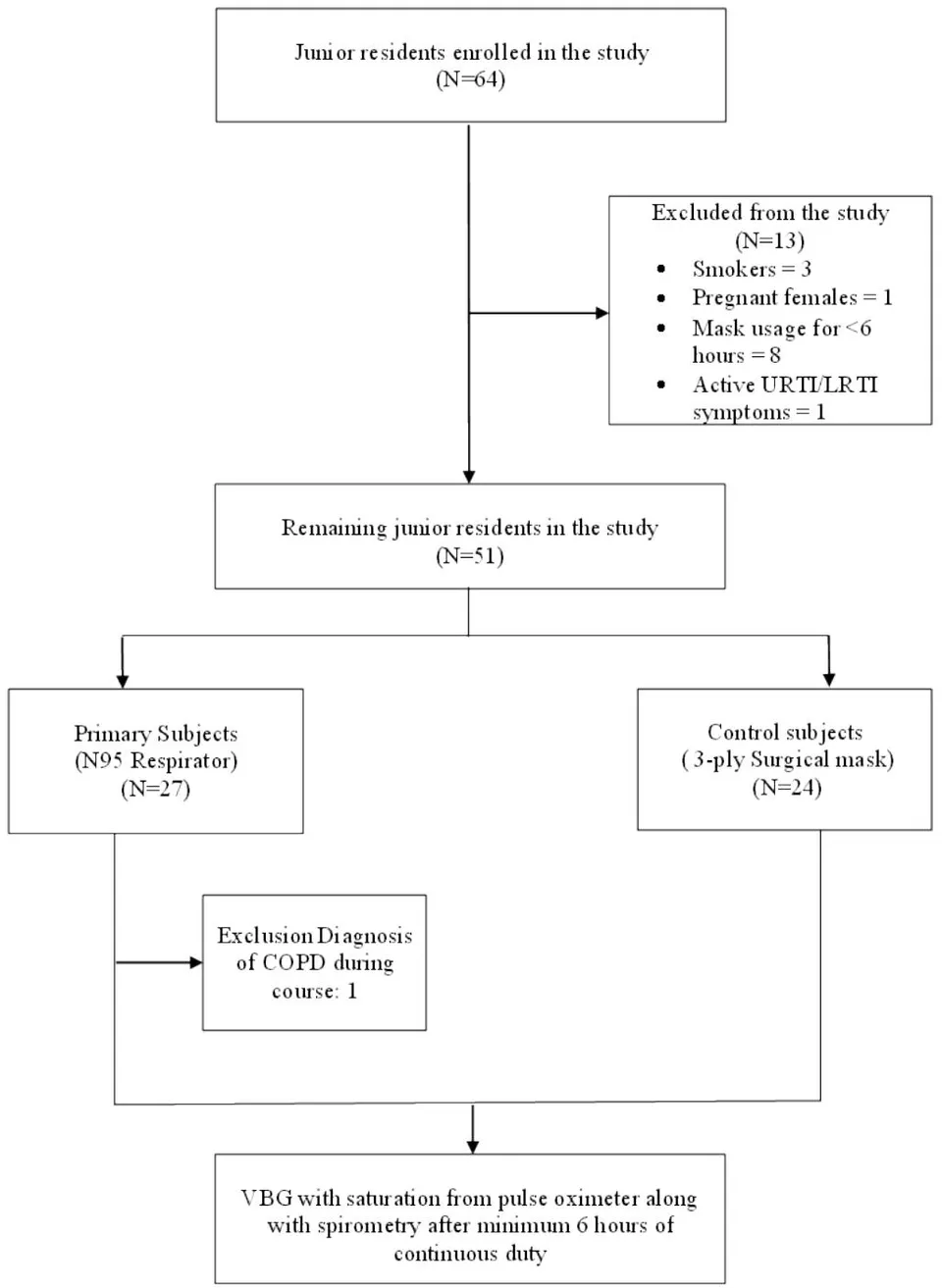
Sixty-four junior residents showed interest in participating in the study. A total of fifty- one subjects were considered as participants, out of which one subject was diagnosed with obstructive lung disease during the course of the research.
b) Respirator and Surgical Mask Selection
Only the subjects that passed the eligibility assessment were taken as participants and divided, randomly, into two groups- one group comprising of residents wearing only a N95 mask and the second group of residents wearing only a three-ply surgical mask.
c) Test Procedures
Both the control and the N95 studies were randomly allotted the days and times of the procedures after they had completed minimum six months of wearing either a three-ply surgical or a N95 facemask. The timing of procedure was fixed after the completion of minimum six hours of active duty on that particular day. The measurement of the respiratory volumes and capacities was recorded using a spirometer and a venous blood gas sample was taken for the biochemical analysis.
d) Experimental Design
Before every procedure, the mouth piece of the spirometer was changed and assessed for adequacy to avoid contamination and to prevent the spread of infection amongst the subjects. A leak test was performed to avoid any discrepancy in the data collection. The procedure of the test was explained in detail to the subject and the subject was allowed to undertake three runs of the test. The subject was then asked to perform the test on another day owing to the difficulty in maintaining a continuous expiratory flow of gases. The blood sample was taken and submitted in the laboratory for the estimation of the values of parameters mentioned below.
e) Variable Measurements
The forced expiratory volume in the first second of expiration , forced vital capacity (FVC) and the ratio of to FVC were the three chosen criteria for the comparison and compilation of data for the assessment of changes in respiratory volumes and capacities. The values of the same were compared to the standard data set by National Institute of Health, USA.
The venous blood sample of the subject was assessed for the partial pressure of carbon dioxide and pulse oximeter was used to assess the percentage saturation of oxygen . The values of each parameter were then compared with the standard values released by National Institute of Health, USA.
f) Statistical Analysis
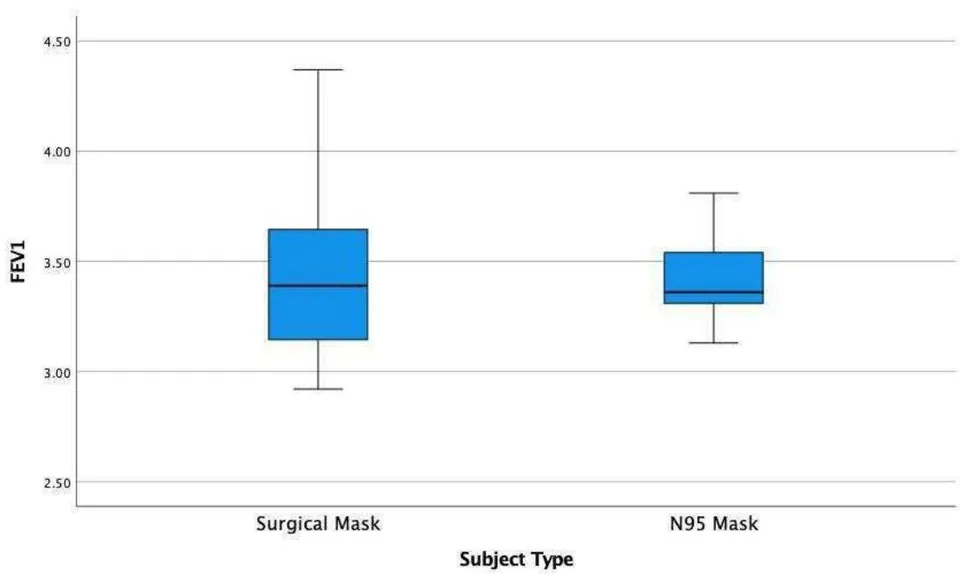
We have compared the Forced Expiratory Volume in the first second and the Forced Vital Capacity (FVC) of every individual involved in the study.
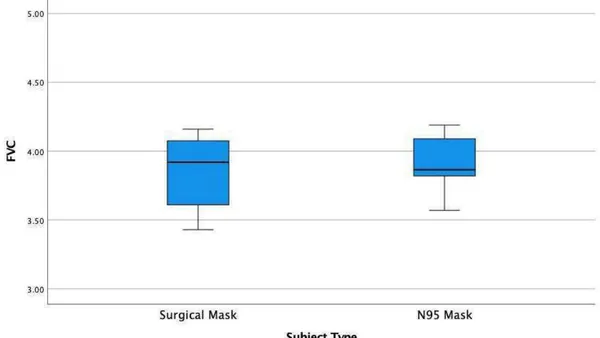
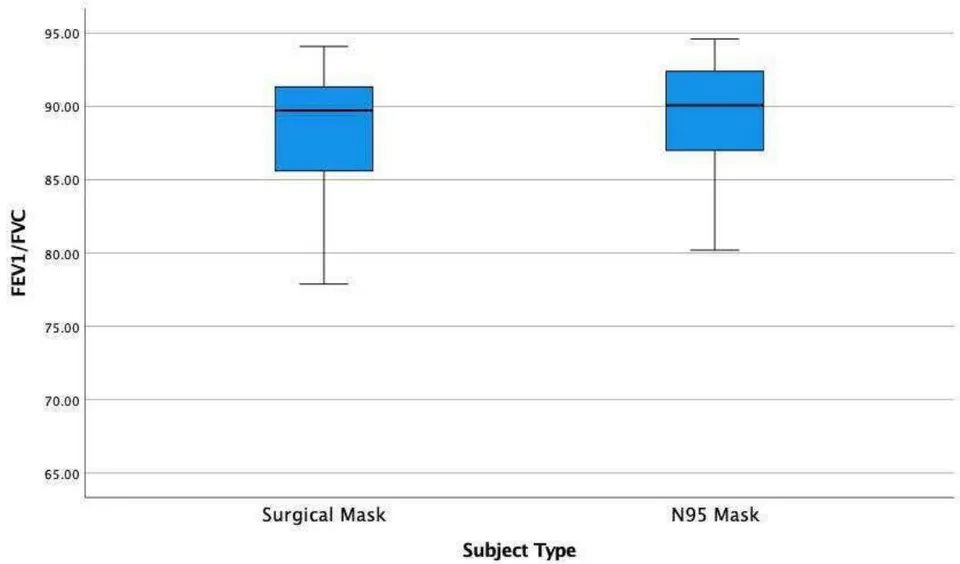
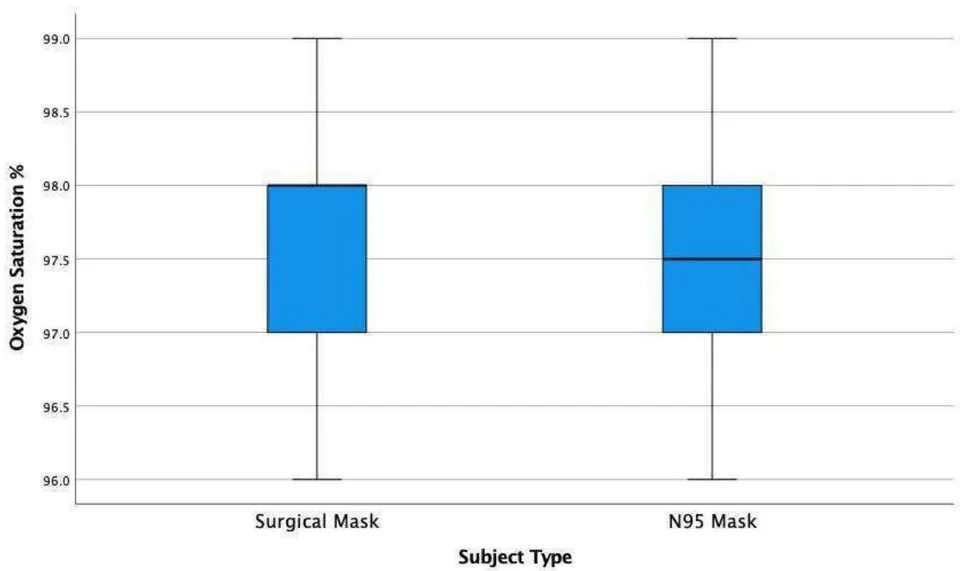
The ratio between these two values has also been compared and plotted as box-plot graph. Percentage saturation of oxygen has been compared for both the masks. To demonstrate statistical significance, a two-sided P value of 0.05 or lower has been considered. The dependent variables were first summarised as means (standard deviations). All the analyses were run to compare the outcome of the variables to see the difference between wearing an N95 mask and wearing a surgical mask on the respiratory volumes and capacities. The analysis was performed using a statistical software package (SPSS v28.0.0.0 (190); IBM, Somerset, NY).
III. RESULTS
A total of sixty-four junior residents were enrolled in the study, out of which thirteen were excluded from the study (smoker-3, pregnant female-1, mask usage for less than six hours-8 and active URTI/LRTI-1) and one participant was excluded during the course of the study due to a diagnosis of COPD. A total of twenty-six subjects wore an N95 mask and twenty-four subjects wore three-ply surgical mask during the study [Flowchart 1]. , FVC, ratio, percentage saturation of oxygen and partial pressure of carbon dioxide were chosen as the parameters. The average for N95 mask users was 3.45L and for three-ply surgical mask users was 3.49L [Table 1]. The average FVC for N95 masks was 3.91L and for three-ply surgical mask users was 3.97L [Table 2]. However, the average ratio for N95 mask users was and for three-ply surgical mask users was [Table 3].
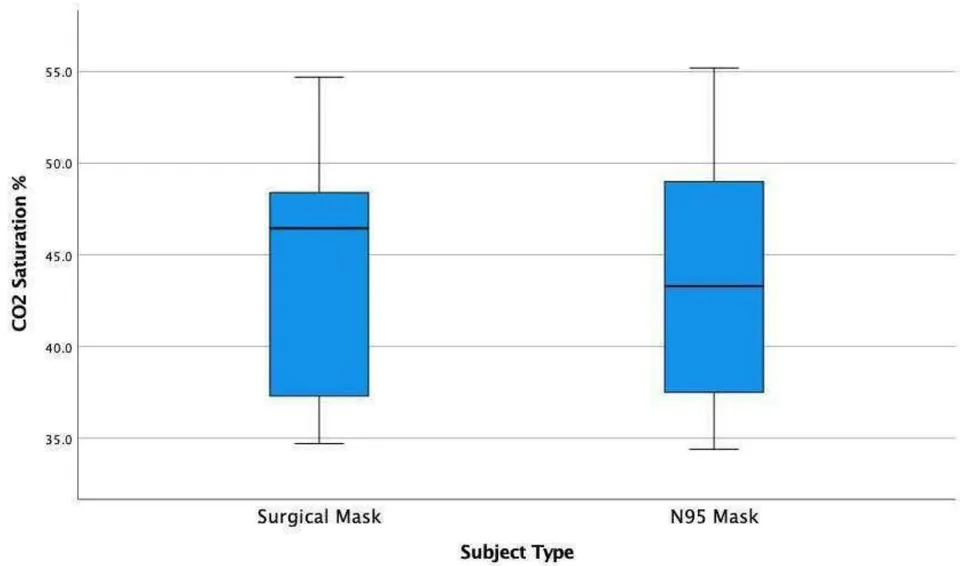
The percentage saturation of oxygen, calculated by using a spirometer, in N95 respirator and three-ply surgical mask wearers averaged out to be and respectively [Table 4]. The mean of partial pressure of carbon dioxide was found to be of Hg with N95 respirator use and at of Hg with three-ply surgical mask usage [Table 5].
Two-sided p-value for FEV1, FVC, FEV1/FVC ratio, percentage saturation of oxygen and partial pressure of carbon dioxide came out to be 0.736, 0.586, 0.711, 0.426, 0.440 respectively [Table 1-5].
| Mask Type | Number of Individuals | Mean | Standard Deviation | Two-sided p Value |
| N95 mask | 26 | 3.45 | .21 | 0.736 |
| Three-plySurgical Mask | 24 | 3.49 | .49 |
Mask Type Number of Individuals Mean Standard Deviation Two-sided p Value N95 mask 26 3.91 .25 0.586 Three-ply Surgical Mask 24 3.97 .47 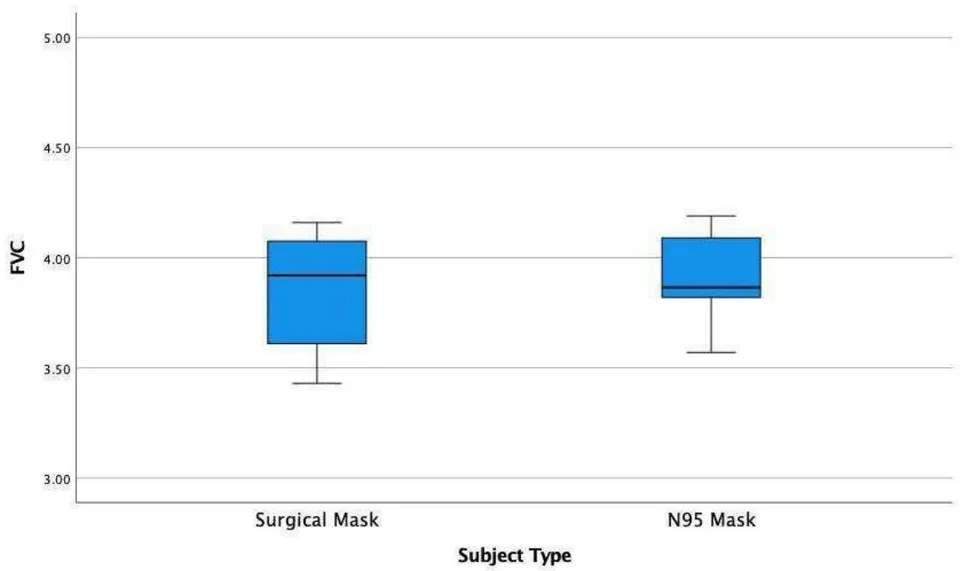
ratio,
| Mask Type | Number of Individuals | Mean | Standard Deviation | Two-sided p-Value |
| N95 mask | 26 | 88.3 | 5.62 | 0.711 |
| Three-ply Surgical Mask | 24 | 87.7 | 5.38 |
Mask Type Number of Individuals Mean Standard Deviation Two-sided p-Value N95 mask 26 97.50 0.761 0.426 Three-ply Surgical Mask 24 97.66 0.702
Mask Type Number of Individuals Mean Standard Deviation Two-sided p Value N95 mask 26 43.23 6.30 0.440 Three-ply Surgical Mask 24 44.58 5.96
IV. DISCUSSION
The pandemic of the coronavirus took the world by storm, causing the entire world to come at a standstill in 2020. To prevent the spread of the disease, the use of three-ply surgical masks and N95 respirator was recommended by various health agencies across the world. Cheng et al , in his study, suggested the use of masks to decrease the spread of the virus.
To assess the effect of wearing both these masks on the respiratory volumes and capacities, the box-plot graphs have been mentioned in the results above. Since the two-sided p value of these parameters, that is, forced expiratory volume in the first second, the forced vital capacity and the ratio between the two, has been greater than 0.05, the values are nonsignificant. Therefore, there is no long-term deleterious effect of wearing either N95 respirator and three-ply surgical mask on the respiratory volume and capacities of the wearer. To compare between the two, a modest effect has been observed due to N95 respirator than by three-ply surgical mask which does not cause any additional physiological burden on the lungs.
The percentage saturation of oxygen, calculated by using a spirometer, in N95 respirator and three-ply surgical mask averaged out to be and respectively, which is within the normal physiological range. Therefore, there has been no significant effect observed by wearing these masks on the percentage saturation of oxygen of the wearer.
The mean of partial pressure of carbon dioxide was found to be of Hg with N95 respirator use and at of Hg with a three-ply surgical mask usage. These values are within the normal range of of Hg. Hence, there was no significant change in partial pressure of carbon dioxide in the mask users.
Since the p-values observed for the aforementioned parameters were greater than 0.05 for all, the results of the study are non-significant.
The conclusions of the study by Raymond et al[^17] included that in a healthy healthcare worker, a one-hour use of filtering facepiece respirator did not inflict any significant burden on the physiology, but the levels of carbon dioxide were above and the levels of oxygen were below the surrounding workplace standards in the filtering facepiece respirator's dead-space. There was also a likelihood of the increase in . The respirator's comfort issues need to be addressed further to maximise healthcare workers adherence to its use.
To battle the short supply of N95 mask during the large-scale infectious outbreaks, and to extend their life, it was suggested to use a surgical mask over the N95 respirator as an outer barrier. 10 healthcare workers wore a N95 respirator with a surgical mask over it, for one hour each, of two work rates. The respiratory rate, the tidal volume, the minute volume, the heart rate, oxygen saturation, transcutaneous carbon dioxide levels and the respiratory dead space gases were monitored by Roberge et al. These were juxtaposed with the controls, which were subjects with N95 filtering facepiece without a surgical mask. It was concluded that the utilisation of a surgical mask, as an outer barrier, did not notably influence the physiological burden of comfort and exhaustion by the wearer in comparison to the one wearing just a N95 respirator.
Ten nurses were considered as subjects, with a twelve-hour work shift for a two-day assessment. Blood pressure, heart rate, the levels of carbon dioxide and oxygen were the variable physiological components considered by Rebmann et al.[19] Carbon dioxide and oxygen were measured using SenTec CO2 and O2 saturation sensors. The persistent use of N95 respirators, either accompanied or unaccompanied by a surgical mask as an external barrier, did not significantly lead to a physiological burden for the personnel, over the course of two work-shifts of twelve hours each.
It is, therefore, highly recommended to wear either mask types to prevent the spread of the coronavirus. These masks do not impose any physiological burden on the respiratory volumes and capacities, as well as the percentage saturation of oxygen and partial pressure of carbon dioxide of the wearer even in cases of extended use.
V. CONCLUSION
Long term continued usage of N95 respirator or a three-PLY surgical mask does not impose any significant physiological burden on the healthy medical personnel. Findings from this study have indicated that there is no significant effect on percentage saturation of oxygen and partial pressure of carbon dioxide by wearing these masks in the healthcare workers. Long-term usage has also not reported any effect on the respiratory volumes and capacities. Additional studies have also backed up these results. It is therefore, highly recommended to wear the mask to prevent the spread of the disease in the community.
Ethical Considerations
The study was conducted after due approval from the Research and Ethical Committee, Government Medical College and Hospital, Chandigarh.
Funding Source
This research received no specific grant from any funding agency in the public or commercial sector.
Conflict Declaration
The authors declare that none of the authors has any conflict of interest in this manuscript.