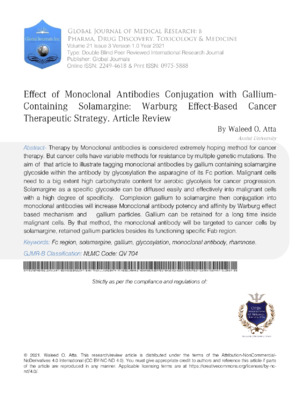
Effect of Monoclonal Antibodies Conjugation With Gallium-Containing Solamargine: Warburg Effect- Based Cancer Therapeutic Strategy. Article Review

α
Waleed O. Atta
Waleed O. Atta
σ
Waleed Atta
Waleed Atta
α Assiut University Assiut University

Send Message

To: Author

Effect of Monoclonal Antibodies Conjugation  With Gallium-Containing  Solamargine: Warburg Effect- Based  Cancer  Therapeutic  Strategy. Article Review

Article Fingerprint

ReserarchID

PDDTMF1YCU

Effect of Monoclonal Antibodies Conjugation  With Gallium-Containing  Solamargine: Warburg Effect- Based  Cancer  Therapeutic  Strategy. Article Review Banner

AI TAKEAWAY

Connecting with the Eternal Ground
  • English
  • Afrikaans
  • Albanian
  • Amharic
  • Arabic
  • Armenian
  • Azerbaijani
  • Basque
  • Belarusian
  • Bengali
  • Bosnian
  • Bulgarian
  • Catalan
  • Cebuano
  • Chichewa
  • Chinese (Simplified)
  • Chinese (Traditional)
  • Corsican
  • Croatian
  • Czech
  • Danish
  • Dutch
  • Esperanto
  • Estonian
  • Filipino
  • Finnish
  • French
  • Frisian
  • Galician
  • Georgian
  • German
  • Greek
  • Gujarati
  • Haitian Creole
  • Hausa
  • Hawaiian
  • Hebrew
  • Hindi
  • Hmong
  • Hungarian
  • Icelandic
  • Igbo
  • Indonesian
  • Irish
  • Italian
  • Japanese
  • Javanese
  • Kannada
  • Kazakh
  • Khmer
  • Korean
  • Kurdish (Kurmanji)
  • Kyrgyz
  • Lao
  • Latin
  • Latvian
  • Lithuanian
  • Luxembourgish
  • Macedonian
  • Malagasy
  • Malay
  • Malayalam
  • Maltese
  • Maori
  • Marathi
  • Mongolian
  • Myanmar (Burmese)
  • Nepali
  • Norwegian
  • Pashto
  • Persian
  • Polish
  • Portuguese
  • Punjabi
  • Romanian
  • Russian
  • Samoan
  • Scots Gaelic
  • Serbian
  • Sesotho
  • Shona
  • Sindhi
  • Sinhala
  • Slovak
  • Slovenian
  • Somali
  • Spanish
  • Sundanese
  • Swahili
  • Swedish
  • Tajik
  • Tamil
  • Telugu
  • Thai
  • Turkish
  • Ukrainian
  • Urdu
  • Uzbek
  • Vietnamese
  • Welsh
  • Xhosa
  • Yiddish
  • Yoruba
  • Zulu

Abstract

Therapy by Monoclonal antibodies is considered extremely hoping method for cancer therapy. But cancer cells have variable methods for resistance by multiple genetic mutations. The aim of that article to illustrate tagging monoclonal antibodies by gallium containing solamargine glycoside within the antibody by glycosylation the asparagine of its Fc portion. Malignant cells need to a big extent high carbohydrate content for aerobic glycolysis for cancer progression. Solamargine as a specific glycoside can be diffused easily and effectively into malignant cells with a high degree of specificity. Complexion gallium to solamargine then conjugation into monoclonal antibodies will increase Monoclonal antibody potency and affinity by Warburg effect based mechanism and gallium particles. Gallium can be retained for a long time inside malignant cells. By that method, the monoclonal antibody will be targeted to cancer cells by solamargine, retained gallium particles besides its functioning specific Fab region.

References

76 Cites in Article
  1. Yasunobu Aoki,Michael Lipsky,Bruce Fowler (1990). Alteration in protein synthesis in primary cultures of rat kidney proximal tubule epithelial cells by exposure to gallium, indium, and arsenite.
  2. Sowmya Balasubramanian,Mattia Matasci,Zuzana Kadlecova,Lucia Baldi,David Hacker,Florian Wurm (2015). Rapid recombinant protein production from piggyBac transposon-mediated stable CHO cell pools.
  3. L Baxter,H Zhu,D Mackensen,R Jain (1994). Physiologically based pharmacokinetic model for specific and nonspecific monoclonal antibodies and fragments in normal tissues and human tumor xenografts in nude mice.
  4. Bill Cham (2013). Drug therapy: Solamargine and other solasodine rhamnosyl glycosides as anticancer agents.
  5. Richard Bockman,Peter Guidon,Lydia Pan,Roberto Salvatori,Alan Kawaguchi (1993). Gallium nitrate increases type I collagen and fibronectin mRNA and collagen protein levels in bone and fibroblast cells.
  6. Lindsey Boroughs,Ralph Deberardinis (2015). Metabolic pathways promoting cancer cell survival and growth.
  7. G Borthwick,A Johnson,M Partington,J Burn,Wilson Arthur,H (2006). Therapeutic levels of aspirin and salicylate directly inhibit a model of angiogenesis through a Cox-independent mechanism.
  8. Willemijn Breunis,Eduardo Tarazona-Santos,Renee Chen,Maureen Kiley,Steven Rosenberg,Stephen Chanock (2008). Influence of Cytotoxic T Lymphocyte-associated Antigen 4 (CTLA4) Common Polymorphisms on Outcome in Treatment of Melanoma Patients With CTLA-4 Blockade.
  9. C,-L Yu,C Wang,M Frenklach (1995). Chemical kinetics of Methyl oxidation by molecular oxygen.
  10. Chih-Hao Chang,Jing Qiu,David O’sullivan,Michael Buck,Takuro Noguchi,Jonathan Curtis,Qiongyu Chen,Mariel Gindin,Matthew Gubin,Gerritje Van der windt,Elena Tonc,Robert Schreiber,Edward Pearce,Erika Pearce (2015). Metabolic Competition in the Tumor Microenvironment Is a Driver of Cancer Progression.
  11. L Chang,T Tsai,J Wang,C Lin,K Kuo (1998). The rhamnose moiety of solamargine plays a crucial role in triggering cell death by apoptosis.
  12. C Chitambar,W Matthaeus,W Antholine,K Graff,W O'brien (1988). Inhibition of leukemic HL60 cell growth by transferrin-gallium: effects on ribonucleotide reductase and demonstration of drug synergy with hydroxyurea [see comments].
  13. Raphael Clynes,Yoshizumi Takechi,Yoichi Moroi,Alan Houghton,Jeffrey Ravetch (1998). Fc receptors are required in passive and active immunity to melanoma.
  14. P Collery,L Khassanova,Z Kuramshina,A Ivanov (1994). The cell membrane, target of antitumour gallium compounds.
  15. P Collery,H Millart,M Pluot,L Anghileri (1986). Effects of gallium chloride oral administration on transplanted C3HBA mammary adenocarcinoma: Ga, Mg, Ca and Fe concentration and anatomopathological characteristics.
  16. D Davies,G Cohen (1996). Monoclonal Antibodies for the Treatment of Cancer.
  17. Tamir Epstein,Liping Xu,Robert Gillies,Robert Gatenby (2014). Separation of metabolic supply and demand: aerobic glycolysis as a normal physiological response to fluctuating energetic demands in the membrane.
  18. E Flescher,T Bowlin,N Talal (1989). Polyamine oxidation down-regulates IL-2 production by human peripheral blood mononuclear cells..
  19. C Galeotti,M Maddur,M-D Kazatchkine,L Mouthon,S-V Kaveri (2009). Immunoglobulines intraveineuses dans les maladies auto-immunes et inflammatoires : au-delà d’une simple substitution.
  20. J Gessner,H Heiken,A Tamm,R Schmidt (1998). The IgG Fc receptor family.
  21. V Gogvadze,A Zhukova,A Ivanov,L Khassanova,Z Khassanova,P Collery,J Etienne,J Llobet (1996). The effect of gallium on the calcium retention capacity of rat liver mitochondria.
  22. D Goldenberg (2007). Radiolabelled Monoclonal Antibodies in the Treatment of Metastatic Cancer.
  23. J Hamerman,L Lanier (2006). Inhibition of immune responses by ITAM-bearing receptors.
  24. S Hsu,T Tsai,C Lin,M Yen,K Kuo (1996). Solamargine purified from Solanum incanum Chinese herb triggers gene expression of human TNFR1 which may lead to apoptosis.
  25. K Hughes,C Pinsky,N Petrelli,F Moffat,Y Patt,L Hammershaimb,D Goldenberg (1997). Use of carcinoembryonic antigen radioimmuno detection and computed tomography for predicting the resectability of recurrent colorectal cancer.
  26. Irina Mladenoska (2016). Synthesis of Octyl-β-Glucoside Catalyzed by Almond β-Glucosidase in Unconventional Reaction Media.
  27. D Ismail,A Badawi,P Collery,N Zakhary,A Raouf (2006). Antitumor effects of gallium(III) tris (salicylate)-ethanol on malignant cell lines and tumor bearing swiss albino-mice. Metal Ions in Biology and Medicine.
  28. Roy Jefferis (2005). Glycosylation of Natural and Recombinant Antibody Molecules.
  29. Joseph Thomas,Pento (2017). Monoclonal Antibodies for the Treatment of Cancer.
  30. R Kim,M Emi,K Tanabe (2005). Cancer cell immune escape and tumor progression by exploitation of anti-inflammatory and pro-inflammatory responses.
  31. Joan Korth-Bradley,Abbe Rubin,Roberta Hanna,Donna Simcoe,Mary Lebsack (2000). The Pharmacokinetics of Etanercept in Healthy Volunteers.
  32. Yannick Kronimus,Richard Dodel,Sebastian Galuska,Sascha Neumann (2019). IgG Fc N-glycosylation: Alterations in neurologic diseases and potential therapeutic target?.
  33. Belinda Kumpel,Yan Wang,Helen Griffiths,Andrew Hadley,Graham Rook (1994). The biological activity of human monoclonal IgG anti-D is reduced by β-galactosidase treatment.
  34. Sergei Kusmartsev,Dmitry Gabrilovich (2002). Immature myeloid cells and cancer-associated immune suppression.
  35. Sergei Kusmartsev,Yulia Nefedova,Daniel Yoder,Dmitry Gabrilovich (2004). Antigen-Specific Inhibition of CD8+ T Cell Response by Immature Myeloid Cells in Cancer Is Mediated by Reactive Oxygen Species.
  36. S Lee,D Jung,J Choi,C Jin,M Hong (2016). PD-L1 polymorphism can predict clinical outcomes of non-small cell lung cancer patients treated with first-line paclitaxel-cisplatin chemotherapy.
  37. Hui Lee,Yifei Qi,Wonpil Im (2015). Effects of N-glycosylation on protein conformation and dynamics: Protein Data Bank analysis and molecular dynamics simulation study.
  38. Geming Li,Su-Hua Sha,Elena Zotova,Joseph Arezzo,Thomas Van De Water,Jochen Schacht (2002). Salicylate Protects Hearing and Kidney Function from Cisplatin Toxicity without Compromising its Oncolytic Action.
  39. Jason Locasale,Lewis Cantley (2011). Metabolic Flux and the Regulation of Mammalian Cell Growth.
  40. Sophia Lunt,Matthew Vander Heiden (2011). Aerobic Glycolysis: Meeting the Metabolic Requirements of Cell Proliferation.
  41. M Bud,Julie Nelson,Katherine Nyhus,Emilio Oravecz -Wilson,Guillem Barbera (2001). Tumor cells express FcγR which contributes to tumor cell growth and a metastatic phenotype.
  42. M Manfait,P Collery (1984). Etude in vitro par spectroscopie Raman de la conformation d'un ADN sous l'influence des ions magne´-sium et gallium.
  43. Maria Liberti,Jason Locasale (2016). The Warburg Effect: How Does it Benefit Cancer Cells?.
  44. L Mark,Dennis Chiu,Alexey Goulet,Gary Teplyakov,Gilliland (2019). Antibody Structure and Function: The Basis for Engineering Therapeutics.
  45. Mary Johnson (2012). Antibody Storage and Antibody Shelf Life.
  46. Mark Mccarty,Keith Block (2006). Preadministration of High-Dose Salicylates, Suppressors of NF-κB Activation, May Increase the Chemosensitivity of Many Cancers: An Example of Proapoptotic Signal Modulation Therapy.
  47. Michal Pyzik,M Kine,Jonathan Sand,Jan Hubbard,Terje,Inger Andersen,Richard Sandlie,Blumberg (2019). The Neonatal Fc Receptor (FcRn): A Misnomer? Front.
  48. David Munn,Ebrahim Shafizadeh,John Attwood,Igor Bondarev,Achal Pashine,Andrew Mellor (1999). Inhibition of T Cell Proliferation by Macrophage Tryptophan Catabolism.
  49. S Murono,T Yoshizaki,H Sato,H Takeshita,M Furukawa,J Pagano (2000). Aspirin inhibits tumor cell invasiveness induced by Epstein-Barr virus latent membrane protein 1 through suppression of matrix metalloproteinase-9 expression.
  50. Takanori Nakamura,Chieko Komori,Yun-Yun Lee,Fumio Hashimoto,Shoji Yahara,Toshihiro Nohara,Akio Ejima (1996). Cytotoxic Activities of Solanum Steroidal Glycosides..
  51. I Nakayama,E Shinozaki,T Matsushima,T Wakatsuki,M Ogura (2017). Retrospective study of RAS/PIK3CA/BRAF tumor mutations as predictors of response to first-line chemotherapy with bevacizumab in metastatic colorectal cancer patients.
  52. Richard Perugini,Theodore Mcdade,Frank Vittimberga,Andrew Duffy,Mark Callery (2000). Sodium salicylate inhibits proliferation and induces G1 cell cycle arrest in human pancreatic cancer cell lines.
  53. Peter Mikuš,Milan Melník,Andrea Forgácsová,Dominika Krajčiová,Emil Havránek (2014). Gallium compounds in nuclear medicine and oncology Main Group Met.
  54. Janet Rasey,Norma Nelson,Steven Larson (1982). Tumor cell toxicity of stable gallium nitrate: Enhancement by transferrin and protection by iron.
  55. M Rather,S Mishra,V Verma,S Chand (2012). Biotransformation of methyl β-dglucopyranoside to higher chain alkyl glucosides by cell bound β-glucosidase of Pichiaetchellsii.
  56. David Rizzieri (2016). Zevalin® (ibritumomab tiuxetan): After more than a decade of treatment experience, what have we learned?.
  57. Josiah Ryman,Bernd Meibohm (2017). Pharmacokinetics of Monoclonal Antibodies.
  58. Samira Ahmadi,Fatemeh Davami,Noushin Davoudi,Fatemeh Nematpour,Maryam Ahmadi,Saeedeh Ebadat,Kayhan Azadmanesh,Farzaneh Barkhordari,Fereidoun Mahboudi (2017). Monoclonal antibodies expression improvement in CHO cells by PiggyBac transposition regarding vectors ratios and design.
  59. Mazyar Shadman,Ajay Gopal,Britt Kammerer,Pamela Becker,David Maloney,Barbara Pender,Andrei Shustov,Oliver Press,John Pagel (2106). Radioimmunotherapy consolidation using <sup>131</sup>I-tositumomab for patients with chronic lymphocytic leukemia or small lymphocytic lymphoma in first remission.
  60. A Shain,Iwei Yeh,Ivanka Kovalyshyn,Aravindhan Sriharan,Eric Talevich,Alexander Gagnon,Reinhard Dummer,Jeffrey North,Laura Pincus,Beth Ruben,William Rickaby,Corrado D’arrigo,Alistair Robson,Boris Bastian (2015). The Genetic Evolution of Melanoma from Precursor Lesions.
  61. Li Shiu,Chia Liang,Li Chang,Hamm Sheu,Eing Tsai,Kou Kuo (2009). Solamargine induces apoptosis and enhances susceptibility to trastuzumab and epirubicin in breast cancer cells with low or high expression levels of HER2/neu.
  62. Vinayakumar Siragam,Andrew Crow,Davor Brinc,Seng Song,John Freedman,Alan Lazarus (2006). Intravenous immunoglobulin ameliorates ITP via activating Fcγ receptors on dendritic cells.
  63. Lukas Smolej (2016). Therapeutic Approach to Patients with Chronic Lymphocytic Leukemia and Significant Comorbid Conditions.
  64. Lingmei Sun,Ying Zhao,Huiqing Yuan,Xia Li,Aixia Cheng,Hongxiang Lou (2010). Solamargine, a steroidal alkaloid glycoside, induces oncosis in human K562 leukemia and squamous cell carcinoma KB cells.
  65. Ronald Taylor,Margaret Lindorfer (2015). Fcγ-receptor–mediated trogocytosis impacts mAb-based therapies: historical precedence and recent developments.
  66. Rupesh S Timothy D Martin,Danielle Patel,Mei Cook,Yuk Choi,Ajinkya Patil,Anthony Liang,Mamie Li,Kevin Haigis,Stephen Elledge (2021). The adaptive immune system is a major driver of selection for tumor suppressor gene inactivation.
  67. Weipeng Wang,Fang Li,Yong Mao,Huan Zhou,Jing Sun,Rui Li,Cuiping Liu,Weichang Chen,Dong Hua,Xueguang Zhang (2013). A miR-570 binding site polymorphism in the B7-H1 gene is associated with the risk of gastric adenocarcinoma.
  68. M Wilson,C Coates,A George (2006). PiggyBac transposon-mediated gene transfer in human cells.
  69. Jian-Ming Xu,Yan Wang,You-Liang Wang,Yan Wang,Tao Liu,Ming Ni,Man-Sheng Li,Li Lin,Fei-Jiao Ge,Chun Gong,Jun-Yan Gu,Ru Jia,He-Fei Wang,Yu-Ling Chen,Rong-Rui Liu,Chuan-Hua Zhao,Zhao-Li Tan,Yang Jin,Yun-Ping Zhu,Shuji Ogino,Zhi-Rong Qian (2017). <i>PIK3CA</i> Mutations Contribute to Acquired Cetuximab Resistance in Patients with Metastatic Colorectal Cancer.
  70. L Yang,D Carbone (2004). Tumor–Host Immune Interactions and Dendritic Cell Dysfunction.
  71. Meiying Yang,Christopher Chitambar (2008). Role of oxidative stress in the induction of metallothionein-2A and heme oxygenase-1 gene expression by the antineoplastic agent gallium nitrate in human lymphoma cells.
  72. Min-Kyung Yeo,Song-Yi Choi,In-Ock Seong,Kwang-Sun Suh,Jin Kim,Kyung-Hee Kim (2017). Association of PD-L1 expression and PD-L1 gene polymorphism with poor prognosis in lung adenocarcinoma and squamous cell carcinoma.
  73. Yoko Akazawa-Ogawa,Hidenori Nagai,Yoshihisa Hagihara (2018). Heat denaturation of the antibody, a multi-domain protein.
  74. Yoko Akazawa-Ogawa,Mizuki Takashima,Young-Ho Lee,Takahisa Ikegami,Yuji Goto,Koichi Uegaki,Yoshihisa Hagihara (2014). Heat-induced Irreversible Denaturation of the Camelid Single Domain VHH Antibody Is Governed by Chemical Modifications.
  75. A Zea,P Rodriguez,M Atkins (2005). Arginaseproducing myeloid suppressor cells in renal cell carcinoma patients: amechanism of tumor evasion.
  76. Weiping Zou (2005). Immunosuppressive networks in the tumour environment and their therapeutic relevance.

Funding

No external funding was declared for this work.

Conflict of Interest

The authors declare no conflict of interest.

Ethical Approval

No ethics committee approval was required for this article type.

Data Availability

Not applicable for this article.

How to Cite This Article

Waleed O. Atta. 2021. \u201cEffect of Monoclonal Antibodies Conjugation With Gallium-Containing Solamargine: Warburg Effect- Based Cancer Therapeutic Strategy. Article Review\u201d. Global Journal of Medical Research - B: Pharma, Drug Discovery, Toxicology & Medicine GJMR-B Volume 21 (GJMR Volume 21 Issue B3): .

Download Citation

High-resolution research on monoclonal antibody conjugation effects.
Journal Specifications

Crossref Journal DOI 10.17406/gjmra

Print ISSN 0975-5888

e-ISSN 2249-4618

Keywords
Classification
GJMR-B Classification: NLMC Code: QV 704
Version of record

v1.2

Issue date

October 27, 2021

Language
en
Experiance in AR

Explore published articles in an immersive Augmented Reality environment. Our platform converts research papers into interactive 3D books, allowing readers to view and interact with content using AR and VR compatible devices.

Read in 3D

Your published article is automatically converted into a realistic 3D book. Flip through pages and read research papers in a more engaging and interactive format.

Article Matrices
Total Views: 2100
Total Downloads: 979
2026 Trends
Related Research

Published Article

Therapy by Monoclonal antibodies is considered extremely hoping method for cancer therapy. But cancer cells have variable methods for resistance by multiple genetic mutations. The aim of that article to illustrate tagging monoclonal antibodies by gallium containing solamargine glycoside within the antibody by glycosylation the asparagine of its Fc portion. Malignant cells need to a big extent high carbohydrate content for aerobic glycolysis for cancer progression. Solamargine as a specific glycoside can be diffused easily and effectively into malignant cells with a high degree of specificity. Complexion gallium to solamargine then conjugation into monoclonal antibodies will increase Monoclonal antibody potency and affinity by Warburg effect based mechanism and gallium particles. Gallium can be retained for a long time inside malignant cells. By that method, the monoclonal antibody will be targeted to cancer cells by solamargine, retained gallium particles besides its functioning specific Fab region.

Our website is actively being updated, and changes may occur frequently. Please clear your browser cache if needed. For feedback or error reporting, please email [email protected]

Request Access

Please fill out the form below to request access to this research paper. Your request will be reviewed by the editorial or author team.
X

Quote and Order Details

Contact Person

Invoice Address

Notes or Comments

This is the heading

Lorem ipsum dolor sit amet, consectetur adipiscing elit. Ut elit tellus, luctus nec ullamcorper mattis, pulvinar dapibus leo.

High-quality academic research articles on global topics and journals.

Effect of Monoclonal Antibodies Conjugation With Gallium-Containing Solamargine: Warburg Effect- Based Cancer Therapeutic Strategy. Article Review

Waleed Atta
Waleed Atta

Research Journals