





I. INTRODUCTION
Plant productivity is influenced by properly grown transplants. Transplants quality is highly dependent on various factors such as light, temperature, , air humidity, water supply, fertilization, substrate, cultivation methods, vegetable species or varieties (Damato and Trotta, 2000; Paul and Metzger, 2005; Brazaitytė et al. 2009; Juknys et al. 2011). One of their quality indices also is the age and growth stage of transplants. The duration of transplants growth affects plant development, vegetative mass, biochemical composition, output of standard transplants, growth after transplantation, resistance to unfavorable conditions, and labor expenses of transplant cultivation (Schrader, 2000; Handley and Hutton, 2003; Henare and Ravanloo, 2008). Research data indicated that the optimal transplant age and growth stage differs for each plant. It may be counted either in weeks, decades, or the appropriate number of leaves. Growers prefer planting young strong-growing transplants, and it is worth noting that the optimal choice of transplant age or growth stage plays a significant economic role.
The genus Echinops is of the Asteraceae family, and consists of about 120 species distributed worldwide (Garnatje et al., 2004). Echinops giganteus has been designated a non-forest timber product (NTFP) in the Congo Basin and the part exploited is the root (Tchatat, 1999). The root have diverse uses spanning from medicinal, culinary to industrial (Noumi, 1984; Menut et al., 1997). The root of this plant is used to treat heart, and gastric troubles (Tene et al., 2004). The root has aromatic properties and has been collected, and distilled to obtain essential oils that are used in synergy with those from other plants to eradicate weevils in stored grains (Ngamo et al., 2007; Pérez et al., 2010). This species is also of interest to the fragrance and flavor sectors Menut et al., 1997).
The main problem with E. giganteus is that, despite all its importance and its conservation status as a nearly threatened species, no implementation of conservation, management and sustainable use strategies have been put in place, due to the lack or insufficient scientific data on their regeneration. This general lack of information is related to a lack in the Sub-Saharan zone of expertise and infrastructures to carry out propagation experiments.
This research work is therefore designed to come out with the best method for the large-scale propagation of E. giganteus in the Western Highlands of Cameroon.
II. MATERIALS AND METHODS
a) Study Site
The germination and transplant experiments were carried out in Dschang situated in the Menuoa Division in the Western Region of Cameroon (Figure 1). It has geographic coordinates, latitude 5° 26'N, longitude 10° 26'E and an altitude 1,400 m. According to the data of the meteorological station of the IRAD of Dschang, there is an equatorial climate characterized by an average annual temperature of 20.1°C and Annual rainfall is 2000 mm on average (Aghofack-Nguemezi and Tatchago, 2010).
The vegetation consists, to a large extent, of savannah grassland, with the Poaceae forming the main vegetation layer, interspersed with a few other annuals, biennials and perennials trees (Ngwa, 1979). According to Aswingnue (2003), the vegetation of this region is both natural, and cultivated. The cultivated vegetation consists of planted trees like Cola accuminata, Eucalyptus globulus, Raphia hookeri, and other fruit trees. Eucalyptus globulus lies mostly in the low lying plains, while woody valley and natural forest exist in the watershed area (Helvetas, 2001).
The soil texture is silt-clay-loam making it very fertile for agricultural activities in the area (Suh et al., 2015). The soil fertility is as a result of humus, which is a dark volcanic soil from the uplands/hilly areas that have been washed down from the hills and deposited on river banks or beds of streams (Helvetas, 2001).
b) Presentation of the plant material: Echinops giganteus CD Adams
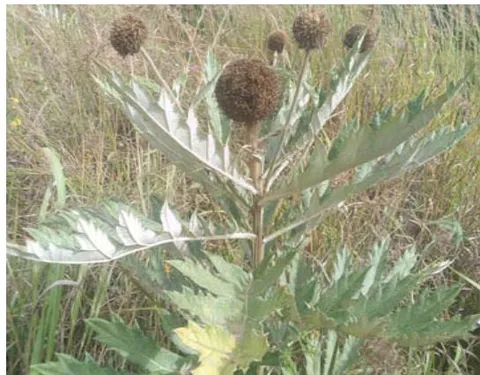
Seeds were collected from the Western Region of Cameroon, in fields where it grows naturally. Mature fruits were collected from the mother plant growing in the wild, dried for two weeks under natural sunlight then matured seeds with healthy grains were selected for germination (Figure 2). Some seeds were randomly selected for viability test by the floatation method. The seeds were placed in a bucket of water at room temperature (Wamegni, 1991; Schaal, 2000). The seeds that sank were classified as viable seeds, while those floating were classified as non-viable.
d) Nursery construction
The field was cleared using a cutlass and plowed with a hoe. Nursery beds measuring 1m by 4 m were established with a distance of 50 cm apart. The entire nursery site was shaded with palm fronds. The seed sowing method was by line broadcast. The Blocks were 1 m apart for each nursery site. Nursery beds were monitored and watered every after one day (Figure 3).
e) Preparation of transplanting sites
The transplanting site was equally being cleared with a cutlass and plowed using a hoe. This space was of total area 20 m x 15 m, further sub-divided into blocks of 6 m x 7 m (Figure 3). Each sub-block had nine units of 1.5 m x 2.5 m each, and on each unit, 20 seedlings were transplanted at a spacing of 50 cm apart as follows:
i. Shoot height
The heights included: 10 cm [TH10], 12 cm [TH12] and 14 cm [TH14]. Each height class had three repetitions of 20 seedlings each. Hence, 180 seedlings for parameter shoot height.
ii. Number of leaves
Off rooting was done at two leaves (TL2), four leaves (TL4) and six leaves (TL6). Each off-rooted seedling had three repetitions of 20 seedlings each. Hence, 180 seedlings for parameter shoot height.
iii. Age of seedlings
Seedlings were off-rooted six weeks after germination (TA6), eight weeks after germination (TA8) and ten weeks after germination (TA10). Each off-rooted age had three repetitions of 20 seedlings each. Hence, 180 seedlings for parameter shoot height (Figure 5).
f) Data Collection
The parameters measured were: height of shoot (H) using a meter rule from the base of the stem to the apex of the stem, the number of leaves (NL) counted on the stem and collar diameter measured 10cm above the ground using a calliper. Thirty seedlings were randomly selected in each treatment and tagged for data collection throughout the experiment. Thus a total of 270 plants were tagged.
g) Data processing and analysis
Data were presented using tables and figures. Data on early growth parameters were subjected to Analysis of Variance (ANOVA) using the statistical program XLSTAT, where the least significant differences (LSD) between the mean was detected and separated using the Duncan's New Multiple Range Test (DNMRT) at .
III. RESULTS
a) Influence of leaf number on the transplant of E. giganteus seedlings
The result of this experiment shows that when seedlings were transplanted with two leaves, they regenerated better than when they were transplanted with four and six leaves (Table: 1). The mean value for number of leave gotten after transplant for seedlings that were transplanted with two leaves was 11.281, with the highest number of leaf being 30. Still on seedlings transplanted with two leaves, the mean value for stem collar diameter was 1.063, with the highest diameter being 1.8. According to ANOVA Newman-Keuls XLSTAT 2014, the mean values obtained when seedlings were transplanted with two, four or six leaves, had no significant difference.
The result showed that when seedlings were transplanted with two leaves, they had the lowest mortality rate as compared to when they were transplanted with four leaves and with six leaves (figure 6). Seedlings transplanted with two leaves had the lowest mortality rate of 17% (10 seedlings dead out of 60 transplanted) and the highest mortality rate of 33% came from seedlings transplanted with six leaves (20 seedlings dead out of 60 transplanted).
b) Influence of seedling height on the transplant of E. giganteus seedlings
Table 2 shows that when seedlings were transplanted at ten centimeters, they produced the highest number of leaves, and at the same time they had the smallest mean value for stem collar diameter. The mean value for number of leave gotten after transplant for seedlings that were transplanted at ten centimeters was 11.0208, with the highest number of leaf being 25. The mean value for stem collar diameter was 0.936, with diameter values as low as 0.4. Statistically, according to ANOVA Newman-Keuls XLSTAT 2014, the mean values obtained when seedlings were transplanted at ten, twelve of fourteen centimetres had no significant difference.
Contrary to the results of early growth parameters on transplanting height, the mortality rate was lowest when seedlings were transplanted at twelve centimetres (figure 7). Seedlings transplanted at twelve centimetres had the lowest mortality rate of 22% (13 seedlings dead out of 60 transplanted). The highest mortality rate of 38% came from seedlings transplanted at fourteen centimetres (23 seedlings dead out of 60 transplanted).
c) Influence of the seedling age on the transplant of E. giganteus seedlings
As shown in Table 3 below, when seedlings were transplanted at eight weeks after germination (WAS), they had the highest number of leaves. The mean value for number of the leaf gotten after transplant for seedlings that were transplanted at ten centimetres was 11.625, with the highest number of the leaf being 30. The mean highest value for stem collar diameter was 0.943, with diameter value as high as 2.0. Statistically, according to ANOVA Newman-Keuls XLSTAT 2014, the mean values obtained when seedlings were transplanted at ten, twelve of fourteen centimetres had no significant difference.
At this age of transplant, we experienced a very high mortality rate of more than 50%. Of the 180 seedlings that were transplanted for the observation of this parameter, just 60 seedlings survived, giving a survival percentage of 35%, while 110 of the transplanted seedlings did not survive, giving a mortality rate of 65% (Figure 8).
IV. Discussion
Many factors determine transplant quality, including leaf area leaf number, root to shoot ratio, root volume, fertilization, height, transplant age and shipping (Cantliffe, 1993). Our results were contrary with those of
Khatun et al. (2002) and Alam et al. (2002), who reported decreasing grain yield with the decrease of seedling age. This could be because of reasons that if E. giganteus is left for too long before transplant, its roots will penetrate very deep into the soil and most of them will cut and be destroyed during uprooting, hence high mortality rate after transplant. According to our research data, the number of leaves, seedling age and height affected the mortality rate of the plant. According to our data, E. giganteus had a lower mortality rates when transplanted at an earlier stage and with fewer leaves. According to Palamakumbura et al., 1987, vegetable transplanted at 30 days were taller than those transplanted at 15 days. Older transplants begin to flower faster. It is confirmed by other researchers (Salik et al., 2000; Khatun et al., 2002) and our research data. This is normal because, after transplant, the plants that survive continue to grow. With younger transplants having more chlorophyll in their leaves, the specific leaf area values and a relative growth rate may have a more efficient photosynthetic system than older transplants (Leskovar and Cantliffe, 1990. The age of transplants is one factor affecting the vegetable yield (McCraw and Greig, 1986; Weston, 1988). The vegetables cultivated from older transplants produce earlier yields (Liptay, 1988). Various researchers state that the age of vegetable transplants affects the early and total yield not of all vegetables. Vavrina et al. (1993) indicated that watermelon transplant age did not affect the early and total yield of these vegetables. Nesmith (1993) investigated the effect of 2, 4, 6 and 8-week muskmelon transplants age on their productivity. Researchers' data indicate that the transplants age affected neither their early nor their total yield. In the experimental work on agricultural elements by various researchers the effect of the transplant age on cucumber yield was also studied (Junior et al. 2004). It is estimated that planting 29 and 34 day transplants their cucumber yield was less than that from the vegetables whose transplants were 19 or 24 days old (Junior et al. 2004). According to Liptay (1988), notwithstanding the fewer yields of younger cucumbers, the total yield of different age vegetables is similar. Hasandokht and Nosrati (2010) present the data that the older the cucumber transplants, the larger their total yield. Some researchers state that the yield of tomato transplants ranging from 3 to 6 weeks old increased linearly with age (Weston and Zandstra, 1989). The others say that the transplant age has no impact on tomato yield (Leskovar et al. 1991). In our tests, the transplant growth stage had no significant effect on growth parameters that were measured after transplant. Lopes and Goto (2003) present their data that the younger tomato transplants the more the fruit weight.
V. CONCLUSION
From the study, it is observed that mortality rates varied significantly due to variation in seedling age, number of leaves, and seedling height after transplant. It is revealed from the results that seedlings transplanted with fewer number of leaves, at a younger growth stage performed better than when they were transplanted at an older stage. In conclusion, it can be said that seedlings transplanted at their juvenile stage could be used to attain higher yield.
Competing interests
The authors have declared no competing interest
Authors' contributions
Christiana Ngyete Nyikob Mbogue carried out this work under the supervision of Anjah G. M. Anjah G.M. designed the experiment and supervised the experiment to the end.
Christiana Ngyete Nyikob Mbogue collected the data on the field with Nkemnkeng Francoline Jong, Yanick Borel Kamga and Manekeu Tanetsa Amandine Elodie. We all worked with the statistician to analyse the data. All the authors participated in formatting the paper.
ACKNOWLEDGMENTS
We are grateful to the Department of Plant Biology at the University of Dschang, Cameroon to provide space and facilities in the Laboratory for this study. The indigenous population of the western region of Cameroon are highly appreciated for the information and the seeds they supplied for this work.


